

Podcasting reached 167 million Americans in the last month, 58% of everyone aged 12 and over, and it still takes only 1% of what the United States spends on digital advertising. Both of those numbers are true, and holding them together is the whole job if you are deciding whether podcasting belongs in your channel mix.
I have hosted Your Digital Marketing Coach for more than 400 episodes, and I have sat on the other side of the microphone as a guest more times than I can count. I have also watched clients pitch podcasting to a CFO and get nowhere, because the deck was built on numbers nobody could trace.
What follows is the evidence you would use to argue for a podcast, or against one, in front of somebody holding the budget. Every figure comes from the organization that produced it. Where the research a marketer would want does not exist, I say so instead of borrowing a number from a vendor blog.
Key Takeaways
✅ 167 million Americans consumed a podcast in the last month. That is 58% of the 12 and over population, an all-time high, and 45% consumed one in the last week.
✅ The audience skews toward the people who sign contracts. 38% of college graduates get news from podcasts against 27% of those with a high school diploma or less.
✅ Podcast advertising is 1% of US digital ad spend. It reached $2.9 billion in 2025 and grew 17.6%, but creator advertising in the same report took $37 billion.
✅ B2B adoption is falling, not rising. 27% of B2B marketers used podcasts as a distribution channel, down from 30% the year before.
✅ Under 6% of new shows ever reach a measurable audience. Roughly 18,000 podcasts launched in a single month, and about 4 in 10 go quiet inside six months.
✅ Guest requests to my show more than doubled from 2023 to 2025, from 123 to 297, against the 25 or so interview slots a year I aim to fill.
How many people listen to podcasts in 2026?
167 million Americans aged 12 and over consumed a podcast in the last month, which is 58% of that population and an all-time high. Weekly consumption reached 45%, or 130 million people. Both figures rose again in 2026, and weekly consumption grew faster than monthly, which says the habit is deepening rather than just widening.

1. 167 million Americans consumed a podcast in the last month, 58% of the 12 and over population
58% of Americans aged 12 and over, an estimated 167 million people, consumed a podcast in the last month, and 45% or 130 million did so in the last week, per The Infinite Dial 2026 from Edison Research at SSRS. Both are all-time highs. The survey reached 2,050 people in January 2026, roughly half drawn from a probability-sampled panel.
Note the word Edison uses now. It is consumed, not listened to, because the study counts watching as well as listening.
What this means for you: this is the number to put on the first slide, because it is the one that makes podcasting look like a mass channel rather than a hobby. Use the weekly figure rather than the monthly one if you want the harder version. Monthly reach tells you how many people brushed against the medium; weekly reach tells you how many built it into a routine, and a routine is what an ongoing show needs.
2. Pew puts past-year podcast listening at 54%, well below Edison’s monthly reach
54% of US adults say they listened to a podcast in the past 12 months, according to Pew Research Center, based on a survey of US adults conducted August 18 to 24, 2025. That is up from 49% when Pew first asked in 2022.
Pew’s past-year figure sits below Edison’s past-month figure, which looks impossible until you check the populations. Pew surveys adults 18 and over. Edison surveys everyone 12 and over and counts watching as consumption.
| Measure | Figure | Population | Question asked |
|---|---|---|---|
| Edison, past month | 58% | US 12+ | Consumed a podcast, listening or watching |
| Edison, past week | 45% | US 12+ | Consumed a podcast, listening or watching |
| Edison, ever | 80% | US 12+ | Ever listened to or watched a podcast |
| Pew, past 12 months | 54% | US adults 18+ | Listened to a podcast |
| Pew, news at least sometimes | 32% | US adults 18+ | Gets news from podcasts |
Source: Edison Research at SSRS, The Infinite Dial 2026; Pew Research Center, Podcasts and News Fact Sheet, 2025.
What this means for you: when two credible sources disagree, read the question before you pick a side. Most of the conflicting podcast numbers you will see this year are not errors, they are different populations and different definitions stacked on top of each other. If somebody hands you a deck with a podcast statistic in it, the first thing worth asking is who was surveyed and what they were actually asked.
3. Only about 483,000 podcasts are active, roughly 16% of the shows listed on Apple
482,930 podcasts were active on Apple Podcasts as of June 2026, out of 3,021,666 listed, which works out at about 16%, according to The Podcast Host’s industry stats, drawing on Podcast Industry Insights data. Active means the show published in the last 90 days.
That active share has held between roughly 15% and 21% since the start of 2022.
What this means for you: the headline count of three million shows is the number your competitors will quote at you, and it is close to meaningless. The field you actually compete in is a sixth of that, and it has been stable for four years. If you are weighing whether the space is too crowded to enter, run the comparison against the active number, then narrow it again to your own category before you decide.
The reach numbers say the audience is enormous. The harder question is whether any of it is the audience you sell to.
Are podcast listeners the audience a business is trying to reach?
Partly. Podcast listeners skew more educated and more news-engaged than the general population, and the heaviest-consuming age band is now 35 to 54 rather than the under-35s. That profile lines up reasonably well with a B2B buying committee. What no research measures is job title, so treat the fit as probable rather than proven.
4. 68% of 35 to 54 year olds consumed a podcast in the last month
68% of Americans aged 35 to 54 consumed a podcast in the last month, up seven points year over year, per The Infinite Dial 2026, which describes the medium as a powerful vehicle for reaching one of advertising’s most valued demographics. That band now out-consumes the 12 to 34 group on a monthly basis.
Edison measures age, not job title. It does not publish a figure for managers, executives or buyers.
What this means for you: this is the closest thing to a decision-maker statistic that exists, and it is an age proxy rather than a seniority measure. You will find pages claiming 72%, 75% or 83% of decision-makers listen weekly. I went looking for the study behind each and could not find one, so they are not in here and they should not be in your deck.
Turn LinkedIn Into a Real Growth Channel
My latest book helps professionals, entrepreneurs, and business owners turn LinkedIn from a static profile into a real source of clients and growth.
Maximizing LinkedIn for Business Growth gives you clear, practical steps to build a profile that gets noticed and a network that actually sends business your way.
Grab your copy on Amazon and put it to work this week. Click the cover or the button below to get started.

5. 38% of college graduates get news from podcasts, against 27% of those with a high school diploma or less
38% of US adults with a college degree or more say they get news from podcasts at least sometimes, compared with 27% of those with a high school diploma or less and 31% of those with some college, according to Pew Research Center. Across all US adults the figure is 32%, up from 22% in 2020.
What this means for you: education skew is the demographic fact that does the most work in a B2B case, because education correlates with the job titles you are trying to reach. It is evidence that the medium over-indexes on the population your buyer sits inside, which is a fair thing to say to a CFO. It is not proof that your buyer is listening, so do not dress it up as attribution.
6. 69% of podcast news consumers listen to shows that explain a topic in depth
Among US adults who get news from podcasts, 69% say they at least sometimes listen to podcasts that primarily explain a topic or issue in the news in depth, per Pew Research Center. That runs ahead of opinion shows at 61% and daily news summaries at 58%.
What this means for you: the format that wins is the one a business podcast is naturally good at. You are not going to out-produce a news network on daily headlines, and you probably should not try to out-argue the opinion shows. Explaining something complicated in your field, at length, to people who want it explained is the format with the largest appetite, and it is the one where your subject matter experts are the strongest asset you have.
Audience composition is one half of the case. Money is the other, and the money numbers are where most podcast decks quietly overstate things.
How big is the podcast advertising market?
Small, and growing quickly. US podcast advertising revenue reached $2.9 billion in 2025 and grew 17.6% year over year, which beats the digital ad market overall. It also represents 1% of total US digital advertising revenue, and that second figure is the context most podcast statistics posts leave out of the picture.
7. US podcast advertising reached $2.9 billion in 2025, up 17.6%
US podcast advertising revenue reached $2.9 billion in 2025, a 17.6% year-over-year increase, per the IAB and PwC Internet Advertising Revenue Report released in April 2026. Total US internet advertising revenue was $294.6 billion, up 13.9%, so podcasting grew faster than the market it sits in.
The report is prepared by PwC from data reported directly by companies selling advertising, and it covers completed-year 2025 rather than the current year.
What this means for you: label the period when you use this number. It is a full-year 2025 result published in 2026, and presenting it as a current-year figure is the fastest way to lose a room that knows the report. Growth outpacing the wider market is the real argument here, because it says buyers with options are still choosing to spend more here.
8. Podcast advertising is 1% of total US digital ad revenue
Podcast advertising accounted for 1% of total US digital advertising revenue in 2025, according to the same IAB and PwC report. Social took 40% at $117.7 billion, search 38.8% at $114.2 billion, digital video 26.5% at $78 billion, and display 27.7% at $81.6 billion.
What this means for you: a channel at 1% of spend is not one you win by outspending people, which is good news if you are the smaller brand in your category. It also means that if your case for podcasting rests on market size, you have picked the weakest argument available to you. Build it on the audience and the depth of attention instead.
9. Creator advertising took $37 billion in 2025, roughly thirteen times podcast advertising
Creator advertising spend reached $37 billion in the United States in 2025 and is projected to reach $44 billion in 2026, per IAB and PwC. Set against podcasting’s $2.9 billion, creator advertising is running at roughly thirteen times the size.
What this means for you: if you are choosing between a podcast and a creator program on scale alone, the creator program wins and it is not close. Make that comparison yourself at the start rather than having someone else make it for you halfway through the meeting. Podcasting earns its slot on a different basis, which is the depth of a single sustained relationship with a listener, and the next section is where that shows up in the data.
| Channel | 2025 US revenue | Year-over-year growth | Share of digital ad revenue |
|---|---|---|---|
| Social | $117.7B | 32.6% | 40.0% |
| Search | $114.2B | 11.0% | 38.8% |
| Display | $81.6B | 9.8% | 27.7% |
| Digital video | $78.0B | 25.4% | 26.5% |
| Commerce media | $63.4B | 18.0% | 21.5% |
| Podcast | $2.9B | 17.6% | 1.0% |
Source: IAB and PwC, Internet Advertising Revenue Report, full year 2025.
Podcasting will never win a budget argument on scale. It has a better one, and the response numbers are where it starts.
Do podcast listeners actually act on what they hear?
Most of them say so. 76% of weekly podcast consumers report acting as a result of hearing a podcast ad, with the actions ranging from visiting a website to making a purchase. A separate media mix analysis found that moving budget into podcasts raised reach among adults 18 to 54 without raising total spend at all.
10. 76% of weekly podcast consumers have acted on a podcast ad
76% of weekly podcast consumers say they have acted as a result of hearing a podcast ad, per The Podcast Consumer 2026 from Edison Research at SSRS, with the reported actions covering visiting a website, making a purchase, using a promo code or recommending a product.
That is a broad definition of action, and the report says so. It bundles a website visit in with a purchase.
What this means for you: use this number for what it is, which is evidence of engagement rather than evidence of conversion. Somebody who visited a site and somebody who bought are counted the same way here. Where I have seen this figure misused is in a slide that implies three quarters of listeners buy something, and the moment a skeptical reader clicks through to the source, the rest of the deck loses credibility with it.
11. Reallocating budget into podcasts lifted reach among adults 18 to 54 by 41% with no increase in spend
A real-world media mix analysis found that reallocating a portion of ad budget to podcasts lifted reach among adults 18 to 54 by 41% with no increase in spend, according to Nielsen Podcast Fusion powered by Edison Podcast Metrics as reported in The Podcast Consumer 2026.
This is a reach measure from one analysis, not a revenue result and not a repeatable benchmark.
What this means for you: this is the strongest media-planning argument I can find with a source attached, and it works because it is a reallocation rather than a new line item. You are asking to move budget, not to add it, and the audience you pick up is people your existing plan was missing. That framing survives a budget conversation better than a request for something new.
Reach and response both look reasonable. So why are so few businesses actually doing this?
How many businesses actually use podcasts?
Fewer than a third of B2B marketers do, and the share is falling rather than rising. 27% used podcasts as a content distribution channel in the previous 12 months, down from 30% the year before. Audio also ranked last among the areas those marketers expected to fund. Measurement difficulty is the reason practitioners most often give.
12. 27% of B2B marketers use podcasts as a distribution channel, down from 30%
27% of B2B marketers said they used podcasts as a content distribution channel in the previous 12 months, down from 30% the year before, per the annual Content Marketing Institute and MarketingProfs B2B research of 980 B2B marketers, fielded between June and August 2024. Organic social sat at 89% and corporate blogs at 84%.
In the same report, A. Lee Judge, co-founder and chief marketing officer of Content Monsta, gave his read on why: “Under pressure to show ROI, valuable marketing programs like podcasts get cut due to imprecise measurement. And marketers often focus on the wrong KPIs for podcasts.”
What this means for you: adoption falling while listening rises is the most interesting tension in this entire post, and it cuts both ways. It means the channel is genuinely less crowded with competitors than the listener numbers suggest. It also means plenty of teams tried this and quit, so go in with your measurement plan written down before episode one, not after your first budget review.
13. Only 20% of B2B marketers expected to increase audio investment, the lowest area on the list
20% of B2B marketers expected their organization to increase investment in audio content, the lowest of the eleven investment areas in the same Content Marketing Institute and MarketingProfs study. Video led at 61%, followed by thought leadership content at 52%.
What this means for you: this is the number that tells you what you are walking into internally. Audio is last in line for money, so a podcast proposal is competing against video and thought leadership programs that already have the room’s confidence. The practical answer is to stop proposing a podcast as an audio project. Propose it as the thought leadership program that happens to record, which is what the next section is really about.
| What the data supports | What it does not support |
|---|---|
| 167 million monthly US podcast consumers | A count of business decision-makers who listen |
| Education and age skews in the audience | Guest-to-client conversion benchmarks |
| $2.9B US ad market growing 17.6% | Sales-cycle acceleration from running a show |
| 76% have acted on a podcast ad | A podcast-specific ROI or attribution benchmark |
| 41% reach lift from reallocated budget | Branded-podcast pipeline multiples |
Source: Compiled from IAB and PwC, Edison Research at SSRS, Pew Research Center, and Content Marketing Institute, 2025 to 2026.
Deciding to do it is one thing. Deciding what it looks like is where most teams get stuck next.
Should a business podcast be audio, video, or both?
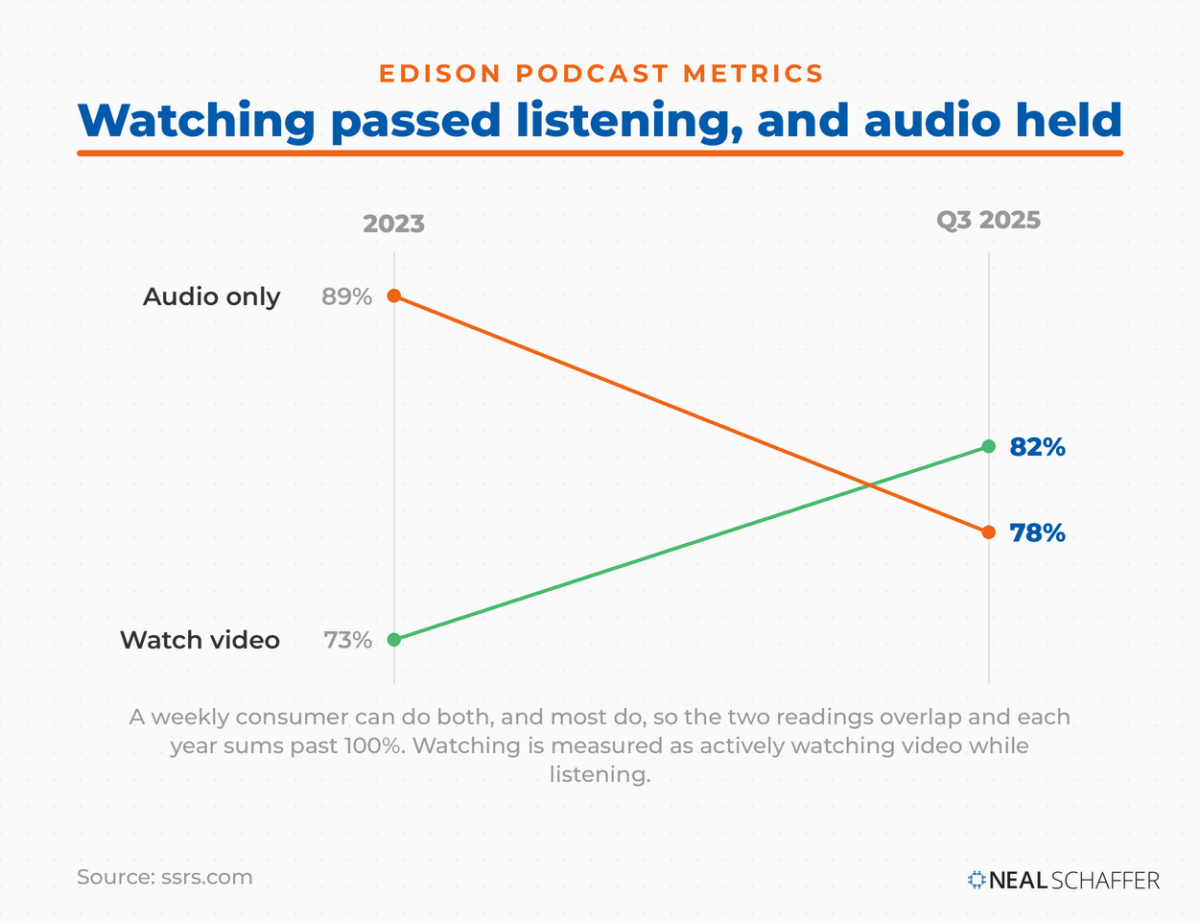
Both, and the balance has already tipped toward video. 82% of weekly podcast consumers actively watch, against 78% who listen to audio only, which reverses where the two formats sat in 2023. Episode length has stayed stable through that shift, with the largest single band still running 20 to 40 minutes.
14. 82% of weekly podcast consumers watch video, against 78% who listen to audio only
Video podcast consumption overtook audio-only consumption for the first time in Q3 2025, with 82% of weekly podcast consumers actively watching video compared with 78% listening to audio only, according to The Podcast Consumer 2026 from Edison Research at SSRS. In 2023 the split ran the other way, with 89% listening to audio only and 73% watching.
The two formats have run close together since. Edison’s summary is that video is expanding the audience rather than replacing audio.
What this means for you: if you are launching now, record video from episode one. Retrofitting it later means redoing your setup, your room and your recording habits just as your process settles. Getting podcasting on YouTube right early costs less than converting, and the video marketing statistics point the same way across formats. My own show sits nowhere near that near-even split, which is the next number.
I dug into exactly this question with Vyyyper, who runs social for vidIQ, and his answer was that you cannot upload a podcast to YouTube and expect the platform to do the rest. The title has to advertise the value of that specific episode rather than name the show.
15. About one in five plays of my own recent episodes came through video
Across three episodes I published between March and April 2026, roughly one in five plays arrived through YouTube and four in five through the podcast feed, measured on my own Buzzsprout and YouTube figures as of September 2026. The spread across just those three ran from about one in eleven to nearly half.
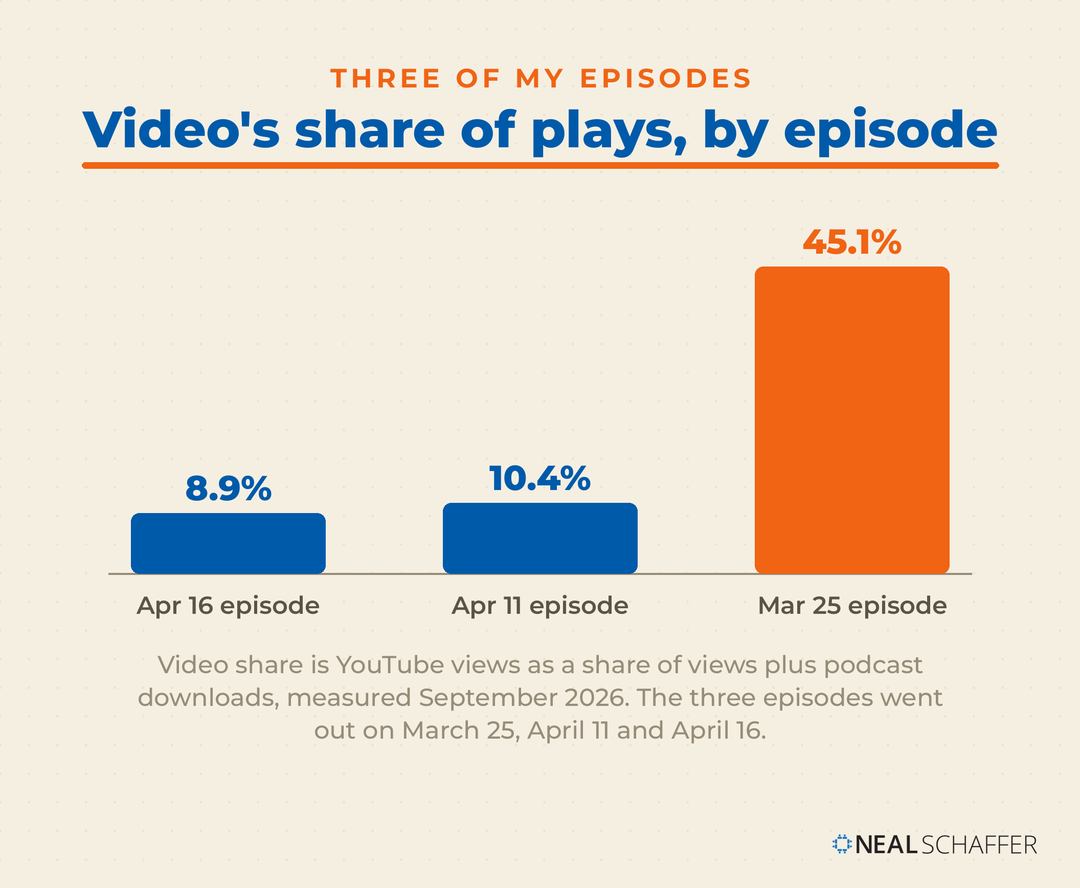
The two counts do not overlap, because YouTube is not in my RSS feed, so a view is never also counted as a download. Three episodes is a sample, not a study.
What this means for you: I am a long way behind the industry split, and I am the audio-first case in my own post. What surprised me more is that the episode drawing the most YouTube views drew the fewest downloads of the three, and the one with the most downloads drew the fewest views. From what I have seen on my own show, uploading to YouTube is not distribution, it is a second product with its own title, thumbnail and audience. Budget for it that way or expect the result I got.
16. 31% of podcast episodes run between 20 and 40 minutes
31% of podcast episodes fall between 20 and 40 minutes long, per The Podcast Host’s June 2026 read of Buzzsprout’s platform data, drawn from more than 114,000 active shows. That makes it the most common length band, ahead of under-10-minute episodes and the 40 to 60 minute band, both at 20%.
What this means for you: this range is a good default when you have no data of your own, because it fits a commute, a workout or a dog walk. The mistake I see more often than bad length is inconsistent length. A listener who knows your show runs about half an hour can slot it into a specific part of their day. One that swings between 12 minutes and 90 cannot be slotted anywhere.
Format and length are solvable. Getting anyone to hear the result is the part the industry undersells.
What are the odds anyone actually hears your podcast?
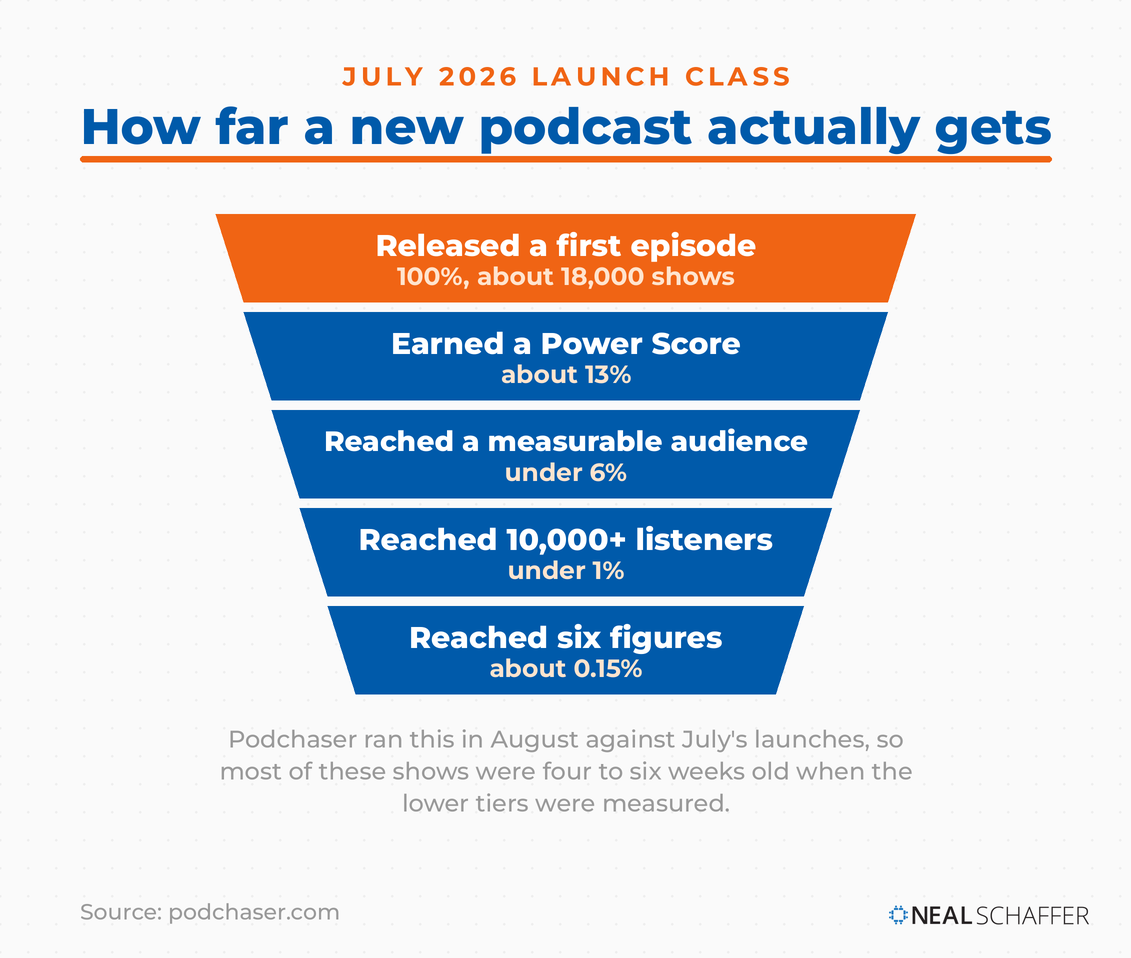
Low on any audience-size measure, and the drop-off is steep rather than gradual. Roughly 18,000 podcasts launched in a single month of 2026, and under 6% of them reached a measurable audience at all. About 4 in 10 new shows stop publishing within six months of launching.
17. Roughly 18,000 podcasts launched in a single month in 2026
Nearly 18,000 podcasts released a first episode in July 2026, part of a run rate of 15,000 to 20,000 new shows a month and roughly 150,000 in the first half of the year, per Podchaser’s catalog analysis published in August 2026. The launch rate has cooled well off its 2020 and 2021 peak.
Podchaser notes the monthly count is a floor, since catalogs keep indexing new shows for weeks afterward.
What this means for you: the barrier to entry really is close to zero, and that is not the constraint worth worrying about. Podchaser also found that a real slice of what launches is repackaged material rather than original shows, including rewatch feeds and public-domain audiobooks. Your actual competition is smaller than the raw launch count, which is the same lesson the active-podcast number taught earlier.
18. Under 6% of new podcasts reach a measurable audience
Of the podcasts that launched in July 2026, about 13% earned a Power Score, under 6% reached a measurable audience, under 1% reached roughly 10,000 listeners, and about 0.15% reached a six-figure audience, according to Podchaser. Podchaser is careful to note these are new shows that have not had time to build up listeners.
The breakout tier was dominated by established media figures who arrived with an audience already built.
What this means for you: read this as a reason to set the right goal rather than a reason not to start. A business podcast that reaches 400 of the right buyers is a success by any measure that matters to a pipeline, and it would sit invisibly inside that under-6%. If your goal is audience size, this data should worry you. If your goal is depth with a named set of accounts, it is close to irrelevant.
When people applied to my Digital First Mastermind community I asked how they knew me and let them tick every answer that applied. Podcast listening came fourth in both response sets, behind my website, my email list and my books, at 20% of one set and 38% of the other, on my own survey exports as of September 2026.
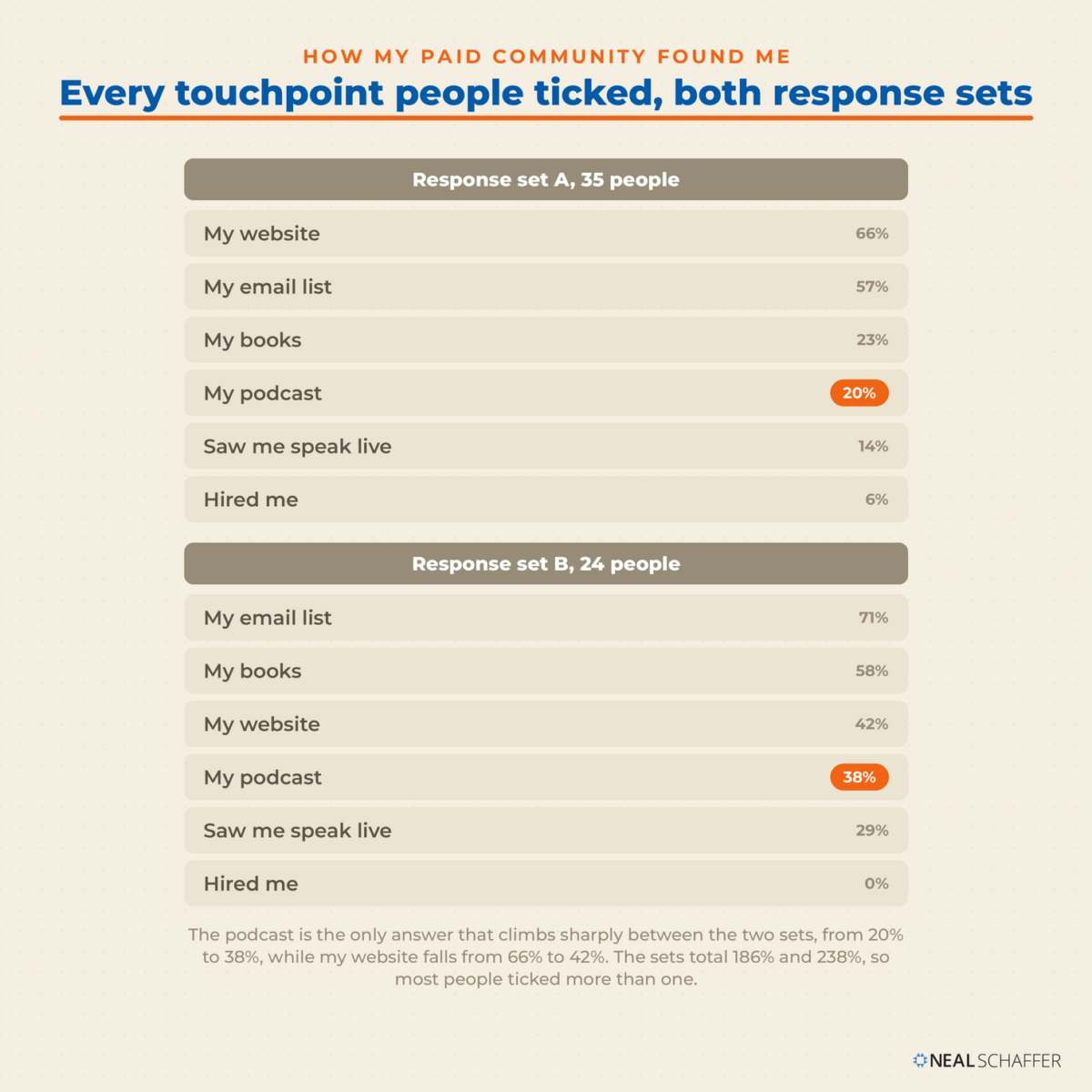
Both samples are small, at 35 and 24 responses, and the question asked about the relationship rather than about where people consume my work.
What this means for you: the podcast was nobody’s main door in, and the community filled anyway. So the question worth taking into a budget meeting is not whether podcasting becomes your biggest channel, because on my own numbers it did not. It is whether the people it does reach are worth reaching, and for a paid B2B offer a fifth to a third of buyers is a long way from nothing.
20. About 4 in 10 new podcasts go quiet within six months
Roughly 4 in 10 new podcasts stop publishing within six months, based on Podchaser’s prior launch cohorts. Podchaser tracks this attrition separately from launch counts because a fresh cohort has not yet had time to fade.
What this means for you: podfade is the real risk to plan against, and it is a resourcing problem rather than a motivation problem. Before you commit, bank six to eight episodes ahead of launch so one bad month does not break your streak, and write down who owns the show when the person who championed it gets busy.
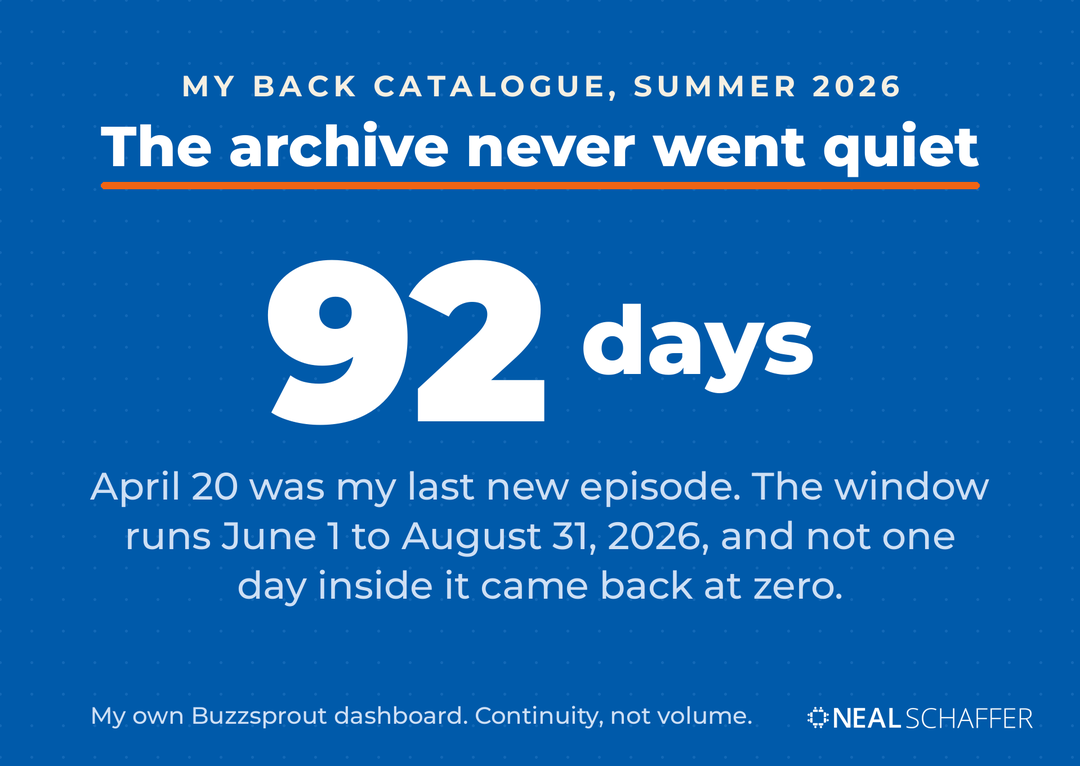
I am closer to this line than I would like. I published no new episodes between late April and the end of August 2026, and the back catalogue still delivered downloads every day of that stretch. A pause and a dead show look identical in this statistic and are not the same thing. Build the archive first, and it holds the floor while you sort yourself out.
21. 72% of podcasters name discoverability as their biggest challenge
72% of podcasters name discoverability and growing an audience as their major challenge, per the 2025 Independent Podcast Report as published by The Podcast Host. Making money followed at 39%, audience engagement at 32%, and time commitment and burnout at 30%.
The competition for attention is narrow at the listener end too. Buzzsprout reports that listeners subscribe to an average of six shows and that 80% finish all or most of every episode they start.
What this means for you: budget for distribution from the start, because the thing that kills shows is not production quality. You are asking a listener to drop one of their six shows to make room for yours, which is a far higher bar than a blog post asking for four minutes. Tracking where you land on the podcast rankings sites tells you whether you are earning a slot.
Running a show is one route in. There is a cheaper one, and the data on it is better than most people expect.
Is being a podcast guest a better bet than hosting?
Often, yes. Only about 12% of new podcasts book guests, which makes the shows that do a small and findable group rather than an endless one. Guesting puts you in front of an audience somebody else spent years building, at a fraction of the cost and the commitment of building your own.
22. Only about 12% of new podcasts book guests
Only about 12% of podcasts launched in July 2026 book guests, per Podchaser’s analysis, which notes that the interview show most people picture is a minority behavior among new entrants. The default new show is a solo host or a co-host pair.
What this means for you: the guest economy is concentrated in a small, identifiable slice of the catalog, so a guesting strategy is a targeting exercise rather than a volume one. When I promoted The Age of Influence I appeared on 100 different podcasts, and as I wrote in Digital Threads, the value showed up in discoverability, because most of those hosts publish show notes, transcripts and links back to their guests.
23. The median listener of a breakout new show is around 34
Among 2026 launches that reached a measurable audience, the median listener is around age 34, with most shows landing between the late twenties and low forties, according to Podchaser’s first-party audience data. The audience clusters in the United States, Canada, the United Kingdom and Australia.
What this means for you: a mid-thirties median is squarely inside the working population, which is a reasonable place to be if you sell to businesses. Pair that with the education skew from earlier and you have a defensible audience argument. What you still do not have is proof that any particular show reaches your particular buyer, which is why the pitch process matters more than the aggregate demographics.
Here is the part of this I can speak to directly rather than through somebody else’s research. Guest requests to my show have climbed sharply. In 2023 I received 123, in 2024 it was 188, and in 2025 it reached 297. Through the end of August 2026 I have had 129.
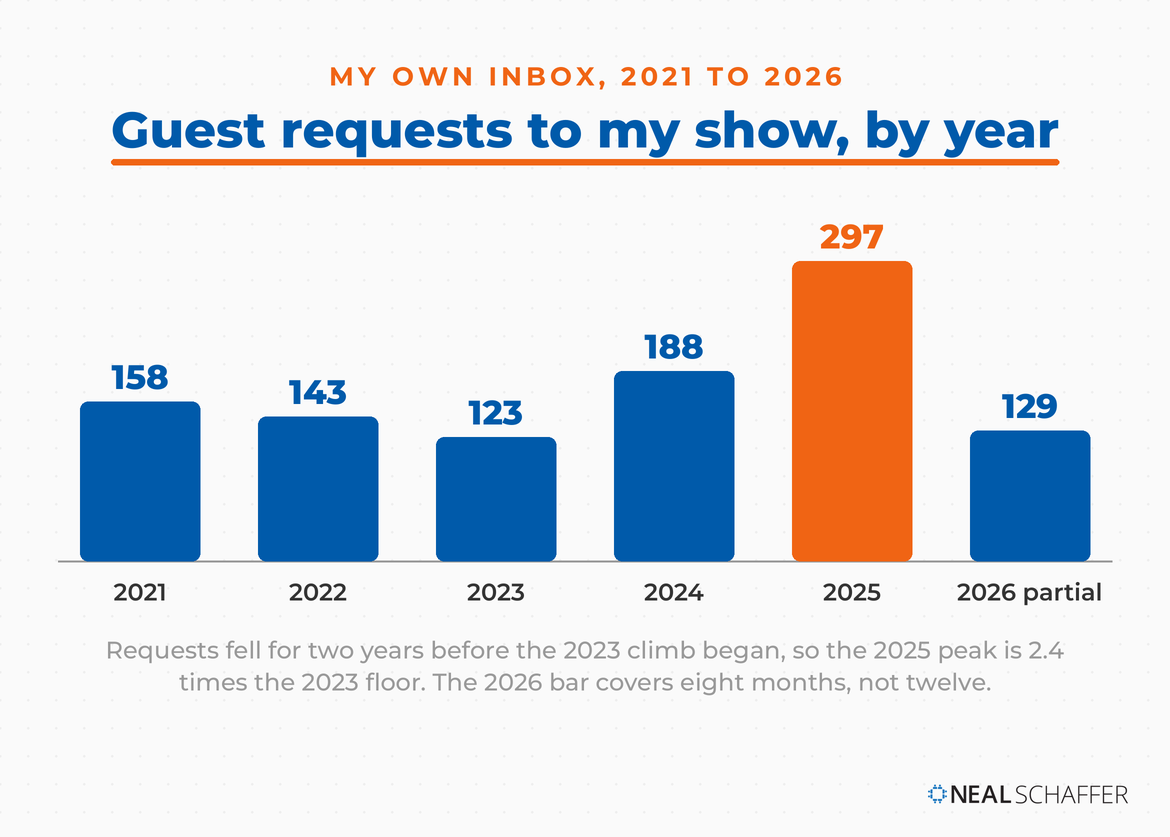
I aim to publish 50 episodes a year, half of them solo and half of them interviews. So in 2025 roughly one request in twelve got a slot, and I turned down the rest. Plenty of those pitches were fine. A show simply has finite episodes, and an existing relationship beats a cold pitch nearly every time.
So if guesting is your route in, treat it as relationship-building with a small number of hosts rather than a volume outreach campaign. The arithmetic on the host’s side is brutal, and a pitch from someone I already know does not have to survive it.
This is the argument I made on an episode of my podcast Your Digital Marketing Coach about where podcast returns actually come from, which I broke into three Cs: connections, content and commerce. On the commerce piece I put it this way: “especially, if you’re in B2B, it does not take that many listeners to generate a year’s worth of income. I mean, you land that dream client and that’s tremendous ROI.”
Frequently Asked Questions About Podcast Statistics
167 million Americans aged 12 and over consumed a podcast in the last month, which is 58% of that population and an all-time high. Weekly consumption reached 45%, or 130 million people. Pew reports a lower past-year figure of 54% because it surveys adults 18 and over and asks a different question.
US podcast advertising grew 17.6% in 2025 to $2.9 billion, faster than digital advertising overall, and 76% of weekly consumers say they have acted after hearing a podcast ad. The caveat is scale. Podcasting is 1% of US digital ad spend, so it works better as a targeted addition to a plan than as its centerpiece.
Fewer than you would expect, and the share is shrinking. 27% of B2B marketers used podcasts as a distribution channel, down from 30% the year before, and audio ranked last among investment areas they expected to grow. Measurement difficulty is the reason practitioners most often cite.
Yes, if you are starting now. Video consumption overtook audio-only among weekly podcast consumers, at 82% watching against 78% listening to audio only, having run the opposite way in 2023. On my own three most recent measured episodes, though, video accounted for only about one in five plays, so the industry average is not a forecast for your show. Building video in from the first episode is far cheaper than retrofitting it.
Under 6% of shows launched in a recent month reached a measurable audience, and about 4 in 10 new podcasts stop publishing within six months. Those odds describe general audience growth, though. A business show reaching a few hundred of the right buyers can be valuable while looking invisible in that data.
There is no research behind that claim that I have been able to find. Several vendor pages cite figures of 72%, 75% or 83% for executives or decision-makers, usually attributed loosely to Edison Research, and Edison does not publish any of them. The closest sourced figure is that 68% of 35 to 54 year olds consumed a podcast in the last month.
Ready to Decide Whether Podcasting Belongs in Your Mix?
Write down what you would count as success before you record anything. The teams that quit are almost always the ones who never defined it. If your answer is reach, the odds above should give you pause. If your answer is depth with a specific set of buyers, podcasting is one of the few channels where a small audience is enough.
Then pick your entry point on the evidence rather than on preference. Guesting is cheaper, faster and lets you test whether your message lands before you commit to a production schedule. Hosting makes sense once you know it does.
If you decide to build one, start with how to start a podcast, then settle your podcast hosting platform early, because that choice shapes your analytics and distribution options later. For the wider view of where audio sits alongside your other channels, see digital marketing strategy, and grab a free preview of Digital Threads for the full framework.
And if you would rather have someone build the channel plan with you, including whether podcasting earns a place in it, my Fractional CMO services might be a fit. I am Neal Schaffer, and I have been making this call with clients for years.

Free Preview of My Definitive Book on Digital Marketing
We respect your privacy. Unsubscribe at anytime.
