


I often hear the following: “I publish blog posts, but hardly anyone sees them.”
That frustration isn’t about laziness or lack of creativity. It’s about one thing: visibility.
Crafting useful content is only half the battle. To get found, shared, and trusted online, you have to think strategically about how search works and how content gets discovered across websites and search engines like Google and Bing.
As the author of Digital Threads, the modern digital marketing playbook covering SEO, content marketing, and AI-driven strategies, I’ve seen firsthand how the right approach transforms invisible blogs into lead-generating assets. In my work as a Fractional CMO, helping businesses build sustainable growth, blog SEO consistently proves to be one of the highest-ROI activities a small business can invest in.
The age of AI search further complicates things, as you are not only trying to have your page published at the top of a search results page. Large language models and artificial intelligence are reshaping how audience members discover content, meaning your blog must now satisfy both traditional algorithms and emerging AI Overviews.
That being said, blog SEO is your bridge between “I wrote it” and “they read it.”
Over the years, working with a variety of businesses, I’ve helped blogs move from invisible to indispensable by applying proven SEO principles. In this guide you’ll find the same framework I apply with my clients: a step-by-step process that covers keyword strategy, content structure, technical health, and emerging 2026 trends so you can make your blogging efforts perform better, even without a big team or big budget.
Key Takeaways
✅ Blog SEO connects great content to the audiences actively searching for it through strategic optimization
✅ Relevance, authority, and user experience form the foundation of higher search rankings
✅ Keyword research focused on search intent drives more qualified organic traffic

✅ Technical factors like page speed and mobile optimization directly impact visibility
✅ AI-powered search requires structured content that both humans and machines understand
✅ Consistent publishing and content updates compound your blog’s authority over time
What Is Blog SEO and Why Does It Matter in 2026?
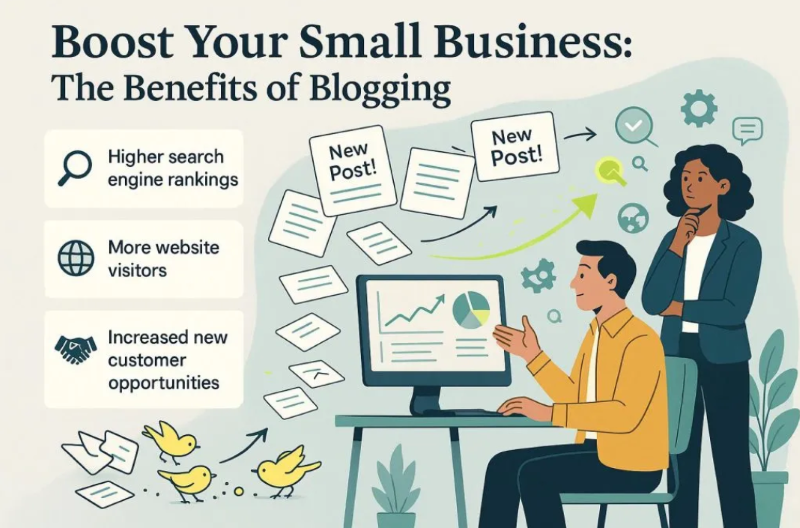
Blog SEO is the practice of optimizing your blog content so both humans and search engines understand its value. It’s not about tricking algorithms. It is about clarity, authority, and connection.
In 2026, the search environment is shifting: AI-powered search tools and new SERP features are changing how people find content. According to Conductor’s State of SEO research, 63% of respondents reported that Google AI Overviews have positively impacted organic traffic, visibility, or rankings since its rollout in May 2024. The foundation still holds, however: match user intent, deliver value, and make your content easy to find for search engines and search users alike.
According to BrightEdge research, a significant 68% of all online activities start with a search engine. That means if your blog isn’t optimized, you’re missing out on the largest inbound channel you already control. While that number will fluctuate with the emergence of ChatGPT and other LLMs, those same large language models will often search the Internet for answers, too. This means your content strategy must account for both traditional SERP rankings and AI Overviews.
For a small business or solo creator using blogging as part of your marketing, SEO is not optional. It’s central. When you publish optimized blog posts, you’re building long-term visibility, not just chasing the next trending topic. According to BKA Content, websites with active blogs have 434% more indexed pages and 97% more inbound links than those without. Whether you’re running a small business or working as a solo blogger, learning how to start a blog with SEO in mind creates opportunities for every website.
What Are the Three Key Elements of Blog SEO?
The three key elements of blog SEO are relevance, authority, and experience. Every successful blog optimization strategy addresses these core factors that search engines use to evaluate and rank content.
Relevance
Relevance means your content matches what people are searching for. It’s about conducting thorough keyword research to choose the right terms, understanding search intent, and writing accordingly. If someone searches “how to write a blog post optimized for SEO,” and your article is about “top blog platforms,” you’re misaligned.
Relevance gets your post into the contest. With conversational search becoming more prevalent, this is more important than ever. Treat your preferred search engine as a conversational entity rather than a computer to show up in search queries. Use a keyword research tool to discover keyword ideas and build a comprehensive keyword list that addresses your audience’s needs.
Trying to Keep Up with Digital Marketing?
Just released: my new book to help small businesses, entrepreneurs, and marketers master digital marketing in today’s digital-first world.
Drawing on my Fractional CMO experience, Digital Threads simplifies complex strategies into clear, actionable steps for success.
Transform your business today—grab your copy! Click the cover or button below to buy on Amazon.

Authority
Once relevance is established, search engines (and humans) want to know that you are credible. Authority comes from quality content, proven expertise, and links (both internal links and external). Backlinks from reputable websites signal trust to algorithms.
According to Advanced Web Ranking, the average #1 ranking on Google receives 27.6% of all clicks. The top position attracts more traffic than all lower-ranked listings combined. That means authority drives visibility. Search engines need to prove their own authority, and will therefore prioritize trusted sites in search rankings. Building your brand profile through quality content and earning backlinks are key factors in how well you rank. Learn more about link building strategies that drive real results.
Experience
Experience covers how your blog reads, loads, and functions. If users bounce quickly or the post is hard to consume, search engines interpret that as a weaker option and rank it lower in search engine results. According to Google’s official documentation, Core Web Vitals is a set of metrics that measure real-world user experience for loading performance, interactivity, and visual stability of the page. Google highly recommends site owners achieve good Core Web Vitals for success with Search.
According to Google research, if page load times increase from 1 second to 3 seconds, bounce rates jump by 32%. If your site takes 6 seconds to load, bounce rates skyrocket by 106%. Good blog SEO includes readability, speed, structure, and mobile-first indexing compliance. While organic traffic is great to bring users to your site, search engine optimization is not complete without taking a close look at your technical SEO and overall user experience.
How Do You Optimize a Blog Post for SEO? A Step-by-Step Framework
Here is the playbook you can apply every time you write a blog post. Each step works deliberately to bring together relevance, authority, and experience.
Step 1: Choose a Keyword with Clear Intent
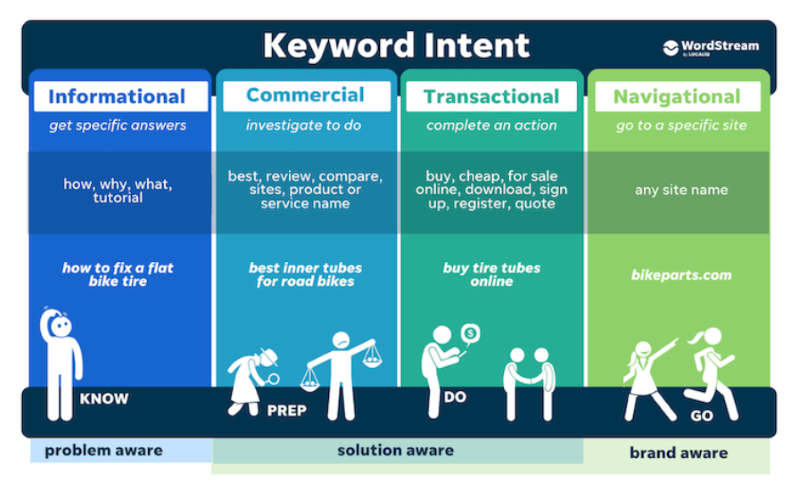
Use tools (Google Keyword Planner, Ahrefs, Semrush) to find phrases your audience actually uses. Start with comprehensive keyword research to identify terms with appropriate search volume and clear search intent. According to Orbit Media, 66% of bloggers use SEO to gain blog traffic. This will help you show up in organic search and will ultimately satisfy any given search algorithm.
Prioritize long-tail keywords (three or more words) because they tend to be less competitive and reflect clearer intent. Check search volumes to prioritize high-value opportunities. For content optimization, clear intent is key. From video content to social media posts, your content should be directed toward a particular audience or query. Learn more about SEO keywords and how to select them strategically.
Ask yourself: What question is the searcher asking? How can my post answer their needs?
Step 2: Craft a Compelling, Keyword-Rich Title
Front-load your keyword so it appears early in the title. Search engine results require you to match search user needs. This means showing in search results that your post is relevant to the search query in question.
According to DemandSage, blog posts with seven or fewer words in their H1 tag obtain 36% higher organic traffic on average than those with fourteen or more words. Make the title click-worthy while still accurate and relevant. Your audience should feel a sense of urgency or value when they come across your post.
Keep it under 60 characters so it doesn’t get cut off in search results. Search engine results are limited in space, so make sure that your titles are not too long to actually show up in organic search results.
Step 3: Structure Your Post with Clear Hierarchy
Use one H1 (your post title). Each post should contain only one H1 for clarity and ease of use. Use H2s for major sections and H3s for sub-points. Proper headers are essential for on-page SEO, because they provide clear structure for your audience and make your content easier to understand and digest.
This structure helps readers scan and helps search engines understand your content flow. Search engine algorithms rely on marketers’ ability to organize and structure content through effective headers. Check out my guide on blog post format for more detailed formatting tips.
Step 4: Write for Your Reader First, Optimize for Search Second
Use conversational language, short paragraphs (three to four sentences), and clear subheadings. Just as page speed focuses on providing an enjoyable experience for your audience, make sure that your language focuses on your audience first and brand awareness or conversions second.
According to HubSpot research, 70% of marketers prioritize creating high-quality content over quantity. Mention your primary keyword near the beginning, but avoid stuffing. Keyword stuffing can actually harm your place on a search results page. Use target keywords and secondary keywords organically and intentionally throughout your content, focusing on relevant keywords that match search intent.
Include semantic keywords (variations) naturally to cover related terms. SEO content writing usually encompasses a range of topics and ideas, so make sure you are using keyword variations to tackle a wider range of ideas and topics.
Step 5: Include Internal and External Links
Internal links: Connect this post to other pages on your site to build clusters and help users navigate. If you are actively developing content for content marketing, make sure you are tying your SEO content together through internal links. Use descriptive anchor text that tells readers and search engines what to expect.
External links: Reference reputable resources to back up claims and build credibility. Broken links can undermine your efforts, so make sure that you regularly check your links for broken or damaged connections. Monitor for errors and redirects that might impact user experience.
Step 6: Optimize Visuals and Media
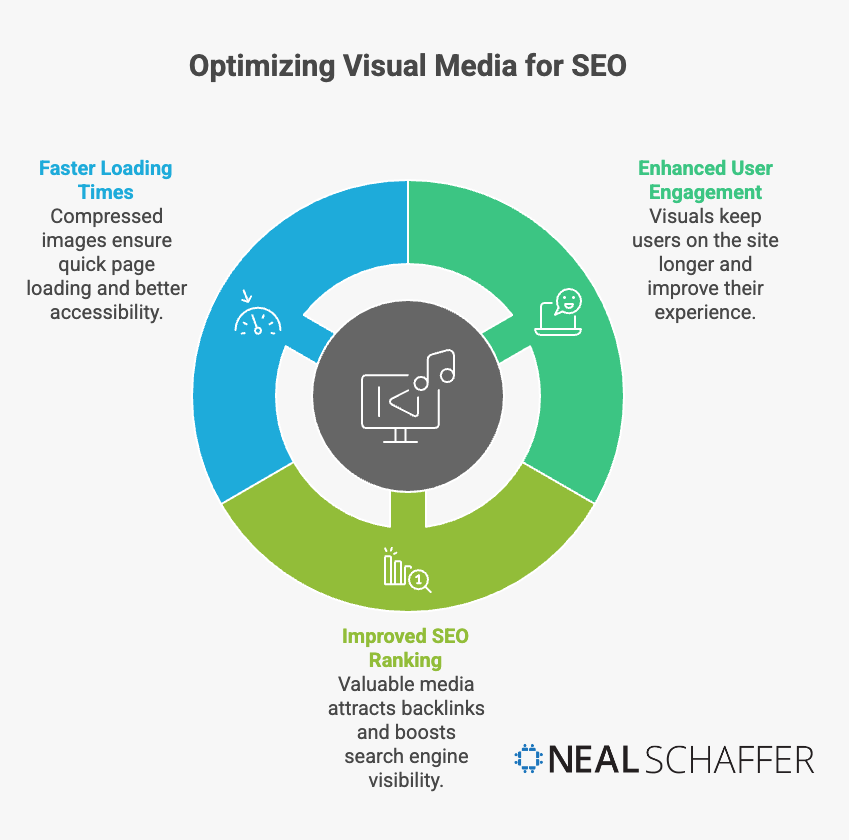
Use images, diagrams, or charts to break up large text walls and support your points. According to SEO.AI’s SEO statistics compilation, 97% of pages appearing on Google’s #1 page incorporate at least one image, highlighting the value of visuals in SEO. A compelling featured image helps attract attention on social media and in search results. Media elements like images, diagrams, and charts help eyes more easily scan your content.
Tools like Canva make it easy to create custom visuals. Optimize filenames (for example, blog-seo-checklist.jpg) and include alt text with descriptive keywords. Alt text and file names should also be optimized and include relevant keywords. Compress images for fast loading using the right blogging tools.
Step 7: Write a Persuasive Meta Description
Treat it as your mini marketing pitch in search results. Your meta description can improve organic search by essentially convincing your audience to click. Include the keyword and a benefit. Keep it around 150 to 160 characters. Learn more about meta tags for SEO and how to write them effectively.
Step 8: Keep Your URL Short and Descriptive
Example: /blog-seo-step-by-step. Longer URLs can clutter your search results and make it difficult to find your pages. According to Backlinko’s study of 11.8 million Google search results, URLs on the first page of Google results are about 66 characters long. But shorter lengths do better than longer ones. URLs that rank at the #1 position are 9.2 characters shorter than URLs in the #10 positions.
Avoid dates, filler words, or long strings. Dates can negatively impact search visibility, as they can make your content seem out of touch. Opt for simplicity and evergreen content instead.
Step 9: Ensure Mobile-Friendly, Fast-Loading Pages

According to Google’s indexing guidelines, Google uses mobile-first indexing for 100% of new websites. This means Google primarily uses the mobile version of your site for ranking. Use a responsive design (built into platforms like WordPress) and make sure your pages are easy to load and navigate on mobile.
Run speed tests using Google PageSpeed Insights and minimize page load time. Core Web Vitals include Largest Contentful Paint (LCP), measuring loading performance with a target of 2.5 seconds; Interaction to Next Paint (INP), measuring responsiveness with a target under 200 milliseconds; and Cumulative Layout Shift (CLS), measuring visual stability with a score target under 0.1.
Remember: user experience affects SEO rankings. Keyword ranking is only one piece in a larger puzzle. Consider your blog hosting options carefully to ensure optimal performance.
Step 10: Add Schema Markup and FAQ Sections
Use structured data for FAQs, how-tos, or review blocks. Providing this content can help drive more traffic to your page and increase the amount of page authority your site is awarded. According to AIOSEO research, the first featured snippet on the SERP gets the most clicks, with a 42.9% click-through rate. If a featured snippet isn’t present, the #1 organic search result gets 39.8% of all clicks.
This increases your chance of appearing in enhanced search results or AI Overviews. As AI Overviews become increasingly common, your ability to show up in this way can significantly impact how well organic search traffic actually comes to your site.
How Do You Build a Blog SEO Strategy That Scales?
Optimizing individual posts is essential, but real scale comes when you build a strategy around your blog. A comprehensive SEO strategy and content strategy working together will drive sustained growth.
Create a pillar post: A long, comprehensive guide covering your main topic (like “Blog SEO for Small Business”).
Then build cluster posts: Shorter posts on subtopics (such as “How to Choose Keywords for Blog SEO” or “Blog SEO Checklist 2026”) that link back to your pillar using optimized anchor text. Browse blog post ideas and topics to find cluster opportunities.
Link strategically: Link each cluster back to the pillar and the pillar to clusters. This builds topical authority and a clear site structure.
Maintain an editorial calendar aligned with your business goals (for example, launch a pillar every quarter and two to three clusters each month). According to DemandMetric, companies with blogs produce an average of 67% more leads monthly than companies that don’t blog. This consistent content strategy helps you rank for more terms over time.
Monitor performance in Google Search Console and GA4. Identify posts gaining traction and update or expand them over time. Watch for Google algorithm updates that might cause rankings to drop, and know how to recover by analyzing the factors involved.
Submit an XML sitemap to Google Search Console and Bing Webmaster Tools to help search engines discover and index your content. Your sitemap serves as a roadmap for crawlers. Learn more about how to do SEO effectively.
What Are Common Blog SEO Mistakes to Avoid?
| Mistake | Why It Hurts | How to Fix It |
|---|---|---|
| Keyword stuffing | Dilutes readability and can hurt rankings | Use keywords naturally, focus on semantic variations |
| Ignoring search intent | Writing what you want instead of what the searcher needs | Research queries thoroughly before writing |
| Neglecting internal linking | Leaves posts isolated, misses site-wide relevance | Link related content strategically |
| Over-promoting products | Turns users away, signals low value | Focus on customer needs first, promotion second |
| Failing to update content | Even good posts lose freshness over time | The majority of successful bloggers update their old posts regularly |
| Ignoring local opportunities | Missing local search traffic | Optimize for local SEO and claim your Google Business Profile |
How Is AI Changing Blog SEO in 2026 and Beyond?
AI is fundamentally transforming how search works. According to WordStream, AI Overviews appear in up to 47% of all search results. On mobile devices, AI Overviews and featured snippets can take up over 75% of the real estate on the screen. Here’s how to adapt:
Optimizing for AI-Powered Search
With features like Google’s AI Overviews and ChatGPT, you’ll want to include clear question-and-answer sections in your posts. According to Yoast’s 2025 SEO wrap-up, SEO has evolved into visibility management for AI-driven search. Artificial intelligence is transforming how search engines interpret and present content.
According to Mike Khorev’s AI SEO analysis, AI Overviews are reducing website clicks by over 30%, even as visibility increases. This shift, often called “The Great Decoupling,” highlights the gap between rising impressions and declining traffic. This makes appearing in AI-generated summaries increasingly important.
Refreshing High-Performing Posts
Rather than always creating new content, research your older posts, update data, add new visuals, and re-promote them on social media. According to Orbit Media’s annual blogging survey, the proportion of bloggers who update their old posts increased from 53% in 2017 to 74% in 2023.
Using Structured Data Markup
Use FAQs, how-to, reviews, or article schema to increase eligibility for rich results. This helps AI systems understand and cite your content effectively.
Building Backlinks Through Thought Leadership
Write guest posts, collaborate with other creators, and aim to earn high-quality links to your pillar content from authoritative websites. According to Backlinko research, 95% of all pages have zero backlinks. But the #1 results have an average of 3.8 times more backlinks than the results that rank 2-10.
Leveraging AI Tools for SEO
According to WordStream, among surveyed businesses, 65% report better SEO results because of AI. 61% of marketers using AI for ranking and attracting organic traffic say they are “effective” or “very effective.” Consider using AI for SEO to streamline keyword research, content optimization, and performance analysis. Explore AI SEO software options that can help accelerate your results.
Measuring What Matters
Use Google Search Console to track clicks, impressions, and average position. Note which keywords bring traffic and which posts convert. Analyze search volume trends and performance data to identify new opportunities. Use the best SEO tools to gain deeper insights.
Blog SEO Checklist for 2026
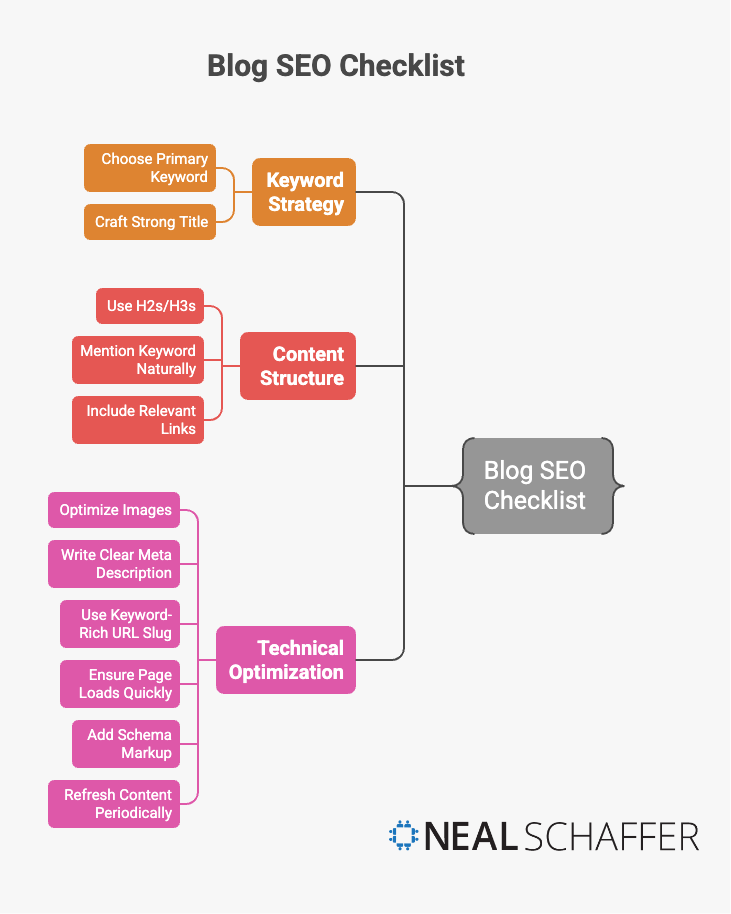
Use this checklist every time you publish:
| Task | Details |
|---|---|
| ☐ Keyword research | Choose a primary keyword with clear intent and appropriate search volume |
| ☐ Build keyword list | Include primary and secondary terms |
| ☐ Title optimization | Craft a strong title with the keyword early |
| ☐ Header structure | Use H2s and H3s to organize content logically |
| ☐ Keyword placement | Mention primary keyword near the top and naturally throughout |
| ☐ Internal linking | Include relevant internal links with descriptive anchor text |
| ☐ External linking | Add authoritative external sources |
| ☐ Image optimization | Add optimized images with filenames, alt text, and a compelling featured image |
| ☐ Meta description | Write a clear meta description including the keyword |
| ☐ URL optimization | Use a short, keyword-rich URL slug |
| ☐ Page speed | Ensure fast loading and proper mobile display (Core Web Vitals) |
| ☐ Mobile compatibility | Verify mobile-first indexing compatibility |
| ☐ Error checking | Check for errors and redirects |
| ☐ Schema markup | Add schema or FAQ markup when applicable |
| ☐ Social sharing | Share on social media to amplify reach |
| ☐ Content refresh | Plan periodic updates to maintain relevance |
FAQ: Blog SEO Questions Answered
Blog SEO typically takes three to six months to show significant results. According to research, the average page’s age that ranks on the first page is over two years. However, well-optimized content can gain traction faster, especially for less competitive keywords. Consistency in publishing and updating content accelerates results.
Yes. According to HubSpot’s State of Blogging Report, 50% of marketers from businesses that maintain blogs say they saw a higher ROI from blogging in 2024. 45% of marketers from blog-maintaining businesses say their companies are going to invest more budget in blogging in 2025. While AI changes how content is discovered, it still relies on quality sources to generate answers.
Quality matters more than quantity, but consistency helps. According to Orbit Media, bloggers who publish 2-6 times weekly are 50% more likely to report strong results. For most small businesses, one to four well-optimized posts per month is a sustainable and effective pace.
AI can assist with research, outlines, and drafts, but human expertise and editing remain essential. According to Orbit Media’s research, 65% of bloggers use AI to some extent. 43% use it to generate ideas for their content. Use AI as a tool to enhance your process, not replace your unique perspective. Learn more about AI blogging best practices.
Both matter, but they serve different purposes. On-page SEO ensures your content is relevant and accessible. According to Ahrefs, SEO leads close at 14.6% compared to 1.7% for outbound leads, making SEO leads 8.5 times more likely to convert. Backlinks build authority. A balanced approach works best.
Blog SEO Delivers Visibility That Translates to Business Growth
Blog SEO is not a one-off task. It is a framework for building lasting visibility, authority, and traffic. When you optimize your blog thoughtfully, you’re not just trying to rank. You’re creating marketing assets that drive awareness, nurture trust, and generate leads on autopilot.
According to Conductor’s research, 91% of marketers reported that SEO had a positive impact on their website performance and marketing goals. For small business owners and entrepreneurs, that shift from “I publish and hope” to “I publish and get found” is what turns blogging from a time-sink into a growth engine. Whether you’re using WordPress, another CMS, or operating as a solo blogger, these principles apply.
Keep your focus on clarity, consistency, and strategic structure. Stay current with Google algorithm updates and emerging artificial intelligence trends. Build resources that serve your customer needs. Your next blog post can be the step that changes what your blog does for your business, providing access to new audience segments and sustainable brand growth.
If you want to go deeper on SEO strategy and content marketing, download a free preview of my book Digital Threads where I cover these topics in detail. For hands-on guidance, consider joining my Digital First Group Coaching Community where I help entrepreneurs and creators implement these strategies step by step. And if you’re looking for personalized strategic guidance for your business, let’s connect about how I can help as your Fractional CMO.
Actionable advice for your digital / content / influencer / social media marketing.
Join 13,000+ smart professionals who subscribe to my regular updates.
