
Close Menu
Trendswave MediaTrendswave Media
  • Home
  • About Us
    • Contact Us
  • Services
  • Influencer Marketing
  • Marketing
  • SEO
  • Social Media
  • Web Design
  • Shop

Subscribe to Updates

Get the latest creative news from Trendswave about Marketing, SEO & Web Design.

Please enable JavaScript in your browser to complete this form.
Loading
What's Hot

Social proof examples: How to use them in your email marketing

August 4, 2026

Unilever Reveals the Creator Marketing Growth Mistake Brands Keep Making

August 4, 2026

Google expands Data Manager API with smarter audience management

August 3, 2026
Facebook X (Twitter) Instagram
Trendswave MediaTrendswave Media
  • Home
  • About Us
    • Contact Us
  • Services
  • Influencer Marketing
  • Marketing
  • SEO
  • Social Media
  • Web Design
  • Shop
Trendswave MediaTrendswave Media
Home»Web Design»How To Make Your Design System AI-Ready — Smashing Magazine
Web Design

How To Make Your Design System AI-Ready — Smashing Magazine

adminBy adminJune 5, 2026No Comments4 Mins Read
Facebook Twitter Pinterest LinkedIn Tumblr WhatsApp VKontakte Email
How To Make Your Design System AI-Ready — Smashing Magazine
Share
Facebook Twitter LinkedIn Pinterest Email


Practical guide on how to reduce drifts, minimize mistakes, maintain context, and improve the quality of AI-generated prototypes. Brought to you by Design Patterns For AI Interfaces, friendly video course on UX and design patterns by Vitaly.

AI-generated prototypes often don’t deliver consistently decent results because of tiny inconsistencies scattered all across a design system. I’s decisions made but not documented, hard-coded values never cleaned up, or relying too much on AI making sense of mock-ups or design flows on its own.

Yesterday I stumbled upon a useful practical guide by Hardik Pandya from Atlassian — on how to reduce drifts, minimize mistakes, maintain context, and improve the quality of AI-generated prototypes. Let’s see how it works.

A diagram comparing traditional with LLM-readable design systems by showing their processes and an example file structure.
To get better results, AI needs better guidance that minimizes assumptions and reduces ambiguity. Guide by Hardik Pandya. (Large preview)

1. Design Decisions Are Infrastructure

Unsurprisingly, better AI prototypes come from better data — but also from better human guidance. We shouldn’t assume that AI knows how to choose the right component and how to design with accessibility in mind. It needs priorities, a clear path on how we make decisions, design principles, examples, do’s and don’ts.

In fact, we should treat design decisions as infrastructure. That means that every time we make a decision — not just a design decision, but even a decision on how to actually prioritize our work and how we make decisions around here — it must find a path into the spec file that is then consumed by AI.

2. Auditing: FigmaLint

One of the useful tools to audit the quality of the design system is FigmaLint. It’s a useful free Figma plugin for auditing tokens, states, accessibility, binding tokens, renaming layers, detecting detached instances, missing interactive states and hard-coded values — and preparing the design documentation.

A screenshot showcasing FigmaLint, an AI-powered design system auditing and auto-fix tool within Figma, with various UI screens displaying features like component auditing, interactive states, design token usage, and property recommendations.
Neat little helper to streamline auditing: FigmaLint. (Large preview)

If you often have to work with vendors and third parties who supply you with their design systems and component libraries, that’s a great helper to have by your side — especially if you want to improve the quality of prototypes, AI-generated code, and AI-written documentation.

3. Three Layers: Spec Files + Token Layer + Auditing

To ensure quality, we establish design principles, guidelines, and rules in the form of “spec files”. It’s structured Markdown files that include spacing rules, color choices, component usage guidelines, priorities, etc. AI is going to read and reuse that spec file every time it’s going to generate a prototype.
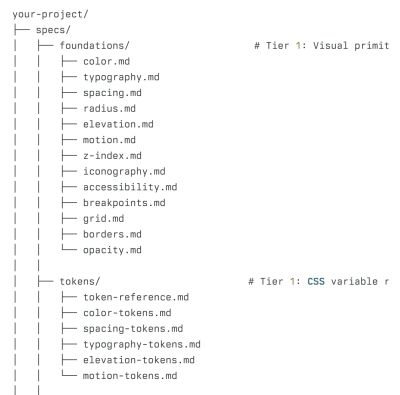
An example of a folder that organizes spec files to be AI-friendly.
An example of a folder that organizes spec files to be AI-friendly. Jump to full example. (Large preview)

Because the spec files are text files, it’s much more cost-effective but also much more accurate, just because we don’t rely on AI recognizing or decoding patterns from mock-ups but get specific guidelines instead. In fact, extending code is often a more effective way than generating code from mock-ups.

The token layer lists and keeps updated all tokens used throughout the design system. AI always chooses from a closed set of named variables instead of inventing plausible values ad hoc.

Five levels of context engineering
Context engineering is everything. Five levels of context engineering: a practical overview, by Matthew Alverson, via Addy Osmani. (Large preview)

An audit script catches what AI gets wrong. It scans the prototype and flags every hard-coded value and flags it if necessary. It can be a regular software doing that, with AI waiting for its feedback to come back.

Finally, when a design system ships updates, a sync routine flags which spec files need updating. The goal is to make sure that AI always reads up-to-date, current specs, not the ones written against an outdated version.

4. Examples of AI-Ready Design Systems

Wrapping Up

Ultimately, AI cannot magically resolve technical debt or design debt without proper guidance. It relies heavily on clear decisions, established priorities, and well-defined principles.

The more deliberate and precise designers are in guiding AI, the better the overall outcomes will be. This requires not just cleaning up and improving design systems but also maintaining them over time as decisions need to trickle down into Markdown files. We’ll be busy for years to come.

Meet “Design Patterns For AI Interfaces”

Meet Design Patterns For AI Interfaces, Vitaly’s new video course with 100s of real-life examples and UX guidelines to design AI features that people actually use — with a live UX training later this year. Jump to a free preview.

Design Patterns For AI Interfaces promo picture
Meet Design Patterns For AI Interfaces, Vitaly’s video course on interface design & UX.

Useful Resources

Smashing Editorial
(yk)


Source link

AIready design Magazine Smashing system
Share. Facebook Twitter Pinterest LinkedIn Tumblr WhatsApp Email
Previous ArticleSignup form templates are holding you back (there’s a better way)
Next Article Daily Search Forum Recap: June 5, 2026
admin
  • Website

Related Posts

Fresh Resources for Web Designers and Developers (June 2026)

August 3, 2026

Small Joys And Big Adventures (August 2026 Wallpapers Edition) — Smashing Magazine

August 2, 2026

20+ Cool Pop Art Style Fonts for Fun Titles

August 1, 2026

The Bull And Bear Case For Digital Design In The Age Of AI — Smashing Magazine

July 30, 2026
Leave A Reply Cancel Reply

  • Facebook
  • Twitter
  • Pinterest
  • Instagram
  • YouTube
  • Vimeo
Don't Miss
Marketing

Social proof examples: How to use them in your email marketing

By adminAugust 4, 20260

By Kelsey Johnson June 12, 2026 Want more clicks, signups, and sales from your emails?…

Unilever Reveals the Creator Marketing Growth Mistake Brands Keep Making

August 4, 2026

Google expands Data Manager API with smarter audience management

August 3, 2026

Fresh Resources for Web Designers and Developers (June 2026)

August 3, 2026

Subscribe to Updates

Get the latest creative news from Trendswave about Marketing, SEO & Web Design.

Please enable JavaScript in your browser to complete this form.
Loading
About Us

Trendswave is an Influencer Marketing Agency with access to one of the largest influencer networks in the Poland, connecting brands and agencies to only the best influencers and social media thought leaders.

Our Picks

Social proof examples: How to use them in your email marketing

August 4, 2026

Unilever Reveals the Creator Marketing Growth Mistake Brands Keep Making

August 4, 2026
Quicklinks
  • Influencer Marketing
  • Marketing
  • SEO
  • Social Media
  • Web Design
  • About Us
  • Contact Us
  • Disclaimer
  • Privacy Policy
  • Terms and Conditions
© 2026 Trendswave.All Rights Reserved

Type above and press Enter to search. Press Esc to cancel.