

When a brand tells me they want to “work with influencers,” my first question is always the same: which kind? Because the word covers a creator with 2,000 followers and a celebrity with 20 million, and the right answer for your business usually sits a lot closer to the small end than you would expect.
That is what influencer tiers are for. They sort creators by audience size so you can match the right level to your goal and budget. I’m Neal Schaffer, I wrote The Age of Influence for HarperCollins Leadership, and I teach influencer marketing at UCLA Extension. In this guide I’ll break down the five standard tiers, what each one costs, and when to use it, and then show you the two other ways to classify influencers that most articles skip entirely.
Key Takeaways
✅ There are five standard influencer tiers by follower count: nano, micro, mid-tier, macro, and mega (or celebrity). The ranges are industry conventions, not an official standard, so expect some variation source to source.
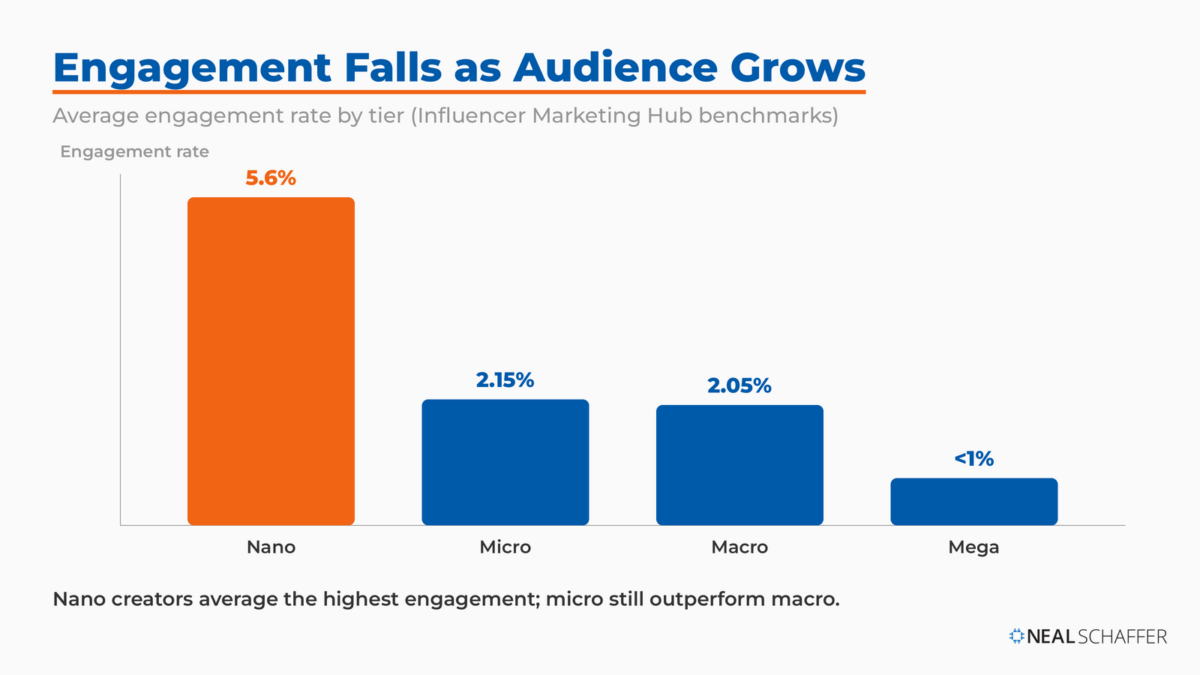
✅ Engagement drops as audience size grows. Influencer Marketing Hub data puts nano engagement around 5.6%, with rates falling as follower counts climb, which is why smaller tiers often beat bigger ones on trust and conversion.
✅ Cost scales with size too, from free product or a few hundred dollars for nano creators up to tens of thousands or more per post for mega influencers.
✅ The biggest tier is not always the best choice. Match the tier to the funnel stage: macro and mega for awareness, micro and nano for conversion.
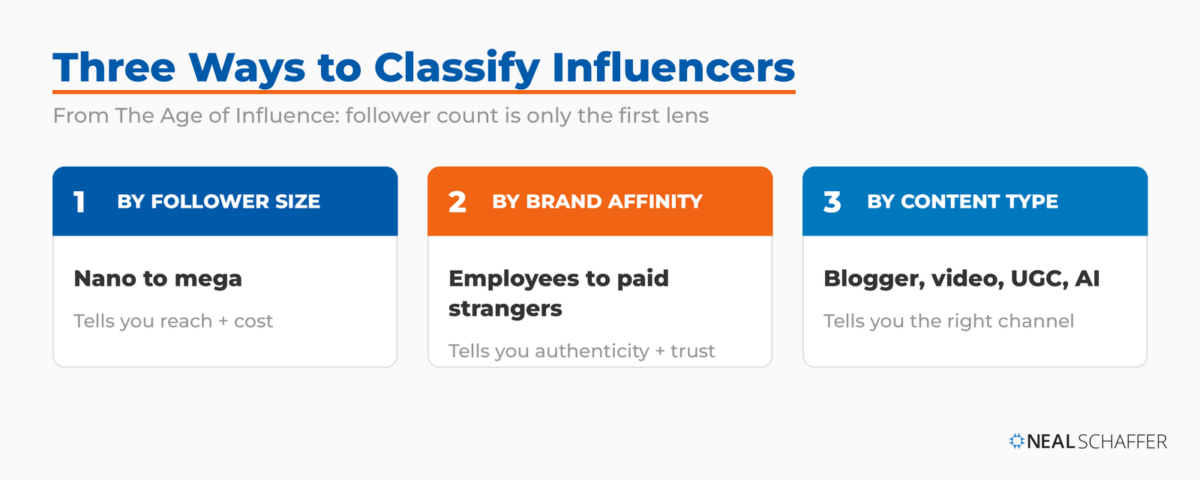
✅ Follower count is only one way to classify influencers. In The Age of Influence I add two more lenses: brand affinity and content-creator type.
✅ Brand affinity is the one most brands miss. Your own employees and customers are often your highest-affinity, lowest-cost, most credible influencers.
What Are Influencer Tiers?
Influencer tiers are categories that group social media creators by the size of their following, usually into five levels from nano up to mega. They give marketers a shared vocabulary for talking about reach, cost, and strategy, and they set realistic expectations before a single dollar is spent.
It helps to be honest about one thing up front: there is no single official body that sets these ranges. Different platforms, agencies, and reports draw the lines in slightly different places, especially around the micro and mid-tier boundary. The version below reflects the ranges most widely used across the industry today, and it is the one I use with clients.
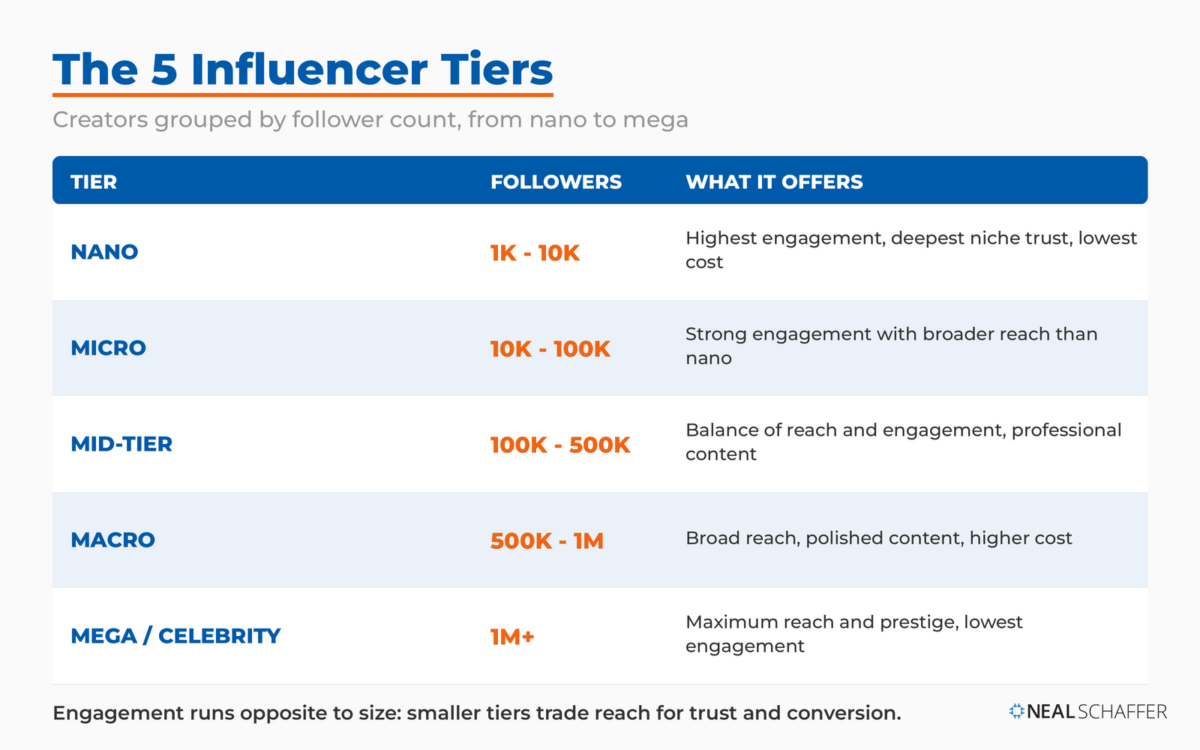
| Tier | Follower Range | What It Offers |
|---|---|---|
| Nano | 1,000 to 10,000 | Highest engagement, deepest niche trust, lowest cost |
| Micro | 10,000 to 100,000 | Strong engagement with broader reach than nano |
| Mid-Tier | 100,000 to 500,000 | Balance of reach and engagement, professional content |
| Macro | 500,000 to 1,000,000 | Broad reach, polished content, higher cost |
| Mega / Celebrity | 1,000,000+ | Maximum reach and prestige, lowest engagement |
One pattern holds across every credible dataset: engagement rate moves in the opposite direction from follower count. Influencer Marketing Hub’s data puts average nano engagement around 5.6%, with rates declining steadily as audiences grow, while micro creators still outperform macro ones. That inverse relationship is the single most important thing to understand about tiers, because it means a bigger audience is not automatically a better one.
The 5 Influencer Tiers, Explained
Each tier earns its place in a different kind of campaign. Below I walk through all five, what they do well, where they fall short, and the kind of brand each one fits. Think of this as a hub: each tier links to a deeper guide if you want to go further.
Nano Influencers (1,000 to 10,000 Followers)
Nano influencers are the entry point, and they are trending for good reason. Their audiences are small, but the connection is close enough that a recommendation lands like advice from a friend rather than a paid promotion. That is where the engagement edge comes from.
For brands, nano creators are the most cost-efficient tier. Many will work for free product or a nominal fee, which means a small budget can fund many partnerships at once. They suit local businesses, niche products that need a credible voice, and product-seeding campaigns built on authentic reviews. The tradeoff is reach: you manage more relationships to add up to real scale, and production quality varies.
Micro Influencers (10,000 to 100,000 Followers)
Micro influencers sit in the sweet spot. They have built a real audience while keeping the engagement and niche trust that make smaller creators effective, and they tend to produce better content than nano creators while staying affordable.
This is the tier most brands should start with for conversion-focused work, which is why so many brands that work with micro influencers build whole programs around them. Their followers are often a defined community, think a goth-fashion audience or a model-building hobbyist crowd, niches too small for a celebrity but perfect for a brand that serves exactly those people.
Mid-Tier Influencers (100,000 to 500,000 Followers)
Mid-tier influencers bridge niche credibility and mainstream reach. They usually work with management, expect fair compensation, and bring higher production values, while keeping more authentic connections than celebrities do. For a brand, they offer enough reach to drive awareness and enough engagement to drive action.
This tier also includes a lot of thought leaders who built audiences around specific expertise, which makes them especially valuable for B2B and professional services. When a campaign needs reliable, professional content at meaningful scale, mid-tier is often the most efficient single choice.
Macro Influencers (500,000 to 1,000,000 Followers)
Macro influencers command large audiences and approach content creation as a full-time profession, usually through a management team. Engagement rates run lower than smaller tiers, but absolute engagement stays high because the audience is so large.
One of the most effective plays at this level is a product collaboration, where the influencer helps design a version of your product. You see it constantly in beauty, where a creator co-develops an eye-shadow palette, and in fashion, where Adidas has run macro collaborations that sell out fast. Expect professional business arrangements at this tier: standardized rate cards, contracts, and content-approval processes.
Mega Influencers and Celebrities (1,000,000+ Followers)
Mega influencers sit at the top of the pyramid, and the line between influencer and celebrity blurs here. The tier includes social-media-native stars and traditional celebrities who brought existing fame to their platforms. Kylie Jenner is the textbook case, with sponsored posts reported in the seven figures, and music names like Beyonce carry the same dual status.
These partnerships function more like celebrity endorsements than influencer marketing. They deliver unmatched reach and prestige, but at the highest cost and the lowest engagement, and the audience is broad rather than niche. For most small and mid-sized brands, the math rarely works, which is exactly why they end up choosing other tiers. If you want the full earnings picture across tiers, I break it down in my guide to how much influencers make.
When to Use Each Influencer Tier
The right tier follows from your objective, not from chasing the biggest number you can afford. Different tiers excel at different stages of the marketing funnel, so the cleanest way to choose is to start with the outcome you actually want.
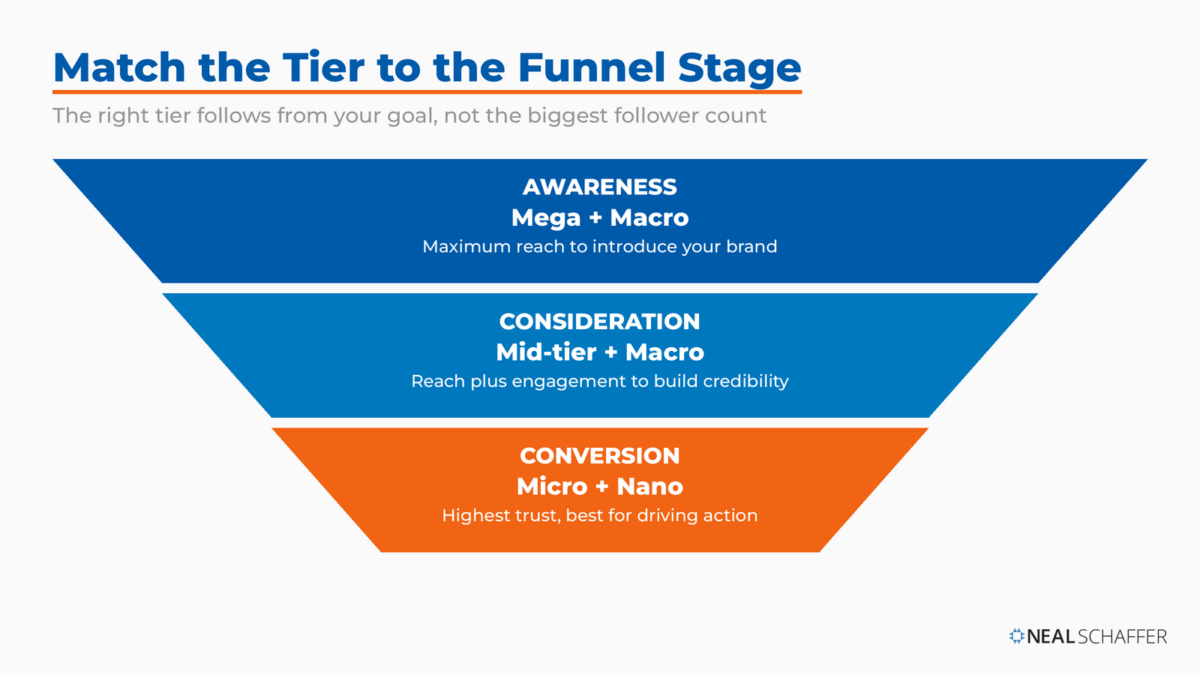
For pure awareness, macro and mega influencers deliver the most reach fastest. For conversion, smaller is usually better: nano and micro creators generate higher engagement and stronger trust, and their recommendations carry the weight of word-of-mouth. Mid-tier sits between the two and works well when a campaign has both goals. A simple funnel map:
- Top of funnel, awareness: mega and macro
- Middle of funnel, consideration: mid-tier and macro
- Bottom of funnel, conversion: micro and nano
Industry context matters too. Mass-consumer categories like beauty, fashion, and packaged goods often justify larger tiers for broad awareness, while specialized B2B and professional services usually perform better with focused micro and mid-tier voices. A local restaurant gains little from a mega influencer with a global audience but can see real results from local nano creators whose followers actually live nearby.
Is Your Digital Marketing All Over the Place?
My latest book helps small businesses, entrepreneurs, and marketers bring search, email, and social together into one digital marketing strategy that actually compounds.
Drawing on my work as a Fractional CMO, Digital Threads turns complicated tactics into a clear, practical plan you can follow, whatever your budget or team size.
Grab your copy on Amazon and start weaving your own digital threads. Click the cover or the button below to get started.

The most sophisticated programs do not pick one tier at all. They run a pyramid: a couple of macro influencers for awareness, several mid-tier creators for credibility, a layer of micro influencers for engagement and conversion, and many nano creators for authentic user-generated content. Each tier reinforces the others, and the larger creators create awareness that the smaller ones convert. If you are building this kind of program, my influencer marketing strategy guide walks through the coordination.
How Much Does Each Tier Cost?
Cost scales with follower count, though it varies widely by platform, niche, and engagement. Treat the ranges below as rough 2026 starting points rather than fixed rates, and always weigh cost against engagement rather than reach alone. For a deeper breakdown, see my influencer rate card guide.
| Tier | Typical Cost Per Post | Best-Fit Budget |
|---|---|---|
| Nano | Free product to a few hundred dollars | Starting budgets, multiple partnerships |
| Micro | Hundreds to a few thousand | Mid-range, conversion-focused programs |
| Mid-Tier | Several thousand to low five figures | Established budgets, quality at scale |
| Macro | Tens of thousands per post | Larger budgets, broad awareness |
| Mega / Celebrity | Tens of thousands to seven figures | Enterprise budgets, mass awareness |
The reason smaller tiers keep winning budget share is cost efficiency. Because nano and micro creators charge far less and engage far more, you can fund several of them for the price of one larger creator and often get better conversion. Many will also work on commission or affiliate terms, which lets you test how influencers make money with you before committing to flat fees.
Beyond Follower Count: The Other Ways to Classify Influencers
When I was writing The Age of Influence, I realized there had to be a better way to categorize influencers than counting followers, because more followers does not simply equal more influence. So I built a model with three lenses, not one. Tiers by size are the first and most familiar. The other two, brand affinity and content type, are where most brands find their best and most overlooked partners.
This is the part of influence that the tier charts miss. As I put it on an episode of my podcast,
“Influencer marketing is not about paying someone else to take selfies and put them online. It is fundamentally about engagement and communication. It is about building relationships.”
Relationships, not follower counts, are the real asset, and that reframe is what the next two lenses are built on.
Classifying Influencers by Brand Affinity
Brand affinity asks a different question than size: how well does this person already know, like, and trust your brand? The insight came to me from nano influencers. If someone with as few as 1,000 followers can hold real digital influence, then look around you, because plenty of people who already love your brand are sitting in plain sight. Affinity runs from high to low:
- Employees and partners. Often your most credible and overlooked influencers. Ask them to talk about the work they do or the products they help build, not to push promotions, and make sure HR is on board.
- Customers. People who already bought and like your product. A testimonial or tutorial format works well, and B2B customers in particular lend real credibility.
- Fans and mentioners. People who interact with or reference your brand without buying yet, like someone who admires a product they cannot afford, or a mechanic who fixes your cars and vouches for the parts.
- Low or no affinity. The strangers you pay to talk about you. Useful, but transactional, and the endorsement reads as bought.
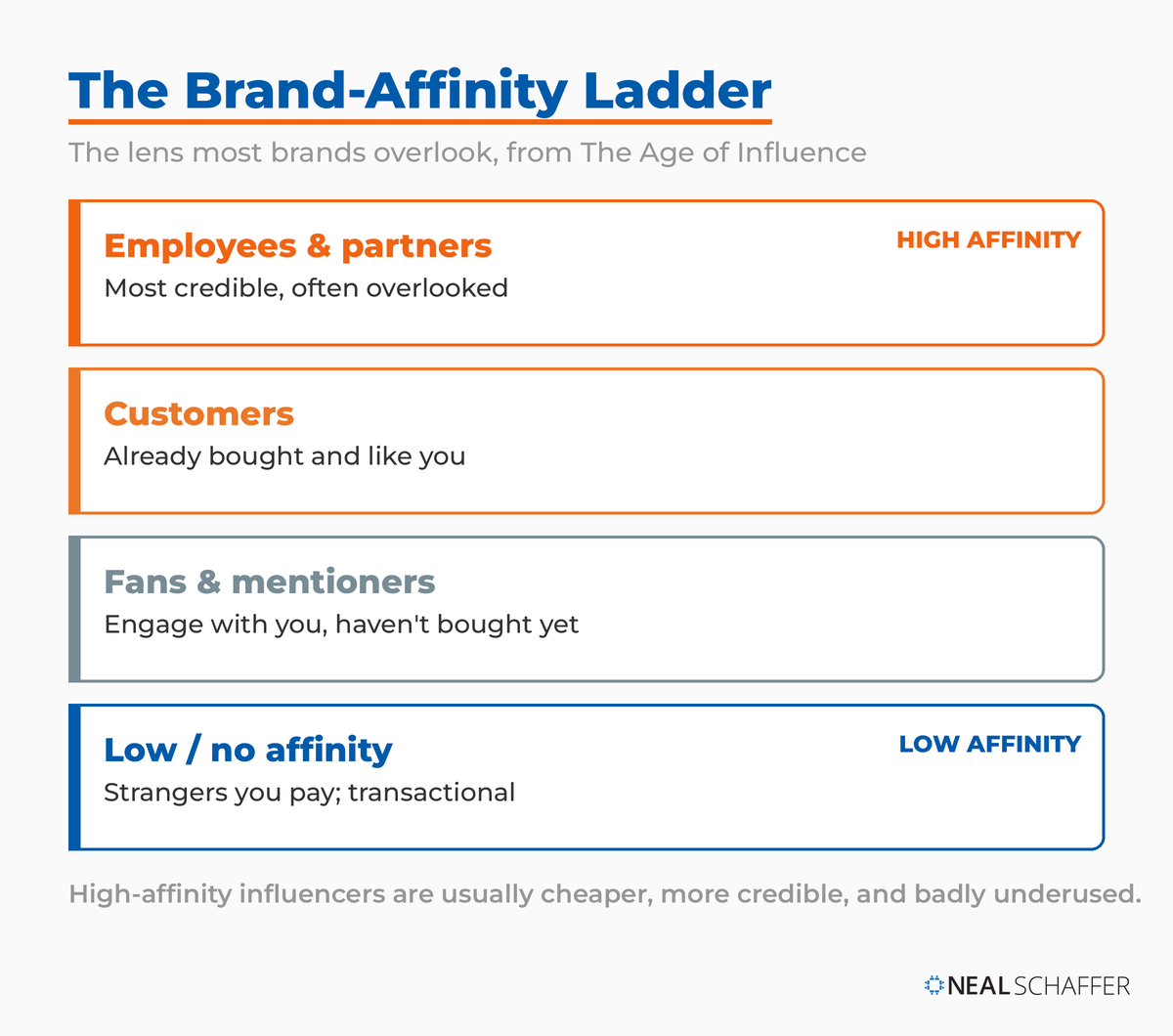
The pattern is that high-affinity influencers are usually cheaper, more credible, and badly underused. A nano-sized customer who already loves you can outperform a macro influencer who has never heard of you. I cover the foundation of this in my guide to what an influencer is.
Classifying Influencers by Content Type
The third lens sorts influencers by the kind of content they create, because at the heart of being an influencer is being a content creator. If you want to influence a specific channel, choose a creator who is native to it:
- Bloggers focus on the written word and long-form depth, which feeds search and suits topics that need explanation.
- YouTubers and vloggers own long-form video and the trust that comes from watching someone over time.
- Short-video and TikTok creators win on discovery and reach through recommendation engines rather than existing following.
- UGC creators make authentic content brands can use directly, often without large audiences of their own.
- Virtual and AI influencers are computer-generated personas that brands now partner with too.
Choosing by content type makes sure the partnership fits where your audience actually pays attention, which matters as much as how big the creator’s following is.
Putting Tiers to Work for Your Brand
Tiers are a planning tool, not a ranking of quality. The job is to match the level, and the type, to your specific objective, audience, and budget. Influence has become a core channel rather than an experiment: in my roundup of influencer marketing statistics, the data shows 93% of marketers have used influencer marketing, and the consistent finding is that smaller, higher-affinity creators punch above their follower count.
So when you plan your next program, resist the pull of the biggest number. Start with your goal, pick the tier that serves it, then look for the highest-affinity creators you can find at that level, including the employees and customers already in your corner. When you are ready to source partners, my guide to finding the right influencers covers the how, and remember that any paid partnership must follow the FTC’s influencer guidelines.
Frequently Asked Questions
The five standard tiers by follower count are nano (1,000 to 10,000), micro (10,000 to 100,000), mid-tier (100,000 to 500,000), macro (500,000 to 1 million), and mega or celebrity (1 million and up). The ranges are industry conventions rather than an official standard, so you will see slight variations between sources.
Nano starts at about 1,000 followers, micro at 10,000, mid-tier at 100,000, macro at 500,000, and mega at 1 million or more. What matters more than hitting a threshold is engagement and audience relevance, since a smaller, highly engaged following often delivers better results than a larger passive one.
For most brands, nano and micro influencers deliver the best return on conversion-focused campaigns because of their higher engagement and lower cost. Macro and mega tiers are better when the goal is broad awareness. The best tier depends entirely on your objective, not on a universal ranking.
For trust and conversion, often yes. Engagement rates are highest at the nano level and decline as audiences grow, so nano creators tend to drive stronger action per follower. Macro influencers still win when you need fast, broad reach. They serve different goals rather than one being better overall.
Tiers classify influencers by follower count. Types is broader and includes two other lenses I use in The Age of Influence: brand affinity (how connected someone already is to your brand, from employees to paid strangers) and content type (bloggers, YouTubers, short-video creators, and more). Tiers are one type of classification among three.
Choosing the Right Tier for Your Next Campaign
Influencer tiers give you a map: five levels of audience size, each with its own strengths, costs, and ideal use. The takeaway is to choose deliberately. Match the tier to your funnel stage, weigh engagement against reach rather than chasing follower counts, and remember that the smaller tiers usually win on trust and efficiency.
Then go one step further than the tier chart. Layer in brand affinity and content type, and you will often find your best partners are the high-affinity employees, customers, and niche creators already within reach. For the full framework, you can download a free preview of The Age of Influence, my book on building an influencer marketing strategy. And if you would like help turning this into a coordinated program for your company, that is exactly what I do as a Fractional CMO.
Actionable advice for your digital / content / influencer / social media marketing.
Join 13,000+ smart professionals who subscribe to my regular updates.
