


Over the last twelve months, my blog earned roughly one click for every 700 impressions in Google Search.
The reflex is to call that a ranking problem. It isn’t. Of my pages ranking on page one with at least a thousand impressions behind them, 41 out of 45 run under a 1% click-through rate. People were seeing my content. They just were not coming to get it.
Answer engine optimization is the industry’s answer to that gap. There is now a large business built on selling it to you as a brand new discipline with its own acronym.
I have spent the past year rebuilding my own site category by category against exactly this problem. I have been publishing here since 2008, so there are around 700 posts to test the theory on. In Digital Threads I make the case that search is one of three threads every business has to pull. And the thing I diagnose most often as a Fractional CMO is a company that skipped the foundations for the shiny thing.
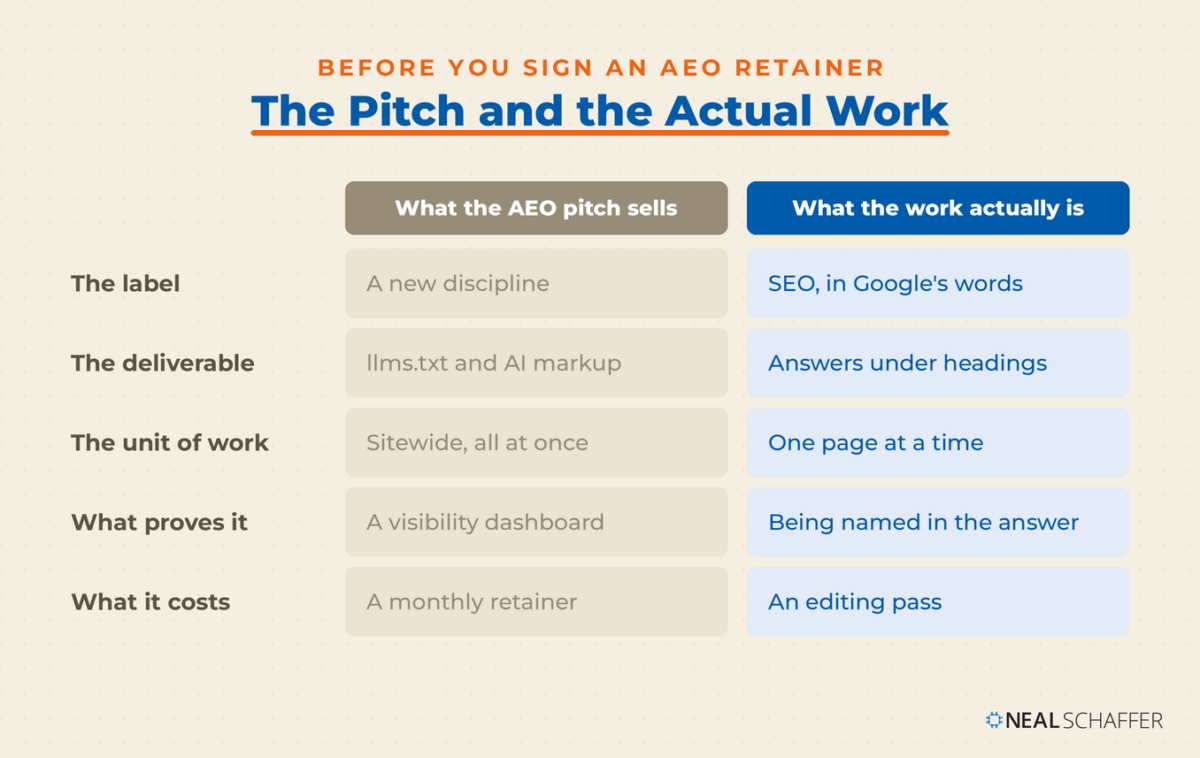
So let me save you some money. I went and read what Google itself now publishes on this. A good portion of what the AEO industry sells sits on its own list of things you can ignore.
Key Takeaways
✅ Answer engine optimization (AEO) means structuring your content so AI systems can extract, trust, and cite it. Google’s position is that this work is still SEO, not a separate discipline.
✅ Google says you do not need llms.txt files, special markup, or content broken into tiny chunks to appear in its AI features. Its guidance on generative AI search lists those as things to ignore.
✅ Peer-reviewed research points at three moves that measurably increase AI citations: adding statistics, adding quotations from credible sources, and citing your sources.
✅ Lower-ranked pages have the most to gain. Being cited by an assistant does not require ranking in the top three, which makes AEO a rational play for a site in recovery.
✅ Impressions without clicks are not automatically a failure, and not automatically a win either. Separate the two before you decide anything.
✅ AI-referred visitors convert better than traditional organic visitors, which is why a thin stream of AI traffic can still be worth real money.
What Is Answer Engine Optimization?
Answer engine optimization is the practice of structuring content so AI-powered answer engines can extract it, trust it, and cite it inside a generated response. Google’s official guidance on generative AI search treats this as part of SEO rather than a separate discipline, and says no special markup or files are required.
The answer engines in question are the surfaces that reply instead of listing. Google’s AI Overviews and AI Mode. ChatGPT. Perplexity. Claude. Copilot. Gemini. Voice assistants.
Anywhere a person asks a question in a full sentence and gets a synthesized answer back with a few source links attached, that is an answer engine.
So the goal shifts. You are no longer trying to rank first. You are trying to be the source the answer got built from.
Put in one line, AEO is what you do so that an AI search engine reaches for your page when it composes a reply.
None of this is as new as the acronym makes it sound. I have been saying for a while that featured snippets were already answer engine territory, and so was asking Siri or Alexa a question out loud. What changed is the volume and the stakes.
It matters most to businesses whose customers research before they buy. If your buyers ask questions in full sentences before spending money, an assistant is now standing between you and them.
Which brings up the acronym problem, because you have probably met three of them by now.
AEO vs GEO vs SEO: Are They Actually Different?
AEO and GEO describe two halves of one job. AEO is about extraction, getting a specific answer pulled cleanly off your page. GEO is about synthesis, getting your page used as one of several sources an assistant blends into a new response. Google’s position is that both are still SEO.
I broke this down on my podcast in December 2025, months before Google published anything official on the terminology. My take then was that these are two sides of the same coin rather than two separate playbooks.
| AEO | GEO | Traditional SEO | |
|---|---|---|---|
| Optimizes for | Being extracted as the answer | Being cited inside a synthesized response | Being ranked in a list of links |
| Typical surface | Featured snippets, AI Overviews, voice results | ChatGPT, Perplexity, Gemini, AI Mode | Google and Bing results pages |
| Unit that matters | One clean answer | The page’s credibility and depth | The page and the domain |
| Success looks like | Your wording appears in the answer box | Your brand named and linked in the reply | Position 1 to 3 and a click |
| Google’s own label | SEO | SEO | SEO |
Look at the bottom row. From Google Search’s point of view, optimizing for generative AI search is optimizing for the search experience, and therefore still SEO.
If you are weighing a proposal from an agency that has repackaged its retainer as an AEO service, that row is the first question to ask about it. Ask what they are doing that a good SEO strategy would not already cover.
The label really does not matter. What matters is whether the work sitting underneath it changes anything on your pages.
Why Does AEO Matter If Nobody Clicks?
Because the click was never the only thing you were buying. Pew Research Center found that Google users clicked a result in 8% of visits when an AI summary appeared, against 15% when it did not. Fewer clicks, many more impressions, and a brand-visibility layer that did not exist five years ago.
Make LinkedIn Your Best Source of Clients
My latest book helps professionals, entrepreneurs, and business owners turn LinkedIn from a static profile into a real source of clients and growth.
Maximizing LinkedIn for Business Growth gives you clear, practical steps to build a profile that gets noticed and a network that actually sends business your way.
Grab your copy on Amazon and put it to work this week. Click the cover or the button below to get started.

Those numbers match what I see in my own reporting. And this is where I want to be careful, because “impressions are the new metric” can quietly become an excuse for not making money.
Separating a billboard from a vanity number
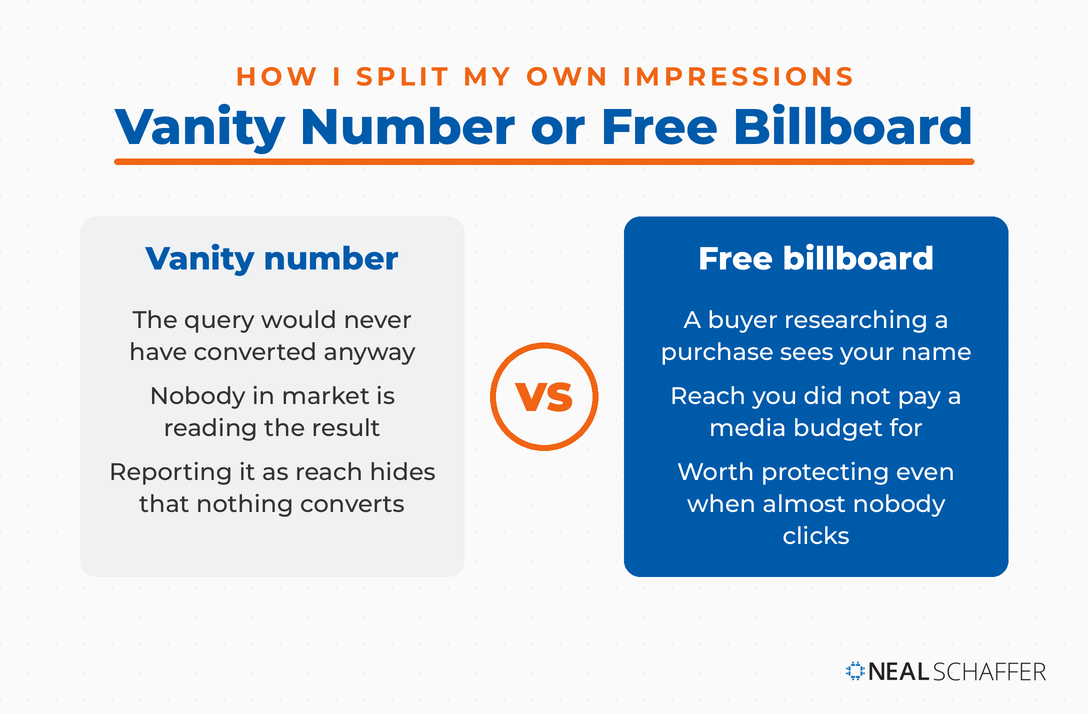
I split them two ways. An impression on a query I would never have converted anyway is a vanity number. An impression that puts my brand in front of a buyer actively researching a purchase is a billboard I did not pay for. Those are not the same thing, and your Search Console export will not separate them for you. It will not clean itself either, which is why the page-one count above excludes table-of-contents anchor links and image files.
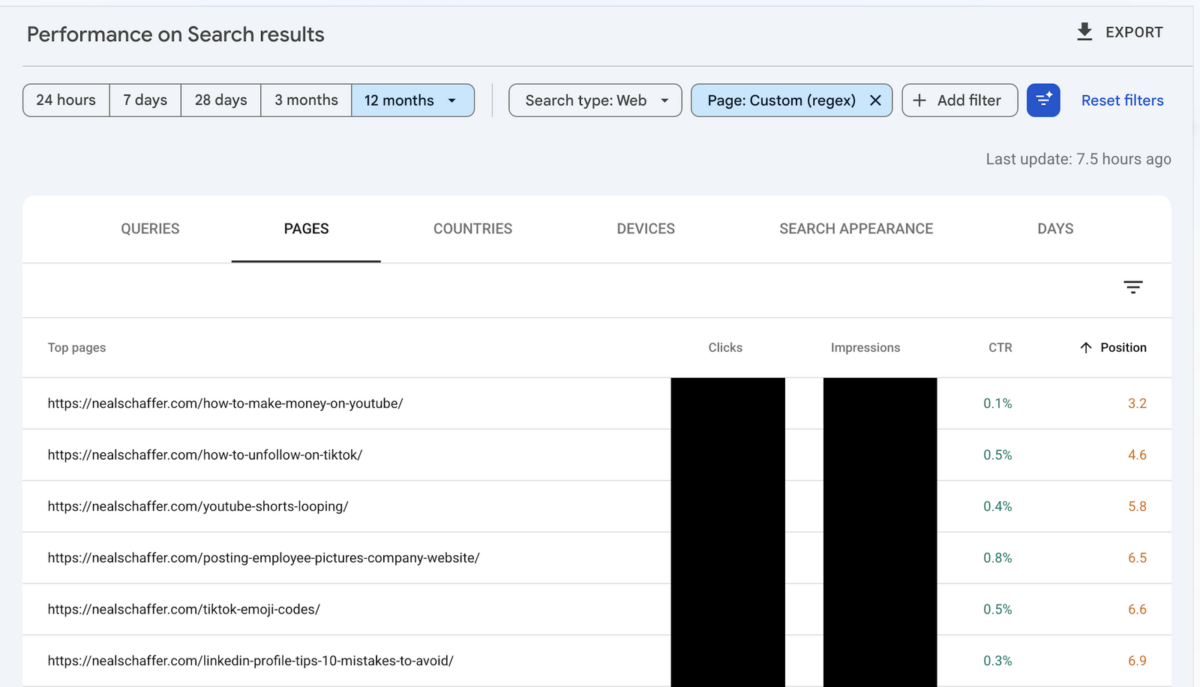
My post comparing Twitter and Threads held an average position of 8.2 across twelve months and earned one click for every 19,000 impressions. That page is not a brand-building triumph. It is a page answering a question so completely in the snippet that nobody needs the article, and it sits near the top of my rebuild list because of it.
The trade the whole web is making
Cloudflare’s analysis of AI crawling and referral traffic puts it plainly. Legacy search crawlers would scan your content a couple of times or less for every visitor they sent back, and that exchange no longer holds.
You will see eye-watering crawl-to-refer ratios quoted everywhere. I am deliberately not repeating one. Cloudflare itself notes that referral counts miss traffic from native apps that send no referrer, so its published ratios may overstate the imbalance by an unknown amount. The figures also swing hard depending on which week you measure. I have no argument with the direction. I would just not put a specific number on it in print.
There is a counterweight worth knowing about. Semrush’s study of AI search and SEO traffic found the average AI search visitor was 4.4 times as valuable as the average traditional organic visitor, measured by conversion rate. People who arrive from an assistant have already done their research inside it.
So a thin stream of AI referrals can outperform a fat stream of organic ones. That is the case for doing the work. The more useful question is which work.
What Does Google Actually Say About AEO and GEO?
Google addresses both acronyms by name and gives the same answer for each: optimizing for generative AI search is optimizing for the search experience, and that is still SEO. The same guidance carries a mythbusting section naming several popular AEO tactics as things you can ignore.
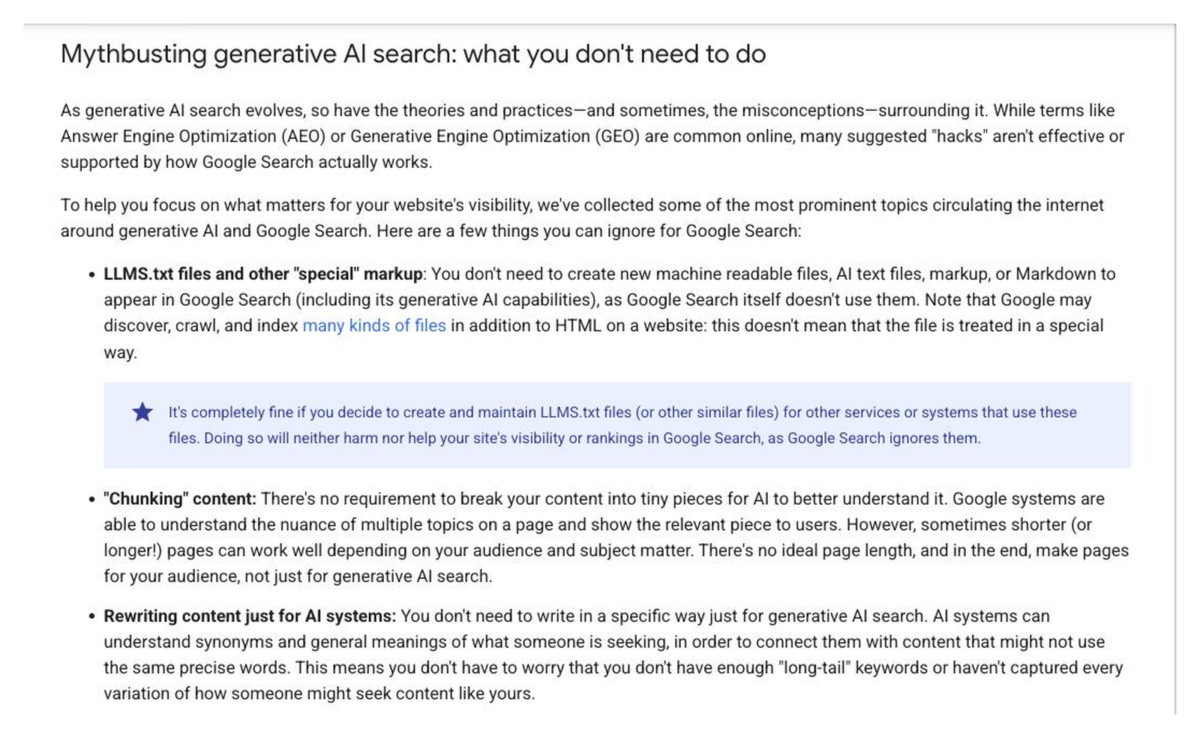
This is where the distance between the vendor pitch and the documentation is widest, so let me be specific.
The tactics Google says you can skip
- llms.txt and other special files. The same guidance says you do not need machine-readable files, AI text files, markup, or Markdown to appear in Google Search. Search does not use them. Keeping one neither helps nor hurts your Google visibility.
- Chunking your content into tiny pieces. There is no requirement to break content up for AI to understand it, and no ideal page length.
- Rewriting your content specifically for AI. These systems understand synonyms and intent, so you do not have to capture every long-tail phrasing.
- Chasing unlinked brand mentions. Seeking inauthentic mentions across the web is listed as less helpful than it sounds.
- Over-investing in structured data. Structured data is not required for generative AI search and there is no special schema to add. Google still recommends it for rich results, which is a different job.
One caveat on llms.txt, because the ecosystem has moved ahead of Google here. Yoast now generates an llms.txt file automatically on every plan, free ones included, and other tools do the same. Both things can be true at once: Google ignores the file, and other systems may read it. Just do not let a plugin toggle convince you that AEO is handled.
What Google says to do instead
The rest of the guidance is less exciting and much more familiar. Keep pages crawlable and indexable. Put important content in text. Keep structured data consistent with what is visible on the page. Give people a decent page experience. All of that is ordinary technical SEO.
Then comes the instruction that carries the most weight, and it is about content rather than code. Google draws a line between commodity and non-commodity content. Its commodity example is “7 Tips for First-Time Homebuyers.” Its alternative is “Why We Waived the Inspection & Saved Money: A Look Inside the Sewer Line.”
One is common knowledge that could have come from anyone. The other could only come from someone who lived it. That is a far harder bar than adding a schema block, and it is the same standard I have been applying to my own content audit work all year.
So if the technical hacks are mostly filler, what does the evidence say moves a page into an answer?
Which AEO Tactics Have Evidence Behind Them?
The strongest evidence comes from the original GEO research presented at KDD 2024, which showed that optimizing content for generative engines can raise visibility by up to 40%. The changes that produced that lift are content changes rather than technical ones. I ranked them below the way a practitioner would use them.
Inside, that paper tested nine content changes across a 10,000-query benchmark. Three worked consistently: adding statistics, adding quotations from credible sources, and citing sources. Keyword stuffing, the classic SEO reflex, produced little to no improvement.
| Tactic tested | Effect on AI visibility | What it means for your page |
|---|---|---|
| Quotation addition | Strongest performer on both metrics | Quote a named expert, with attribution |
| Statistics addition | Close second | Replace qualitative claims with sourced numbers |
| Cite sources | Top three, and strongest in combination | Link the claim to whoever published it |
| Fluency optimization | Meaningful gain | Clean, readable prose beats dense prose |
| Easy-to-understand | Meaningful gain | Plain language over technical density |
| Authoritative tone | Small gain | Sounding confident is not enough on its own |
| Keyword stuffing | Little to none, sometimes negative | Stop |
Two findings there deserve more attention than they get.
These tactics stack
The best pairing in the study was fluency plus statistics. Citing sources performed better in combination with other methods than it did alone. You are not picking one item off that table; you are running several on the same page.
Low rankings are not a disqualification
One finding in that same paper should interest anyone whose traffic got hit. Lower-ranked pages gain the most. Adding citations lifted visibility by 115.1% for pages ranking fifth in search results, while the average visibility of the top-ranked page fell by 30.3%. Semrush’s study, cited earlier, found something consistent from the other direction: ChatGPT cites pages ranking in organic positions 21 and beyond almost 90% of the time.
If you are sitting on a library of pages that used to rank and no longer do, that is not a consolation prize. It just might be the best opportunity on your site.
I will add one wrinkle from my own rebuild, because it surprised me. When I suppressed a batch of underperforming pages, I scoped the noindex directive to Googlebot specifically instead of applying it site-wide. Those pages vanished from Google and kept right on earning Bing impressions and assistant referrals. If you are pruning, check which crawler you are actually talking to before you take a page off the board everywhere.
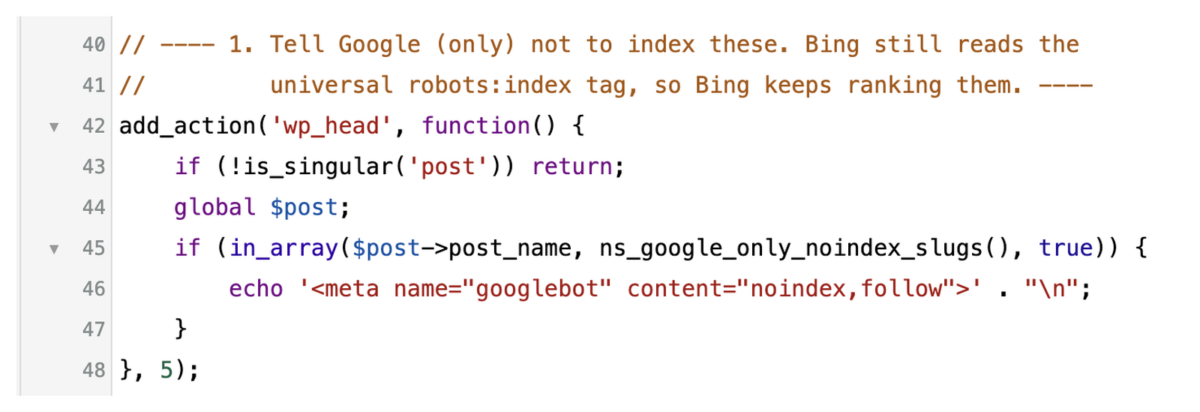
Knowing which tactics work is one thing. Getting them onto a page is another, so this is the sequence I run.
How Do You Optimize a Page for Answer Engines?
Work one page at a time, and start with pages that already earn impressions without clicks. Those pages have cleared the harder bar, because the engines have already judged them relevant. Fixing extractability on a page that is being seen is far quicker than earning relevance from scratch on a page nobody sees.
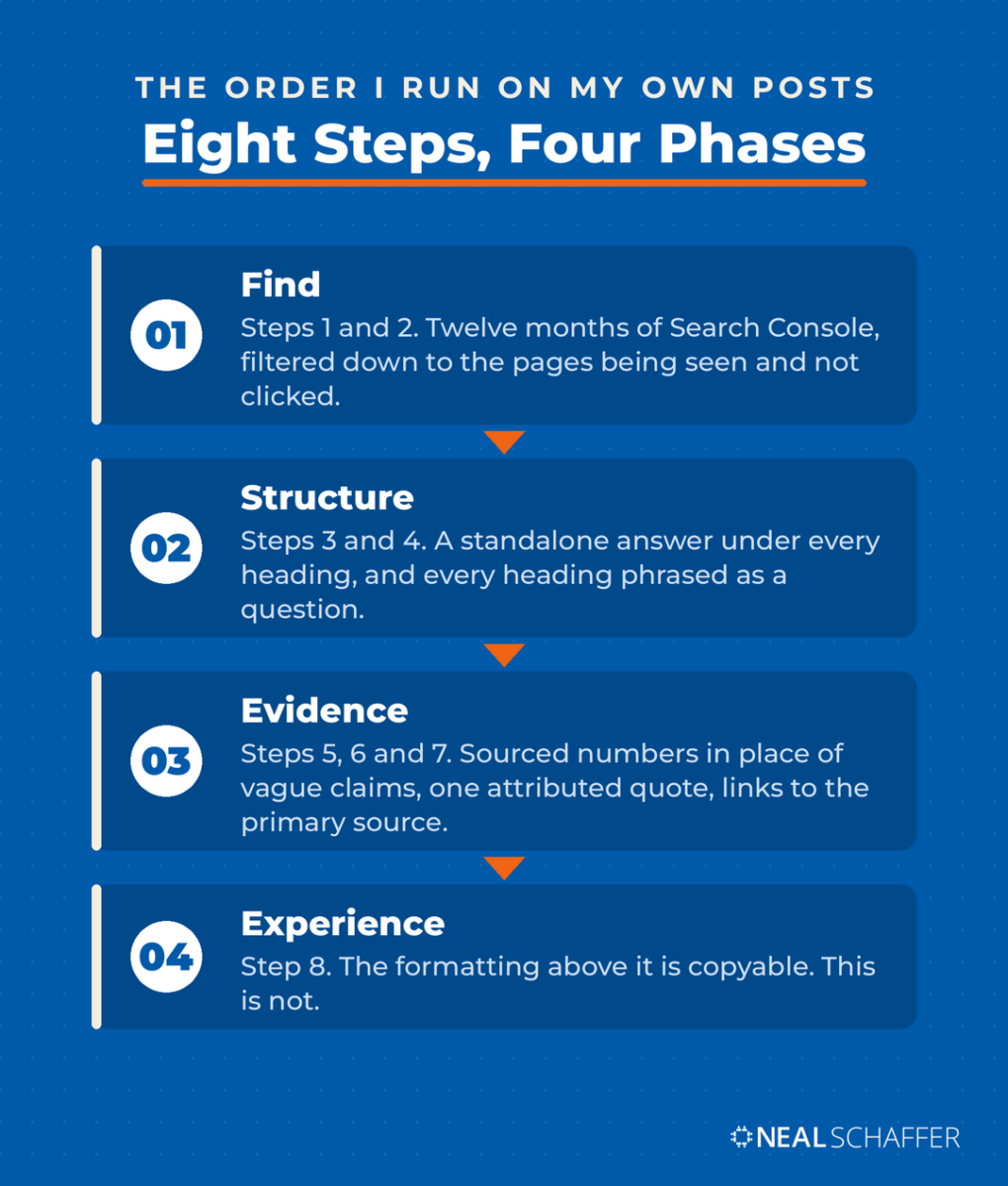
This is the order I use on my own posts.
- Pull your zero-click pages first. Open Performance in Search Console and set the date range to the last 12 months. Only Clicks and Impressions show by default, so click the Average CTR card above the chart to add that column. Then open the Pages tab and sort by Impressions descending. Any page with at least a thousand impressions and a CTR under 1% goes on the list.
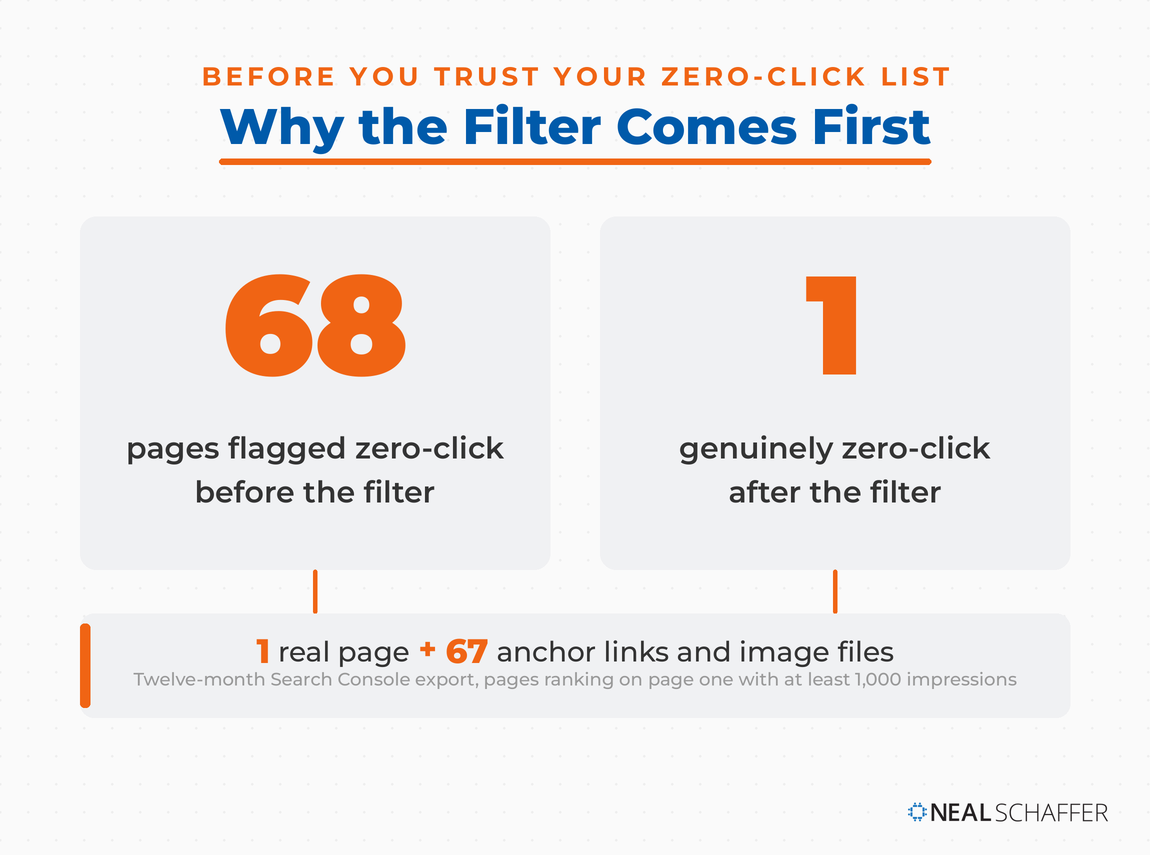
- Clean that list before you read it. Add filter, then Page, then Custom (regex), then Doesn’t match regex, and paste this: (#custom-toc-anchor|/wp-content/uploads/). Swap in whatever your own table-of-contents plugin puts in its anchor links. Both classes collect impressions and cannot really earn clicks, so leaving them in inflates your zero-click count. In my own export they turned one genuinely zero-click page into sixty-eight.
- Put the answer directly under the heading. The first paragraph after each H2 becomes a standalone answer of roughly 40 to 60 words. It has to make sense to somebody who lands on that section cold. Pew found the median AI summary in its study ran 67 words, so that is roughly the shape you are writing to.
- Turn statement headings into questions. “Pricing” becomes “How Much Does It Cost?” Pew’s data showed 60% of queries starting with question words produced an AI summary, against 8% of one- and two-word searches. Question headings match the queries that trigger these surfaces.
- Replace every vague claim with a sourced number. Search your draft for “many,” “most,” and “a lot of.” Each hit is either a statistic you have not looked up yet or a claim you cannot support. Fix it or cut it.
- Add one real quote with a name attached. A named expert, a customer, a podcast guest, or yourself from something you have already published. Quotation addition was the strongest single tactic in the research, and almost nobody does it.
- Link out to the primary source, not the roundup. If the number came from Google, link Google. If it came from a named study, link the study. This is the move that stacks best with the others.
- Add the thing only you could have written. One paragraph of firsthand detail per page: what you tested, what it cost, what broke. This is the difference between Google’s two homebuyer examples, and no competitor can copy it.
The step people skip
Step eight is the one people skip, and it decides whether the page deserves a citation at all. Everything above it is formatting. If you want the mechanics of steps three and four in more depth, that is the same structure I use for blog SEO generally.
On a recent episode of my podcast Your Digital Marketing Coach I put it this way: “A lot of what I’m describing isn’t necessarily creating new work. A lot of it is about doing what you’re already doing but doing it with AI visibility in mind.”
I would still frame it exactly that way. If you already write well, this is a checklist you run at the end, not a new content program. And it applies just as much to a piece of AI generated content as to something you typed yourself.
Once the page is live, the question becomes whether any of it worked.
How Do You Measure Answer Engine Optimization?
Google’s Generative AI performance report in Search Console is the closest thing to a first-party measure. It shows how your content performs in generative AI features on Google Search and Discover. Everything else is either a referral count in your analytics or a third-party estimate, because no outside tool has access to Google’s internal ranking or AI systems.
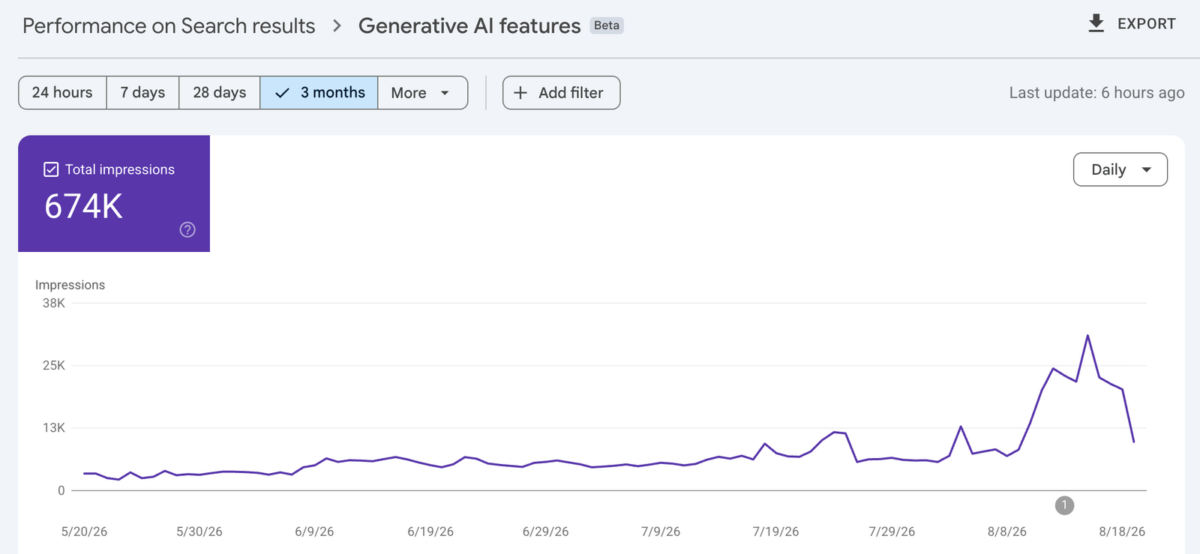
My own report ran flat for most of the last quarter and then climbed sharply through the first three weeks of August, roughly tripling off its baseline. I would not read that as proof my AEO work landed. The report is still labelled beta, and a new surface expanding its own coverage looks identical to a site gaining ground on it.
Three places to look, each answering a different question.
| Where to look | What it tells you | The catch |
|---|---|---|
| Search Console Generative AI report | Whether Google’s AI surfaces show your content | Google only, and the reporting is newer than the surfaces |
| GA4 referrals from chatgpt.com, perplexity.ai and similar | Whether assistants send you real people | Native apps often send no referrer, so this undercounts |
| Prompting the assistants yourself | Whether you are named, and how you are described | Slow, and results vary by user and session |
That third one sounds primitive, and it is the one I would not skip. Once a quarter, take your ten most commercially important questions, ask them in ChatGPT and Perplexity, and write down whether you appear and what gets said about you. If the description is wrong, the fix lives on pages you control.
Be skeptical of any tool promising ranking success or claiming to use internal Google metrics, since none of them have that access. Use them if they fit your workflow, then check what they tell you against the official documentation.
One warning from my own numbers. Impressions climbing while clicks fall can mean AEO is working, or it can mean you have started ranking for a wider set of queries you will never convert. Segment by query intent before you celebrate. I did not, at first, and I spent a month feeling good about a chart that meant nothing.
Which raises the obvious next question, since half the industry is now selling software to solve this.
Not to start. The measurement stack that matters is free: Search Console for Google’s AI surfaces, GA4 for assistant referrals, and your own prompting for how you get described. Paid AEO visibility tools track brand mentions across assistants at scale, which becomes genuinely useful once you have enough content in market to need sampling.
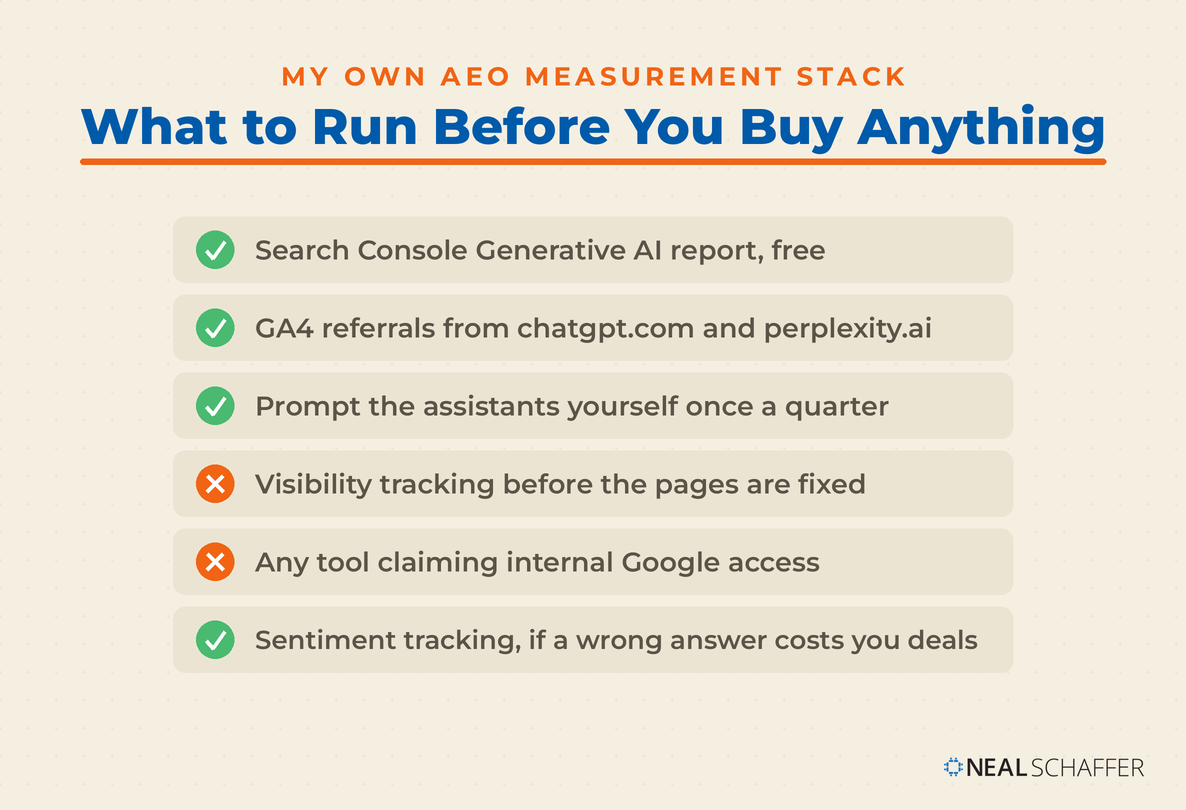
I pay for two things in this workflow, and neither is an AEO tool. Yoast Premium, which I use for schema and for the summary block at the top of my posts. Ubersuggest, for keyword and difficulty data.
The order matters, so let me say why. Visibility tracking tells you where you stand. It does not tell you what to publish. Buy tracking before you have fixed extractability on the pages already earning impressions, and you will pay monthly to watch a number nothing in your workflow is changing. Fix the pages, measure whether the fix worked, then buy the tool that measures it at scale.
One exception. If you sell into a category where being described inaccurately costs you deals, sentiment tracking earns its keep on day one. A wrong answer about your pricing or your positioning is a live problem rather than a reporting gap.
Frequently Asked Questions
From Google’s point of view, yes. Its documentation on AI features states there are no additional requirements to appear in AI Overviews or AI Mode, and no other special optimizations necessary. AEO is a useful label for a subset of SEO work, not a separate discipline with its own rulebook.
Lead each section with a direct answer of roughly 40 to 60 words. Phrase headings as questions. Support claims with sourced statistics, include at least one attributed quote, and link to primary sources. Then add firsthand detail nobody else could write.
Often better. The GEO research above found lower-ranked pages gained the most from citation and statistics additions, and Semrush’s data shows ChatGPT frequently citing pages well outside the top 20. Poor rankings are not a disqualification for AI citation.
The Google documentation linked above notes that recrawling can take anywhere from several days to several months, depending on how often its systems decide a page needs refreshing. Give any change a full quarter before judging it, and check at 30, 60 and 90 days rather than weekly.
Not for Google, which ignores them. Other systems may read them, and plugins will generate one for you at no cost, so there is little downside to having one. Just do not treat it as your AEO strategy, because it is closer to a business card than a plan.
Start With the Pages You Already Have
Pull your Search Console export this week and find the pages earning impressions with almost no clicks. That list is your work queue, and it is usually shorter than people expect. Take the top five and run the eight steps above on each one, in order, without skipping the last.
Clean the list first. Answer under the heading. Questions as headings. Sourced numbers. One real quote. Primary-source links. Then the paragraph only you could have written.
Give it a quarter before you judge it, and check the Generative AI report rather than your overall traffic line. That line moves for a dozen reasons that have nothing to do with this work.
If you want the wider picture on how AI is reshaping search behavior, the latest SEO statistics are where I keep the current numbers. There is more on the assistant side in my post on AI search engine optimization.
And if you would rather not do this alone, I work with a small number of companies as a Fractional CMO on exactly this kind of rebuild. I also run a group coaching community for entrepreneurs working through it themselves. You can download a free preview of Digital Threads to see how search fits alongside the other threads.
Actionable advice for your digital / content / influencer / social media marketing.
Join 13,000+ smart professionals who subscribe to my regular updates.
