

SEO is a way to drive more traffic to your website. By ranking high on Google, you attract more people to your site, which in turn leads to increased sales and a higher number of returning visitors. You must optimize your content for the right words to get people to your site. However, you should consider search intent to increase your chances of ranking, convincing people to buy your products, subscribe to your newsletter, or even return to your website. We’ll tell you what search intent is and how you can optimize your content for search intent.
Key takeaways
- Search intent refers to the purpose behind a query, influencing how you optimize content for improved SEO performance
- Understand the four main types of search intent: informational, navigational, commercial, and transactional
- Utilize semantics in SEO to help search engines understand users’ intents and enhance content accuracy
- Research your audience’s needs by analyzing search results and employing tools like Yoast SEO and Semrush
- Content should align with user intent, guide them in their journey, and be structured for both search engines and AI tools
What is search intent?
Search intent, also called user intent or audience intent, is the purpose behind someone’s search. It is the answer to the question: What does this person actually want to do? Every search tells a story. People might want to learn something, visit a website, compare options, or buy a product. These different motivations often correspond to distinct stages of the user journey.
Search engines try to understand this intent so they can show results that make sense. Over the years, Google has become much better at recognising the meaning behind a query rather than simply matching keywords.
Understanding semantics in search
Let’s take a small detour before we go deeper into search intent. To understand why search engines can recognize intent so effectively today, it is helpful to examine a concept called semantics. Semantics is simply the study of meaning. In search, it means understanding what a query actually means, not just which words appear in it.
How do search engines use semantics to understand intent?
Search engines cannot guess a user’s intent unless they first understand the meaning behind the query. Semantics bridges that gap and helps Google interpret language the way people naturally use it.
Semantics allows search engines to recognise things like:
- Different words with the same meaning, such as ‘budget smartphone’ and ‘affordable phone’
- The correct meaning of terms with multiple interpretations, such as ‘Java’ (coffee, island, or programming language)
- The relationship between entities, such as brands, people, and concepts
- Variations in phrasing, like ‘how to fix a leaking tap’ and ‘leaking faucet repair’
In other words, semantic understanding helps Google move beyond exact keyword matching. Once Google understands the meaning behind a query, it can make a more accurate prediction about the user’s intent, whether they are seeking information, a comparison, or a product page.
This is also where modern AI models come in. The AI models analyse context across entire sentences, not just isolated words. Semantics help them understand how different words connect, what users are likely looking for, and how intent may shift within a search journey.
In short, semantics explains the language, and intent explains the goal.
A quick note on helping AI understand your content
Since AI assistants do not crawl or interpret websites the same way search engines do, they sometimes miss important context. If your site runs on WordPress, Yoast SEO can help by generating an llms.txt file that guides AI tools to your key content. This enhances how AI understands your site, reduces incorrect references, and fosters a consistent AI brand perception without requiring any additional work on your part.
The four main types of search intents
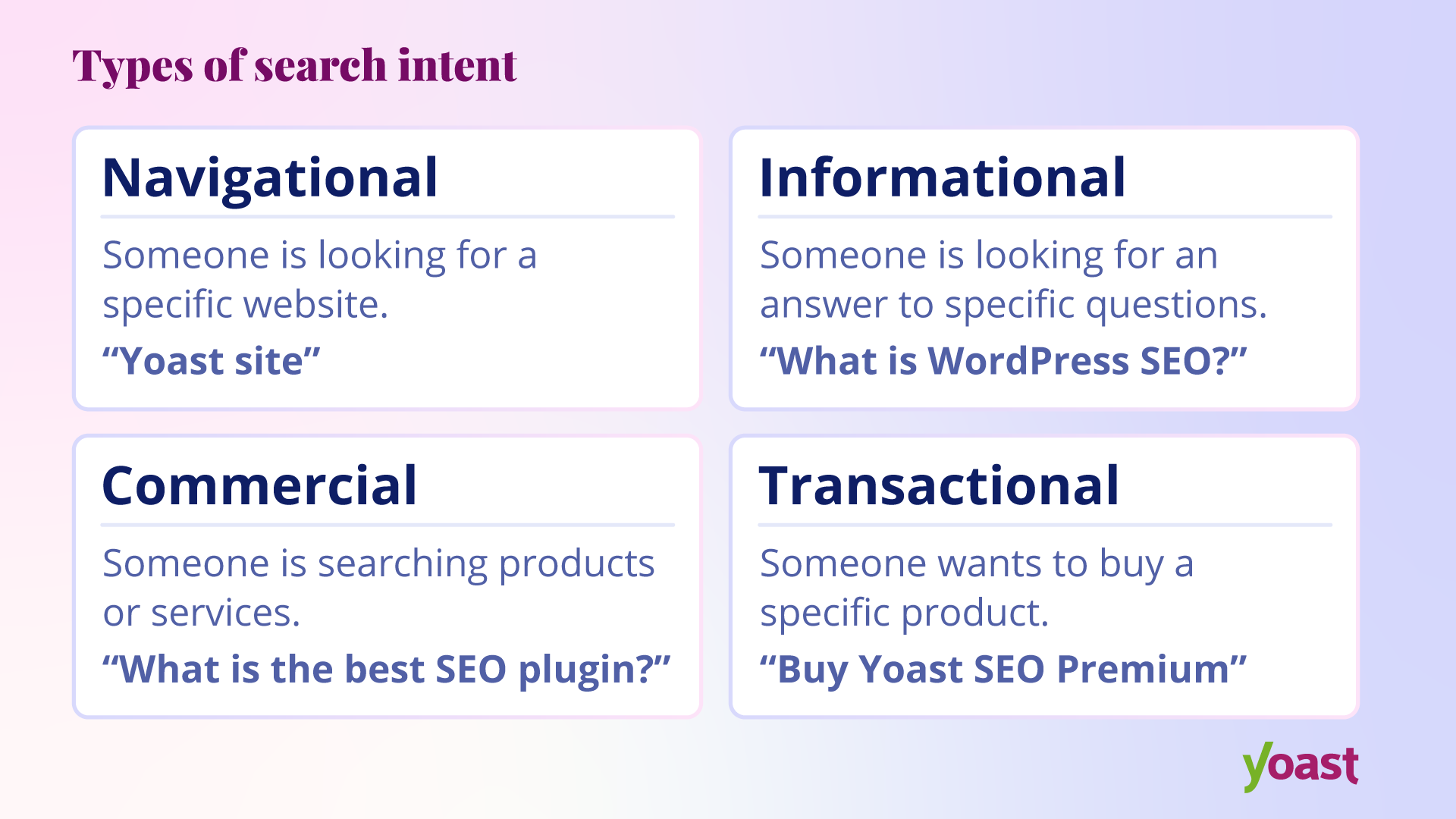
Understanding search intent becomes much easier when you look at how people search online and what Google expects to deliver. In SEO, we typically discuss four primary types of search intent – informational, navigational, commercial, and transactional. Google, however, classifies intent a little differently in its Search Quality Evaluator Guidelines – know, do, website, and visit-in-person. Both models describe the same user behaviour, just from different angles.
Here are the four common types of search intent you will see in SEO.
Informational intent
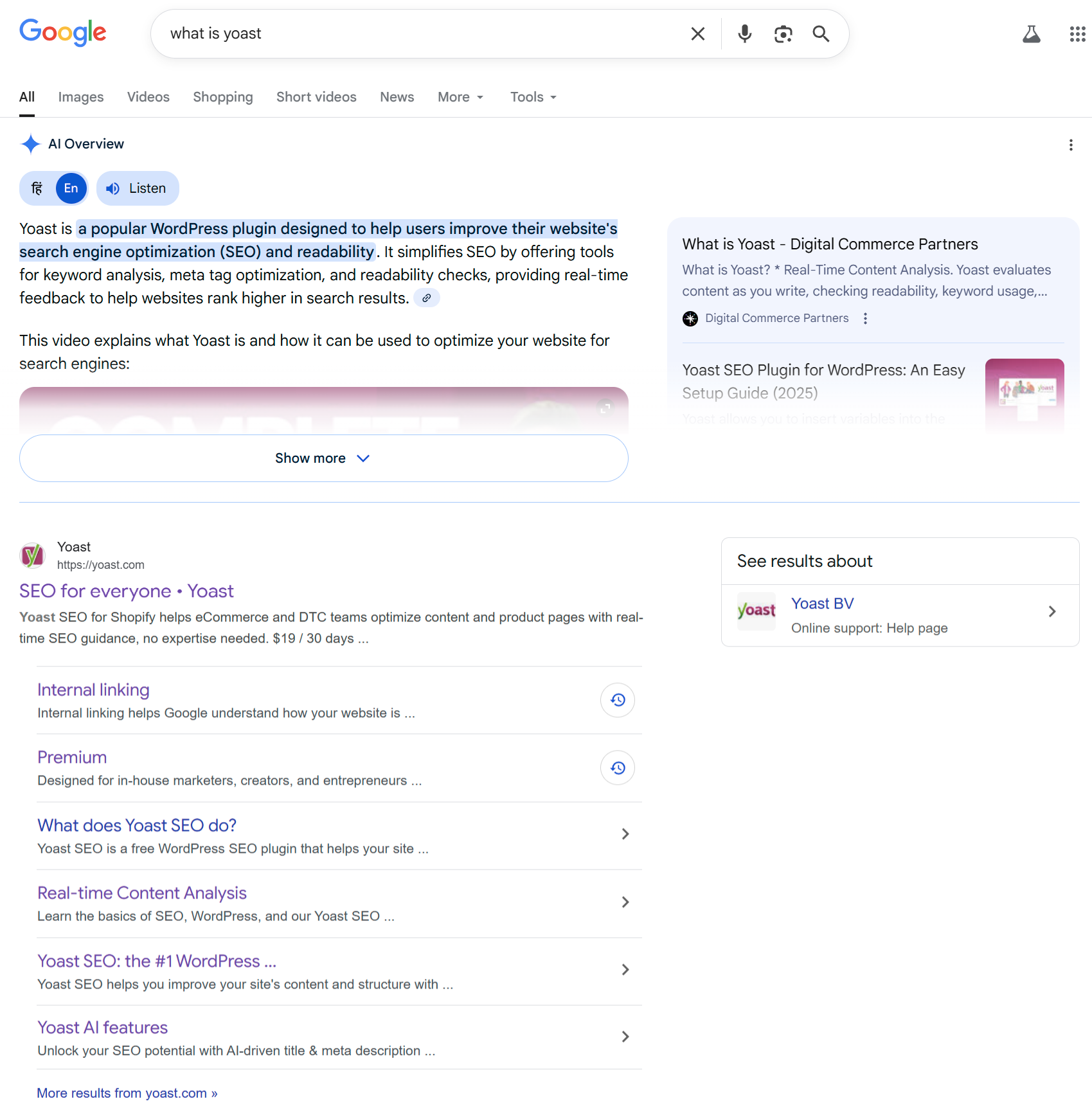
People search with informational intent when they want to learn something. These queries often start with phrases like ‘how to’, ‘what is’, ‘why’, or ‘best way to’. They might be asking a direct question, trying to understand a concept, or simply browsing to learn more about a topic.
Examples include:
- How to fix a leaky tap
- What is SEO
- London weather
- Stephen king biography
Google is very good at understanding what people actually want to see for these searches. If someone types ‘tomato sauce’, Google knows they probably want recipes, not a history lesson. If someone searches for ‘Mercury’, Google usually prioritizes results about the planet, not the chemical element.
How to optimize for informational intent
Create clear and complete content that answers the question directly. Use simple headings, short paragraphs, and helpful visuals. This type of content fosters trust, demonstrates authority, and helps people understand the topic before progressing to the next stage in their journey.
Navigational intent
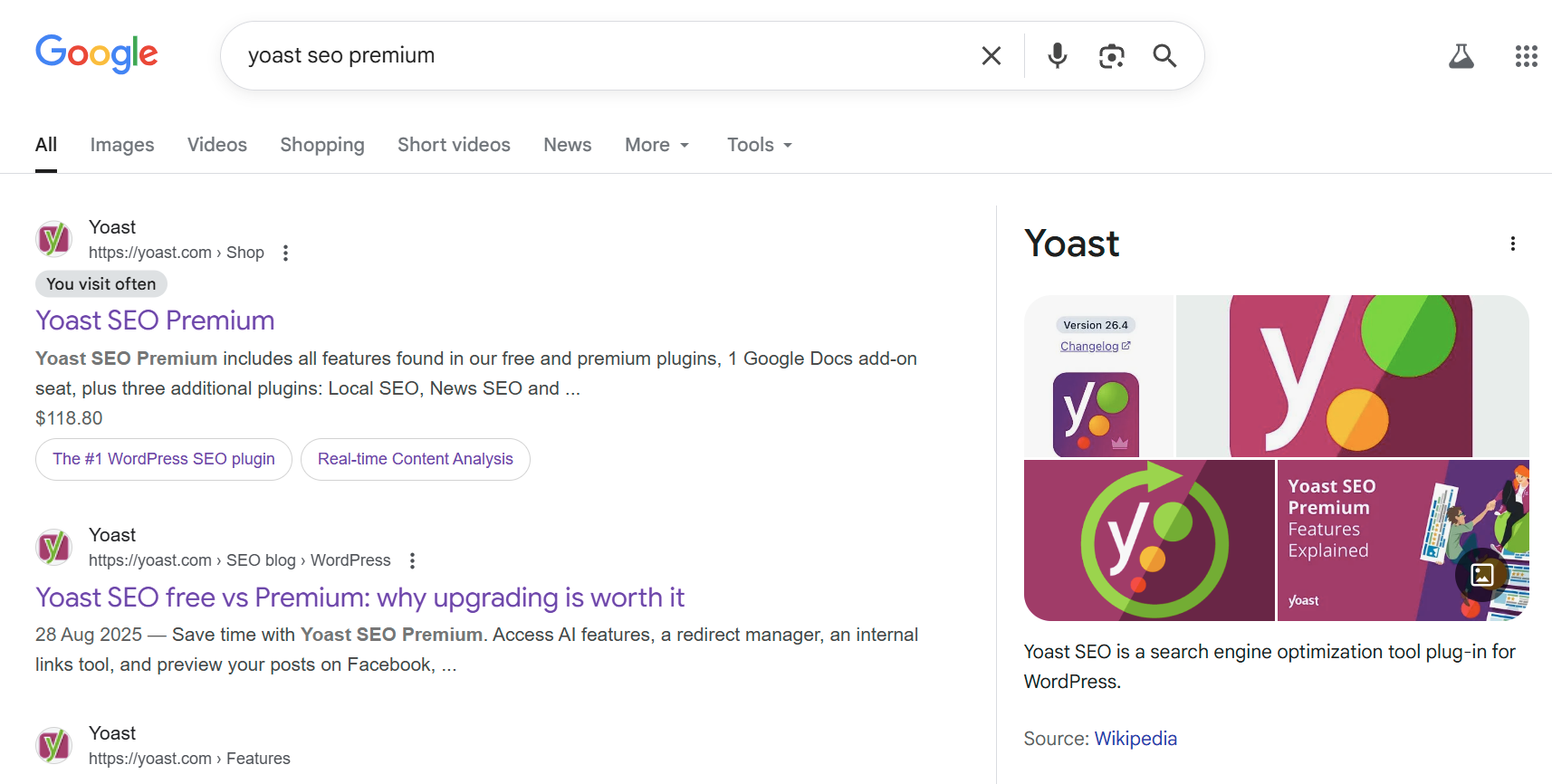
Navigational intent occurs when someone intends to visit a specific website or page. Users already know where they want to end up, and they use Google as a shortcut instead of typing the full URL.
Examples include:
These queries often include brand names or product names. If your audience is searching for your company, you want to make sure your site appears promptly and accurately.
An example from the past: our old Google Analytics plugin once ranked well for the term ‘Google Analytics’. That may sound great, but it did not help us. People searching for ‘Google Analytics’ were trying to reach Google’s website, not our plugin. Ranking for navigational queries only works when users are actually looking for you.
How to optimize for navigational intent
Ensure your branded pages are easily accessible, and that your homepage, login pages, and key product pages are well-optimized for branded keywords.
Be sure to check out our recorded webinar on ‘How to Make Killer Product Pages,‘ where we reveal our secret sauce ingredients for creating stellar product pages.
Commercial intent
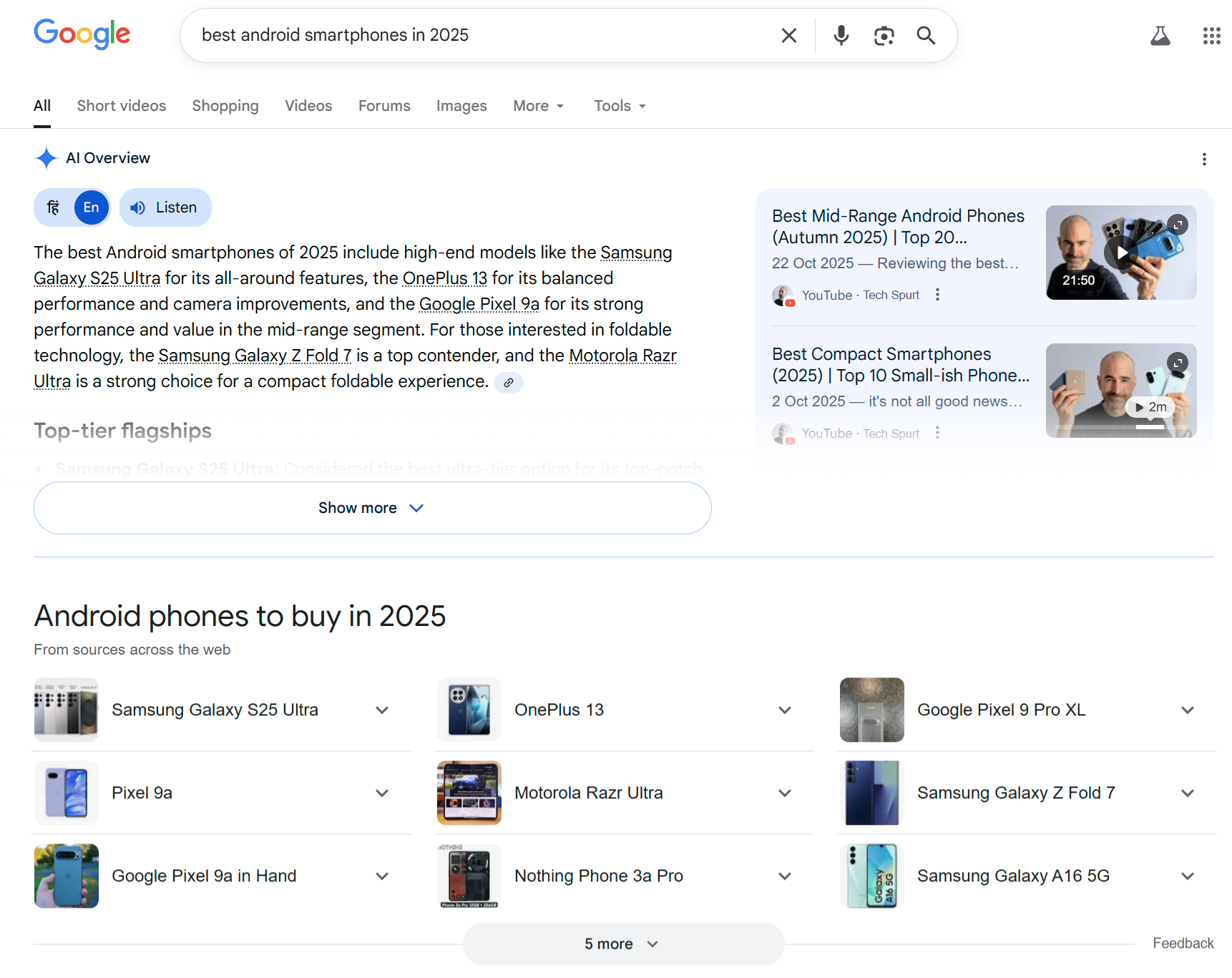
Commercial investigation sits right between learning and buying. Users are researching options and comparing products or services. They are interested, but not yet ready to commit.
These searches usually include words like ‘best’, ‘top’, ‘review’, ‘compare’, or ‘alternatives’.
Examples include:
- ‘Best coffee maker’
- ‘Canon 6D review’
- ‘Samsung Galaxy price’
- ‘Alternatives to Adobe Photoshop’
- ‘Best WordPress SEO plugin’
These queries show strong interest but not yet final intent. People want reassurance, honest comparisons, expert opinions, and content that highlights the pros and cons of each option.
How to optimize for commercial investigation
Write helpful comparison guides, reviews, ‘best of’ lists, and product roundups. Focus on answering the questions people ask when they are still weighing their options. If you sell something, this is your chance to build trust before they make their final decision.
Transactional intent
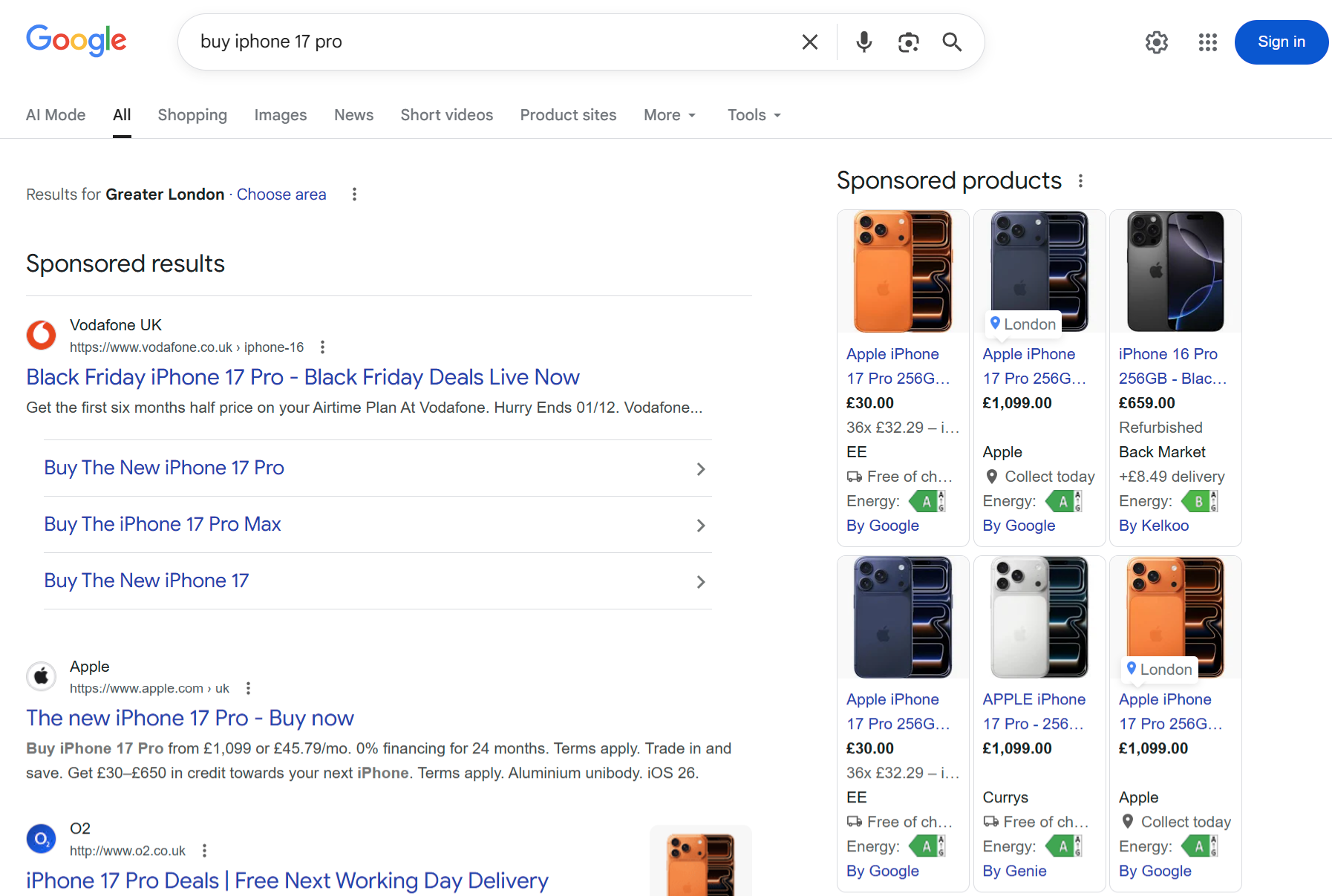
Transactional intent appears when someone is ready to take action. Most of the time, this means buying a product, signing up for a service, or completing a download. These searches are the closest to conversion and often contain words like ‘buy’, ‘order’, ‘subscribe’, ‘download’, or the exact product name.
Examples include:
- ‘Buy Apple iPhone’
- ‘Netflix discount’
- ‘Mangools subscription’
- ‘Cheap laptops for sale’
These users already know what they want. They expect to land on the exact product page and complete the action without unnecessary steps.
How to optimize for transactional intent
Use clear calls to action, detailed product descriptions, simple checkout flows, and intent-focused keywords. Make the path from search to conversion quick and smooth.
Mixed intent
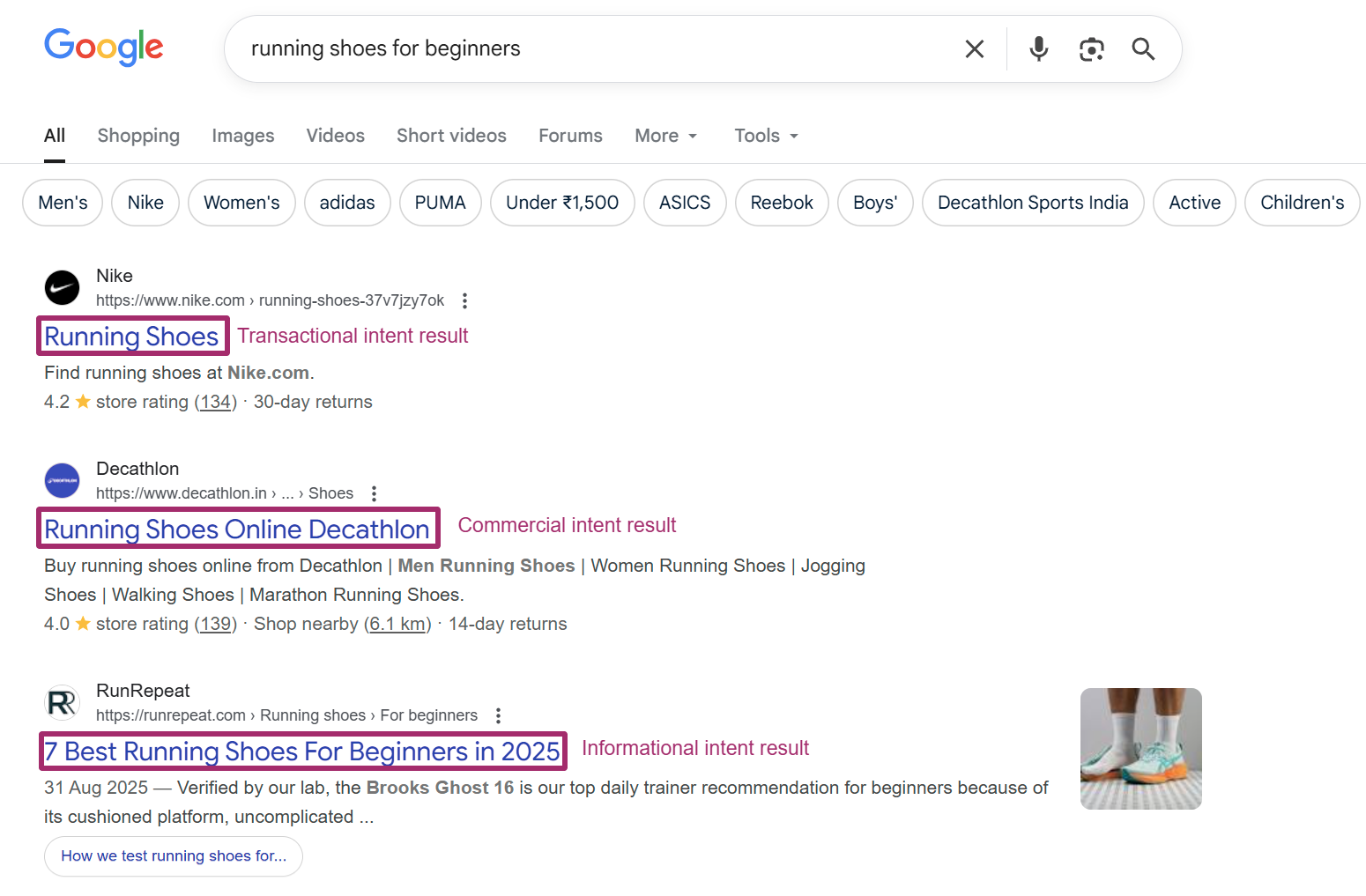
Not every search fits neatly into one intent category. Some keywords exhibit a blend of two or more intents, and these are referred to as mixed intent queries. They are common because real users do not always follow a perfect sequence. Someone might want information and still be open to buying, or they may want comparisons but also expect to see product pages.
Mixed intent often appears when a keyword is broad, unclear, or commonly used by people at different stages of their journey.
Examples include:
- best laptops for students under 1000
- running shoes for beginners
- coffee maker reviews
- best phones 2025
These searches can reflect both informational and commercial investigation intent. A user may want to read reviews, learn about features, compare options, and ultimately make a purchase. As a result, Google often mixes different types of results on the same page, such as buying guides, review articles, videos, and direct product links.
How to optimize for mixed intent
When you encounter mixed intent in your keyword research or in the SERPs, it’s helpful to create content that can serve multiple needs. You can:
- Answer the key informational questions
- Include comparisons and pros and cons
- Guide users toward relevant products or services
- Use clear, helpful headings so users can scan easily
- Add strong internal links to direct people to deeper resources or product pages
Mixed intent is a sign that users are exploring, learning, and evaluating their options. By covering these angles in one helpful piece of content, you meet their expectations and give them the freedom to choose their next step. This often results in better engagement and improves your chances of ranking across different variations of the keyword.
Understanding how Google defines intent
Google’s Search Quality Evaluator Guidelines group the intents into four categories that overlap with SEO’s four types:
- Know: learn something
- Do: perform an action or purchase
- Website: go to a specific site
- Visit in person: find a physical location or business
This is how it aligns neatly with the SEO model:
| Search Intent (SEO and Google Guidelines) | What the user wants | Best content format | Examples |
| Informational (know) | Learn about a topic or answer a question | Guides, tutorials, blog posts, FAQs | ‘How to bake muffins’, ‘What is blockchain’ |
| Navigational (Website) | Reach a specific site or page | Homepage, login page, branded content | ‘Facebook login’, ‘Yoast SEO’, ‘Amazon homepage’ |
| Commercial (know/do) | Research before making a purchase | Reviews, comparisons, buying guides | ‘Best cameras 2025’, ‘iPhone vs Samsung comparison’ |
| Transactional (do) | Complete an action like buying or signing up | Product pages, landing pages, checkout flows | ‘Buy running shoes’, ‘Netflix discount’ |
Understanding your audience to match the right intent
Now that you understand the different types of search intent, the next step is to determine what your own audience expects from you. Getting intent right is not about guessing; it’s about understanding. It is about paying attention to what people search for, how they behave on your site, and what the search results reveal about their needs.
A helpful place to start is by asking a simple question: What does someone hope to achieve when they type this keyword?
Sometimes the answer is obvious, but many queries fall somewhere in the middle. Two people may use the same word but expect completely different things. That is why audience research matters.
You can look at search terms in your analytics, review common questions customers ask, or run a small on-site survey. Even a brief poll asking, “What were you hoping to find here?” can provide valuable insight. Just keep it friendly and non-intrusive so you do not interrupt their experience.
A more reliable way to understand intent is to study the actual search results. Google’s results page is one of the clearest sources of information you have. If the page features guides and how-to articles, the intent is usually informational; if you see reviews and comparisons, that suggests commercial investigation; and if product pages dominate, that is a strong signal of transactional intent.
Regularly reviewing SERPs helps you understand what users expect and how Google interprets the keyword.
How Yoast SEO and Semrush help you identify and use search intent
If you want to take this a step further, the Semrush integration in Yoast SEO can make intent research much easier. When you enter a keyphrase, Yoast can pull related keywords from Semrush and label them with the intent that Semrush has identified. This provides a quick snapshot of how people search and what they are likely trying to accomplish.
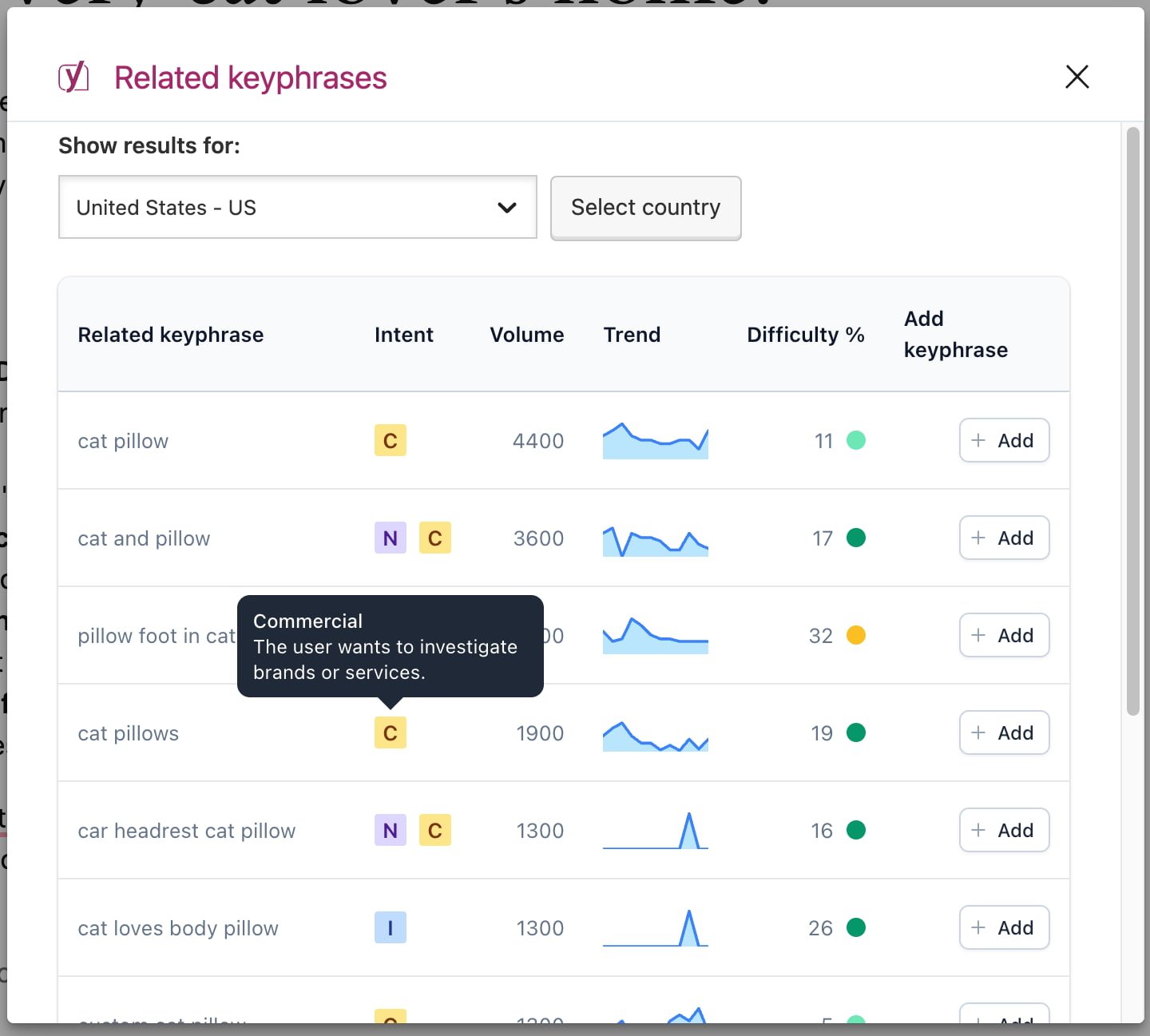
The color-coded labels help you understand at a glance whether a keyword is informational, navigational, commercial, or transactional.
For example:
- I (blue): Informational intent
- C (yellow): Commercial intent
- T (green): Transactional intent
- N (purple): Navigational intent
This saves you time because you don’t have to guess which content format best fits the keyword. If your target phrase shows a mix of commercial and informational variations, that may signal an opportunity for a buying guide or comparison article. If related keyphrases lean heavily toward transactional searches, you know your audience is closer to making a decision and needs a clear, helpful product page.
You can click through variations, explore new ideas, and check how competitors are handling the same topics. Pairing this with a quick scan of the SERPs helps you understand the expectations behind each keyword. Once you understand what users want, you can craft content that feels natural, helpful, and aligned with their needs and intentions.
On sale
A smarter analysis in Yoast SEO Premium
Yoast SEO Premium has a smart content analysis that helps you take your content to the next level!
How your audience’s behavior is shifting in the age of AI
As you learn more about your audience’s intent, it also helps to recognise how their search behavior is changing. People are no longer relying on short, keyword-based queries alone. With AI tools like ChatGPT, Gemini, Perplexity, and Google’s AI Overviews, users now phrase their needs as longer, more natural prompts that often combine multiple intents at once.
What used to be a series of separate searches can now become a single request, such as:
- ‘Compare three affordable smartphones and recommend the best one for students’ (commercial + transactional intent)
- ‘List the best SEO plugins for WordPress and their pros and cons’ (commercial + informational intent)
This shift is sometimes referred to as prompt intent. Instead of searching, users are delegating. They want completion, not just information. And because AI models often provide instant summaries or answers, this also contributes to the rise of zero-click searches, where users never leave the results page or the AI interface at all.
So what does this mean when understanding your audience?
Here are a few simple takeaways:
- People expect clearer, more direct answers across both search engines and AI tools
- Your content needs to be organised in a way that AI can easily read, extract, and reuse
- Queries may carry mixed or evolving intent, so pages that serve multiple needs often perform better
- Fresh, well-structured, trustworthy content is more likely to surface in AI answers and featured results
The core idea remains the same: when you understand what your audience is trying to accomplish, you can create content that genuinely helps them, whether they find you through a traditional search box or an AI prompt.
Wrapping up!
It’s crucial to ensure that your content fits the terms people are searching for and your audience’s search intent. Ensure your post or page provides valuable information when people are seeking it. Be the first result when someone searches for your company name. Provide content that helps people make informed decisions while they investigate their options. However, lead people to your sales pages if they wish to purchase one of your products.
Read more: Keyword research: the ultimate guide

