

Finding a YouTube Shorts idea is easy. Finding one your audience will actually watch to the end is the hard part.
I have published 211 Shorts on my own YouTube channel since December 2022, and I went back through every one of them for this update. The 15 formats below are the same ones I first recommended here in 2023. Where I have tried a format myself, you will see what happened, including the ones that did not work.
I teach social media marketing to executives at Rutgers Business School, and short-form video has been a recurring subject on my podcast since 2022. As a Fractional CMO, I look at these formats from a business angle first. So each idea says where it fits a brand and where it can backfire.
My channel is a part-time one, and the numbers reflect that. What they can show you is which formats held people’s attention, and I would argue that part carries over regardless of channel size.
Key Takeaways
✅ Shorts can run up to three minutes, but the idea does more work than the runtime. Keep each Short to one idea, a rule I set for myself when I started making short-form video in 2022.
✅ The typical Short on my channel holds 41% of its length. Eight of my ten most-viewed Shorts teach one specific thing, such as what an impression is or how to use links in a LinkedIn post.
✅ Reposting a TikTok with its watermark can cost you ad revenue. YouTube’s monetization policy lists short videos compiled from other social media websites as content it will not monetize.
✅ Keep your niche and vary the format. Group your Shorts by format in YouTube Analytics, compare how much of each one people watch, and make more of the format that wins.
✅ My single most-viewed Short is a 60-second product demo, and it brought in a quarter of every subscriber my Shorts have ever earned.
What are YouTube Shorts?
YouTube Shorts are vertical or square videos of up to three minutes that play in a swipeable feed inside the YouTube app. You can record one with the Shorts camera or upload a vertical file, and YouTube treats it as a Short. Shorts live on your channel alongside your long-form videos.

If you need the mechanics first, start with how to make YouTube Shorts, where I share how long a Short should run based on my own retention data. Everything below is about what to put in one.
You can shoot a Short on your phone and upload it straight to YouTube, and plenty of people also repost their TikTok videos as Shorts. Both produce vertical video. But a video downloaded from TikTok carries a TikTok watermark, and the monetization policy I linked earlier treats short videos compiled from other social platforms as ineligible for ad revenue. Export a clean file from your editor instead.
Knowing what a Short is only matters if it earns a place in your marketing, so the business case comes next.
Why should Businesses Create YouTube Shorts?
Businesses should create YouTube Shorts because the Shorts feed can put your videos in front of people who have never searched for your brand. YouTube CEO Neal Mohan wrote in January 2026 that Shorts now averages 200 billion daily views. I treat Shorts as a discovery channel first and a conversion channel second.
Your buyers are there, too. Pew Research Center found in 2025 that 84% of U.S. adults use YouTube, and YouTube was one of only two platforms Pew asked about that a majority of every age group uses. For a B2B brand, that means most of the decision-makers you sell to are likely on YouTube, whatever their age.
When I attended VidSummit in 2022, two YouTube employees told the room that Shorts matter most for discoverability. They also said they wanted creators running Shorts and long-form on the same channel. I recapped that session on my podcast, and it is still how I run my own channel: one channel, both formats.
So treat Shorts as the top of the funnel. Pair them with long-form videos that turn viewers into subscribers. And if you already post short-form video on TikTok or Instagram, Shorts is the easiest place to reuse it.
Shorts probably work best as one piece of a broader video marketing plan, and the latest video marketing statistics show where short-form sits in that mix.
Once Shorts have a place in the plan, the next question is what to talk about.
What Topics are Best for YouTube Shorts?
The best topics for YouTube Shorts are the questions your audience already asks you, answered one at a time. From what I have seen, humor, how-tos, reviews, stories, and before-and-after reveals all work, as long as the topic comes from your niche. A trending sound or format probably helps only when it fits your channel.
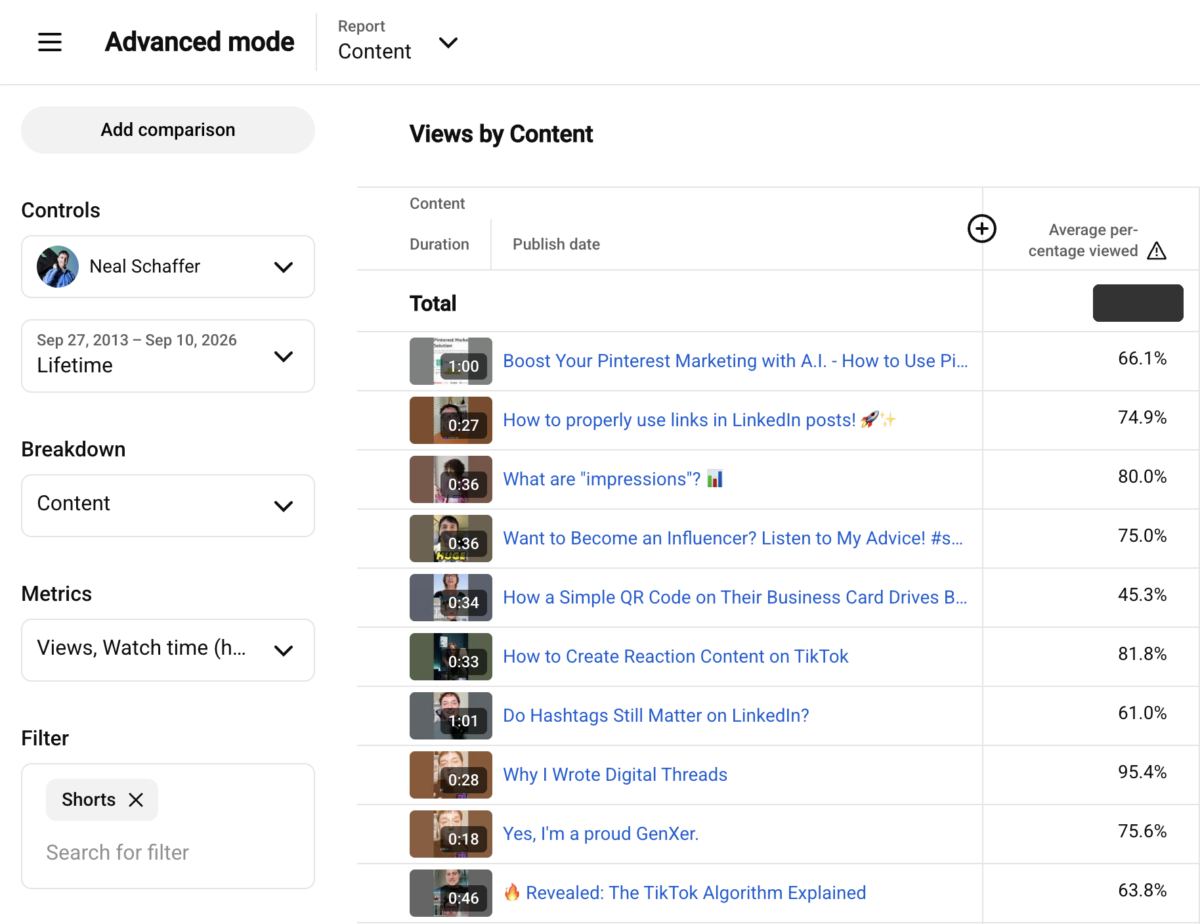
When I started making short-form video in late 2022, I said on my podcast Your Digital Marketing Coach that “every short form video must have one idea.” Nearly four years and 211 Shorts later, my own numbers point the same way. Eight of my ten most-viewed Shorts teach one specific thing.
| Rank by views | My Short | Format (idea number) | Length | Share watched |
|---|---|---|---|---|
| 1 | Boost Your Pinterest Marketing with A.I. – How to Use Pin Generator | Product demo (4) | 60 sec | 66% |
| 2 | How to properly use links in LinkedIn posts! | How-to (6) | 27 sec | 75% |
| 3 | What are “impressions”? | Explainer (3) | 36 sec | 80% |
| 4 | Want to Become an Influencer? Listen to My Advice! | Advice (2) | 36 sec | 75% |
| 5 | How a Simple QR Code on Their Business Card Drives Book Sales | Tip (5) | 34 sec | 45% |
| 6 | How to Create Reaction Content on TikTok | How-to (6) | 33 sec | 82% |
| 7 | Do Hashtags Still Matter on LinkedIn? | Myth check (14) | 61 sec | 61% |
| 8 | Why I Wrote Digital Threads | Brand story (10) | 28 sec | 95% |
| 9 | Yes, I’m a proud GenXer. | Personal aside (none) | 18 sec | 76% |
| 10 | Revealed: The TikTok Algorithm Explained | Explainer (3) | 46 sec | 64% |
Share watched is YouTube Studio’s average percentage viewed for each Short over its lifetime, from my Studio export in September 2026. Across all 211 Shorts, the typical one holds 41%.
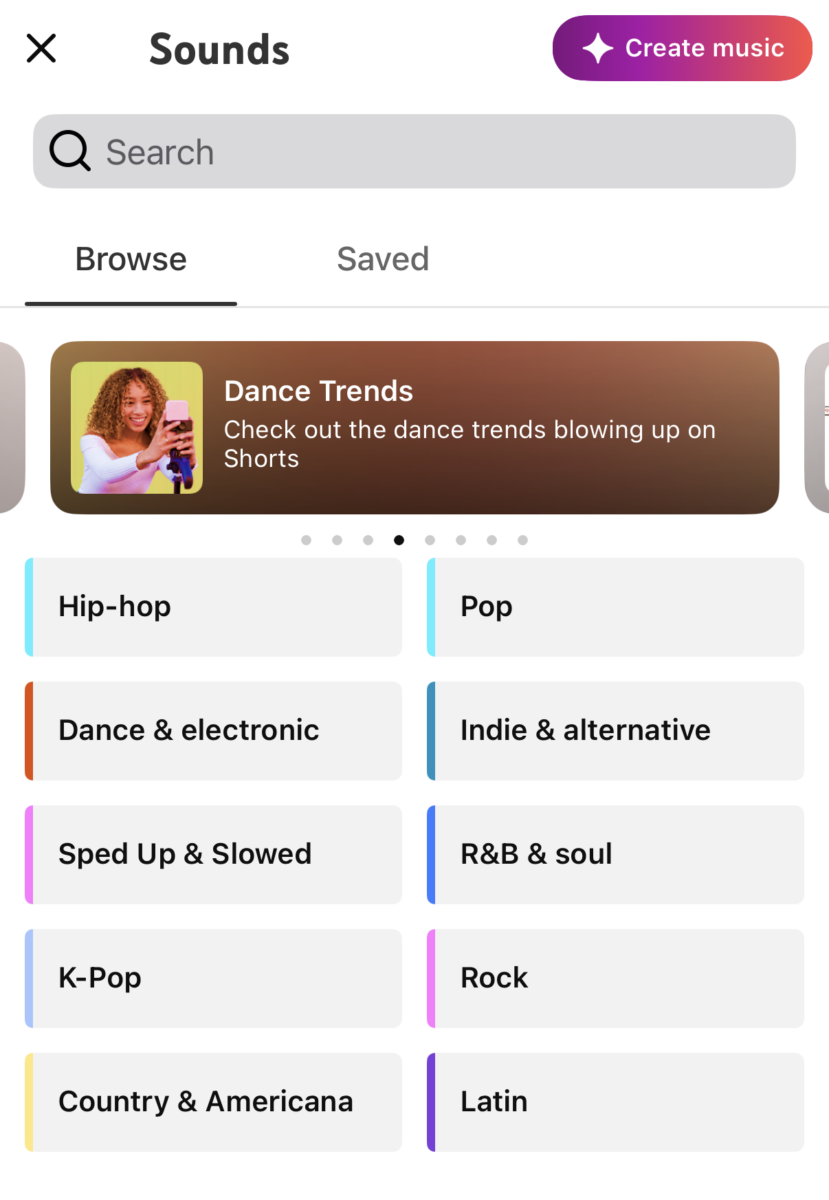
To see what is working in your niche right now, YouTube gives you three places to look inside the app:
- Open the Shorts camera and tap Add sound at the top. YouTube calls browsing trending audio one of the easiest ways to get Shorts ideas, and its guide points to a Trending list on that screen. My app showed something different in September 2026: a rotating banner of featured sounds, such as Dance Trends, above a grid of genres. Start with that banner.
- Type a hashtag for your niche into the search bar and tap it to open its pivot page, where YouTube shows the Shorts that community is watching.
- When a Short’s pacing catches your eye, tap Remix, then Use this template, and swap your own clips into its framework.
Borrowing a trend is fine. YouTube’s monetization policy lists “a Short that puts your own personalized spin on a trend” as allowed content. The spin is the part that has to come from you.
With that filter in place, the 15 formats come next.
Make LinkedIn Your Best Source of Clients
My latest book helps professionals, entrepreneurs, and business owners turn LinkedIn from a static profile into a real source of clients and growth.
Maximizing LinkedIn for Business Growth gives you clear, practical steps to build a profile that gets noticed and a network that actually sends business your way.
Grab your copy on Amazon and put it to work this week. Click the cover or the button below to get started.

15 Viral YouTube Shorts Ideas
The 15 YouTube Shorts ideas below are formats rather than trends, so they should still work next year. Each one names where it fits a brand and, where I have tried it on my own channel, what happened. Pick two or three that suit your niche and test them against each other before committing.
Nothing on this list guarantees a viral Short. What these formats give you is a set of repeatable shapes you can test, and the ones I have tried come with my numbers attached.
1. Funny Shorts
Funny Shorts are skits, memes, bloopers, and reactions built to make someone smile before they swipe. Humor travels well on Shorts because a laugh lands in a few seconds, but in my opinion it is also the easiest format for a brand to get wrong. Match the joke to your brand voice before you match it to a trend.
Some companies build their whole brand on humor, and others would look foolish trying it. Before you script a skit, ask whether your best customer would share it or wince at it. If you would not put the joke in a sales deck, it probably does not belong on your brand channel either.
Humor does not have to be slapstick. A few I would try on a business account: bloopers from long-form shoots, a skit about a weekly customer complaint, or a reaction to a common industry mistake. YouTube’s own inspiration tips suggest starting from a sound, since a single trending audio track can spark a comedy skit. The Add sound screen I walked through earlier is where to look.
I would argue there is room to laugh even in B2B, as long as the humor comes from something your audience lives through every day.
2. Motivational Videos
Motivational Shorts share a push to act: a lesson you learned the hard way, what it takes to succeed in your field, or a nudge to finally start. They do not need entertainment value to work. For a brand, they show the people and values behind the logo, which can help with customers and with hiring.
My first edited short-form video, back in December 2022, was exactly this. It told viewers not to overthink TikTok and to just press the record button, which was really me holding myself accountable. I described it on an episode of my podcast that same month.
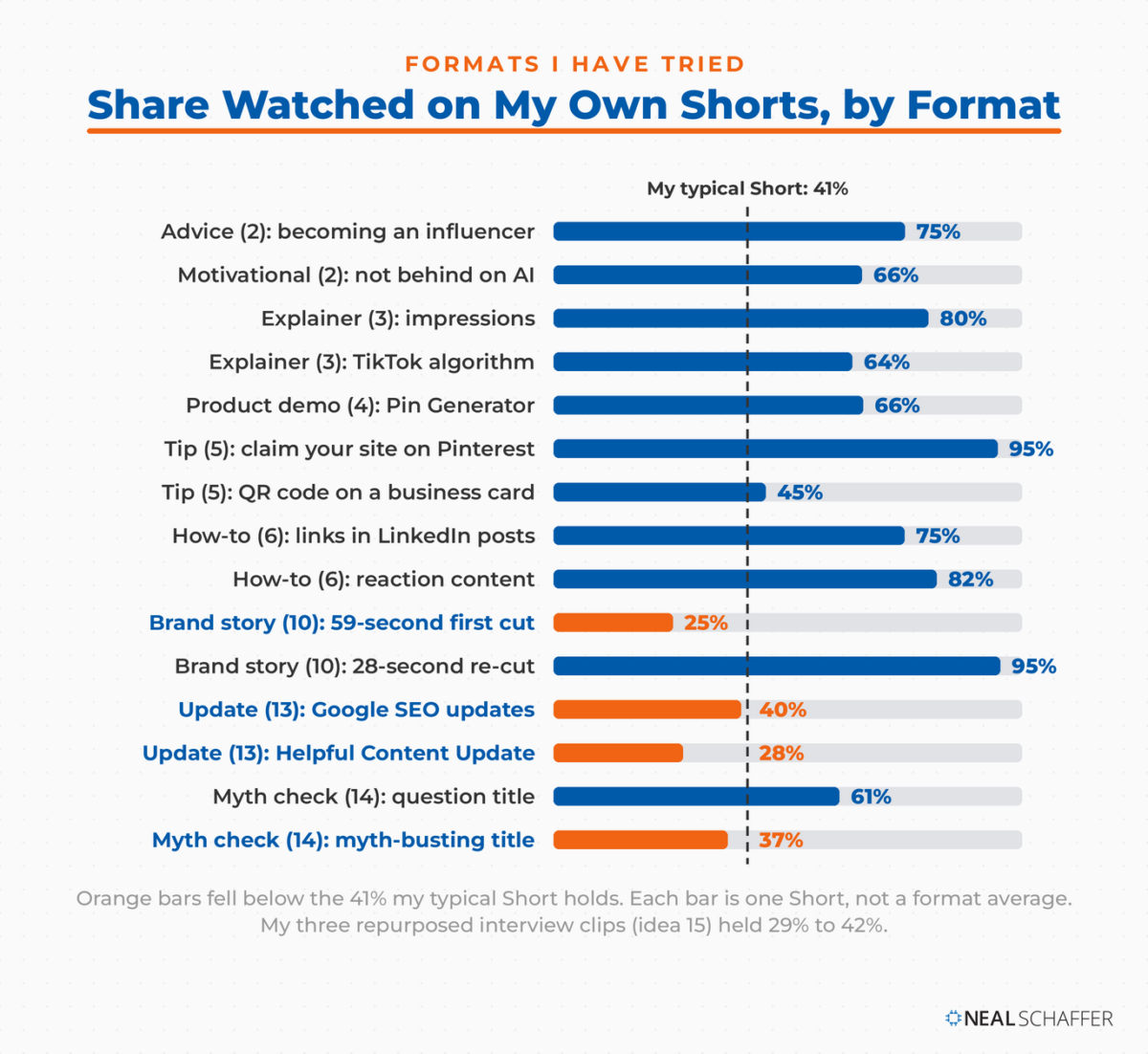
The second one answered a letter-style question I often get: I want to become an influencer, how do I do it? My YouTube Short on that question, published that same month, is still my fourth most-viewed Short and holds 75% of its 36 seconds. It is advice more than inspiration, which suggests to me that the push works best when it comes with something useful.
A 20-second Short of mine titled You’re NOT Behind on AI! holds 66%, well above my channel’s typical 41%.
If you are a brand, point the camera at someone real. A founder explaining why the company exists, or an employee sharing how they grew into their role, probably does more than a stock-footage quote card.
3. Educational Videos
Educational Shorts teach one concept your audience wants to understand, in the time it takes to wait for a coffee. If you are good at something, whether it is serious or creative, chances are someone wants to learn it from you. This is the format where a business can give value first without a sales pitch.
Learning is a big reason people open YouTube in the first place. The same CEO letter I linked earlier cites a 2025 Kantar survey in which 93% of U.S. viewers aged 18 to 27 agreed that YouTube helps them learn new skills.
My third most-viewed Short, What are “impressions”?, is a 36-second explainer of one piece of marketing jargon, and it holds 80% of its length. Another explainer, on how the TikTok algorithm works, holds 64%. Neither one tries to cover a whole topic.
Brands can do this too, either on camera themselves or by working with a creator who already teaches your audience. Pick a question your sales team answers every week and answer it in a Short.
4. Product Reviews
Product review Shorts show what a product does and whether it is worth buying, in two or three points rather than ten. They suit creators reviewing tools they use and brands showing their own products in action. They also pair naturally with influencer marketing, where a creator reviews your product under a sponsorship or an affiliate link.
One Short in this format has done more for my channel than any other. My single most-viewed Short is a 60-second demo of Pin Generator, an AI tool for creating Pinterest pins, published in June 2023. It holds 66% of its length, and it brought in a quarter of every subscriber my Shorts have ever earned.
Keep the review tight. Pick two or three things the product does well, show them on screen rather than describing them, and name who the product is for. If you are a brand, a review is also a chance to show how you differ from a competitor without naming them.
If you plan a series, YouTube’s monetization policy specifically allows a channel that does product reviews, as long as each video has a distinct focus rather than feeling interchangeable. Vary the product and the angle from one Short to the next.
If you sell physical products, the same thinking carries over to the product videos on your site and store pages.
5. Niche Relevant Tips, Tricks & Hacks
Tips, tricks, and hacks Shorts share one small, useful shortcut from your niche that a viewer can use today. They differ from full how-to videos because they skip the setup and deliver a single insight. For a brand, the tip does not have to feature your product at all, only your area of expertise.
Maybe you are great at baking cupcakes, or you are a photographer who knows how to shoot in harsh summer light. Either way, a quick tip from what you know is a natural Short. A car company could share family road-trip tips without the car ever being the point of the video.
A 26-second tip of mine on claiming your website on Pinterest holds 95% of its length. Another tip, about how a simple QR code on a business card drives book sales, holds 45%, still above my channel’s typical 41%. I cannot prove why, but the first covers a single setting and the second covers a whole tactic.
From what I have seen, people like getting something useful from a brand without a pitch attached. If nothing else, they remember who helped.
6. How-To Videos
How-to Shorts walk a viewer through a short process from start to finish, like changing a setting, fixing a common problem, or using one feature. In my experience, the best candidates have three steps or fewer. Anything longer probably belongs in a long-form video that you can point viewers to from the Short.
Two of my most-viewed Shorts are how-tos, and both are short. How to properly use links in LinkedIn posts runs 27 seconds and holds 75%. How to create reaction content on TikTok runs 33 seconds and holds 82%. Each one covers exactly one task.
You can record yourself talking through the steps, or have someone film your hands while you demonstrate. Screen recordings suit software. Either way, show the finished result in the first few seconds so the viewer knows the payoff is worth the rest.
7. Creative Short Films
Creative short films are tiny stories told in a minute or two: a scripted scene, a teaser, or a visual experiment. They let a person or a brand play without taking itself too seriously. Movie trailers sell films this way, and a Short can preview a launch, an event, or a longer video.
If you have creative ideas sitting in a notebook, a Short is a low-risk place to try one. You do not need a studio. Any of the video editing apps that export straight to vertical will do, and I lean on Adobe Express for quick vertical edits. I am an Adobe Express Ambassador, so weigh that recommendation accordingly.
In my recap of VidSummit on my podcast, one takeaway I shared from Paddy Galloway’s session was that the story should matter more than the production value. A creative Short needs a beginning, a middle, and a payoff far more than it needs a camera upgrade.
8. Unboxing Videos
Unboxing Shorts film the moment a product comes out of its packaging, building a few seconds of anticipation before the reveal. They show a buyer exactly what arrives at their door. The format suits creators who receive products and brands that put care into their packaging, and it pairs well with a product review.
Part of the appeal, I would argue, is suspense. Everybody knows the feeling of opening a package, and gift-giving season runs on the same excitement of not quite knowing what is inside. Creators who get sent products can move from suspense to discovery in seconds.
One caution for brands selling to families. YouTube’s quality principles for made-for-kids content treat heavily promotional content, including content that encourages excessive buying “like unboxing videos,” as a factor that can affect monetization. If your audience is children, lead with play or learning rather than the purchase.
If you sell through Shopify, unboxing Shorts fit naturally alongside the other ways to promote your Shopify store on YouTube.
9. Behind the Scenes Shorts
Behind-the-scenes Shorts show the part of your work customers never see: the setup before an event, the prep before a shoot, or the team that makes the product. They turn a faceless company into people with stories. They also give you a way to show a community or social commitment without a formal announcement.
Whether you are filming a cooking demo, recording a live set, or shooting a wedding, the moments around the main event can be more interesting than the event itself. A little humor helps here too. If people see your employees enjoying the work, that says something about how you treat them.
My own obvious candidate is the podcast. In Digital Threads, I describe how I livestream my podcast recordings to LinkedIn, Facebook, X, and YouTube, so the minutes before we go live are right there to film.
10. Brand Story
Brand story Shorts tell why your company or career exists, usually through one moment, one value, or one decision. Telling a whole brand story in under a minute is hard, so pick the single piece of it that makes someone care. For nonprofits and mission-driven brands, the story can open a series about every part of the work.
I learned this one the direct way. I published a Short titled Why I Wrote Digital Threads twice in 2025, with the same title about the same book. The first version ran 59 seconds. The second ran 28.
| Version | Published | Length | Share watched | Views |
|---|---|---|---|---|
| First cut | February 2025 | 59 sec | 25% | Baseline |
| Re-cut | July 2025 | 28 sec | 95% | About 30 times the first cut |
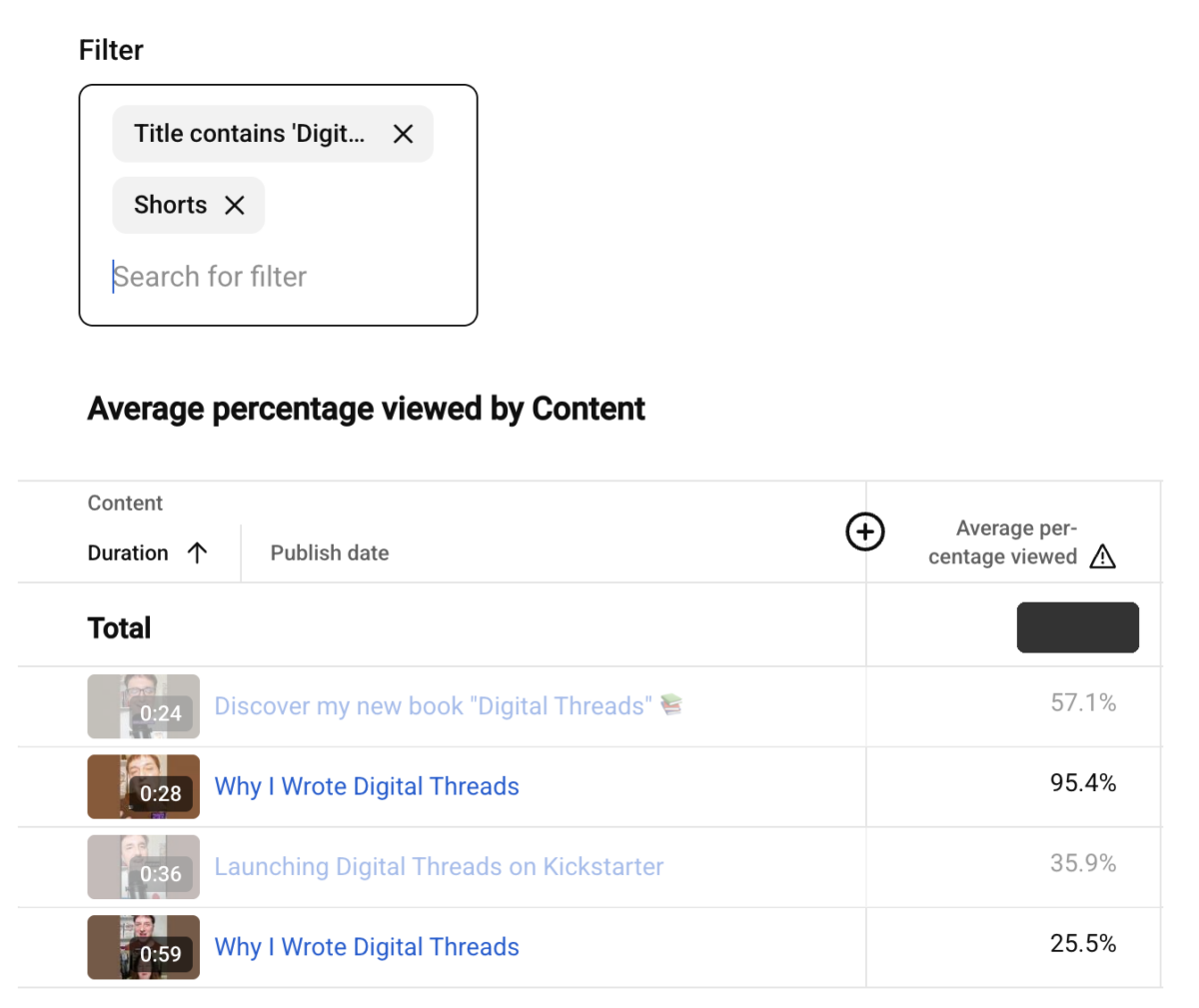
The shorter version held almost four times as much of its length. I cannot tell from the numbers alone which edits made the difference. If I were telling a brand story again, I would start from the re-cut’s rule: one reason, said fast.
Another way in is a single core value. Brands that serve a specific group, such as vegans or shoppers who avoid cosmetics tested on animals, can tell their story through that commitment in one Short. The same discipline applies to a longer brand video on your website.
11. Travel Videos
Travel Shorts capture a place: the city you are visiting, what you did there, and what you saw. For creators, that can mean a weekend away. For a business, travel usually means work travel, such as a conference you speak at, a trade show booth, or a visit to a client or supplier.
A travel Short gets more useful when it answers a question a viewer has. A 30-second tour of a conference venue tells future attendees where to go. Three things you learned at a trade show give people who could not attend a reason to watch. A quick look inside a supplier’s workshop shows where your product comes from.
Plan the shot list before you leave, because the good moments at an event go by fast. Film vertically from the start so you are not cropping horizontal footage later.
12. Before and After Video
Before-and-after Shorts show a problem, then the result once your product, service, or skill has been applied. The contrast does the persuading for you. Renovations, cleaning products, website redesigns, and profile makeovers all fit, and so does any service that produces a visible change you can film or screen-record.
My own clearest before-and-after came from editing. When I started with short-form video in 2022, I hired an editor I found on Upwork. I sent him a video I had recorded and asked him to edit it the way he edits for other creators. The result was, as I put it on my podcast at the time, “absolutely night and day.”
Put two versions like that side by side and you have a Short that teaches editing without a single tutorial step. YouTube’s Remix menu has a Collab option that places your video next to another one on the same screen, as the inspiration post I linked earlier describes.
Do not stage the before shot. From what I have seen, viewers can tell, and a staged problem undercuts the result.
13. Industry Trends and Updates
Industry update Shorts explain a change in your field in plain terms: a new rule, a platform update, or a product launch. They keep your channel current and give viewers a reason to return. Treat this as a format rather than a trend report, and pick updates your audience will still care about next month.
Take a change from my own world. On March 31, 2025, YouTube changed how Shorts views are counted, so a view now registers every time a Short starts to play or replay, with no minimum watch time. That makes a clean 30-second update: what changed, why your view counts went up, and why Engaged views is now the number to compare.
New product announcements fit too. Show the product, cite its key features quickly, and put the product page link in the description. If the launch answers a competitor, show the difference.
A warning from my own channel: my two update Shorts sit below my channel’s typical 41%. One asking whether Google’s latest SEO updates were time to panic holds 40% of its length, and one about Google’s Helpful Content Update holds 28%. Both run over a minute. If you make updates, keep them short and specific.
14. Bust Myths and Facts
Myth-busting Shorts take a belief your audience holds and check it against the facts in under a minute. Shorts also appear in YouTube search results, so a clear answer can keep earning views long after you post it. A quick, surprising fact from your field works the same way and builds your authority.
Framing seems to matter here. My Short asking Do Hashtags Still Matter on LinkedIn? holds 61% of its 61 seconds and ranks seventh on my channel by views. Another one, titled Busting Influencer Marketing Myths, holds 37% of its 72 seconds. I cannot separate the title from the content in that comparison, but I would test a question-style title before a myth-busting label.
The search side is also why YouTube SEO basics apply to Shorts. A myth phrased the way people type it into search is easier to find.
Doctors, lawyers, and financial professionals have an advantage here, because their audiences arrive with questions. Just stay within what you are qualified to say.
15. Repurpose Your Long-Form Content
Repurposed Shorts are clips cut from content you have already made: a webinar, a podcast interview, a long-form video, or a blog post turned into a script. This is probably the cheapest way to fill a Shorts calendar. YouTube lets you edit up to 60 seconds of your own public video into a Short that links back to the original.
In Digital Threads, I wrote that “the most powerful repurposing potential starts with video content that features real people.” A talking head explaining something, a guest making a point, a customer telling their story: in my experience, those are the moments that survive being cut down.
To turn one of your own long-form videos into a Short in the YouTube app:
- Open the watch page of a public video you uploaded.
- Tap Remix, then Edit into a Short.
- Select up to 60 seconds of the video, tap Next, add text or filters, and upload.
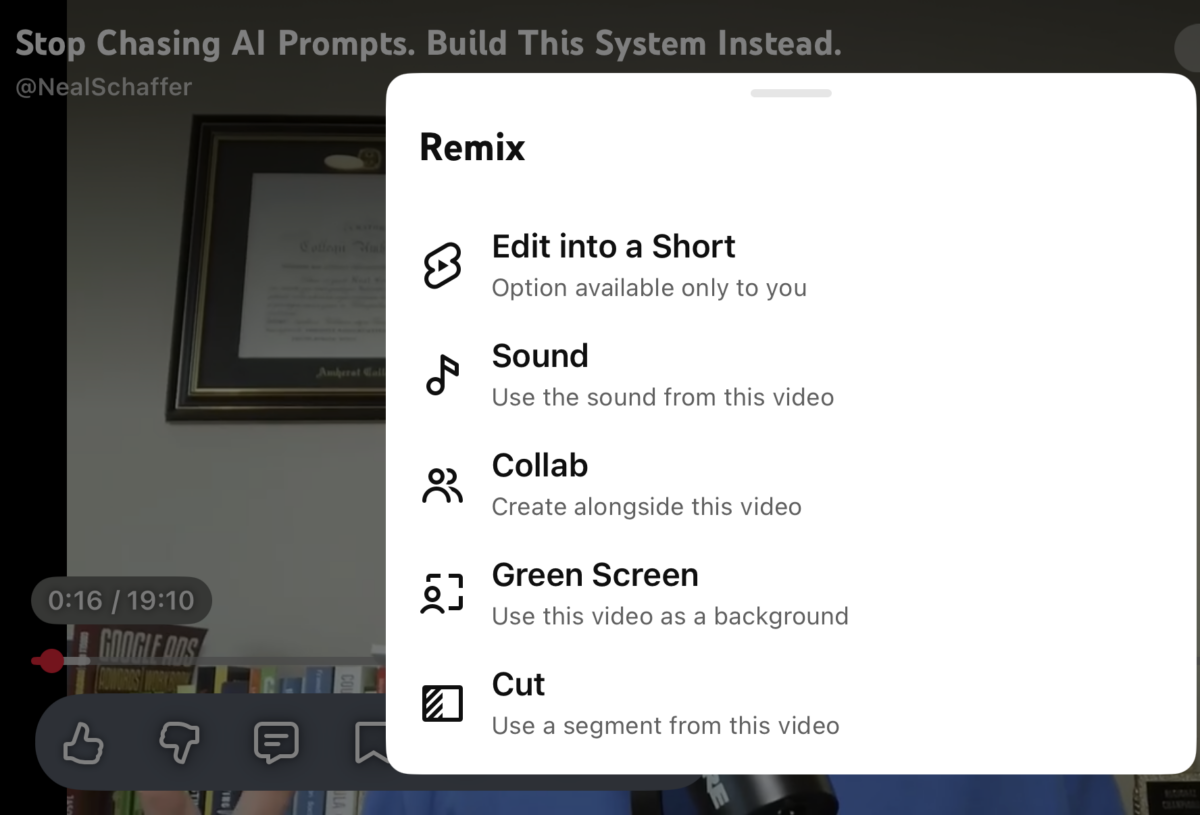
If the option does not appear, the same page says to turn on sampling. Open the video in YouTube Studio, click Show more, check Allow people to sample this content under Shorts remixing, and click Save.
In June 2024 I tested ten AI clipping tools and settled on Opus Clip, which suggested around 30 clips from a single hour-long livestream. Over one weekend I scheduled about 25 Shorts from two YouTube videos. Then a glitch forced me to re-edit them, so I now download each clip the moment it is ready. I shared the whole test on my podcast.
The clips were easy to make, but they were not my strongest Shorts. The interview clips I published that summer with John Jantsch, Dennis Yu, and Andy Lambert hold between 29% and 42% of their length, against my channel’s typical 41%. My takeaway from that test still holds: you are the best judge of which moment deserves a Short, so choose the moments yourself and let the tool do the cutting.
My approach to content repurposing starts from the same place: one recording, many assets, and Shorts are the easiest of them to cut.
How can I Make My YouTube Shorts Go Viral?
From what I have seen, no format guarantees a viral Short. What you can control is how quickly you learn which formats your audience finishes. Publish several formats within the same niche, group them in YouTube Analytics, compare how much of each one people watch, and make more of the format that wins.
That approach comes from my VidSummit notes. One speaker, who had worked at both YouTube and Instagram, compared a talk show that repeats a few formats with a variety show that keeps trying new ones. He said his own growth came when he moved to the variety approach. His advice, as I recapped it on my podcast: keep your niche, vary the format.
Another speaker, a Shorts creator, gave the room a four-part test he called RICE:
| Test | What to ask about the idea |
|---|---|
| Repeatable | Once it works, can you make it again and again? |
| Inclusive | Does it appeal to the audience you want to attract? |
| Curious | Does it give people a reason to keep watching? |
| Evergreen | Will it still make sense a year from now, since a Short stays on your channel? |
Give each format enough uploads to tell you something before you judge it. One creator at the same event said it took him about 50 videos to find the one that took off.
How do I compare formats in YouTube Analytics?
Set up one group per format in YouTube Studio:
- Sign in to YouTube Studio and select Analytics from the left menu.
- Click Advanced mode (or See more) under a report.
- Click your channel name in the search bar at the top left, open the Groups tab, and select Create new group.
- Name the group after a format, such as How-to or Product demo, select the Shorts that fit, and save.
- Back in the report, use Add comparison to put two groups side by side, and compare average percentage viewed.
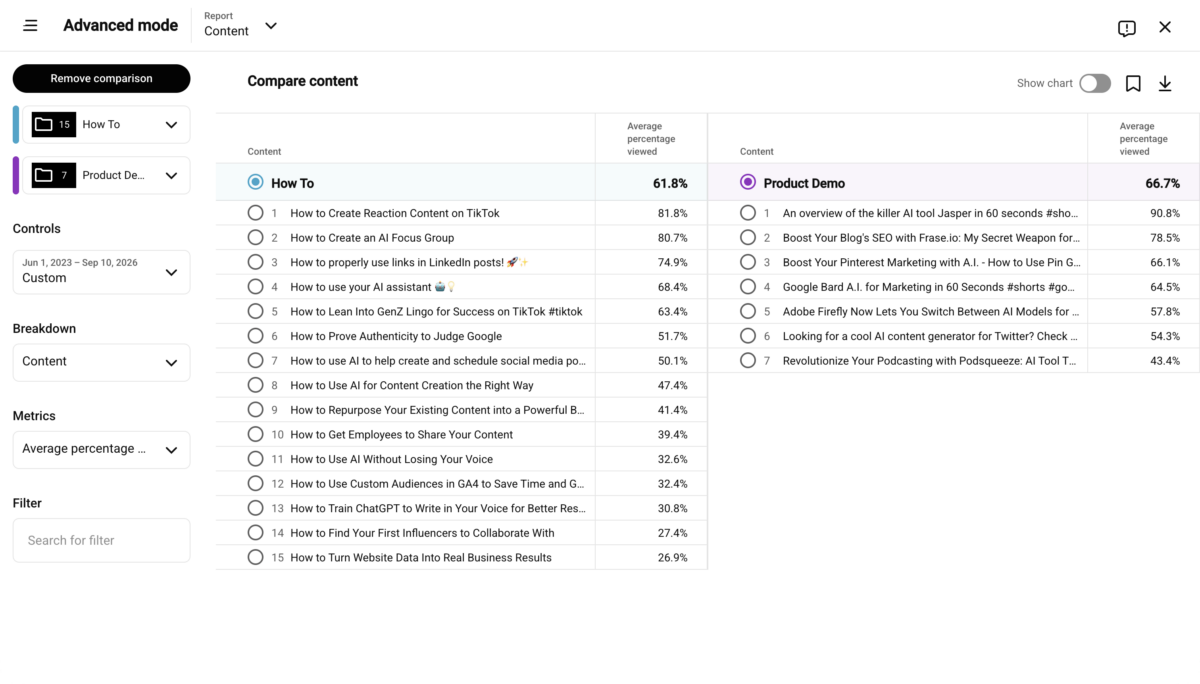
YouTube’s Advanced mode instructions note that a group holds up to 500 videos. They also note that Studio has been getting a new layout since July 2026, so your screen may look a little different.
One more thing to build into any format. A Short replays automatically when nobody swipes away, so building a video around YouTube Shorts looping gives it extra watch time from the same viewer. And if a format gets no traction at all, work through the reasons Shorts stop getting views before you give up on it.
Frequently Asked Questions
Start with the format you could publish weekly for a month without straining. A format you can pull off only once will not give you enough uploads to compare. If two formats tie, pick the one closest to content you already make, since the production work is already done.
Trending topics change too quickly to list, so check them inside the app instead, starting with the featured sounds under Add sound and the hashtag pivot pages I described earlier. Then run the trend through one of the 15 formats above so the Short still fits your channel.
Treat it as a testing budget rather than a quota. I would start with three a week, which is enough to compare two or three formats within a month. Consistency probably matters more than the exact number, so pick a cadence you can hold through a slow month.
No. Screen recordings, product close-ups, text-on-screen explainers, and voiceover-only videos can all work, and several ideas on this list never need you on camera. For a brand, a format tied to one person’s face can also break the moment that person leaves.
Yes, but upload a clean file without the TikTok watermark. The YouTube monetization policy I linked earlier names short videos compiled from other social media websites as content it will not monetize. Export the original from your editor, then add YouTube’s own sounds or text if you want it to feel native.
Put These YouTube Shorts Ideas to Work This Week
Pick two formats from this list that fit your niche. Make one a format you already have footage for, such as a product demo or a webinar clip, and the other one you have never tried.
Make three Shorts in each over the next two weeks. Keep every one to a single idea, and film vertically from the start.
Then group them in YouTube Analytics and compare how much of each people watch. Make more of the winner, and swap the loser for the next format on the list.
When you are ready to take these formats beyond YouTube, start with how I use social media videos to grow a business. And if you want help fitting Shorts into a coordinated digital strategy, grab a free preview of Digital Threads or talk to me about Fractional CMO services.
