

At some point, your influencer marketing software stops being the place where you want all your influencer data to live.
Perhaps you’re building a proprietary creator discovery tool, developing a reporting portal for agency clients, or connecting creator performance with sales data in your company’s data warehouse. You need access to the underlying data rather than another dashboard.
An influencer marketing API gives you that access. What you can actually do with it, however, varies considerably between providers.
Some specialize in creator discovery and audience analysis. Others give you access to live social media content, historical sponsorship data, verified contact information or campaign management functionality. Even the way providers charge for retrieving a single creator profile can differ considerably.
We’ve examined 10 influencer marketing APIs, looking at their data coverage, available endpoints, pricing models and practical applications to help you find the right infrastructure for whatever you’re building.
Influencer Marketing APIs Compared
Choosing an influencer marketing API comes down to the type of data you need, how you intend to use it, and how frequently your systems need to retrieve it.
Some providers offer complete creator intelligence infrastructure, while others specialize in specific applications such as contact enrichment, live content monitoring or retrieving data directly from connected creator accounts.
| Influencer Marketing API | Best For | Key API Capabilities | Starting API Price |
| HypeAuditor | Creator intelligence and campaign infrastructure | Audience quality analysis, fraud detection, discovery, competitor analysis, campaign management and MCP | $200/month |
| Modash | Creator discovery and live social media data | AI search, audience demographics, historical collaborations and raw content retrieval | $10,000/year for Raw API; $16,200/year for Discovery API |
| Upfluence | Creator data and campaign workflow integrations | Discovery, audience data, content analytics, campaign data and MCP | Custom token packages |
| Influencity | Internal reporting and data synchronization | Profile analysis, content tracking and publication metrics | Custom annual contract |
| Influencer Hero | Building proprietary creator marketing products | Creator discovery, audience analytics, collaboration history and email checks | Business plan from $1,743/month, billed annually |
| Influencers.club | Creator identification and contact enrichment | Email verification, social account matching, creator discovery and audience analytics | $208/month |
| CreatorDB | Sponsorship and competitive intelligence | Brand partnership history, estimated creator rates, audience analysis and individual field retrieval | $79/month or $40 minimum credit purchase |
| Influship | Automated creator matching | Natural language search, campaign fit scoring, lookalike discovery and raw social data | $0.01 per credit, no minimum commitment |
| influData | Unified social media data integrations | Profile enrichment, discovery and standardized data retrieval across 6 social platforms | €1,199/month with a 12-month commitment |
| Phyllo | Creator authorized performance data | Connected account analytics, content performance and Instagram Stories data | Custom |
Pay particular attention to how providers charge for data access. A creator search, an audience demographics report and a request for recent publications can carry considerably different costs, even within the same API.
Before comparing subscription prices, establish which endpoints your integration will use and estimate your monthly request volume. A lower starting price does not necessarily translate into lower operating costs.
Top
best influencer marketing apis
2026
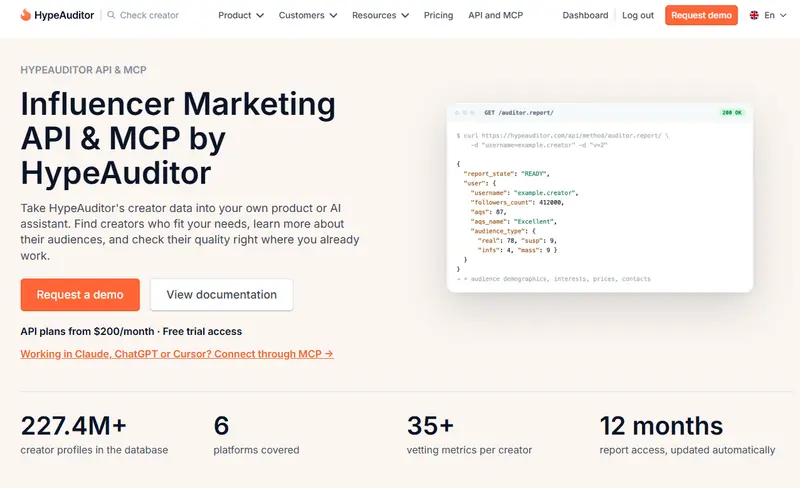
Best For: Creator intelligence, audience vetting and custom influencer marketing infrastructure
API Pricing: Starts at $200/month
Supported Social Platforms: Instagram, TikTok, YouTube, X, Twitch and Snapchat
Free Testing: Available upon request
HypeAuditor offers 7 REST APIs, providing access to over 227.4 million creator profiles and 35+ vetting metrics. Businesses can integrate its proprietary audience intelligence, fraud detection and campaign management capabilities into their own products without requiring creators to connect their social accounts.
Its Influencer Discovery API offers 50 search filters, including audience location, estimated collaboration costs, audience quality and previous brand partnerships. Developers can enrich creator profiles with detailed audience reports, synchronize creator records with their CRM and retrieve campaign performance data for custom reporting dashboards.

Key Features: Search/Discovery, Influencer Relationship Management, Content Review, Campaign Management, Campaign Reporting, Influencer Analysis, Audience Analysis, White Label Reporting, Fake Follower/Fraud Detection, Market & Competitor Analysis, Forecasting, Creator Outreach, Ecommerce Integration, Product Gifting, AI creator discovery, Affiliate tracking, Creator payments,
Channels: Instagram, YouTube, TikTok, Twitch, X (Twitter), Snapchat
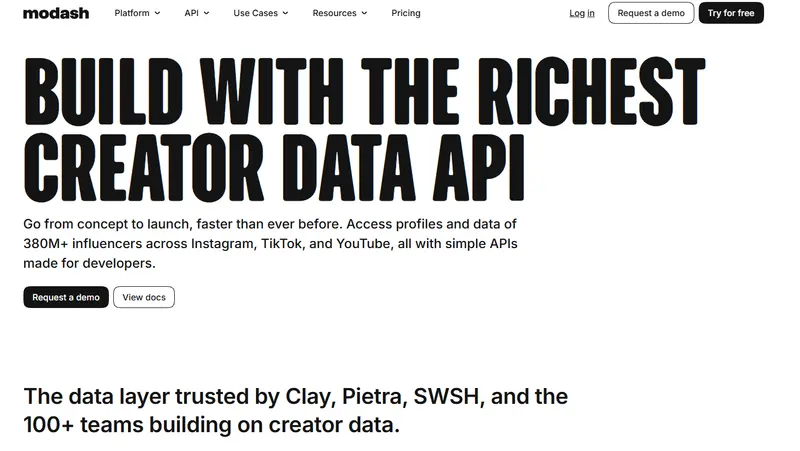
Best For: Building creator discovery tools and monitoring live social media data
API Pricing: Raw API starts at $10,000/year; Discovery API starts at $16,200/year
Supported Social Platforms: Instagram, TikTok and YouTube
Free Testing: Testing credits available upon request
Modash offers 2 dedicated APIs covering over 380 million creator profiles. Its Discovery API provides structured creator intelligence, while its Raw API retrieves live social media data, including posts, comments, Stories and engagement metrics.

Key Features: Campaign Management, Influencer Discovery, Influencer Analytics, Influencer Campaign Monitoring, Influencer Management,
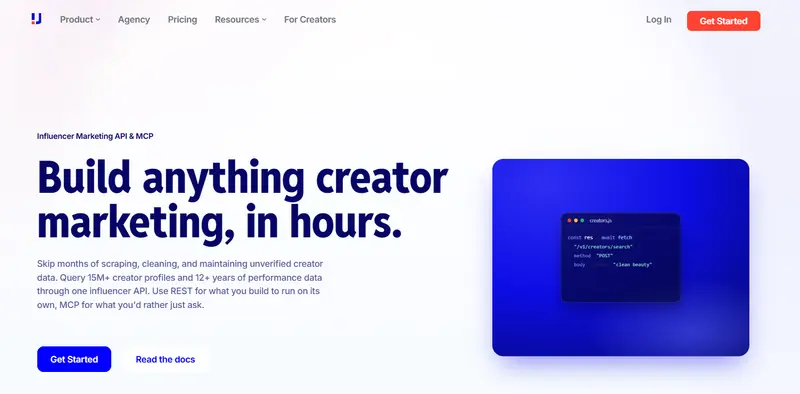
Best For: Integrating creator intelligence with ecommerce, CRM and campaign workflows
API Pricing: Custom token packages
Supported Social Platforms: Instagram, TikTok and YouTube
Free Testing: Not publicly disclosed
Upfluence’s influencer marketing API provides access to over 14 million vetted creator profiles and 12+ years of historical performance data. Its REST API is particularly useful for businesses looking to connect creator intelligence with existing customer databases, eCommerce systems and marketing automation workflows.
An ecommerce business, for example, could build an automated system that identifies influential customers, evaluates their social media presence and qualifies them for its ambassador program.

Key Features: Influencer Search & Discovery, Relationship Management, Campaign Management, Third Party Analytics, Automated Recruiting, Influencer Lifecycle Management, Team Collaboration Tools, Content Review, Campaign Reporting, Audience Analysis, E-commerce Tools, Product/Gifting Tools, Payment Processing, Social Listening, Affiliate Management, Affiliate Campaigns,
Channels: Instagram, Youtube, Facebook, Twitch, Tiktok, Twitter, Pinterest, Blogs
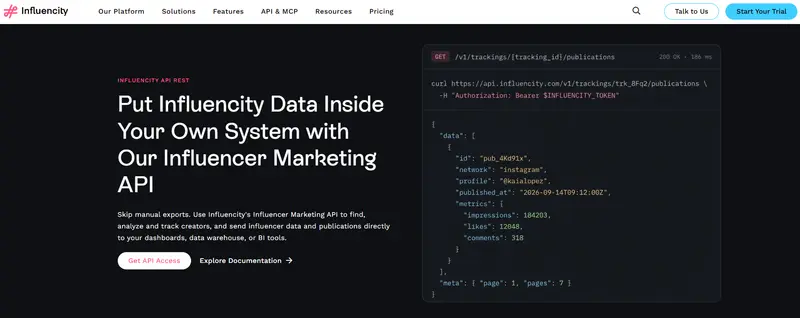
Best For: Automating campaign reporting and synchronizing creator data with internal systems
API Pricing: Custom pricing with an annual contract
Supported Social Platforms: Instagram, TikTok, YouTube and Twitch for profile analysis
Free Testing: Interactive API examples available; production trial access requires confirmation
Influencity’s REST API covers 3 core areas of influencer marketing operations: creator discovery, profile analysis and content tracking.
Its distinguishing feature is the synchronization between the API and the Influencity platform. Creator profiles and campaign trackings created through the API also appear in the software interface, allowing marketing and development teams to work with the same data.
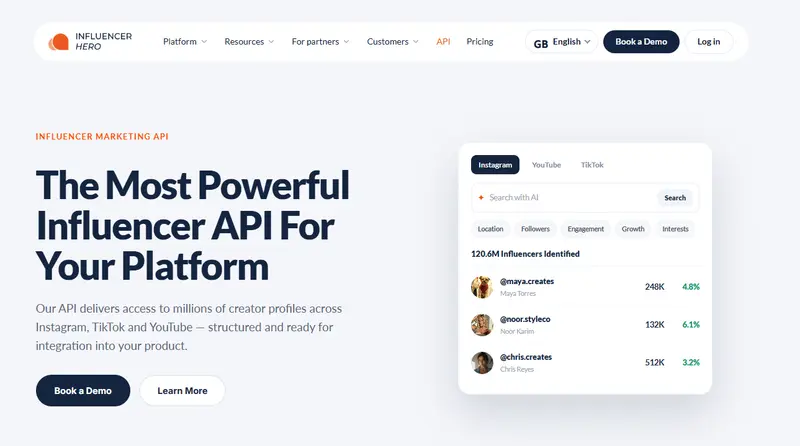
Best For: Building custom creator discovery tools and brand collaboration intelligence systems
API Pricing: Included in the Business plan, starting at $1,743/month, billed annually
Supported Social Platforms: Instagram, TikTok and YouTube
Free Testing: Personalized API demonstrations available
Influencer Hero’s REST API provides access to over 450 million creator profiles, combining audience demographics, content analysis and brand partnership data. Its AI Content Search allows developers to build discovery tools that match creators based on their published content, including captions and visual elements.

Key Features: Influencer Search & Discovery, Relationship Management, Campaign Management, Influencer Outreach and Engagement, Performance Tracking with Audience Demographics and Conversion Attribution, Global Influencer Payment, Fraud Detection and Audience Health, Team Collaboration Tools, Content Library, E-commerce Tools, Product/Gifting Tools, Forms and Compliance, Competitor Research, Exportable reports, Affiliate Management,
Channels: Instagram, TikTok, and YouTube
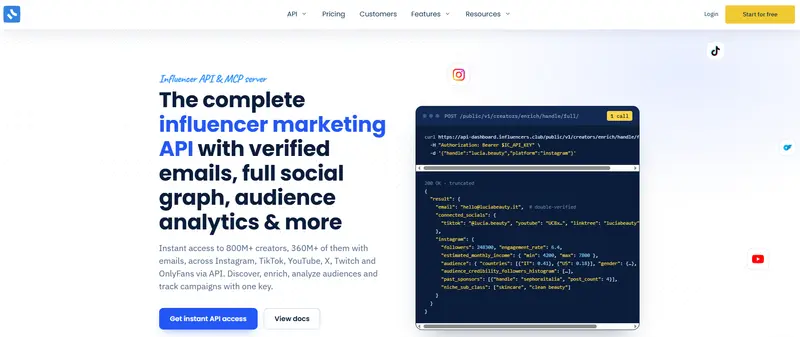
Best For: Creator contact enrichment and identifying creators across multiple social platforms
API Pricing: Starts at $208/month
Supported Social Platforms: Instagram, TikTok, YouTube, X, Twitch and OnlyFans, with connected account data across 47 platforms
Free Testing: 10 free credits upon registration
Influencers.club’s REST API provides access to over 800 million creator profiles, including 360 million with email addresses. Its standout capability is identity resolution, allowing businesses to retrieve multiple social profiles using a single email address or social media username.
For businesses managing large customer databases or creator marketplaces, this means identifying and qualifying creators within their existing networks rather than relying exclusively on external discovery.
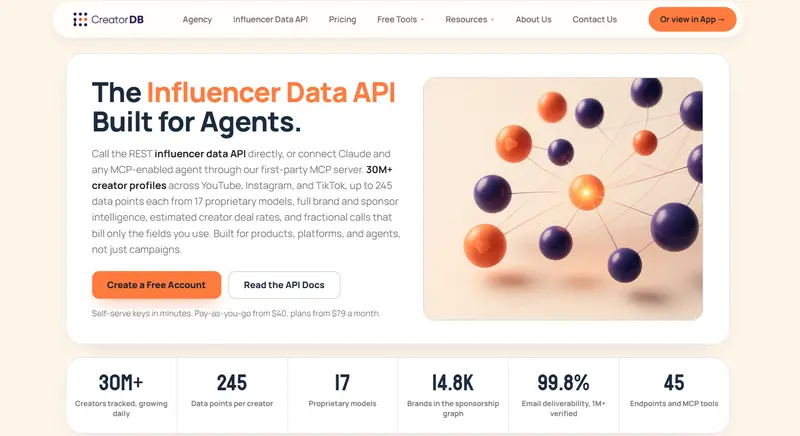
Best For: Sponsorship intelligence, competitor analysis and granular creator data retrieval
API Pricing: Starts at $79/month or a $40 minimum credit purchase
Supported Social Platforms: Instagram, TikTok and YouTube
Free Testing: 14 days with 100 free credits
CreatorDB’s influencer marketing API provides access to over 30 million creator profiles, with up to 245 data points per creator. Its sponsorship intelligence capabilities are particularly valuable for businesses developing competitive research tools or influencer pricing models.
Developers can access a searchable brand directory, retrieve historical creator partnerships, examine sponsored content performance and estimate how much competing brands spend on influencer marketing.
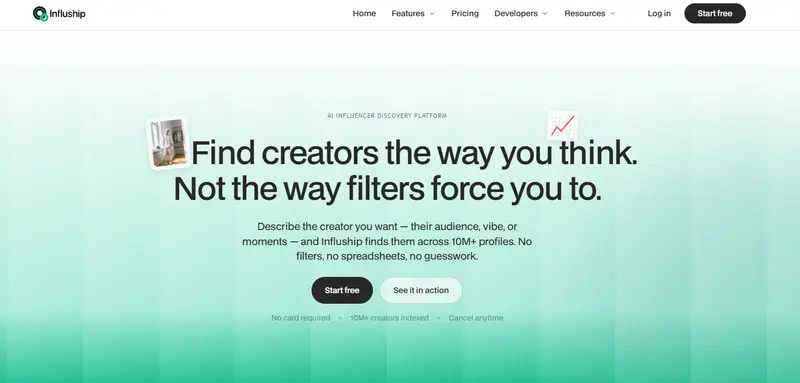
Best For: Automated creator matching and campaign suitability scoring
API Pricing: $0.01 per credit with no minimum commitment
Supported Social Platforms: Instagram for creator discovery and scoring; Instagram, YouTube and TikTok for raw data retrieval
Free Testing: 500 free credits with no expiration date
Influship’s influencer marketing API specializes in contextual creator discovery and campaign suitability. Developers can submit detailed campaign briefs in natural language and receive ranked creator recommendations alongside individual match scores and explanations.
Its campaign scoring endpoint goes beyond follower counts and engagement rates by analyzing creator content against specific brand requirements, including potential conflicts with competing sponsors.
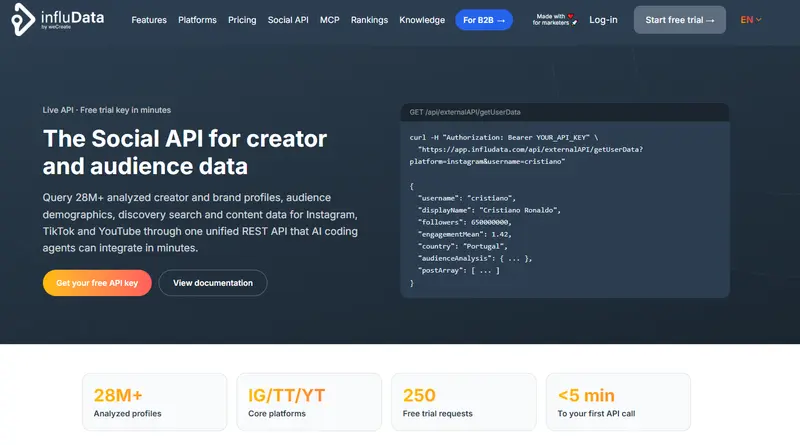
Best For: Unifying social media data across multiple platforms and integrating creator intelligence into existing systems
API Pricing: Included in the All-In plan at €1,199/month with a 12-month commitment; standalone API agreements also available
Supported Social Platforms: Instagram, TikTok, YouTube, Twitch, Facebook and Snapchat
Free Testing: 250 free requests over 14 days
influData’s Social API provides access to over 28 million analyzed creator and brand profiles through a single REST interface. Developers can use the same endpoints, parameters and response structures across supported social networks, reducing the technical work involved in maintaining separate integrations.
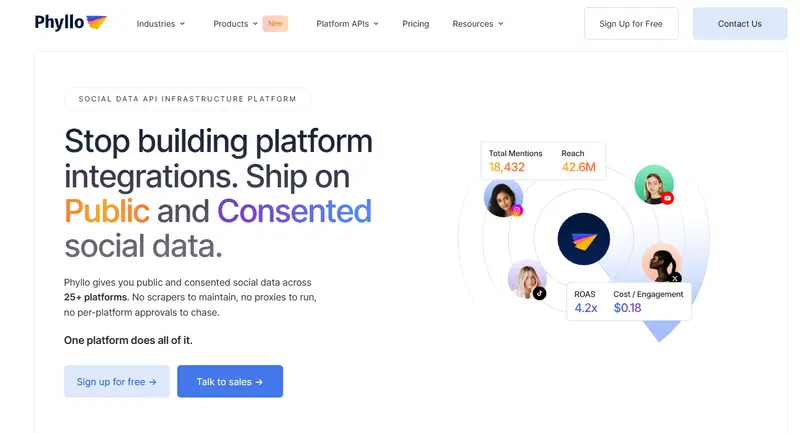
Best For: Accessing verified creator data and private campaign performance metrics
API Pricing: Custom
Supported Social Platforms: 25+ platforms, including Instagram, TikTok, YouTube, LinkedIn, Twitch, Snapchat, Reddit and Facebook
Free Testing: Developer sandbox and free signup available
Phyllo combines public social media data with private data that creators authorize businesses to access. Its public API covers over 470 million creator profiles, while its authenticated APIs retrieve information directly from connected social accounts.
The latter is particularly valuable for businesses that need metrics unavailable through public data collection, such as Instagram Stories reach, organic impressions, saves, actual audience demographics and verified creator earnings. Available metrics vary by platform.
What Can You Build With an Influencer Marketing API?
The real value of an influencer marketing API comes from combining creator intelligence with data your business already owns. Your customer records, sales history, campaign budgets and previous creator collaborations can all inform how you use the data retrieved through an API.
Before choosing a provider, consider which business processes you want to improve or automate.
| What You Can Build | Data Required From the API | Practical Application |
| Creator recruitment engine | Contact details, social profiles and audience demographics | Identify influential customers within your existing customer database and invite them to join your ambassador program. |
| Automated creator vetting system | Audience authenticity, follower growth and engagement quality | Screen incoming creator applications before assigning them to your partnership team. |
| Competitor intelligence dashboard | Brand mentions, sponsorship history and content performance | Identify creators repeatedly hired by competitors and uncover potential partnership opportunities. |
| Influencer pricing engine | Estimated collaboration rates, audience size and historical performance | Establish influencer pricing benchmarks before entering creator negotiations. |
| Custom campaign reporting portal | Published content, reach, engagement and campaign performance | Give agency clients access to personalized reporting alongside other marketing activities. |
| Creator affiliate management system | Creator identities, content metrics and campaign data | Combine creator performance with commission, conversion and revenue data from your affiliate platform. |
| AI influencer marketing assistant | Creator discovery, audience intelligence and brand safety data | Turn campaign briefs into qualified creator shortlists using your own selection criteria. |
You can also combine multiple endpoints to automate an entire decision making process.
Imagine receiving 1,000 applications for your brand ambassador program every month. Rather than purchasing detailed audience reports for every applicant, you could design a workflow that:
- Matches applicants with their social media accounts.
- Removes profiles that fall outside your minimum campaign requirements.
- Retrieves detailed audience reports for the remaining applicants.
- Ranks creators using your own qualification criteria.
- Sends shortlisted applicants to your CRM for human review.
If only 100 applicants pass your initial screening, you need detailed reports for just 10% of the original applicant pool.
The same principle applies to campaign measurement. HypeAuditor’s Campaign Management API, for instance, can retrieve purchases, revenue, campaign spending and ROI from connected eCommerce integrations.
Combine those metrics with your own product margins, customer acquisition costs and repeat purchase data, and you can build a reporting system that evaluates creator partnerships based on profitability rather than engagement alone.
Start with the business decision you want to improve, determine which data points inform that decision, and then select the API endpoints that supply them. You’ll be in a much better position to evaluate providers and negotiate pricing.
How Much Does an Influencer Marketing API Cost?
Influencer marketing API pricing can start at a few cents per request or require an annual contract worth thousands of dollars. The difference comes down to the type of data you’re retrieving, how frequently you need it and the provider’s billing model.
Most providers follow one of 4 pricing structures.
| Pricing Model | How It Works | Example |
| Credit based | Different endpoints consume different amounts of credits depending on the data requested. | HypeAuditor, CreatorDB |
| Token based | Requests draw from a shared token allowance, with consumption varying by data type. | Upfluence |
| Per request | You pay for individual API calls, typically within a purchased request allowance. | Modash Raw API |
| Subscription based | API access and usage allowances are included in a software subscription. | Influencer Hero, influData |
Calculating Your Actual API Costs
Suppose you’re building a creator discovery tool that retrieves 10,000 search results, 500 creator profiles and 500 audience reports every month.
Here’s how the same projected workload translates into different billing units using Modash’s API pricing and Upfluence’s token structure.
| Monthly Activity | Modash Discovery API | Upfluence API |
| 10,000 search results | 100 credits | 20 tokens |
| 500 creator profiles | 500 credits | 100 tokens |
| 500 audience reports | 500 credits | 500 tokens |
| Total Monthly Usage | 1,100 credits | 620 tokens |
Credits and tokens have different monetary values, and the corresponding endpoints may return different data. Request a quote for your projected workload rather than comparing the number of billing units alone.
Additional API Costs to Consider
Your initial subscription or credit purchase is only part of your operating budget. Before signing a contract, establish whether the following factors will affect your expenses.
- Data refreshes. Will retrieving updated audience demographics or engagement metrics consume additional credits?
- Failed requests. Does the provider charge for requests that return incomplete or unavailable data?
- Credit expiration. Can unused credits roll over into the following month?
- Rate limits. Will higher request volumes require purchasing additional processing capacity?
- Commercial licensing. Does your agreement permit displaying or reselling creator data within your own commercial product?
- Development and maintenance. How much engineering work will authentication, data normalization, storage and API updates require?
HypeAuditor, for example, provides automatic report updates for 12 months after the initial unlock without consuming additional report credits. For businesses that regularly revisit the same creator profiles, such a pricing arrangement could significantly reduce recurring data costs.
Ultimately, the most useful financial metric is your cost per completed business process, whether that’s a qualified creator, an enriched customer record or a fully monitored campaign.
How to Evaluate an Influencer Marketing API Before Committing
A database of 800 million creators means very little if the API consistently returns incomplete audience data for creators in your target market.
Before signing an annual contract, run the same set of tests across your shortlisted providers.
Start with a sample of 100 creators you already know, covering different influencer audience sizes, locations, content categories and social platforms. Include recently established creators, niche influencers and creators who have changed their usernames.
Use the following criteria to evaluate each API.
| Evaluation Criteria | How to Test It | What to Look For |
| Creator coverage | Search for all 100 creators in your sample. | Percentage of profiles successfully retrieved. |
| Data accuracy | Compare returned metrics with public profiles and authorized creator analytics. | Consistency between reported and observed figures. |
| Data freshness | Monitor recently published content over 7 days. | Time between publication and API availability. |
| Search relevance | Submit 5 identical campaign briefs across providers. | Percentage of results that meet your campaign requirements. |
| Data completeness | Request audience reports for your sample creators. | Missing demographics, engagement metrics or contact information. |
| Identity resolution | Search using different usernames and email addresses. | Accurate matching across social accounts. |
| API performance | Run individual and bulk requests. | Response times, error rates and processing capacity. |
| Cost efficiency | Record the credits, tokens or requests consumed. | Cost per usable creator profile or report. |
| Developer experience | Build a small working integration. | Documentation quality, authentication, error handling and technical support. |
Establish Where the Data Comes From
Pay particular attention to the distinction between observed, estimated and creator authorized data.
Estimated collaboration rates can help establish negotiation benchmarks, while authenticated creator analytics may be more appropriate for contractual campaign reporting.
Ask providers to explain how they collect their data, calculate proprietary metrics, refresh historical records and handle missing information. Developers should also establish whether API responses distinguish unavailable data from metrics with a genuine value of 0.
Review Your Commercial Data Rights
Accessing creator data and having permission to commercialize it are separate matters.
If you’re building a customer facing product, confirm whether your API agreement allows you to store data, display it to paying customers, generate derivative insights or redistribute it through your own API.
Establish what happens to previously retrieved data if you terminate your subscription, along with your obligations regarding creator privacy and data deletion.
A successful API evaluation should leave you with 3 measurable outcomes: the proportion of usable data retrieved, the cost of retrieving it and the engineering resources required to maintain the integration.
Together, these provide a much stronger basis for selecting a provider than database size or subscription price alone.
Choosing the Right Influencer Marketing API
The best influencer marketing API for your business depends on what you’re building and which data points drive your decisions.
HypeAuditor is a strong choice for businesses that need creator discovery, sophisticated audience intelligence and campaign management within their own infrastructure. Modash is particularly suitable for building discovery products and retrieving live social media data, while Upfluence offers flexible token based access to creator intelligence and campaign workflows.
Whichever provider you shortlist, test its endpoints against your actual requirements. Evaluate data accuracy, coverage, refresh frequency and commercial usage rights before committing to a contract.
Ultimately, you want an API that delivers reliable, actionable creator data at a cost that makes sense as your business scales.
Frequently Asked Questions
What Is the Difference Between an Influencer Marketing API and an Influencer Marketing Platform?
An influencer marketing platform provides a ready to use interface for discovering creators, managing campaigns and analyzing performance. An API allows developers to integrate these capabilities into their own systems. Businesses without dedicated development resources may find traditional influencer marketing software more practical.
Why Use an Influencer Marketing API Instead of an Official Social Media API?
Official social media APIs typically provide access to data from individual networks, subject to specific permissions and usage restrictions. Influencer marketing APIs consolidate data from multiple networks and often add proprietary analytics, searchable influencer databases and audience intelligence.
Can I Use Multiple Influencer Marketing APIs in the Same Product?
Yes. Businesses can combine APIs to access complementary capabilities, such as creator discovery from one provider and authenticated performance data from another. However, developers should establish consistent creator identifiers and data structures to prevent duplicate records within their influencer relationship management systems.
Can Influencer Marketing APIs Retrieve Historical Creator Data?
Some APIs provide several years of historical follower growth, engagement metrics, published content and brand partnerships. Historical coverage varies by provider, social network and individual metric. Businesses conducting long term performance analysis should compare the historical capabilities of different influencer analytics tools before committing.
What Are Webhooks in Influencer Marketing APIs?
Webhooks automatically notify your application when a specific event occurs, such as a creator publishing new content or completing account authentication. They reduce the need for repeated API requests and can make automated influencer campaign tracking more efficient.
Can an Influencer Marketing API Track Sales and Conversions?
Yes, provided the API supports ecommerce integrations or connects with an attribution system. Businesses can combine creator performance data with purchases, discount code redemptions and referral activity retrieved through affiliate tracking software to measure individual creator contributions to revenue.
What Is the Difference Between an Influencer Marketing API and an MCP Server?
An API provides programmatic access to data and functionality through defined endpoints. An MCP server makes those capabilities accessible to compatible AI assistants through a standardized protocol. Businesses can use both technologies to develop custom influencer marketing AI agents.
Can I Compare Engagement Rates Retrieved From Different Influencer Marketing APIs?
Yes, but you should first establish how each provider calculates engagement. Some divide interactions by follower count, while others use views or reach. Standardizing these calculations across providers is essential when conducting an influencer performance audit or building comparative reporting dashboards.
About the Author

Writer
Kalin Anastasov plays a pivotal role as an content manager and editor at Influencer Marketing Hub. He expertly applies his SEO and content writing experience to enhance each piece, ensuring it aligns with our guidelines and delivers unmatched quality to our readers.
