


Most advice on how to monetize a blog is written for someone who wants the blog to become their job. If you already run a business, and the blog exists to feed that business, that advice points you at the smallest revenue stream on the list and calls it the first step.
I have run this blog since 2008. As of this month there are 700 posts on it, which is a long enough run to have watched every method below work, stall, or quietly stop being worth the effort. In *Digital Threads* I call that pile of posts a Library of Content, and the library is the asset. Monetization is what you bolt onto it.
The part I got wrong is worth saying first. I said as much on a recent episode of my podcast Your Digital Marketing Coach, talking with a marketer who had built a consulting practice out of his blog: “Everything that I do now really began from a blog as well, and I wish it had been a little bit more business focused.” The traffic was there for years before I pointed much of it at anything I sell.
So before you pick a method, work out which group it belongs to and what it will ask of you every month. That is the decision that determines whether the blog pays.
Key Takeaways
✅ There are seven ways to monetize a blog, and they fall into two groups: renting your audience to somebody else, or selling your own work to it.
✅ Both of the big ad networks moved their entry rules in 2026, and the sources are linked below. The bar at the top end is now annual ad revenue rather than a traffic number, which matters if you have been growing traffic toward a threshold that no longer exists.
✅ On a business-audience blog, the per-sale commission percentage matters far less than what one referred signup is worth. Those two numbers can differ by a factor of ten.
✅ Putting your affiliate disclosure at the bottom of the post does not meet the FTC standard. It has to sit with the recommendation itself.
✅ Selling your own work, meaning products, memberships and services, is where a business blog earns most, and it is the group most monetization posts treat last.
✅ Google organic on my own site is running at roughly half of where it sat in January, which changes which of these seven methods is worth building on this year.
What does it mean to monetize a blog?
Monetizing a blog means turning the attention your posts already earn into revenue, either by selling that attention to advertisers and brands or by selling your own products and services to the people reading. Google’s own AdSense team lists five models for this: ads, affiliate marketing, physical or digital products, subscriptions, and coaching.
Split a little finer, the practical list runs to seven: affiliate marketing, ad networks, sponsored content, memberships and subscriptions, digital products, freelance and consulting services, and physical products. Every ranking page on this topic covers roughly the same seven. What almost none of them do is tell you which ones suit the business you already have.
The split that matters is who you are actually selling to. Three of the seven sell your readers’ attention to somebody else. Four sell something of yours to the readers themselves, and that difference changes everything downstream.
Should your blog rent its audience or sell your own work?
A blog can earn in two ways. You can rent your audience to advertisers, affiliate programs and sponsors, which pays per impression, click or sale and requires volume. Or you can sell your own products, memberships and services, which pays per customer and requires trust. Businesses almost always earn more from the second group.
The reason is arithmetic rather than principle. Rented-audience income scales with pageviews, so it rewards whoever has the most traffic. Owned-audience income scales with what one customer is worth to you, so a consultancy with two thousand monthly readers can out-earn a lifestyle blog with two hundred thousand.
Renting is also the group you control least. Ad rates move with advertiser demand, affiliate programs cut commission rates without much notice, and sponsors leave when their budget cycle turns. None of those levers sit on your side of the table.
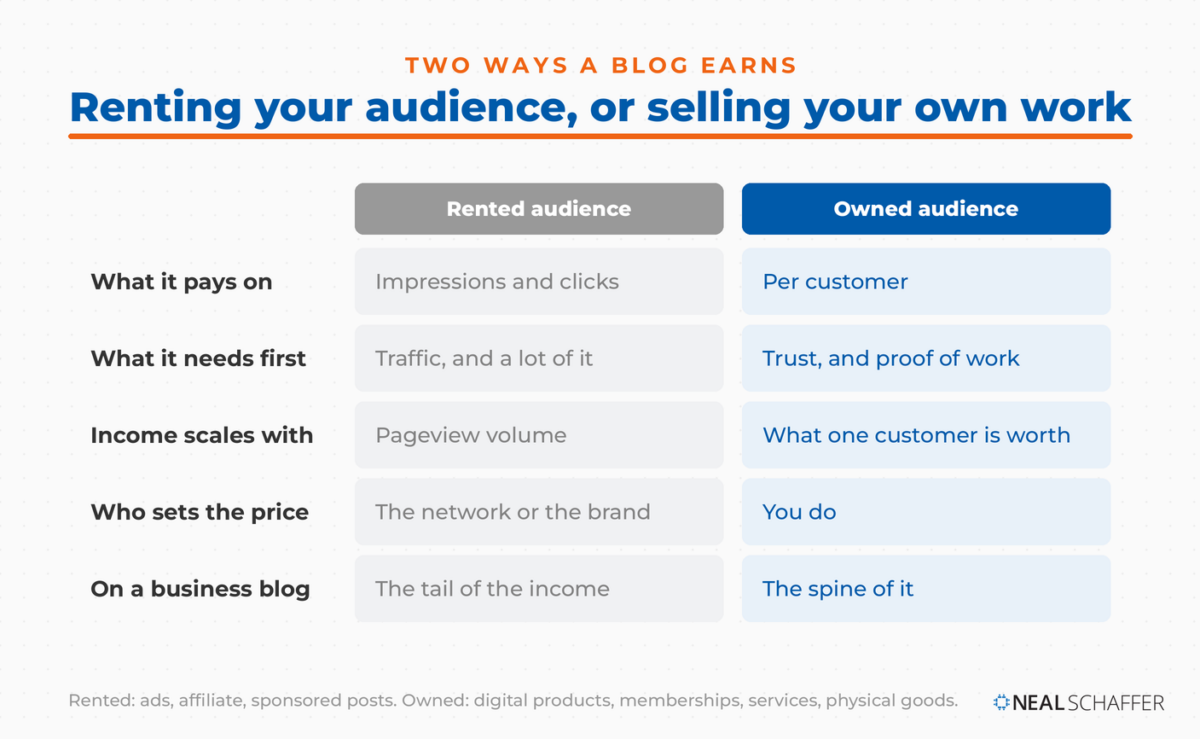
| Method | Group | What it pays on | What it needs first |
|---|---|---|---|
| Ad networks | Rented | Impressions and clicks | Volume, and tier-one traffic |
| Affiliate marketing | Rented | Referred sales and signups | Product fit with your niche |
| Sponsored content | Rented | Per placement | A media kit and audience proof |
| Digital products | Owned | Per unit sold | A problem you can package |
| Memberships and subscriptions | Owned | Recurring per subscriber | An audience that already returns |
| Services and consulting | Owned | Per engagement | Proof you can do the work |
| Physical products | Owned | Per unit, minus fulfilment | Demand plus operations |
None of this makes the rented group worthless. For a business it is the tail of the income rather than the spine, and it is worth being deliberate about how much effort it gets. Ads are where nearly everyone starts, so start there.
How much do display ads and ad networks actually pay?
Display advertising pays you a share of what advertisers spend to appear beside your content, measured per thousand pageviews. Google AdSense has no traffic minimum and pays, in its own words, when a user views or interacts with an ad. The bigger networks pay considerably more per visitor, and they set entry requirements you have to clear first.
Those requirements changed in 2026, and the change matters if you have been chasing an old number. Mediavine now sets Program eligibility by a site’s annual ad revenue from the previous calendar year, with its Official tier starting at $5,000 earned. That replaces the 50,000-sessions rule that most blog posts still quote.
Raptive moved in the other direction and lowered its bar. The current minimum is 25,000 pageviews a month. Sites between 25,000 and 99,999 pageviews also need half their traffic from the US, UK, Canada, New Zealand or Australia. Raptive wants long-form content on most pages and a domain at least six months old.
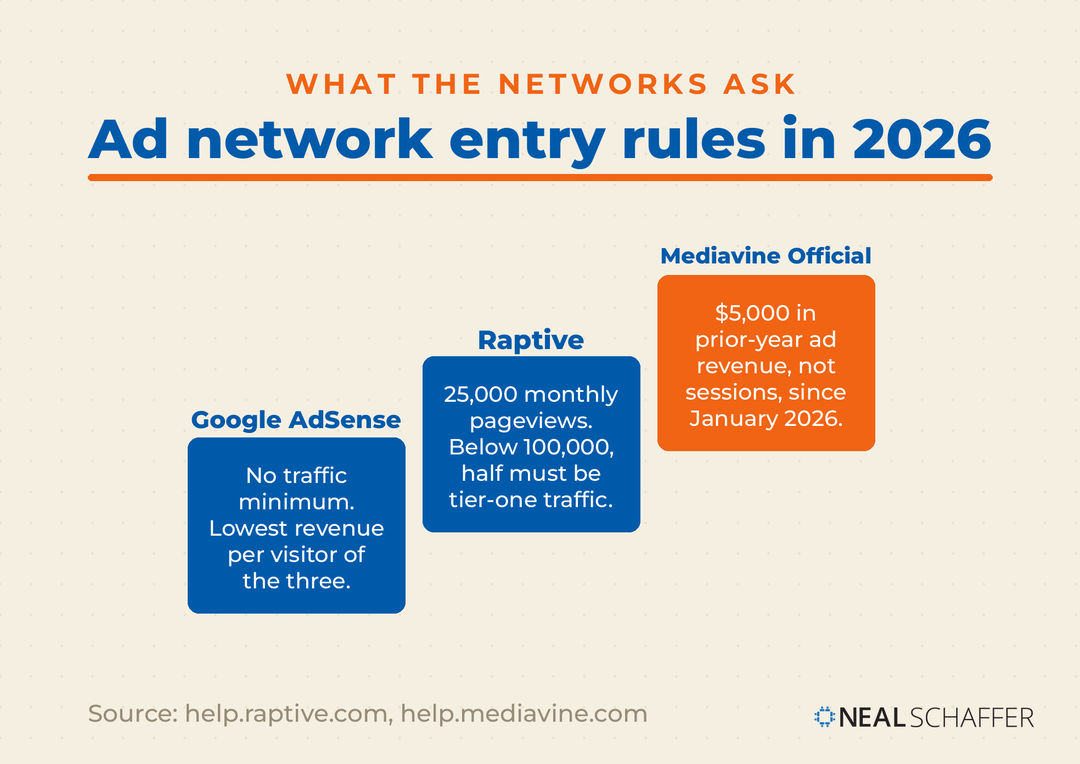
| Network | Entry requirement | Notes |
|---|---|---|
| Google AdSense | None | Sign up and place the code; lowest revenue per visitor |
| Raptive | 25,000 monthly pageviews | 50% tier-one traffic below 100,000 pageviews |
| Mediavine Official | $5,000 in prior-year ad revenue | Revenue-based since January 2026 |
You can also skip the networks and sell placements yourself. AdSense calls this a direct deal, and it is worth considering when your readers are concentrated in one industry, because an advertiser who wants exactly those readers will pay more than a programmatic auction will.
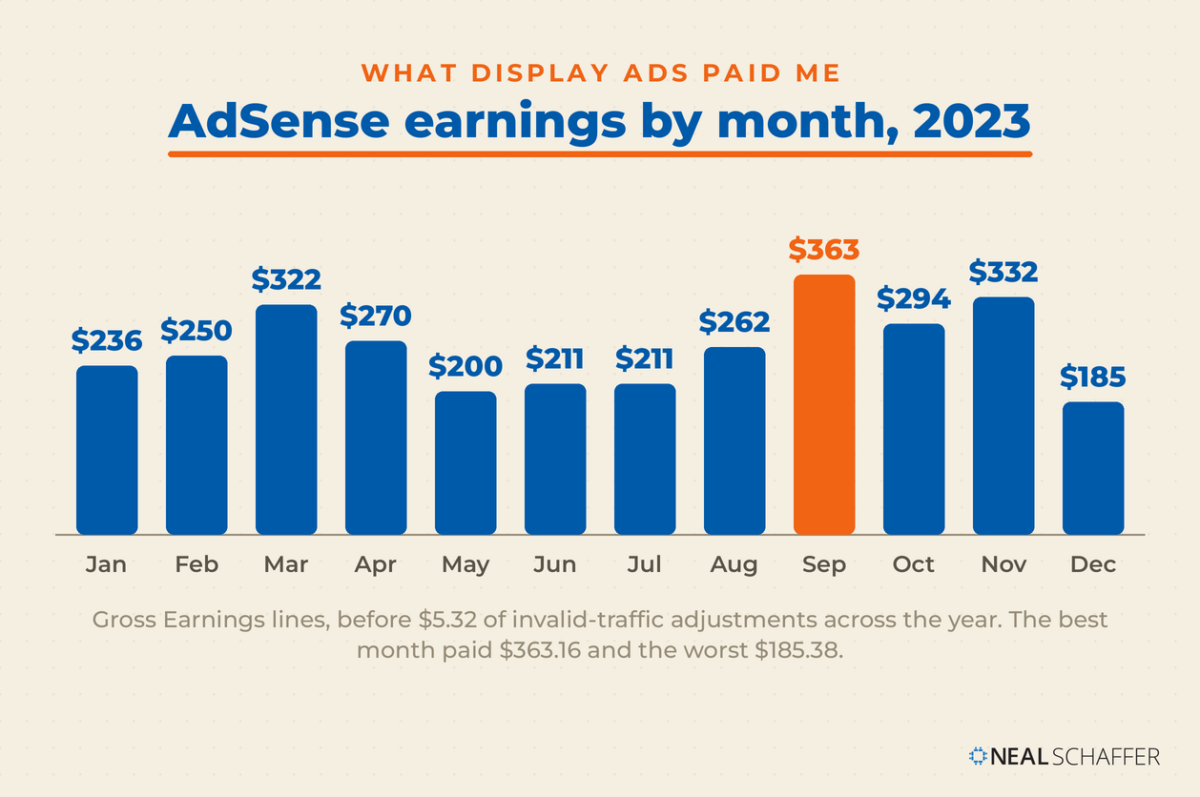
I can put a number on that trade. In 2023, the last year AdSense paid me every month, this blog earned $3,136 from AdSense for Content. That works out to $261 a month across the whole library. Invalid-traffic clawbacks came to $5.32 for the entire year, so that figure is close to the gross.
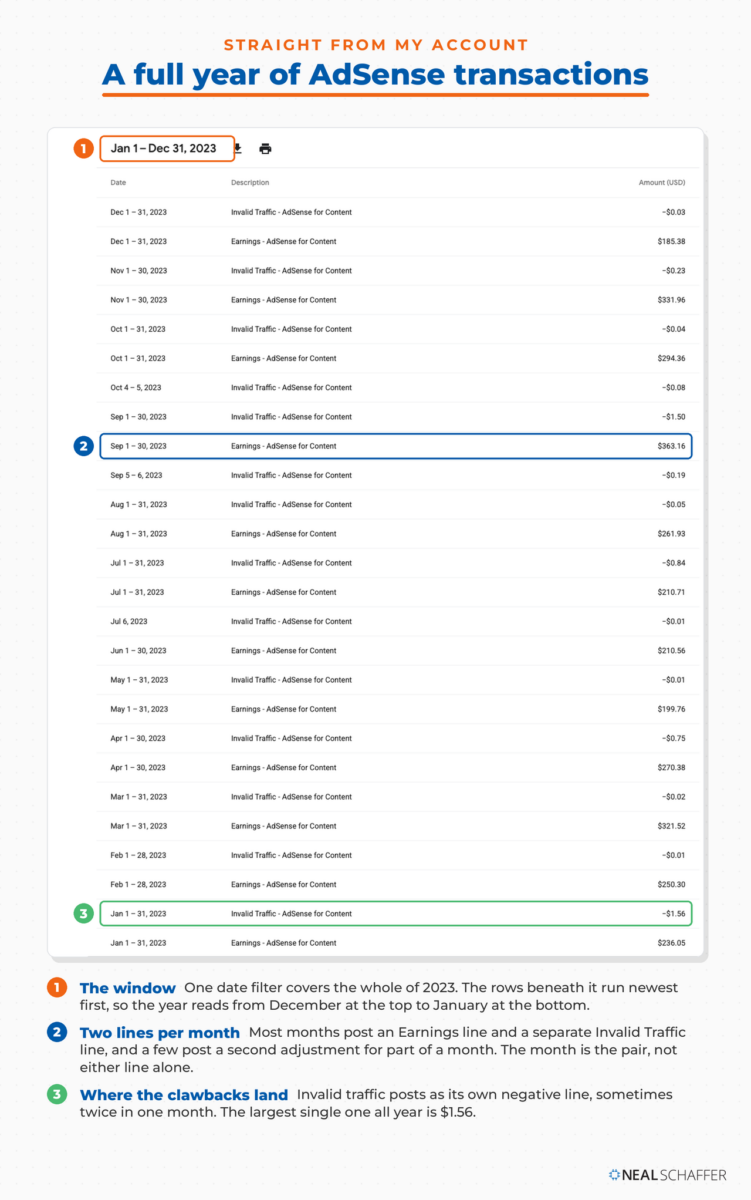
Then I took the ads off. Google’s helpful content update had hit my traffic hard, and stripping ads was part of how I responded. I cannot prove the ads were hurting me, and I would not claim it. What I can tell you is that I gave up roughly $3,100 a year to find out, and I have not missed it.
One of my blogging tips has not changed in years: do not sacrifice user experience for income. Ads slow pages down and send readers away from a site you spent years getting them to. If your blog exists to produce leads, $261 a month is a poor price for a slower page. Affiliate links create a gentler version of the same trade, which is where I would look next.
How does affiliate marketing work on a business blog?
Affiliate marketing pays you a commission when a reader clicks your tracked link and buys from someone else. Amazon’s published rate card runs from 1% on grocery and health products up to 10% on luxury beauty, with a 4% catch-all rate for everything not otherwise listed. Physical books pay 4.5%.
One Strategy to Connect All Your Marketing
My latest book helps small businesses, entrepreneurs, and marketers bring search, email, and social together into one digital marketing strategy that actually compounds.
Drawing on my work as a Fractional CMO, Digital Threads turns complicated tactics into a clear, practical plan you can follow, whatever your budget or team size.
Grab your copy on Amazon and start weaving your own digital threads. Click the cover or the button below to get started.

Read that table as a business and something jumps out. Amazon also pays flat bounties for referred signups, and the Amazon Business bounty is $15 for a single successful account registration. A B2B blog sending readers to open a business account earns more from one of those than from roughly $375 of referred grocery spend.
| What you refer | What Amazon pays |
|---|---|
| Grocery, health and personal care | 1% of the sale |
| Televisions and digital video games | 2% of the sale |
| Physical books | 4.5% of the sale |
| Anything not otherwise listed | 4% of the sale |
| Luxury beauty | 10% of the sale |
| One Amazon Business account signup | $15 flat |
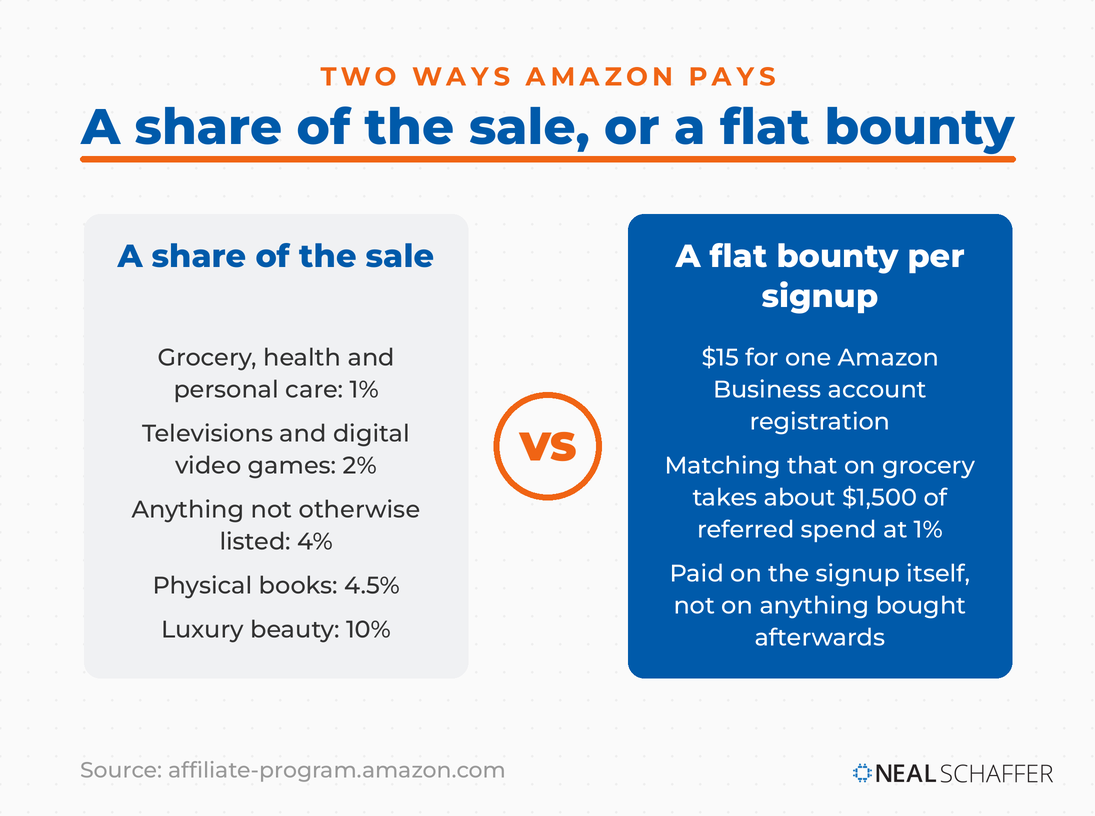
That gap generalises past Amazon. The right question for a business blog is not what percentage a program pays but what one referred customer is worth to the company paying you. Software, financial services and B2B tools price affiliate relationships against customer lifetime value, and their rates reflect it.
Amazon Associates is where most bloggers start, and Rakuten Advertising and the eBay Partner Network sit alongside it as general networks. Direct programs, applied for at the vendor’s own site, tend to pay better and take longer to get into. I go through program selection, link placement and disclosure in more depth on blogging and affiliate marketing.
Disclosure is the part most business blogs get wrong, and it is a legal requirement rather than a courtesy. The FTC treats a financial relationship as a material connection. Its guidance is specific about placement: disclosures are likely to be missed if they appear only on an About page, at the end of a post, or anywhere a reader has to click to see more. Put the line next to the recommendation, in plain words, not folded into a group of links.
Affiliate income asks a brand to pay you for a sale. Sponsored content asks a brand to pay you for the placement itself, which is a harder sell and a bigger cheque.
Sponsored content is a brand paying you a flat fee to publish a post, a review or a mention. It pays more per unit than ads or affiliate links, and it carries the highest entry bar, because a brand is buying access to an audience you have to describe and prove first.
Three things get a sponsorship priced. Traffic, which you pull from analytics. Audience composition, meaning who those readers are and what they buy. And past performance, meaning what happened the last time you featured something. A media kit is where those three live, and it is the equivalent of a CV for your blog.
For a business blog, audience composition is the strongest of the three and the one most bloggers underuse. A thousand readers who are heads of marketing at mid-market companies are worth more to the right sponsor than fifty thousand general readers. A trade publication charges more per reader than a consumer magazine for the same reason.
The same FTC placement rule applies here, and more visibly: a paid post needs the word “sponsored” where a reader meets the content, not in a footer. Beyond the law, sponsorships spend trust. Take too many, or take ones your readers can tell you do not believe in, and you damage the asset that made the sponsorship valuable.
Every method so far pays you for access to your readers. The next four pay you for something you made.
How do you sell your own products from a blog?
Selling your own products turns a blog post into a storefront for something you control: a course, a template, an ebook, or physical goods. Margins and pricing are yours, no platform can cut your rate overnight, and the post that sells the product is the same post that ranks.
Digital products
Digital products suit a business blog because the thing you already sell is usually expertise, and expertise packages well. Courses, templates, spreadsheets, ebooks and paid research all work. Thinkific and Teachable host courses, WooCommerce and Shopify handle checkout on your own site, and Gumroad handles it without one.
The pattern I would follow is the one my podcast guest described. Graham Robertson, founder and CEO of Beloved Brands, built a consulting practice on a marketing blog and then productised the same material for readers who would never hire him. He told me on my podcast that his product pages are “your classic case of content marketing, except I’m doing the content in order to generate my own business.”
Start with the material you already have. If you run training, the slides are a template product. If you answer the same client question every month, that answer is an ebook. Price it low enough to be an entry point rather than a decision, because its job is to start a relationship with the readers who are not going to buy your main service.
Physical products and merchandise
Physical products are the harder half. Branded merchandise, print-on-demand goods and full product lines all work from a blog, and all of them add operations: stock, shipping, returns and tax. AdSense’s own summary of the model puts it plainly, noting that digital goods are less complex logistically because they can be delivered electronically.
Print-on-demand and dropshipping remove most of the inventory problem by pushing fulfilment to a partner, at the cost of margin and quality control. For most business blogs, physical products make sense only when the product is the business already, or when merchandise is a brand play rather than a revenue line.
Products sell once. The next method sells the same audience the same thing every month.
Do paid memberships and subscriptions work for a business blog?
Paid memberships and subscriptions charge readers a recurring fee for access to something your free posts do not include: a community, a private newsletter, tools, office hours or an archive. The revenue is predictable, which is its main advantage over every other method here. It also requires an audience that already comes back without being prompted.
Platform choice comes down to what the fee structure costs you at your size. Substack takes 10% of each transaction, on top of Stripe’s 2.9% plus $0.30 per transaction and a 0.7% recurring billing fee. Patreon and Memberful sit in similar territory. Running membership on your own site through WordPress costs a flat monthly fee instead, which becomes the cheaper option once your subscription revenue is large enough that a percentage hurts.
What you put behind the wall just might matter more than where you host it. Business audiences pay for things that save them time or reduce their risk: templates, benchmarks, direct access to you, a peer group facing the same problem. They do not pay for more articles.
I run a group coaching membership myself, so I will say the unglamorous part. A membership is a delivery obligation every single month, and it is the monetization method most likely to become a second job. Weigh that before you launch one, because the churn from a neglected community costs more than the revenue was worth.
A membership asks many people for something small every month. The last method asks a few people for something large, and for most business blogs it is the one that pays.
How do you turn blog readers into consulting or service clients?
Service revenue means a reader hires you. For a consultancy, agency or professional practice, this is usually the highest-value thing a blog produces, because one engagement can beat a year of ad income. The blog does the qualifying: by the time someone contacts you, they have read your thinking and agree with it.
The mechanics are unglamorous and most blogs skip them. Every post needs a route to the thing you sell, placed where a reader who is convinced can act. That means an in-content link to the relevant service page, not a sidebar banner, because readers who scroll to the end of a 3,000-word post are the ones already leaning in.
Set it up in this order, and the reason for the order is that each step is useless without the one before it. First, pick the three or four posts that already rank for problems your service solves. Second, add a specific call to action inside those posts naming the outcome, not the service. Third, add a lower-priced entry point for everyone who will never buy the main thing. Graham described that last step as the answer to what you do with the other 49,000 readers a month who are never going to hire you.
This is what a digital marketing funnel looks like when the top of it is a blog, and it is worth measuring like one. If you are not attributing signups and enquiries to the posts that produced them, you cannot tell which of your posts is a business asset and which is just traffic. I get into the measurement side of that on content marketing ROI.
All seven methods assume readers, and a blog that nobody finds pays nothing under any of them. So check the foundations before you pick one.
What has to be working before any of these methods pay?
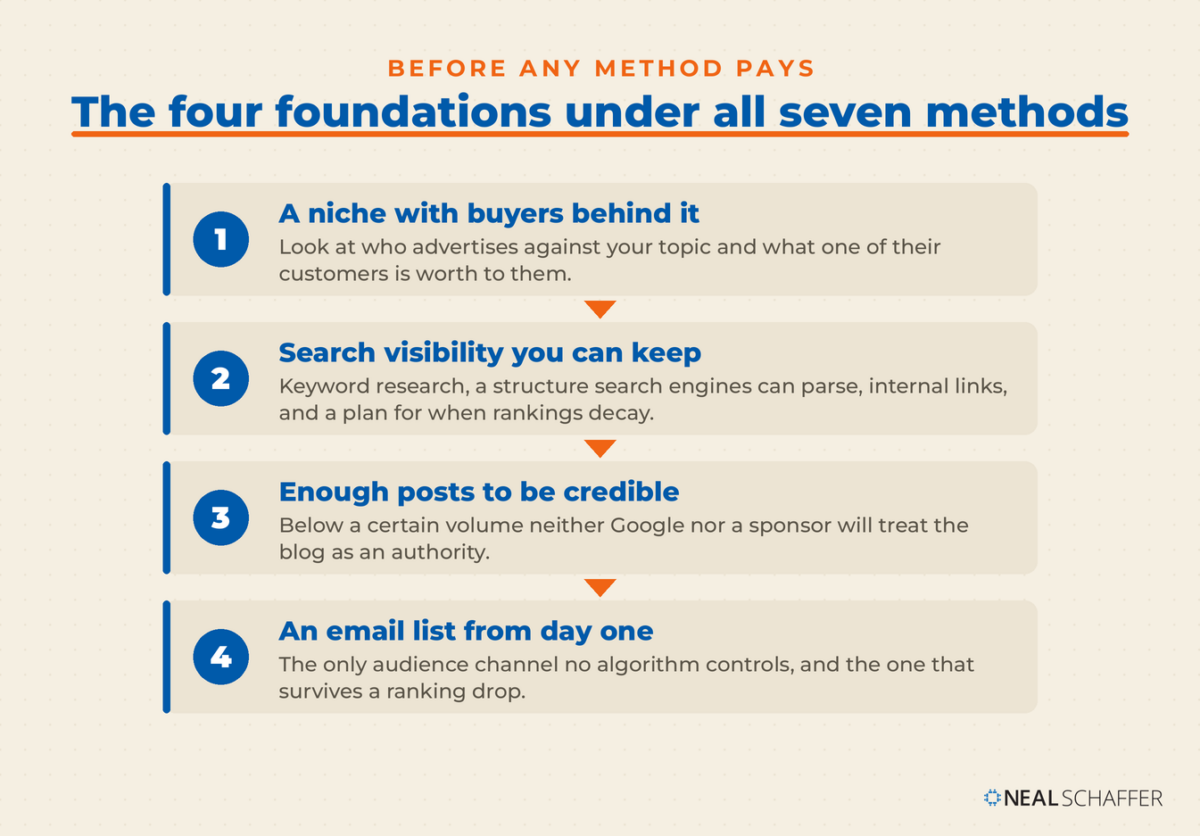
Four things sit underneath all seven methods: a niche with commercial demand, search visibility, enough published content to have authority, and an email list. Skip any of them and the monetization method you choose will underperform for reasons that have nothing to do with the method. Fix them in that order, because each one makes the next one cheaper.
Pick a niche with buyers behind it
A profitable niche and your preferred niche are not always the same thing. I use the same example every time I teach this: plenty of people search for recipes, and there is no shortage of consumer brands who will work with a food blogger. If you can write credibly about financial advice, you may earn far more per sponsor, because the customer lifetime value behind each reader is higher.
That is the whole test. Look at who advertises against your topic and what one of their customers is worth. If nobody is selling anything expensive to your readers, no monetization method will fix it. If you are still choosing, how to start a blog is the place to work through it.
Get search visibility, then keep it
Search is what brings people who do not already know you. That means keyword research, a post structure search engines can parse, and internal links between related posts. I have written out the specifics on blog SEO, and the structural side on blog post format.
The part nobody warns you about is decay. You publish, you rank, competitors update their pages, and your position slides. It took me until 2020, twelve years into blogging, to take search seriously, and that delay probably cost me more than any monetization decision I made.
Publish enough to be credible
A blog with a dozen posts does not have topical authority, and neither Google nor a sponsor will treat it as an authority. Volume is not the goal by itself, but there is a threshold below which nothing else works. Scale it by writing more yourself, hiring writers, accepting guest blogging submissions, or using AI carefully to draft while keeping the judgment yours.
Build the email list from day one
Email sits underneath all seven methods, because it is the only audience channel no algorithm controls. It is how you launch a product to people who already trust you, how you prove audience quality to a sponsor, and how you bring readers back when a search update moves your rankings. The mechanics of opt-in offers and placement are on how to build an email list.
Those four have been the foundations for a decade. What has changed underneath them is where the traffic comes from in the first place.
How is AI search changing what a blog can earn?
AI summaries in search results are cutting the click-through that ad and affiliate income depend on. Pew Research Center found that Google users who saw an AI summary clicked a traditional search result in 8% of visits, against 15% for users who did not. Clicks on a link inside the summary itself ran at 1% of visits.
I can see the same thing on my own numbers. Google organic sessions on my site are running at roughly 54% of where they sat in January. I have watched the decline hit hardest on exactly the kind of post that answers a question completely in its first paragraph. Those posts were never going to earn much per visitor anyway. The ones that hold up are the ones with something in them a summary cannot reproduce.
That reshuffles the seven methods rather than ending them. Every rented-audience method is priced off volume, so a volume decline hits ads, affiliate links and sponsorship rates directly. The owned-audience methods are priced off trust, and a reader who arrives having already read three of your posts converts the same as they did two years ago.
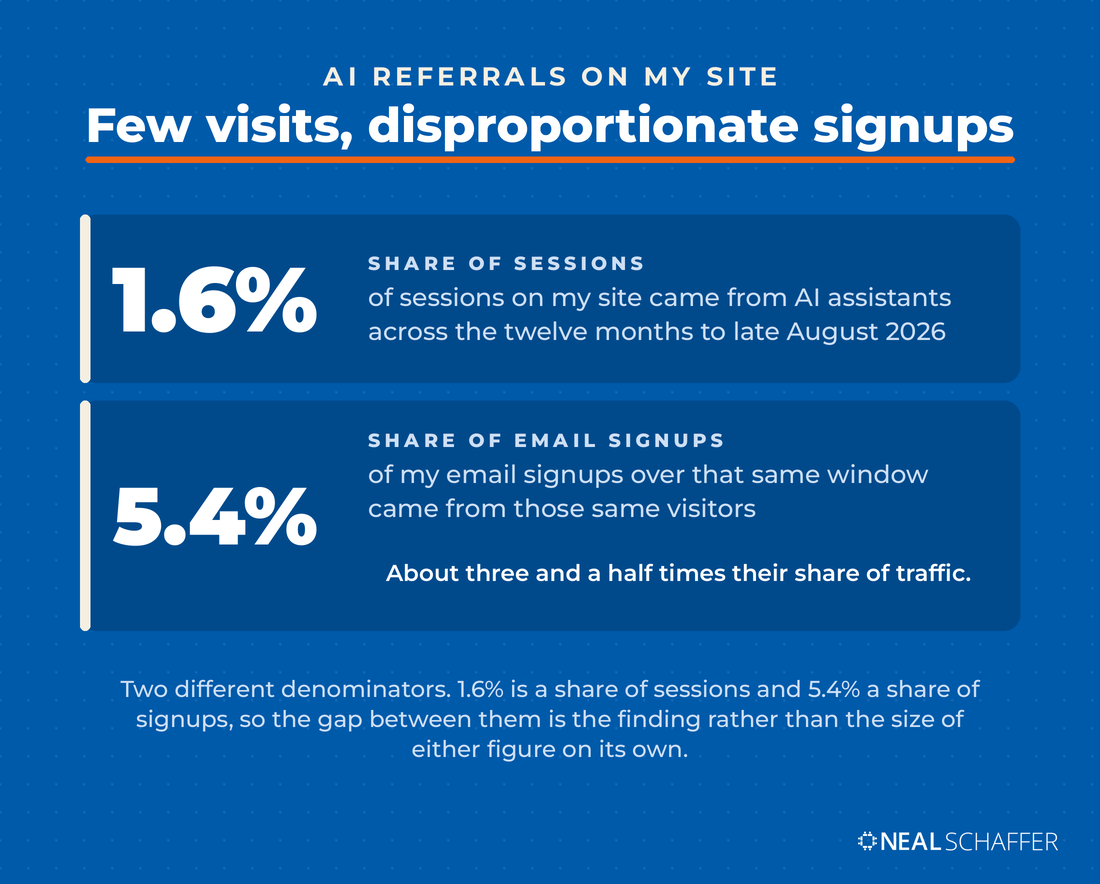
My referral numbers say the same thing from the other direction. Across the twelve months to late August, AI assistants sent 1.6% of my sessions and 5.4% of my email signups, roughly three and a half times their share of traffic. Those visitors engage slightly less than my site average, and they sign up anyway. I broke the rest down on AI search engine optimization.
Businesses appear to be reading it the same way. In the Content Marketing Institute’s survey of 1,015 B2B marketers, owned media, meaning content assets, website, blog and email, was the third-highest investment priority for 2026 at 32%, behind AI tools and events. The same survey found the top content challenge was creating content that prompts a desired action, named by 40%. If that is your problem too, it is an argument for the owned group rather than a better ad placement.
Frequently Asked Questions About Monetizing a Blog
Less than most people assume, if you sell your own work. Google AdSense has no traffic minimum, and consulting or a digital product can be sold to a few hundred of the right readers. The traffic thresholds people quote, like Raptive’s 25,000 monthly pageviews noted earlier, apply only to the ad networks.
Start with a route from your best-performing posts to whatever you already sell, because it needs no new product, no application and no audience minimum. Add affiliate links to tools you genuinely use, then look at products or a membership once you can see which posts convert.
Plan on months rather than weeks for search-driven income, since rankings compound slowly and sponsors want to see an existing audience. Selling to your own email list can produce revenue much sooner. A year of consistent publishing is a fair expectation before a blog reads as income rather than overhead.
Yes. The FTC treats payment, free products and discounts as material connections that require disclosure, and the disclosure has to appear with the recommendation itself rather than in a footer or an About page. Its guidance on placement is linked in the affiliate section above.
Yes, though the mix has shifted. Methods that pay per pageview are worth less than they were, and methods that pay per customer are worth about the same. Posts built on firsthand experience and original data still earn clicks and citations, because a summary cannot reproduce what only you have seen.
Start With the Revenue Stream You Already Have
Pick one method this week rather than four. If you run a business, the fastest money is almost never a new ad unit; it is a clear route from the three posts that already rank to the thing you already sell. Add that route, then measure which post produced the enquiry.
Once that is working, choose a second method from the owned group. A digital product priced as an entry point tends to be the easiest second step, because you can build it from material you have already published.
If you want the numbers behind why business blogging still pays, the business blogging statistics are worth bookmarking, and the same logic applied beyond the blog is on how to monetize a website. If you would like help wiring your blog into the rest of your marketing, download a free preview of Digital Threads or talk to me about Fractional CMO services.
Actionable advice for your digital / content / influencer / social media marketing.
Join 13,000+ smart professionals who subscribe to my regular updates.
