

You wrote a post built to get comments. It asked a question, it had a decent photo, and it landed four likes. Two came from people who work with you.
Then you searched for Facebook engagement post ideas, found a list of eighteen of them, and half the list told you to ask people to tag a friend or vote with a reaction.
Those two things are connected. Those prompts are the exact tactics Meta built a machine learning model to push down, and it has been doing so since December 2017.
I have been teaching social media marketing to executives at Rutgers Business School for years, and I still run into the same confusion in client work. In Maximize Your Social I argued that social platforms reward content people actually want, not content engineered to trigger a tap. Facebook has spent the years since making that argument mechanically true. I write about this regularly and come back to it on my podcast, and the gap between what gets recommended and what gets distributed has only widened.
I am not going to pretend my clients are pouring effort into Facebook right now. Most of them are not, because the organic numbers stopped justifying the production time.
Facebook has become pay to play, and I would argue the dollars you put into Facebook Ads will do more for you than the hours you burn producing organic content and trying to outguess the algorithm. If you have budget, that is the first place I would put it, and whether Facebook ads are worth it is the more useful question for most businesses to answer first.
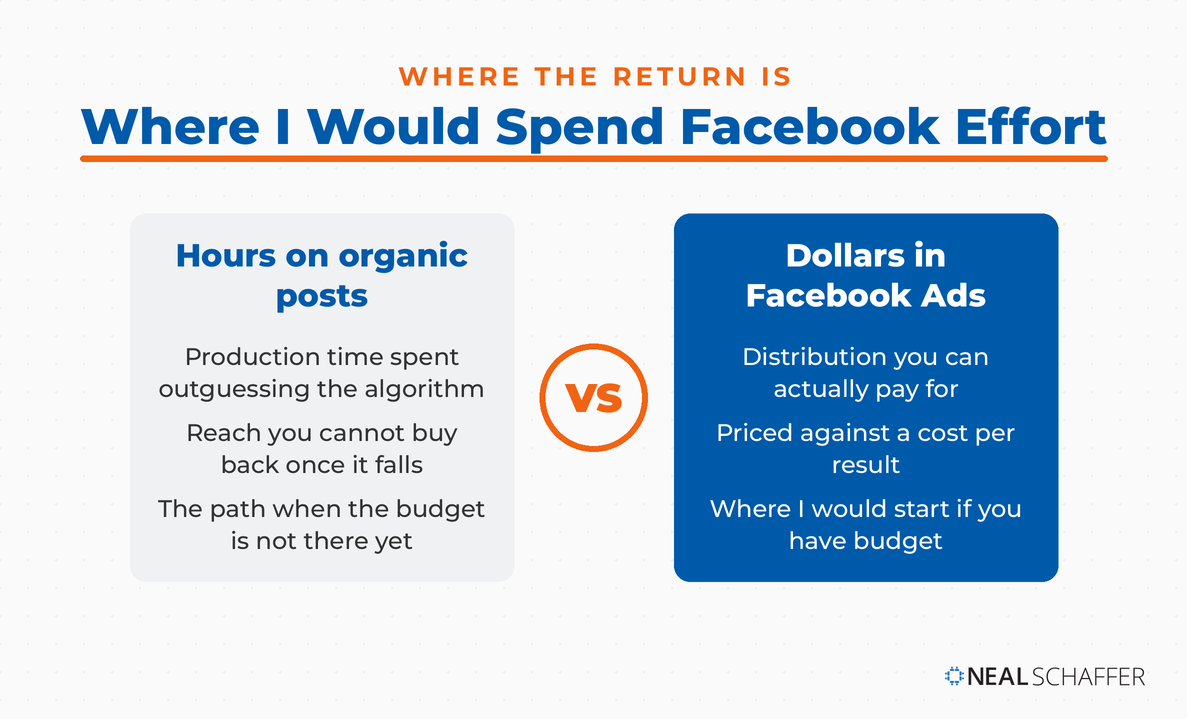
Plenty of you are going to post organically regardless, because the budget is not there yet or because the Page still has to look alive to anyone who checks it. If you are spending that time, spend it on the posts that work.
Which brings me to the question I keep coming back to. Can you treat your Page as an extension of your personal profile, and treat the people following it as if they were friends?
That question happens to line up with what Facebook says it does, which is why the rest of this holds together.
Key Takeaways
✅ Post to your followers like they are friends. Facebook’s 2018 ranking overhaul told Pages plainly that posts prompting conversation between friends would lose less reach than posts nobody answers.
✅ Engagement bait is a named, demoted category. Meta demotes individual posts that goad people into liking, sharing, commenting, or tagging, and applies stricter demotions to Pages that do it repeatedly.
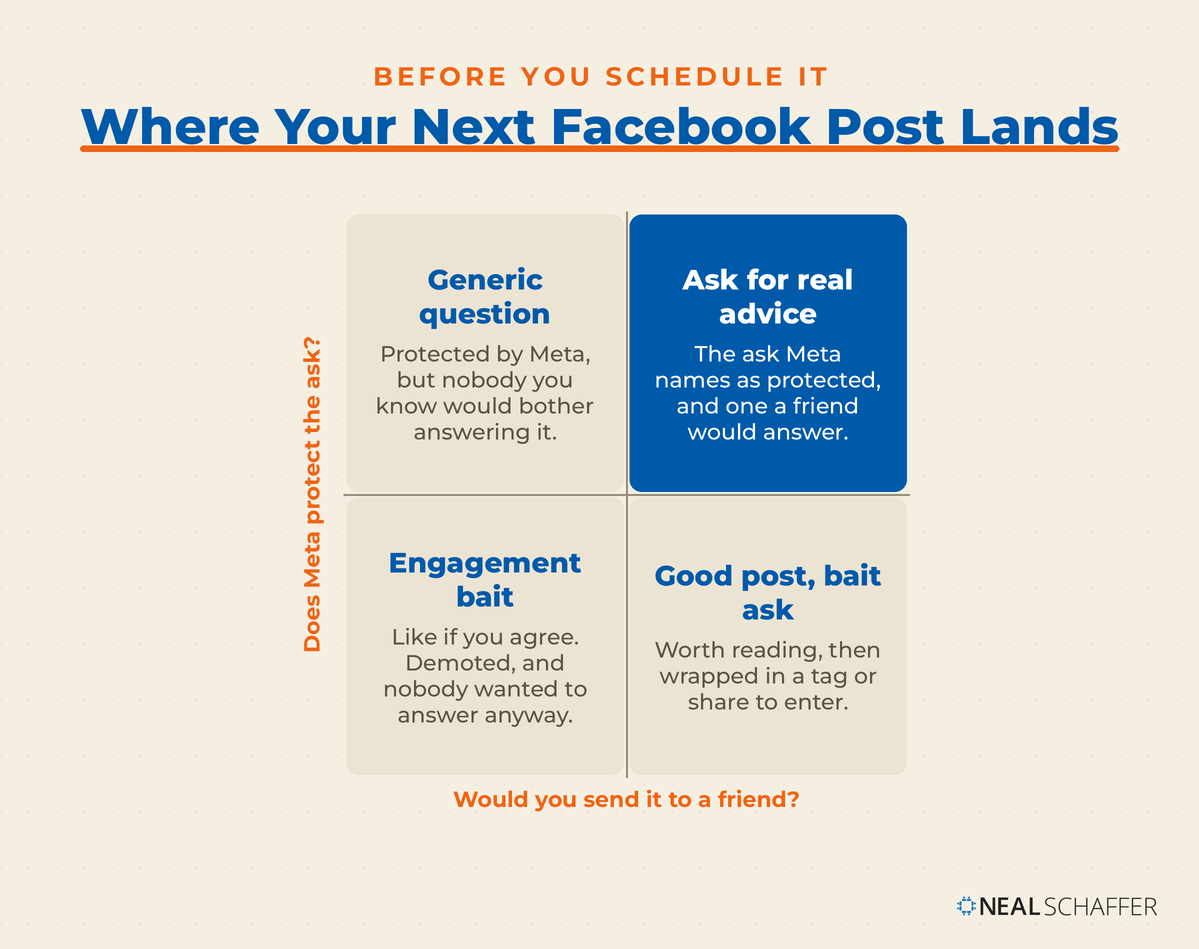
✅ Asking for help, advice, or recommendations is explicitly protected. The same Meta announcement says those posts are not adversely affected, which I would argue is the most useful line in it.
✅ Format barely matters on Facebook. Buffer’s analysis of 52 million posts found images, video, and text landing within one percentage point of each other, so what you post about probably matters more than whether it is a photo.
✅ Replying is the most underused lever available. Facebook Pages that replied to comments saw roughly 9.5% more reactions on the post itself, measured against their own baseline.
✅ Brands cut Facebook posting volume hard and engagement held. The all-industry median fell to about three posts per week in Quid’s 2026 benchmark, its lowest in six years.
What Is a Facebook Engagement Post?
A Facebook engagement post is a post written specifically to prompt a reaction, comment, or share rather than to drive a click or a sale. Questions, polls, fill-in-the-blanks, and behind-the-scenes photos all qualify. What separates the good ones from the demoted ones is intent, which is what I want to walk through here.
That definition matters because it cuts both ways. A post designed to start a conversation and a post designed to farm a tap look similar in a content calendar. They do not look similar to Facebook.
The difference sits in whether the interaction you are asking for is something a reader would plausibly want to do. “What is the one tool you would keep if you had to drop the rest?” invites a real answer. “Like if you agree” invites a reflex.
And that is exactly where the friend question from the top of this page does its work.
What Happens If You Treat Your Page Like a Personal Profile?
Treating your Page like a personal profile means posting what you would post to friends and answering people like a person rather than a brand. Facebook’s January 2018 ranking overhaul told Pages directly that those whose posts prompt conversations between friends would see less of a reach decrease than Pages nobody answers.
Adam Mosseri, then Head of News Feed, put the split in one sentence when he announced the change. Pages posting things people do not react to or comment on “could see the biggest decreases in distribution,” while “Pages whose posts prompt conversations between friends will see less of an effect.”
Notice what Meta chose as its examples of the posts it wanted to reward. A friend seeking advice. A friend asking for trip recommendations. Both are things a person does, and neither is something a brand account typically does.
So the friend test is a practical filter rather than a warm sentiment. Before you schedule anything, ask whether you would send it to someone you know. If the answer is no, your followers are unlikely to treat it as anything other than an ad.
I would argue this reframing does more for a struggling Page than any format change on offer, because it changes what you write rather than how you package it.
Which raises the mechanical question underneath: what is Facebook actually doing with all of this?
Is LinkedIn Actually Bringing You Business?
My latest book helps professionals, entrepreneurs, and business owners turn LinkedIn from a static profile into a real source of clients and growth.
Maximizing LinkedIn for Business Growth gives you clear, practical steps to build a profile that gets noticed and a network that actually sends business your way.
Grab your copy on Amazon and put it to work this week. Click the cover or the button below to get started.

How Does Facebook Decide Which Posts to Show?
Facebook’s Feed ranking runs in four steps: it gathers eligible posts, reads thousands of signals, runs over 100 prediction models, and assigns each post a relevance score. Meta publishes the model list in its Transparency Center, and reading it changes how you write posts.
The models in Meta’s top-weighted group are worth naming, because they are not the ones most advice optimizes for. They include how likely you are to meaningfully interact through some combination of commenting, reacting, resharing, or spending time viewing. They also include how likely you are to spend time viewing the comments on a post.
That last one deserves attention. A post whose comment section people read and stay in is being scored on something a like never touches. So is the model predicting how many additional comments or replies a post gets if you comment on it.
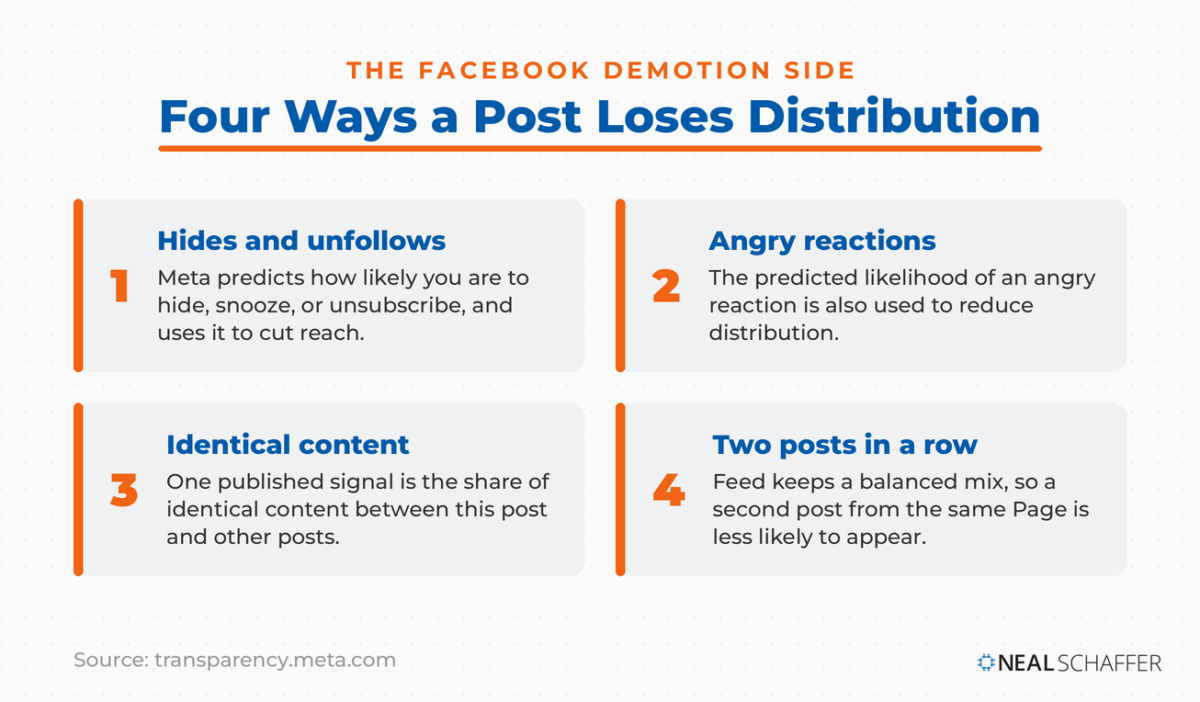
Two models run in the opposite direction. Facebook predicts how likely you are to hide, snooze, or unsubscribe from a post, and how likely you are to leave an angry reaction, and both are used to reduce distribution.
So a bait post carries an asymmetric risk. It might earn a shallow tap. It might also earn a hide, and the hide costs more than the tap pays.
The signal most people miss
Buried in that same published signal list is one about the post itself rather than the person: the percentage of identical content between this post and other posts. Recycling the same status across your Page, or lifting a viral prompt everyone else already ran, is measurable at the platform level.
Meta also states that its system tries to keep a balanced mix in your Feed, so you are less likely to see multiple posts from the same Page in a row. Posting five times before lunch does not get you five slots.
Understanding the scoring is one thing. Knowing which specific tactics are classified as abuse is another, and that list is shorter and more specific than most marketers realize.
Engagement bait is content that goads people into interacting through likes, shares, comments, or tags when the content itself is not meaningful to them. Meta began demoting these posts in December 2017 and warned that Pages doing it repeatedly would see larger drops in reach. The policy has only expanded since.
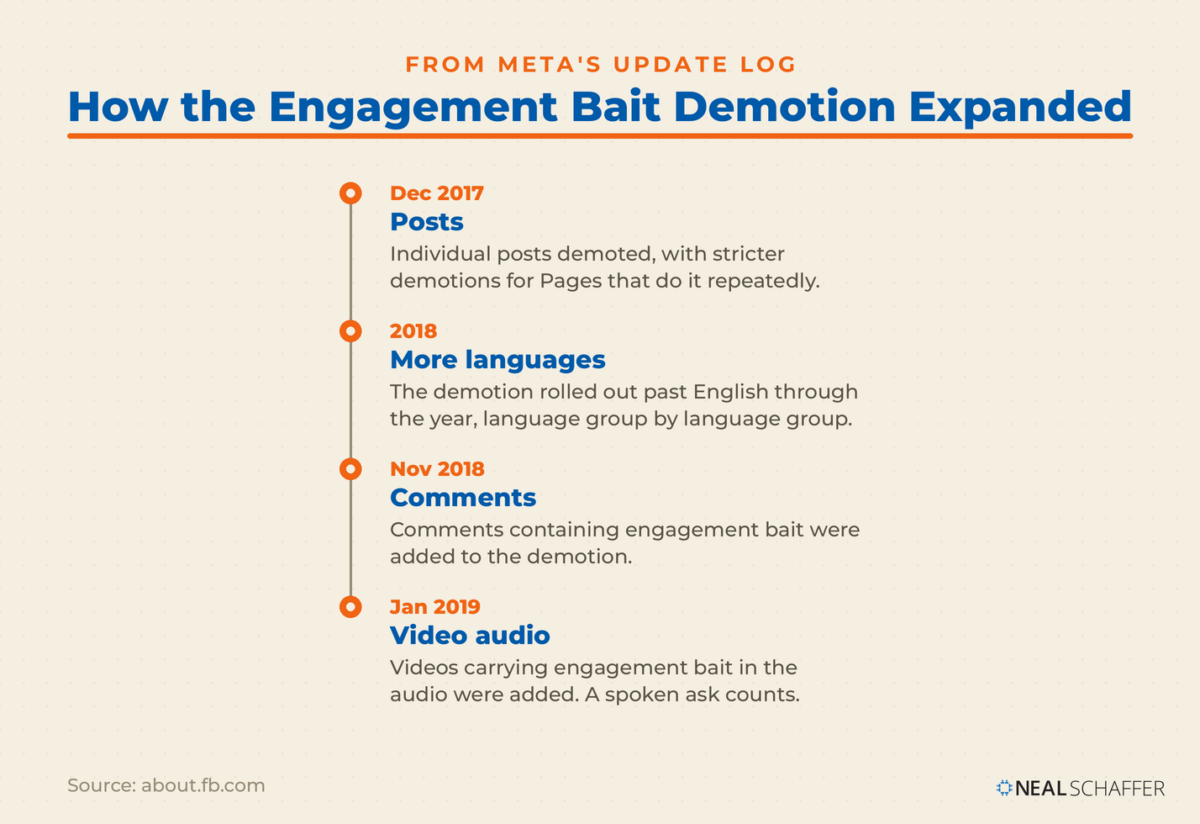
Meta’s own integrity team explained the reasoning plainly. Engagement bait “seeks to take advantage of our News Feed algorithm,” wrote Henry Silverman and Lin Huang, the Meta operations integrity specialist and engineer who announced the change.
The enforcement expanded steadily after launch. Meta’s own update log on that announcement records the demotion reaching comments containing engagement bait in November 2018, then videos containing engagement bait in the audio in January 2019. A voiceover saying “smash that like button” sits inside the policy.
Now for the part that almost nobody quotes, and it is the useful part. Meta stated that posts asking people for help, advice, or recommendations would not be adversely affected by the update.
Read those two rules together and you get a working test. Asking for something the reader benefits from giving is fine. Asking for something only you benefit from receiving is not.
| The bait version | The version that survives |
|---|---|
| “LIKE if you agree” | “Which of these two would you actually use? Curious because we are choosing one.” |
| “Tag a friend who needs this” | “If you know someone dealing with this, I would send them the second tip.” |
| “Comment YES below” | “What did you try before this, and did it work?” |
| “Vote with a reaction: 😍 or 😢” | “We are deciding between these. Tell me which and why.” |
| “Share to enter” | A Facebook contest with entry rules that live off-post |
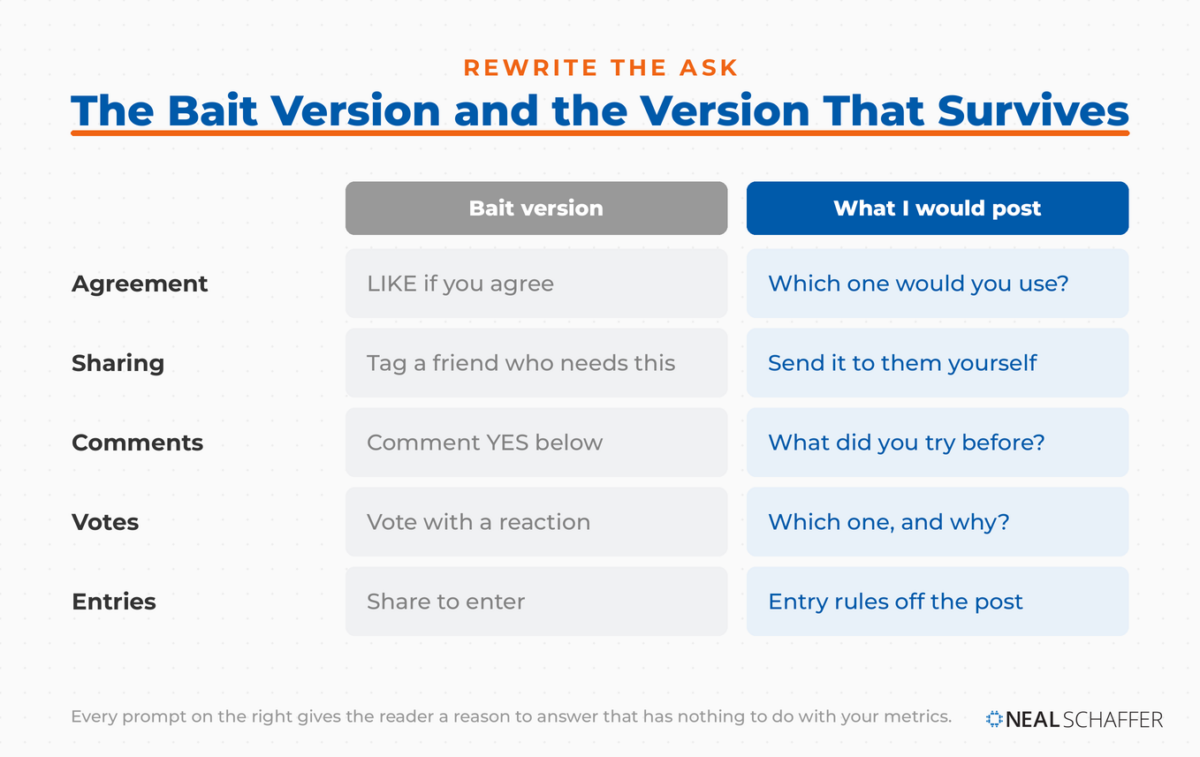
The pattern in that right column is that every prompt gives the reader a reason to answer that has nothing to do with helping your metrics. That is the whole trick, and it is also why generic prompt lists underperform: a prompt lifted from a listicle cannot know what your audience would want to weigh in on.
Knowing what to avoid still leaves the harder question of what to publish instead.
Which Facebook Engagement Posts Actually Work?
The Facebook engagement posts that work in 2026 ask for something the reader gets value from giving: an opinion they hold, advice they can offer, or a recommendation they enjoy making. Meta protects those formats by name. Everything else on this list earns its reach by being genuinely interesting rather than by requesting a tap.
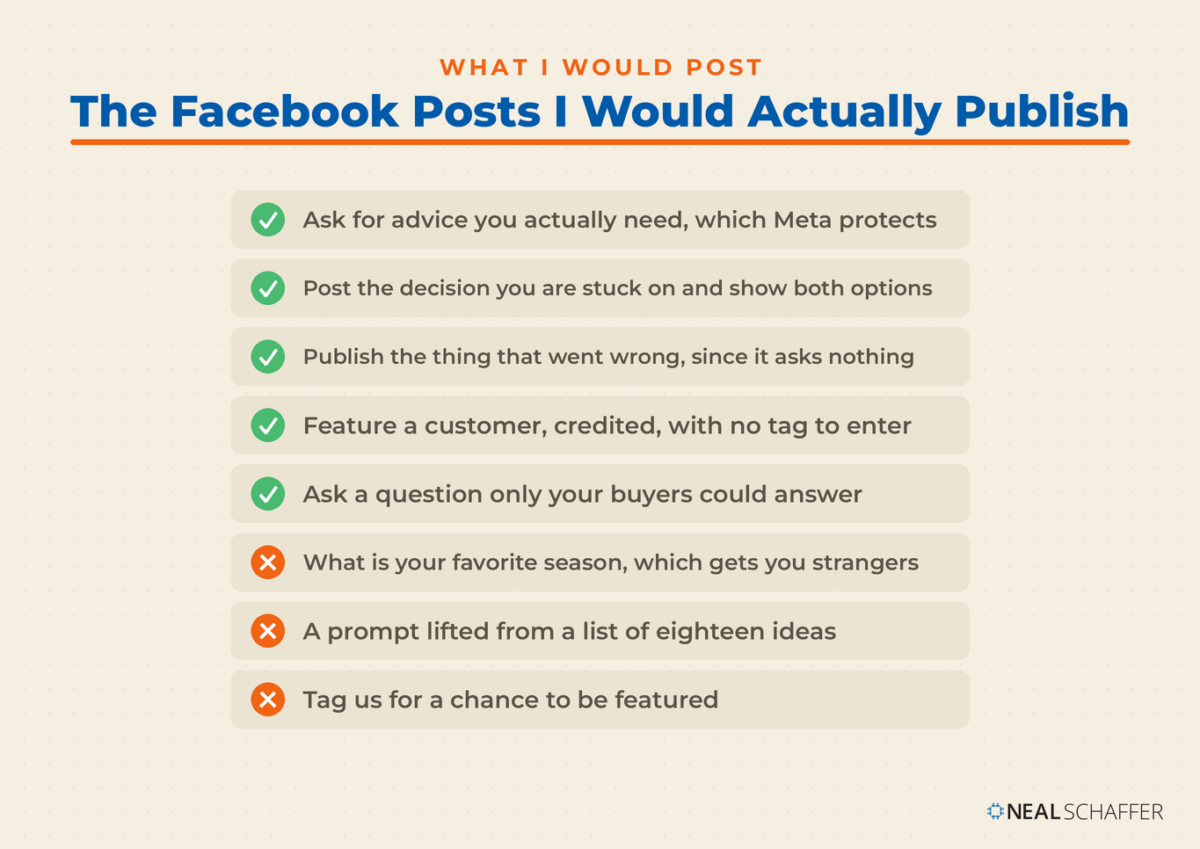
I picked these by running each one through the friend test rather than by copying what ranks. Most of my clients have pulled back from organic Facebook, so what follows is the set that survives that question and that Meta’s own documentation either protects outright or rewards through its ranking models.
Ask for advice you actually need
This one sits inside Meta’s protected category, so it carries no demotion risk at all. It is also the exact example Meta reached for when describing what it wanted more of, which is not a coincidence: asking for advice is what friends do.
The requirement is that the question be real. “What should we name the new one?” from a business that is actually naming something reads differently from a manufactured prompt, and readers can tell.
Post the decision you are stuck on
Show two options and ask which. Think of how often you have watched a friend post two paint colors and collect forty replies. Answering costs nothing and people have opinions about choices.
I have used this pattern with clients choosing between packaging designs and cover concepts, and the comment threads routinely turn into a better research panel than a formal survey would have produced.
Publish the thing that went wrong
Posts about a mistake, a failed batch, or a delayed shipment earn comments because they invite people to share their own version. From what I have seen, these consistently outperform the polished announcement sitting next to them in the calendar.
They also carry no bait risk, since you are not asking for anything.
Feature a customer or their content
User-generated content works on Facebook for a structural reason. The person featured has a reason to comment and to bring their own network into the thread, which feeds the comment-volume prediction Meta runs.
Ask permission, credit clearly, and skip the “tag us for a chance to be featured” framing, which lands you back in bait territory. A friend crediting a friend does not attach terms to it.
Ask a question only your audience can answer
Niche beats broad here. “What is your favorite season?” gets you strangers. “What is the one thing you wish your first supplier had told you?” gets you buyers, and it tells you something.
If you need more angles than these, there are more Facebook post ideas on the site, along with social media engagement posts for formats that carry across platforms.
Run the conversation in a Group
Page posts compete with everything. Facebook Groups are a different surface with different dynamics, and member-to-member conversation is the point rather than a side effect. If you do not have one yet, creating a Facebook Group takes about five minutes.
All of which raises the question of whether any of this depends on the format you choose. The data says less than you would think.
Does Post Format Matter on Facebook?
Less than almost anywhere else. Buffer’s study of 52 million posts found Facebook’s format gaps are unusually small, with under one percentage point separating a photo from plain text. Images hold a slight edge and link posts sit slightly behind, which fits the platform’s pattern of keeping people on-site.
| Facebook post format | Median engagement rate |
|---|---|
| Image | 5.20% |
| Video | 4.84% |
| Text only | 4.76% |
| Link post | 4.43% |
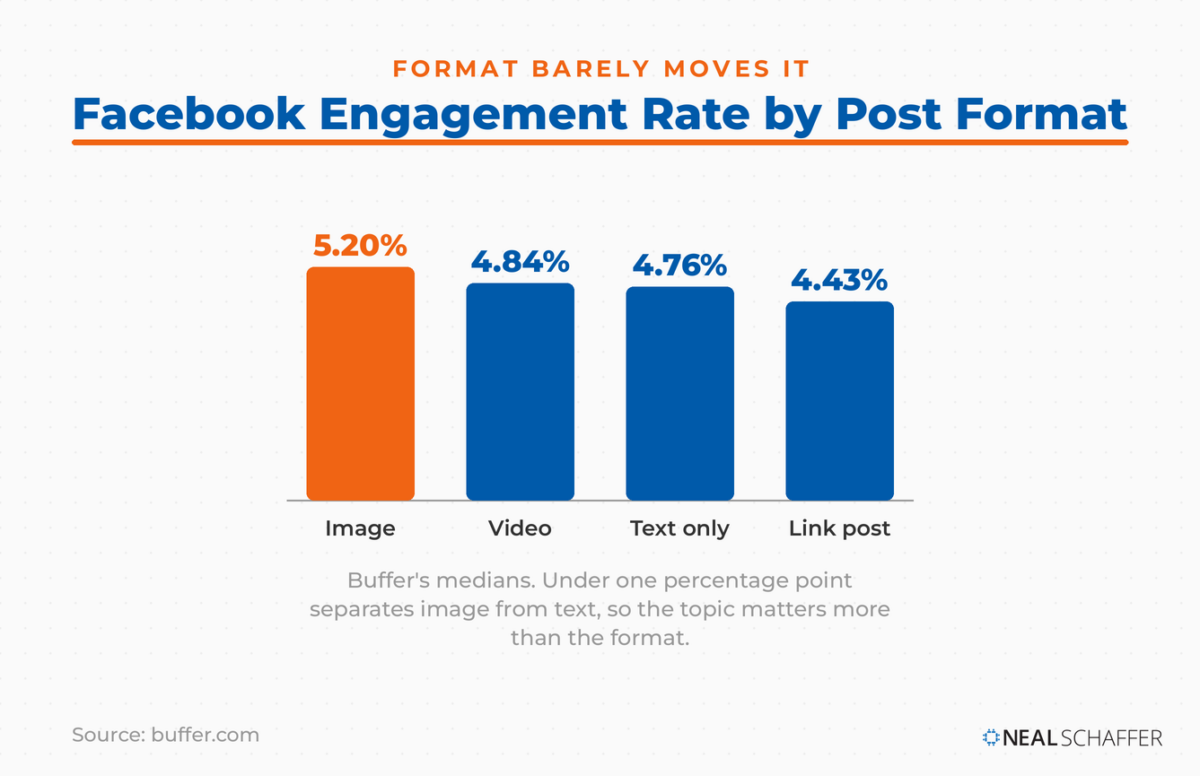
Compare that spread to Instagram in the same study, where carousels run more than double the rate of Reels. On Facebook, the wrapper is close to irrelevant, and I would argue the topic of your post matters considerably more.
That is worth internalizing, because the advice ecosystem points the other way. If you have been told your engagement problem is a video problem, the data does not support it on this platform.
Make the visual good anyway, since a clear graphic still earns the scroll stop, and Adobe Express is what I reach for when I need one quickly. Just stop treating format as the variable that will fix a post nobody wanted to read.
Format aside, there is one behavior that moves the number more reliably than anything else you can control.
Replying to comments is the strongest and most underused lever in Facebook engagement. Buffer’s within-account analysis of nearly two million posts found Pages earned roughly 9.5% more reactions on posts where they replied, with about 54% of Pages beating their own baseline on those posts.
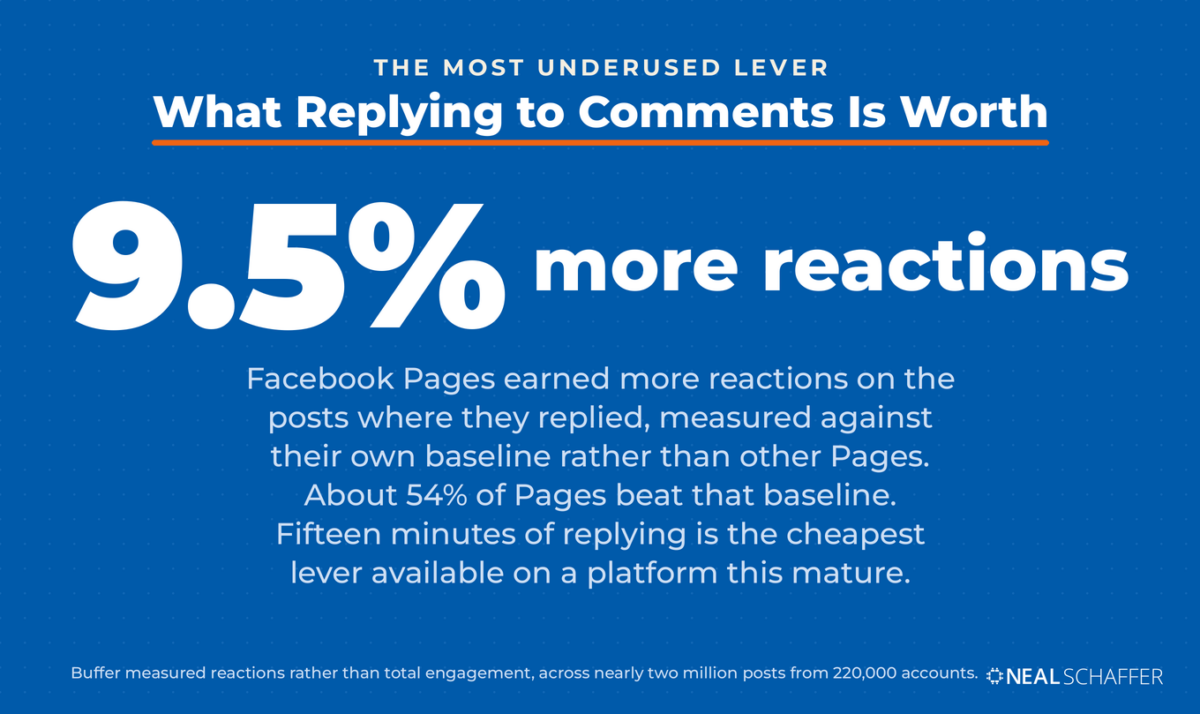
The mechanism is what makes this interesting. Buffer measured reactions rather than total engagement, so the lift is not just the replies padding the comment count. Other people reacted more to a post once the Page joined the conversation.
Line that up against Meta’s published models and it fits. Facebook predicts time spent viewing comments, and it predicts how many additional replies a post will draw. A live comment section produces both.
Nine and a half percent will not sound dramatic. On a mature platform where most levers do nothing, a repeatable single-digit lift from a behavior that costs you fifteen minutes is probably the best return available.
Set a timer for twenty minutes after you publish and answer everyone who shows up. Then look in again once that evening, because the second wave of comments usually arrives after work.
Replying assumes you know which posts are worth returning to, which means reading your own numbers correctly. That is where most people get stuck.
How Do You Diagnose a Facebook Post That Flopped?
Diagnosing a flat Facebook post means separating a reach problem from a content problem, and Meta Business Suite gives you enough to tell them apart in about ten minutes. Compare the post’s reach against your recent median first, because a post that nobody saw and a post that nobody liked need opposite fixes.
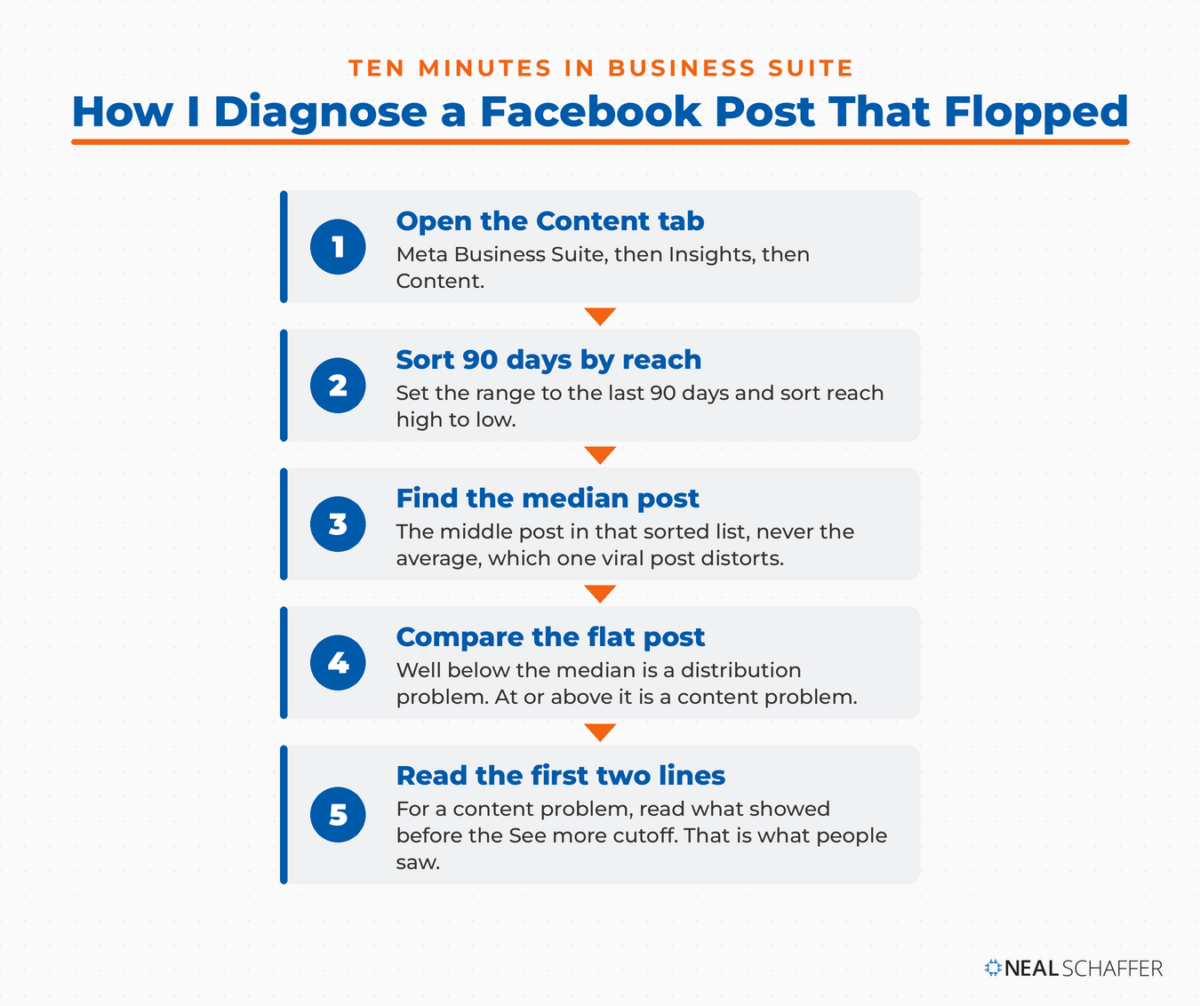
Here is the sequence I run.
- Go to and open the Content tab. If the layout has moved, look for Insights in the left sidebar of Meta Business Suite, then Content.
- Set the date range to the last 90 days and sort the list by Reach, high to low.
- Find the median reach figure, meaning the middle post in that sorted list, not the average. One viral post will distort an average badly.
- Compare your flat post’s reach against that median. Well below it, you have a distribution problem. At or above it, you have a content problem.
- For a distribution problem, check the post text against the bait table above, then check whether you published two or more posts within a few hours of each other.
- For a content problem, open the post and read the first two lines as they appear before the “See more” cutoff. That truncated preview is what most people actually saw.
- Check Negative feedback on the post, if available for your Page. Hides and unfollows are the metrics Meta uses to reduce distribution, so even a handful is worth acting on.
If you would rather work outside Meta’s own interface, Facebook analytics tools will pull the same underlying numbers with better filtering.
Why your engagement rate looks completely different depending on the source
This confuses more people than any other number in Facebook marketing, and the answer is that two respected studies are measuring different things.
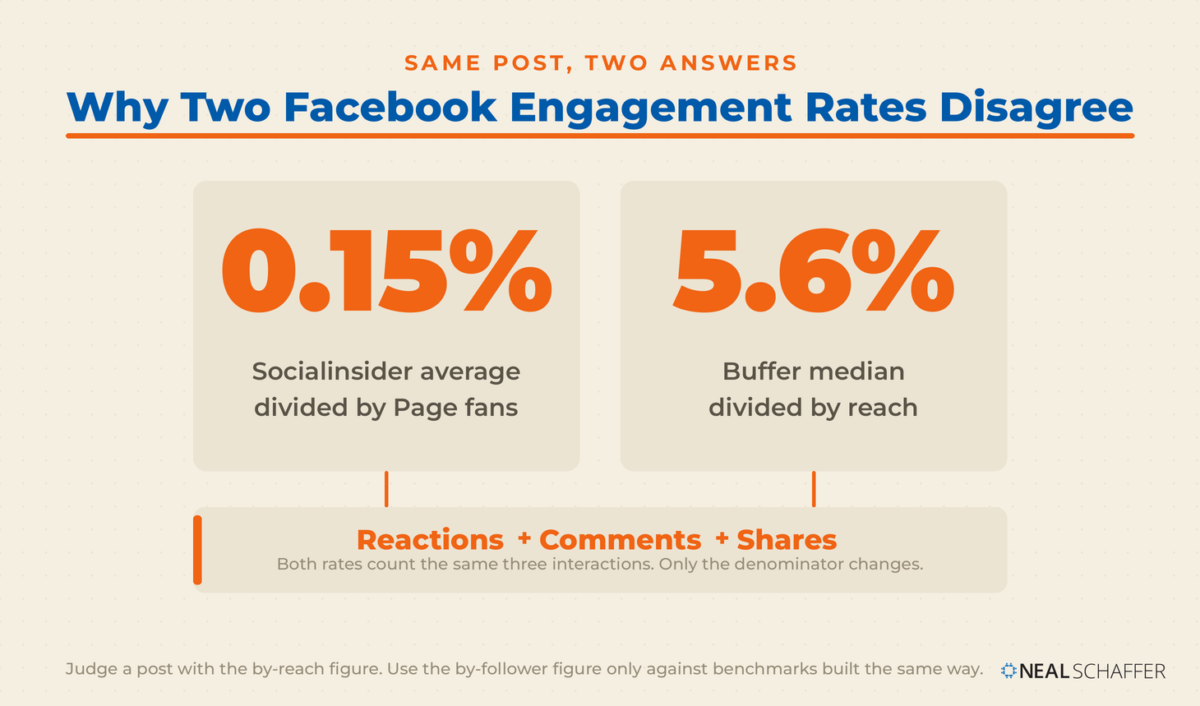
Socialinsider’s benchmark of 70 million posts puts the average Facebook engagement rate at 0.13% through Q2 2026, calculated as reactions plus comments plus shares divided by total Page fans. Buffer’s figure is around 5.6%, calculated as engagements divided by reach.
Both are correct. The first divides by everyone who follows you, including the many who never saw the post. The second divides by the people who did.
Use the by-reach version to judge whether a post was any good, and the by-follower version only to compare yourself against industry benchmarks that use the same method. If you want to run either calculation yourself, how to calculate engagement rate has the formulas.
Diagnosis usually turns up the same underlying issue, and it is rarely the one people expect.
How Often Should You Post on Facebook?
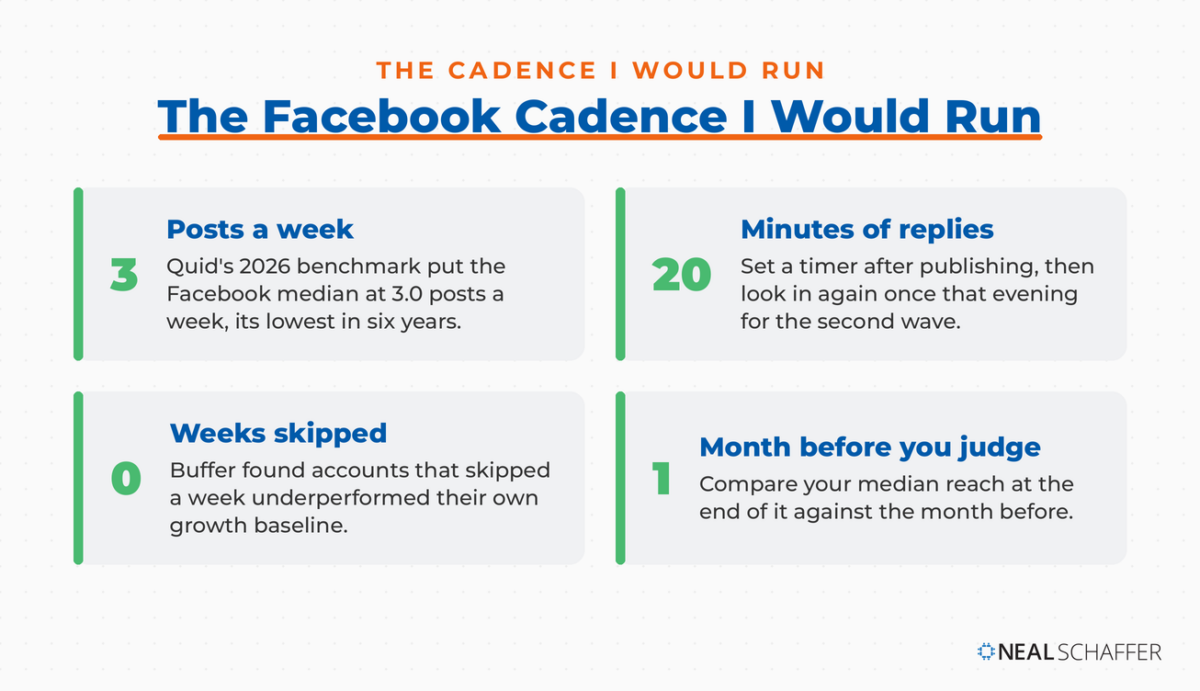
Roughly three times a week, and the industry has already converged there. Quid’s 2026 benchmark of 150 companies across 18 industries found Facebook posting frequency fell to about three posts per week, the lowest in its six-year view, while engagement held flat.
Socialinsider’s benchmark, cited above, points the same direction from a different sample, showing brands roughly halving monthly Facebook output. The same study found Facebook interactions per post rising over that window, with average comments up 20% and shares up 30%.
Fewer posts, more interaction on each. I would argue that is the clearest instruction Facebook has given marketers in years.
There is a floor, though. The same Buffer report cited above analyzed 4.8 million channel-weeks and found accounts that skipped a week consistently underperformed their own growth baseline, a pattern Buffer named the no-post penalty. Going quiet costs you more than posting imperfectly.
Three posts a week, each one worth reading, with twenty minutes of replies after each. That is the cadence, and the reason it works is that it matches how Facebook scores: a smaller number of posts that hold attention beats a larger number that get scrolled past.
If timing is your next question, start with the best time to post on Facebook. Buffer’s own conclusion in the report above was that timing amplifies a good post rather than rescuing a weak one.
Frequently Asked Questions
No, as long as you actually want the answer. Meta specifically stated that posts asking for help, advice, or recommendations are not adversely affected by the engagement bait demotion. A question you genuinely want answered is protected. “Comment YES if you agree” is not a question.
Yes, and the audience is still there. Pew Research found 71% of U.S. adults report using Facebook in its 2025 survey of 5,022 adults. What has changed is that the bait-style tactics stopped working, while conversational posts and replies still move the number.
It depends entirely on your follower count, which is why raw like counts are close to useless as a target. Compare each post to your own median reach in Meta Business Suite instead. That comparison tells you something; a competitor’s like count does not.
Boosting buys reach, not relevance, so it amplifies whatever the post already was. If a post is flat because nobody wanted to answer it, paying to show it to more people produces a more expensive version of the same result. Boosting a Facebook post makes sense once you have a post that already performed organically.
Both are possible. Meta demotes individual posts that use engagement bait, and applies stricter, Page-level demotions to accounts that do it systematically and repeatedly. One bad post is recoverable. A calendar built on bait is the thing to worry about.
Start With the Next Post You Publish
Pick your next scheduled Facebook post and read it against the friend test. Would you send this to someone you actually know? If not, rewrite it until the ask is something a person would want to answer. Then reply to everyone who shows up, the way you would on your own profile.
Do that three times a week for a month, and compare your median reach at the end against the month before. That is a small enough test to actually run.
If you want the wider picture of how the pieces fit together, start with Facebook marketing, and keep the current Facebook statistics bookmarked for benchmarking.
And if you would rather have someone build the coordinated plan with you, download a free preview of Digital Threads or get in touch about Fractional CMO services.
Actionable advice for your digital / content / influencer / social media marketing.
Join 13,000+ smart professionals who subscribe to my regular updates.
