

Let’s face it: for many businesses, email marketing started out as a vague idea (“We should send out a newsletter”) and was transformed into an irregular practice of “We send something whenever there’s a new promotion.” This approach isn’t a strategy; it’s a missed opportunity.
A genuine email marketing strategy is a deliberate plan that integrates email into your business goals, sales process, and customer relationships. It’s the architectural blueprint that connects your email list, your content, and your automation into a powerful system that drives growth in the background. It transforms your inbox from a simple communication tool into a predictable engine for revenue and loyalty, potentially deepening your relationships with your customers and prospects with every message.
As a Fractional CMO, I’ve seen how email marketing can generate tremendous ROI when done right. For a B2C client of mine, the revenue generated from their email marketing was equal to that of their six-figure Google ad budget. This hints at why email marketing’s ROI is often cited as the highest of all digital channels. I dedicated an entire section to email marketing in my book Digital Threads because I believe every business, regardless of size, needs to treat their email list as a core business asset.
To help you get started or give you ideas for revising your strategy, this 5-step playbook will walk you through building that engine. We’ll cover how to define email’s role in your overall marketing, design a simple yet powerful system for your business, and prioritize what to do first to maximize your return on investment and build relationships that last.
Key Takeaways
✅ Email marketing delivers the highest ROI of any digital channel, with businesses earning an average of $36 for every $1 spent
✅ Automated email workflows drive significantly more revenue than one-off campaigns while requiring fewer ongoing resources
✅ Simple segmentation based on behavior and customer journey stage dramatically improves engagement and conversion rates
✅ Email authentication (SPF, DKIM, DMARC) is now mandatory for deliverability with major providers like Gmail, Yahoo, and Outlook
✅ A sustainable email system focuses on three core automations: welcome sequences, abandoned cart recovery, and re-engagement flows
What Is an Email Marketing Strategy (and Why Does It Matter)?
An email marketing strategy is a long-term, documented plan that dictates how your business will use email to achieve specific, measurable goals. It’s far more than a schedule for sending newsletters. A true strategy unites your audience, content, timing, and technology into a single, cohesive system designed for one purpose: to deliver the right message to the right person at the right time.
Think of it this way: your strategy defines the overarching objective (like increasing customer lifetime value by 20%), while your tactics are the individual actions that bring that plan to life. Crafting a compelling email marketing campaign, A/B testing a subject line, or setting up an abandoned cart sequence are all tactics. Without a clear strategy, these tactics are just disconnected actions. With one, they become a powerful, unified force for growth.
Why Does Email Marketing Still Matter in 2026?
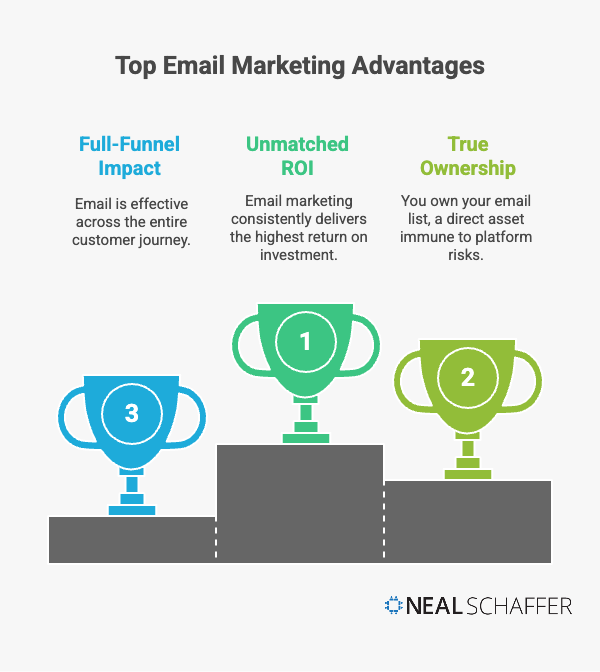
In an era dominated by fleeting social media trends and complex algorithms, email remains a cornerstone of effective digital marketing. Three advantages set it apart:
Unmatched ROI: According to Litmus’s State of Email research, for every $1 spent on email marketing, the average return is $36, delivering a 3600% ROI. My own research on email marketing statistics shows that email marketers can make $42 in sales for each $1 spent sending emails. Stripo’s analysis of eCommerce email performance found that some industries are doing even better, with Retail, eCommerce and Consumer Goods achieving the highest email ROI of any sector at 4500%.
True Ownership: You own your email list. Unlike social media followers, your subscribers and their customer data are a direct asset, immune to algorithm changes or platform risk. I’ve blogged about the benefits of email marketing extensively, and ownership is at the top of that list.
Full-Funnel Impact: Email is uniquely effective across the entire customer journey, from building awareness and nurturing leads to driving conversion and fostering long-term loyalty and retention.
| Channel | Average ROI | Ownership | Algorithm Dependent |
|---|---|---|---|
| Email Marketing | 3,600% – 4,500% | Yes | No |
| Paid Social Ads | 200% – 500% | No | Yes |
| Organic Social | Variable | No | Yes |
| SEO | 800% – 1,000% | Partial | Yes |
According to Omnisend’s email marketing statistics report, 42% of B2B marketers cite email as their most effective marketing channel, only outranked by in-person events and webinars. And while some social media platforms have billions of users, Statista’s research on global email usage shows that nearly 4.5 billion people use email worldwide in 2025, with projections reaching over 4.8 billion by 2027. It’s safe to say that while every Internet user uses email, not every email user is a social media user on any given social network.
Why Is Email Marketing Especially Powerful for Small Businesses?
For small businesses, a solid email marketing strategy isn’t just an advantage; it’s a force multiplier. You don’t need a massive audience to succeed. You need a responsive one that trusts your brand. Email excels at turning a modest list of subscribers into a reliable source of sales and repeat business through personal, permission-based communication.
According to DemandSage’s email marketing statistics, email marketing for small businesses serves as the primary customer acquisition channel for 81% of businesses and the primary retention channel for 80%. It serves as the essential “conversion and relationship layer” that connects your entire marketing ecosystem:
- It turns social media followers into owned subscribers
- It nurtures website visitors into qualified leads
- It re-engages past customers, transforming them into loyal advocates
For example, a consultant can use a short, automated email nurture sequence to book strategy calls consistently. An e-commerce brand can dramatically increase repeat purchases with automated post-purchase messages and personalized product recommendations. This direct line of communication is the most predictable, profitable growth tool a small business can possess. If you’re a small business owner looking to get started, the principles in this playbook apply directly to you.siness can possess.
Step 1: How Do You Clarify Email’s Role and Define Your Audience?
Every effective email strategy starts with purpose, not volume. Before you worry about send frequency or email templates, get crystal clear on the one to three core jobs email should perform for your business. Is its primary role to nurture and educate leads? To launch and promote new offers? Or to onboard new customers and build a thriving community?
Is Your LinkedIn Not Delivering Results?
Just released: my new book to help professionals, entrepreneurs, and business owners maximize LinkedIn for real growth.
With years of LinkedIn expertise, Maximizing LinkedIn for Business Growth offers actionable steps to build your brand, expand your network, and drive results.
Start leveraging LinkedIn like never before—grab your copy now! Click the cover or button below to buy on Amazon.

Defining this purpose creates focus, ensuring every email campaign you send is designed to support a measurable business outcome instead of just adding to the noise in someone’s inbox.
How Should Your Business Model Shape Your Strategy?
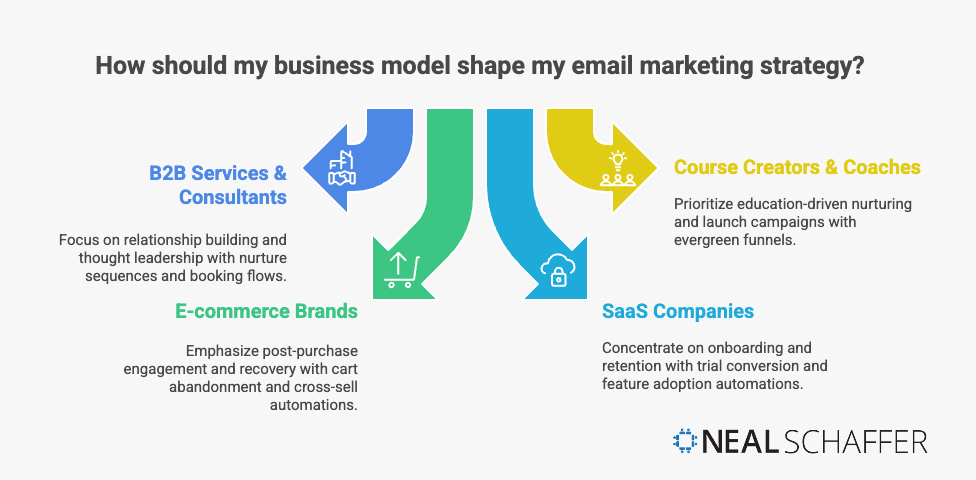
The “job” of your email marketing will change based on how your business operates. A one-size-fits-all approach won’t work. Customize your strategy to your specific model:
| Business Model | Primary Email Focus | Key Automations |
|---|---|---|
| B2B Services & Consultants | Relationship building, thought leadership | Nurture sequences, booking flows |
| Course Creators & Coaches | Education-driven nurturing, launches | Evergreen funnels, launch campaigns |
| E-commerce Brands | Post-purchase engagement, recovery | Cart abandonment, cross-sells |
| SaaS Companies | Onboarding, retention | Trial conversion, feature adoption |
If you’re in the B2B space, your focus should be on establishing thought leadership and using conversion-focused sequences to book calls or demos. According to Omnisend’s B2B email research, 81% of B2B marketers use email newsletters as their main form of content marketing. Course creators should prioritize education-driven nurture flows and high-impact launch campaigns.
Clarify what “success” looks like for you, whether that’s booked calls, course sales, or repeat orders, and build your strategy backward from that goal.
How Do You Define Your Priority Audience Segments?
You can’t speak to everyone at once. Trying to do so results in generic messaging that resonates with no one. Instead, start with simple but powerful email segmentation. Too many subscriber segments at the start will dilute your focus.
Base these initial segment definitions on your audience’s real motivations or behaviors, not just surface-level demographics. Examples include:
- “The overwhelmed solo founder who needs clients fast”
- “The marketing manager under pressure to prove ROI”
- “The repeat customer looking for exclusive access”
According to Powered by Search’s B2B email marketing benchmarks, detailed email segmentation leads to 30% more opens and 50% more clicks than unsegmented email campaigns. Using these psychographic subscriber segments will guide the tone, frequency, and offers within your email copy, making every message feel more relevant and personal.personal.
How Do You Map the Customer Journey?
To To send the right message at the right time, you need to understand the customer lifecycle. Use a lightweight journey model that works for any business:
Problem Unaware → Problem Aware → Solution Aware → Provider Aware → Customer → Loyal Advocate
For each stage of this journey, ask yourself:
- What is my customer thinking or feeling? (e.g., “I know I have a problem, but I don’t know where to start.”)
- What belief shift does my email need to create? (e.g., “This brand understands my specific problem and has a clear solution.”)
- What is the single next action I want them to take? (e.g., Download a guide, watch a demo, make a purchase.)
Mapping this journey ensures your email communications meet your customer where they are, guiding them logically and empathetically toward a conversion. This is where drip email marketing becomes essential.
A great strategy needs a reliable system to execute it. This step is about assembling the essential tools, automation workflows, and measurement practices to create a sustainable email engine. Before building anything new, start by auditing every email touchpoint your audience currently experiences, from opt-in forms and transactional emails to welcome sequences and newsletters.
Ask yourself, “If a new user joined my email list today, what journey would they have?” This simple question reveals your current experience from a subscriber’s perspective, highlighting what’s working, what’s missing, and what needs to be improved. This audit becomes your baseline for building a stronger, more cohesive system.
What Are the Essential Components of Your Email Tech Stack?
You don’t need a complex tech stack. Focus on four core components:
- Email Platform (ESP): Choose one email marketing tool that fits your current email list size and future automation needs. There are even free email marketing services to get you started.
- Opt-in Sources: These are the gateways to your list, including website forms, pop-ups, and lead magnets that capture new subscribers. I’ve written extensively about how to build an email list from scratch.
- Automation Triggers: These are the specific actions, such as a download, a sign-up, a purchase, or an abandoned cart, that initiate your key automated sequences.
- Core Content Types: Plan for a mix of educational, promotional, and relationship-building email content to keep your audience engaged.
What Does an “Always-On” Email Framework Look Like?
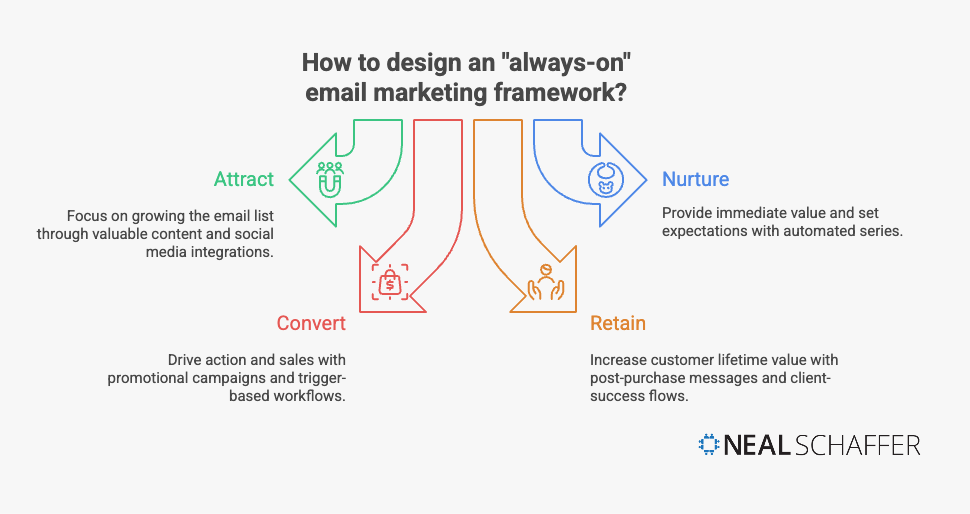
Structure your email marketing as a continuous cycle that operates quietly in the background, guiding every subscriber through a value-driven experience:
Attract → Nurture → Convert → Retain
| Stage | Goal | Key Tactics |
|---|---|---|
| Attract | Grow your list | Lead magnets, content upgrades, social media integration |
| Nurture | Deliver value, set expectations | Welcome series, automated educational sequences |
| Convert | Drive action and sales | Promotional campaigns, trigger-based workflows |
| Retain | Increase customer lifetime value | Post-purchase messages, client-success flows |
Each stage should connect to the next, creating a complete journey for every customer. This is what email marketing automation is all about.
Which Three Foundational Automations Should You Build First?
Don’t try to build everything at once. According to Omnisend’s research, automated emails drove 37% of all email-generated sales in 2024. Focus on the three highest-impact automation workflows first:
1. Welcome / Onboarding Sequence: This is your first impression. According to EmailChef’s email marketing statistics, welcome emails have an average open rate of 69%, reaching up to 80%. A strong welcome email (or series) introduces your brand, delivers on your promise, and sets expectations for future communication.
2. Abandoned Cart or Unfinished Action Flow: This is the lowest-hanging fruit for recovering lost sales or incomplete leads for both e-commerce and SaaS companies. According to OptinMonster’s email marketing report, abandoned cart email campaigns have an open rate of 50.50%, and businesses earn an average of $3.45 in revenue per abandoned cart email recipient.
3. Re-engagement Flow: This automated flow helps maintain good list hygiene by attempting to reactivate dormant subscribers before removing them, protecting your sender reputation.
Once these foundational automated flows are running smoothly, you can add more sophisticated personalization and branching. According to Cognism’s email marketing research, although automated emails account for just 2% of all emails sent, they generate over 41% of email orders.
What Metrics Should You Track?
Avoid vanity metrics. Track only the Key Performance Indicators (KPIs) tied directly to your business goals. You can use email tracking software to monitor these:
- Engagement Metrics: Open rates and click-through rates (CTR) tell you if your messaging is resonating
- Conversion Metrics: Track sales, calls booked, or sign-ups to measure ROI
- List Health Metrics: Monitor unsubscribe rates and bounce rate to gauge audience satisfaction and deliverability
Review these core email metrics every 90 days. Each quarter, choose one area to improve, whether it’s optimizing a welcome email, refreshing your content, or tightening your automation logic. This habit ensures your email system evolves with your audience and delivers steady progress.
Step 3: How Do You Create Content That Converts and Retains Customers?
With your system in place, the focus shifts to the messages themselves. Before writing a single word, define your content’s purpose. Every email you send should have one of three clear goals: to build trust and authority, drive engagement or sales, or strengthen customer loyalty. This clarity ensures each message has a job to do, helping you avoid inbox clutter and keeping your audience engaged.
As Seth Godin famously stated, “Content marketing is the only marketing left.” Email, at its best, is exactly that: valuable content delivered directly to people who asked for it.
What Are Your Core Content Pillars?
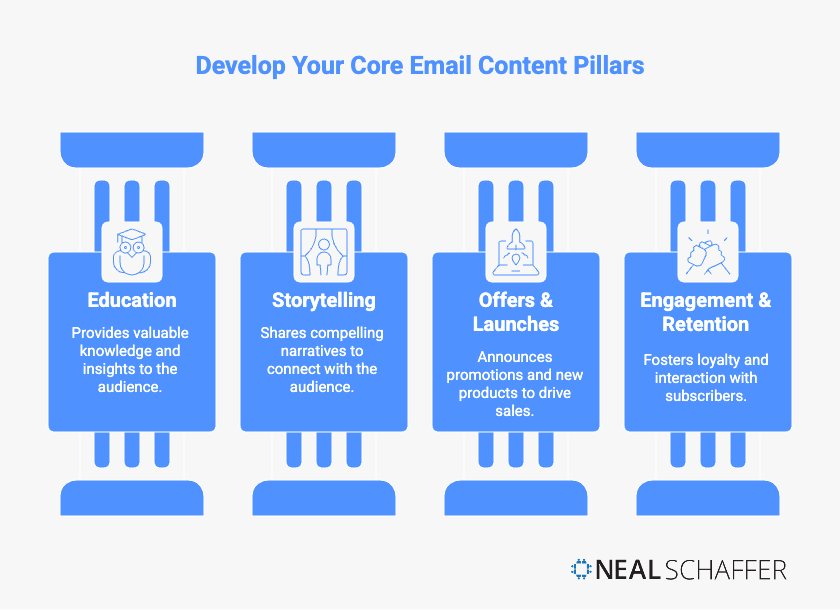
TreaTreat your email strategy as an ongoing conversation, not a series of random promotional blasts. To maintain consistency and relevance, choose 3-4 recurring content themes, or “pillars,” that align with your brand and your audience’s needs. If you need email marketing ideas, start here:
| Content Pillar | Purpose | Examples |
|---|---|---|
| Education | Build authority, provide value | How-to guides, tutorials, industry insights |
| Storytelling | Create connection, build trust | Case studies, behind-the-scenes, customer success |
| Offers & Launches | Drive conversions | Promotions, new products, event invitations |
| Engagement & Retention | Strengthen relationships | Surveys, feedback requests, exclusive content |
These pillars provide structure for your content calendar, making it easier to plan and create consistently valuable emails. For more on execution, check out my email marketing tips.
How Do You Segment Your Audience Effectively?
Effective segmentation is the key to making a large audience feel like an audience of one. Start with 3-6 high-impact subscriber segments that allow for meaningful message tailoring:
- New Subscribers: Those in their first 30 days who need onboarding and nurturing
- Engaged vs. Inactive Subscribers: Based on open and click-through activity
- Leads vs. Paying Customers: To separate prospective buyers from existing clients
- Product/Service Interest: Based on pages they’ve visited or products they’ve browsed
According to G2’s email marketing statistics, the most effective strategies for email marketing campaigns are subscriber segmentation (78%), message personalization (72%), and email automation campaigns (71%). Use this email segmentation to customize your messaging. Send more frequent, value-driven communications to your most engaged segment, and align offers and case studies with each group’s specific needs and position in the customer lifecycle.
How Do You Personalize Beyond “Hi FirstName”?
True personalization goes far beyond inserting a contact’s first name. It reflects context and demonstrates that you understand your customer. As email marketing expert Dan Jak says, “Personalization – it is not about first/last name. It’s about relevant content.”
Powerful personalization tactics include:
- Dynamic Content: Display different content blocks within the same email based on the recipient’s industry, role, or subscription level
- Behavioral Triggers: Send product recommendations based on a user’s browse or purchase history
- Contextual Messaging: Reference a pain point a subscriber shared in a quiz or a resource they previously downloaded from your site
According to DemandSage’s research on AI in email marketing, AI-driven personalization boosts revenue by 41% and CTR by 13.44%. Start with one or two high-value personalization use cases that you can implement and maintain effectively. If you want to explore how AI can help, I’ve written about AI email marketing and AI email assistants.
How Do You Maintain a Consistent Content Rhythm?
Consistency builds anticipation and trust. Aim for a predictable sending cadence, such as one value-first email per week, with promotions layered in as needed. I’ve also covered the best time to send marketing emails if you want to optimize your timing.
When crafting your email content, remember that people scan their inboxes:
- Keep it scannable: Use short paragraphs, ample white space, and clear headings
- Write like you talk: Adopt a human, conversational tone that is benefit-focused
- Have a clear Call to Action (CTA): Every email campaign should guide the user toward a single, clear next step
Use your analytics to understand which topics and formats resonate most with your audience. If an email campaign underperforms, A/B test the subject line, the framing of the offer, or the call-to-action before abandoning the core idea. For inspiration, check out some email marketing campaign examples.
Step 4: How Do You Safeguard Your Deliverability and Compliance?
Even the most brilliant email marketing strategy will fail if your messages land in the spam folder. Email deliverability, the ability to successfully deliver emails to subscriber inboxes, is the non-negotiable foundation of every successful program. By practicing good list hygiene, following compliance laws, and protecting your sender reputation, you ensure your hard work gets seen.
From a pure revenue perspective, deliverability is a silent killer. According to SalesHive’s B2B deliverability analysis, global inbox placement in 2024 was about 83.5%, meaning roughly 1 in 6 legitimate marketing emails still don’t reach the inbox.
How Do You Keep Your List Clean and Engaged?
Inbox providers like Gmail and Outlook reward senders who have high email engagement. A clean, engaged email list is your greatest asset for maintaining strong deliverability. Here are the email marketing best practices you need to follow:
- Prune Your List: At least quarterly, remove inactive or bounced email addresses. Sending to unengaged subscribers hurts your sender reputation.
- Use Double Opt-In: This confirms that a real person wants to receive your emails, reducing bounce rates and spam complaints.
- Run Re-engagement Campaigns: Before removing dormant users, send them a re-engagement email campaign to give them a chance to stay on your list.
What Compliance Laws Must You Follow?
Adhering to anti-spam laws like the CAN-SPAM Act in the U.S. and GDPR in Europe isn’t just a legal requirement; it’s a best practice that builds trust. The core principles are simple:
- Provide a Clear Exit: Always include a visible and functional unsubscribe link in every email
- Get Consent: Never add people to your marketing list without their explicit permission
- Identify Yourself: Clearly state your business name and provide a valid physical mailing address in your email footer
These rules on data privacy protect both the customer and your brand.
How Do You Maintain a Trustworthy Sender Reputation?
Your sender reputation is a score that inbox providers use to determine if you’re a legitimate sender. A poor reputation means your emails go to spam. When you do get SPF/DKIM/DMARC right, the payoff is huge. According to SalesHive’s deliverability research, fully authenticated senders (SPF + DKIM + DMARC with enforcement) are about 2.7x more likely to reach the inbox than unauthenticated senders.
Email Authentication Is Now Mandatory:
According to Email on Acid’s guide to email authentication protocols, in 2025, all senders must be using some form of email authentication. If you are a bulk sender, which generally means sending thousands of emails every day, then you need to be using all three of these authentication methods.
| Protocol | What It Does | Why It Matters |
|---|---|---|
| SPF | Specifies which IP addresses can send on your behalf | Prevents spoofing |
| DKIM | Uses a digital signature to verify your emails | Proves authenticity |
| DMARC | Tells receivers what to do if SPF/DKIM fails | Enforces your policy |
According to Google’s official email sender guidelines, all senders should set up SPF, DKIM, and DMARC for their domains. Microsoft’s announcement on Outlook requirements confirmed that after May 5th, 2025, Outlook began routing messages from high volume non-compliant domains to the Junk folder. These measures help reduce spoofing, phishing, and spam activity, empowering legitimate senders with stronger brand protection and better deliverability.
Cloudflare’s explanation of DMARC, DKIM, and SPF notes that domains that have not set up these protocols correctly may find that their emails get quarantined as spam, or are not delivered to their recipients at all.
Additional best practices include:
- Avoiding Spam Triggers: Steer clear of deceptive email subject lines, excessive capitalization, or a high image-to-text ratio
- Warming Up Your Domain: If you are sending from a new domain or IP address, gradually increase your sending volume to build a positive reputation over time
Excellent deliverability is a sign of a healthy, respectful email marketing program.
Step 5: How Do You Continuously Improve Through Testing and Measurement?
A powerful email strategy is never static; it’s a living system that you refine over time. By tracking the right metrics, testing intentionally, and making small but consistent improvements, you turn raw data into clear direction. This final step ensures your email marketing efforts become more effective with every email campaign you send.
Which Core Metrics Matter Most?
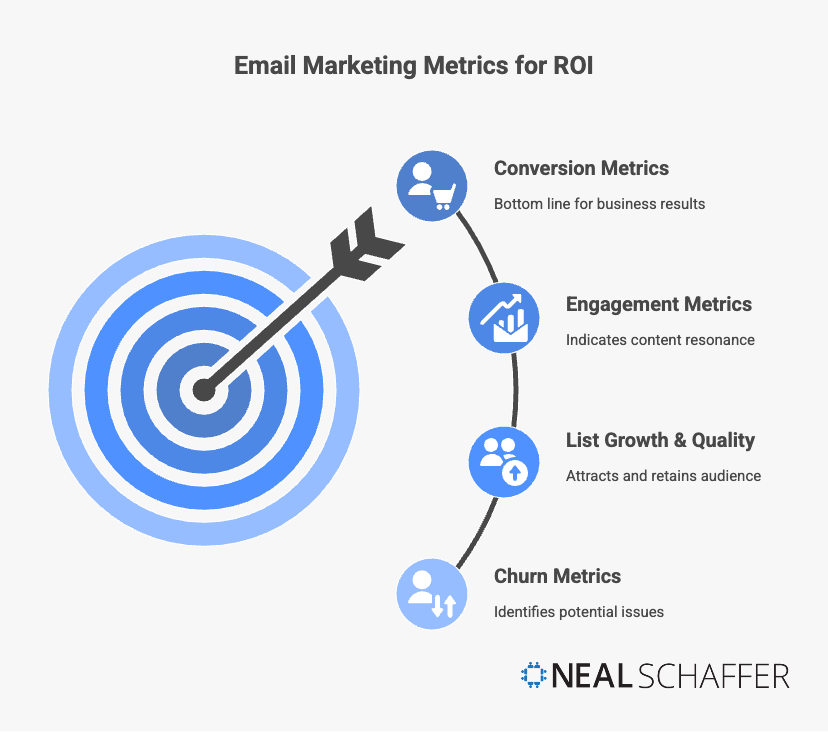
Don’t get lost in a sea of daDon’t get lost in a sea of data. Focus on a handful of core email metrics that are directly tied to your primary goals:
| Metric Type | What to Track | Why It Matters |
|---|---|---|
| Conversion | Sales, demos booked, sign-ups | Bottom line for business results |
| Engagement | Open rate, click-through rate | Indicates content resonance |
| List Growth & Quality | New subscribers, source attribution | Attracts and retains audience |
| Churn | Unsubscribe rate, spam complaints | Identifies potential issues |
According to Omnisend’s statistics, email campaign click-to-conversion rates grew by 27.6% in 2024. If you want to improve your email open rate, start by tracking these benchmarks against your own performance.
How you prioritize these metrics will vary. An e-commerce business might focus on conversion rates from an abandoned cart flow, while a B2B service company may prioritize the click-through rate on a link to book a consultation.
How Do You Approach A/B Testing Strategically?
A/B testing is essential for optimization, but it should be approached with discipline. Meaningful improvement comes from deliberate, strategic tests, not random changes.
- Test One Variable at a Time: To know what caused a change in performance, you can only change one element per test (e.g., subject line A vs. subject line B)
- Start with High-Impact Elements: Before testing button colors, focus your A/B test efforts on elements that can produce significant wins, like the core offer, the email subject lines, or the call-to-action
Instead of minor tweaks, consider running tests that answer bigger strategic questions:
- Does a short, three-email nurture sequence perform better than a longer, seven-email one?
- Does a direct offer email generate more conversion than an email that leads with educational content first?
- Which lead magnet attracts the highest-quality subscribers for a specific audience segment?
This approach to testing turns your email program into a learning engine, providing insights that strengthen your entire marketing strategy.
Frequently Asked Questions About Email Marketing Strategy
Start with a simple framework: build your list with a single lead magnet, create a 3-5 email welcome sequence, and send one value-driven email per week. Focus on understanding your audience’s needs before adding complexity like advanced segmentation or multiple automations. Master the basics first.
Most businesses see success with 1-4 emails per week. The right frequency depends on your audience’s expectations and your ability to deliver value consistently. Test different cadences and monitor unsubscribe rates. If unsubscribes spike, you may be sending too often or not providing enough value.
Average open rates vary by industry, but generally, 20-25% is considered good for promotional emails. According to GetResponse’s email marketing benchmarks, the average email open rate across all industries is 39.64%. However, focus more on click-through rates and conversions than opens, especially since Apple’s Mail Privacy Protection affects open rate accuracy.
Set up proper email authentication (SPF, DKIM, DMARC), maintain a clean list by removing inactive subscribers, avoid spam trigger words, and send consistently to build a positive sender reputation. Keep spam complaint rates below 0.1% as recommended by Gmail and other providers.
Absolutely. According to OptinMonster’s email marketing research, 59% of consumers say marketing emails influence their purchase decisions, with over 50% saying they purchase from an email at least once a month. With proper strategy, email consistently delivers the highest ROI of any marketing channel.
Turning Your Email Marketing Strategy Into a Revenue Engine
The true measure of your email marketing strategy isn’t the cleverness of your subject lines or the beauty of your email designs; it’s the real, measurable impact it has on your business’s growth. When you treat your email list as a core business asset, map your communications to the customer journey, and commit to improving your core programs each quarter, email ceases to be a marketing chore. It becomes foundational infrastructure.
You don’t need enterprise-level complexity or a massive team to achieve remarkable results. This 5-step playbook provides the framework. Focus on your clear goals, build simple email automation to support them, and send valuable, relevant messages to the people who trust you with their inbox. That is how any business, no matter its size, can turn a simple email list into a powerful engine for meaningful revenue and lasting customer relationships.
If you want to go deeper on any of these topics, download my free Definitive Guide to Email Marketing, which expands on everything we’ve covered here. And if you’re looking for hands-on guidance implementing these strategies for your business, consider joining my Digital First Group Coaching Community where I work directly with entrepreneurs and marketers to build systems like these. For larger organizations needing strategic marketing leadership, learn more about my Fractional CMO services.
Actionable advice for your digital / content / influencer / social media marketing.
Join 13,000+ smart professionals who subscribe to my regular updates.
