

You want more subscribers on YouTube. Fair enough. The subscribe button is the one thing every creator asks you to press, and the count sits at the top of your channel like a scoreboard.
So let me answer the question you came here for, and then show you something from my own YouTube analytics that changed how I think about it.
I am a Fractional CMO and the author of six books on digital and social media marketing. I have hosted the Your Digital Marketing Coach podcast for more than 400 episodes. I also teach social media marketing to executives at Rutgers Business School. And I run a YouTube channel that, as of today, has 7,453 subscribers.
That number sounds respectable. Wait until you see what those subscribers actually do.
Key Takeaways
✅ Subscribers are earned as a side effect of a video that satisfies a specific viewer, not as a goal you optimize directly. Get the packaging and the substance right for a defined audience and the subscriptions follow.
✅ Subscribing does not deliver your next video to anyone. YouTube states plainly that its recommendation system finds videos for your audience rather than promoting videos to them, and channel subscriptions are one signal among many.
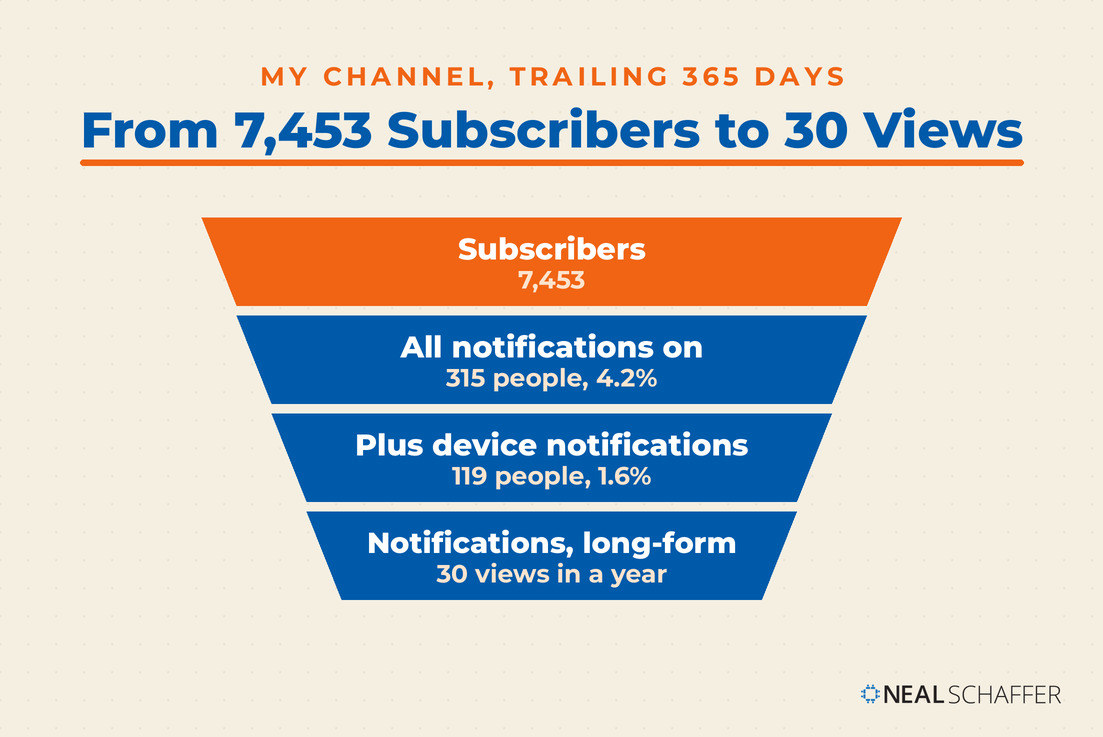
✅ My own channel earned 7,453 subscribers and 3.2% of its watch time from subscribers over the last 365 days. Notifications delivered 30 views in a year.
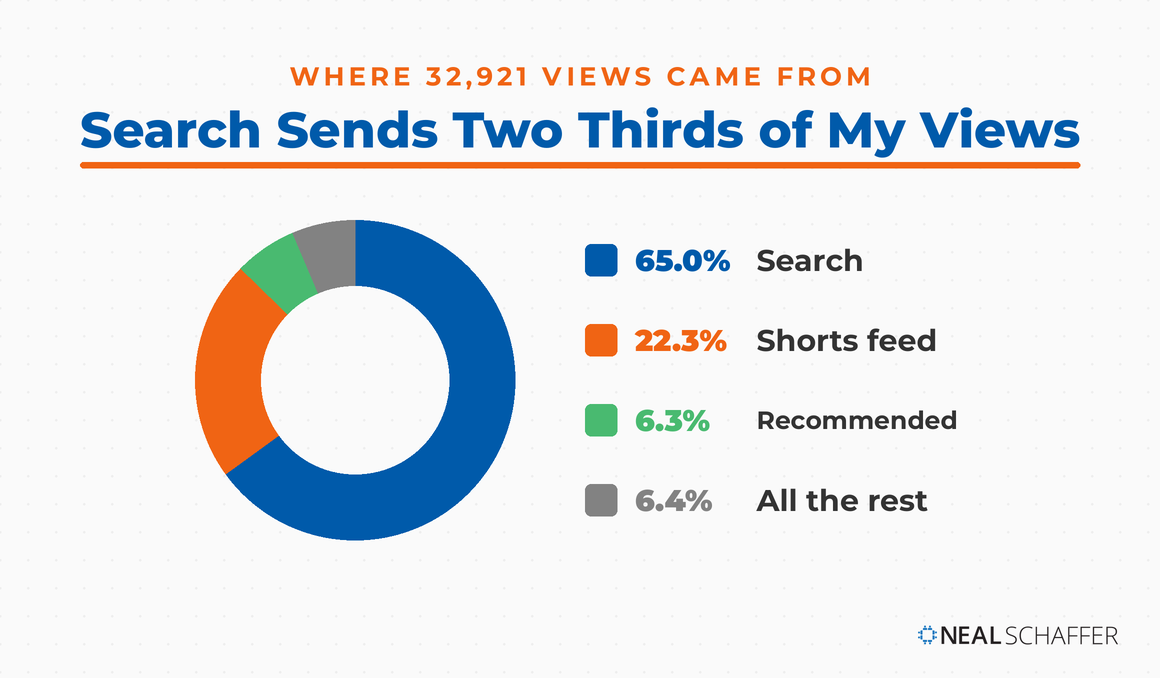
✅ Search sent 65% of my channel’s views last year, counting external referrals and YouTube search together. The algorithm’s recommendation surfaces sent 6.3%. Your videos are search assets that happen to live on YouTube.
✅ Buying subscribers violates YouTube’s fake engagement policy and poisons the audience signal the algorithm uses to decide who else should see your work.
✅ The subscriber number matters in exactly one place: the eligibility thresholds for the YouTube Partner Program.
How Do You Get Subscribers on YouTube?
You get subscribers on YouTube by making a video that answers a specific question for a specific audience, packaging it so the right person clicks, holding their attention to the end, and asking them to subscribe. Subscriptions are the receipt a viewer leaves after you have already delivered something worth their time.
Everything else people sell you as a subscriber tactic sits downstream of that. A channel trailer helps only if the channel behind it is worth committing to. An end screen subscribe button helps only if the viewer got to the end screen. Asking for the subscription works, and you should ask, but asking a viewer who is already reaching for the back button does nothing.
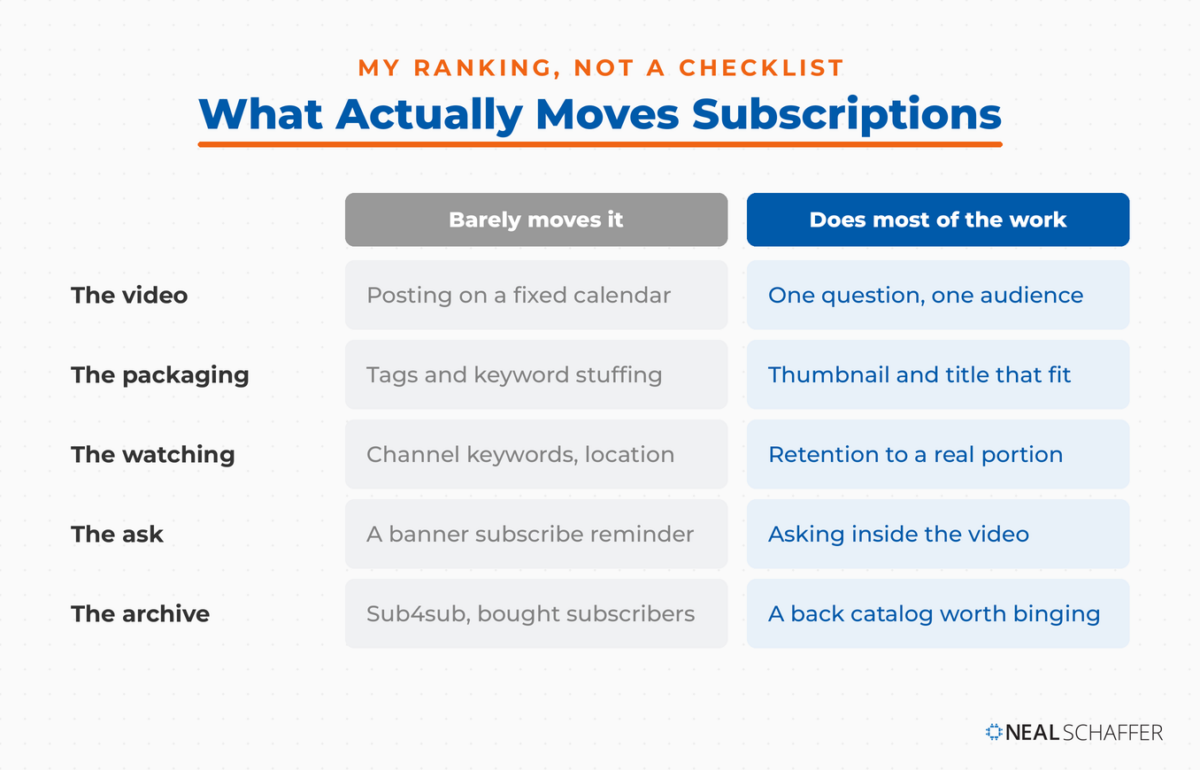
I want to be direct about why I am framing it this way. My old version of this article listed seventeen tactics in a row without ranking them, and that framing implied all seventeen carry roughly equal weight. They do not. Three of them do most of the work, and the rest are rounding errors.
| What actually moves subscriptions | What barely moves them |
|---|---|
| A video that answers a real question for a defined audience | Posting more often on a fixed calendar |
| Thumbnail and title that set an accurate, specific expectation | Tags and keyword stuffing in the description |
| Retention, meaning people watch a meaningful portion | Channel keywords and location settings |
| Asking for the subscription inside the video | Subscribe reminders in a channel banner |
| A back catalog worth binging once someone likes one video | Sub4sub, giveaways for subscriptions, purchased subscribers |
Now the part that most articles on this topic will not tell you, because it requires opening your own analytics and reporting a number that does not flatter you.
What Do 7,453 Subscribers Actually Deliver?
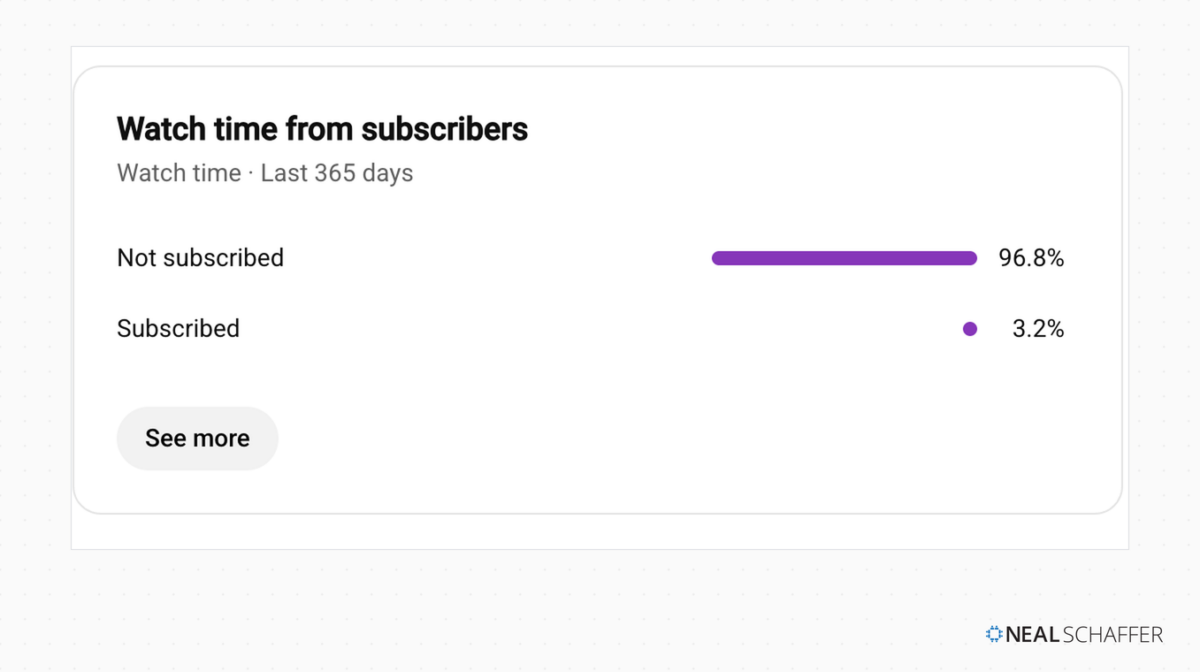
Very little, in my case. Over the trailing 365 days my channel drew 32,921 views and 747.4 hours of watch time. Subscribers accounted for 3.2% of that watch time. The other 96.8% came from people who were not subscribed to me. Net subscriber growth over the same year was 29.
Notifications, the mechanism the subscribe button supposedly triggers, delivered 30 views across the entire year. That is 0.2% of my long-form views. Not 30 thousand. Thirty.
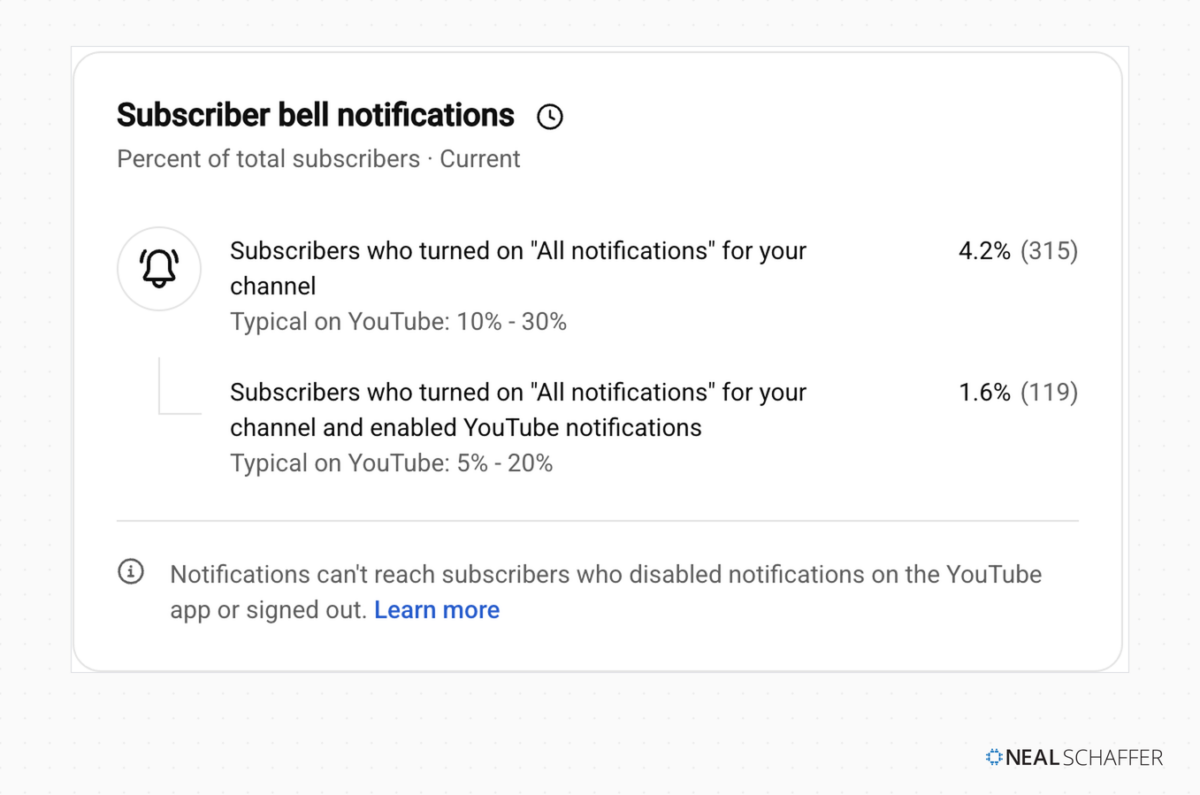
The bell numbers explain part of it. Just 4.2% of my subscribers, 315 people, have turned on all notifications for my channel, against a typical range of 10% to 30% that YouTube itself displays in Studio as the benchmark. Only 119 of them, 1.6%, have both turned on all notifications and enabled YouTube notifications on their device, against a typical range of 5% to 20%.
| My channel, trailing 365 days | Figure |
|---|---|
| Subscribers (live) | 7,453 |
| Net new subscribers in the year | 29 |
| Share of watch time from subscribers | 3.2% |
| Views from notifications (long-form) | 30 |
| Subscribers with all notifications on | 4.2% (315 people) |
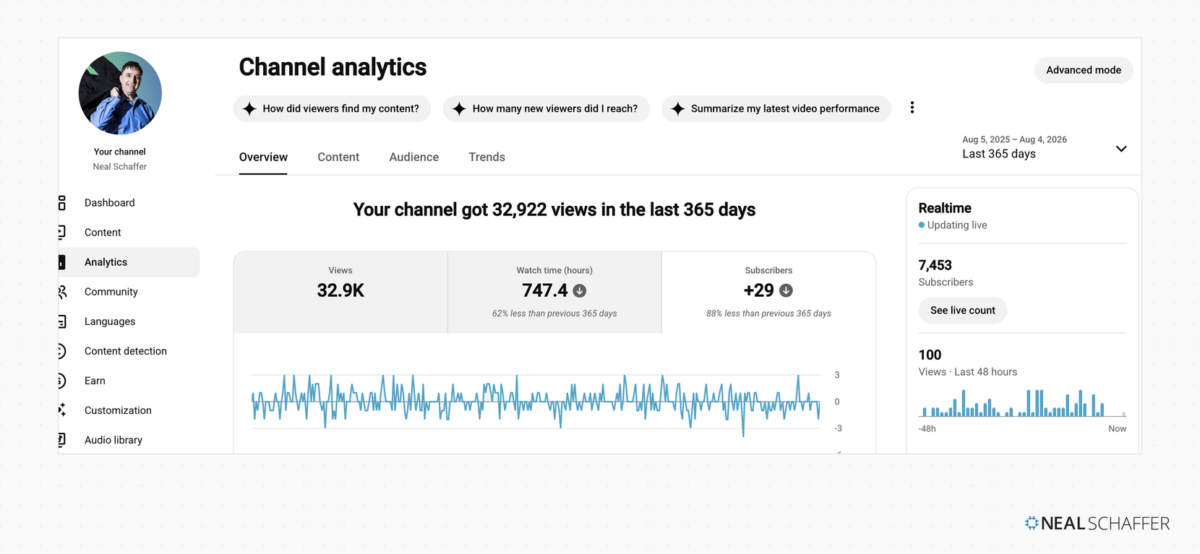
When I first wrote about this in 2022, I checked my analytics and found subscribers driving about 10% of my views. I compared it at the time against a benchmark from Tubular Labs, which put the expected views-to-subscribers ratio at around 14%. That benchmark dates to 2014, and it is worth naming its age, because the gap between 14% then and 3.2% now is the entire story of how YouTube distribution has changed.
And this is not a quirk of my channel. YouTube maintains a standing answer in its own help documentation to the question of why your views are lower than your subscriber count. Its explanation is that the count does not represent the number of viewers who watch your videos, that viewers are typically subscribed to dozens of channels, and that people commonly stay subscribed to channels they no longer watch. YouTube would not keep a standing FAQ for a rare problem.
Why Doesn’t Subscribing Put Your Video in Front of People?
Because subscribing is a preference signal, not a delivery mechanism. YouTube’s own documentation states that its recommendation system does not promote videos to your audience but instead finds videos for your audience when they visit YouTube. Your subscribers still have to be shown your video, and that showing is decided on performance.
Read that again, because it is the sentence that reframes the whole topic. Someone subscribing to you does not create a pipe from your uploads to their screen. It adds one input to a ranking decision that gets made fresh every time they open the app.
The scale of that decision is worth understanding. YouTube says its recommendation system learns from over 80 billion pieces of information it calls signals, and lists eight primary ones: watch history, search history, channel subscriptions, likes, dislikes, “not interested” selections, “don’t recommend channel” selections, and satisfaction surveys. Channel subscriptions is the third item on a list of eight, inside a system processing 80 billion signals. It carries real weight. It does not carry decisive weight.
Even the Home feed, the surface where subscriptions have the strongest claim, gets ranked. YouTube says Home displays videos from subscriptions alongside videos watched by similar viewers, and that the selection is based on how well your video has interested and satisfied similar viewers, plus how often your audience watches that channel or topic.
I wrote about this mechanism in Digital Threads before I had the analytics to prove it on my own channel. Recommendations generate roughly 70 percent of YouTube’s views, and the algorithm has one job, which is to keep people watching. My conclusion in the book was blunt: “Success on social media doesn’t come down to follower count. It comes down to the fact that quality content counts more than ever.”
Two years of my own channel data now says the same thing in numbers.
The LinkedIn Playbook for Real Business Growth
My latest book helps professionals, entrepreneurs, and business owners turn LinkedIn from a static profile into a real source of clients and growth.
Maximizing LinkedIn for Business Growth gives you clear, practical steps to build a profile that gets noticed and a network that actually sends business your way.
Grab your copy on Amazon and put it to work this week. Click the cover or the button below to get started.

Where Do My Views Actually Come From?
Search, overwhelmingly. Across all 32,921 views my channel drew last year, external referrals delivered 36.0% and YouTube’s own search another 29.0%. Together that is roughly two-thirds of everything from people actively looking for something. The recommendation surfaces most creator advice obsesses over delivered 6.3% combined.
| Traffic source, all content, trailing 365 days | Views | Share | Avg view duration |
|---|---|---|---|
| External (Google Search and other sites) | 11,858 | 36.0% | 1:35 |
| YouTube search | 9,559 | 29.0% | 1:38 |
| Shorts feed | 7,324 | 22.3% | 0:37 |
| Direct or unknown | 1,395 | 4.2% | 2:29 |
| Browse features (Home) | 820 | 2.5% | 4:47 |
| Channel pages | 765 | 2.3% | 2:08 |
| Suggested videos | 479 | 1.5% | 5:27 |
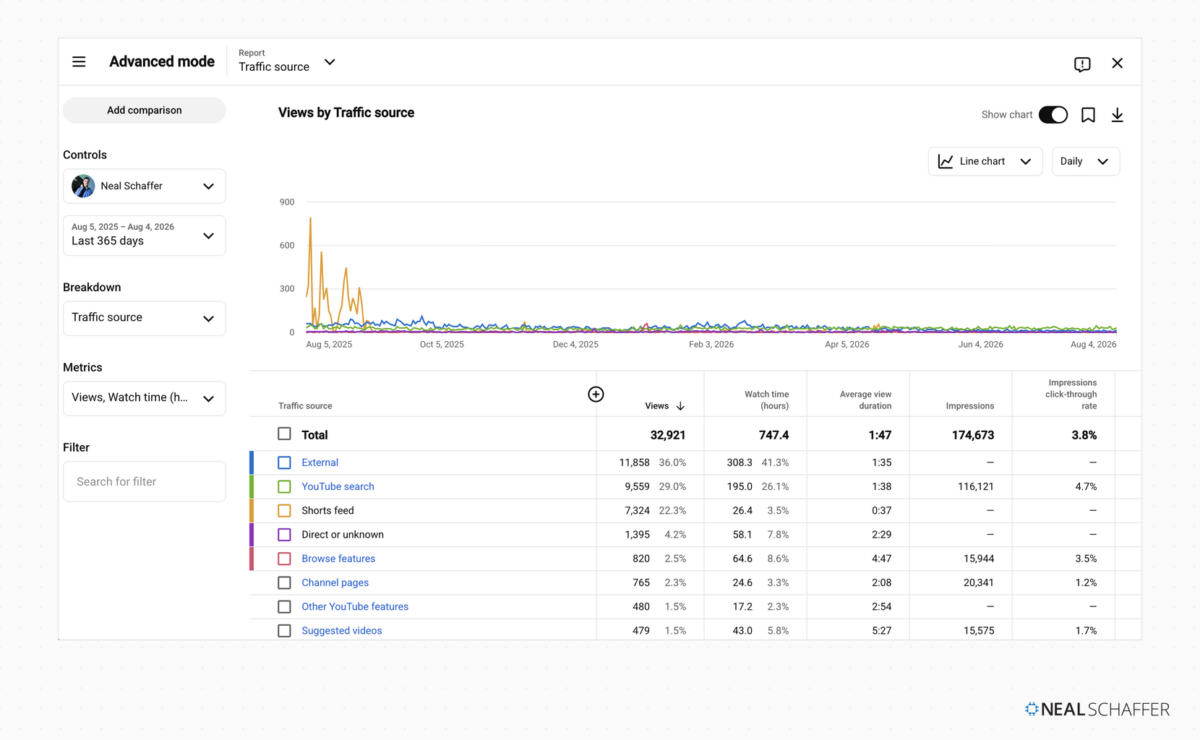
Look at the duration column and a second pattern appears. The Shorts feed sent 7,324 views at 37 seconds apiece. Suggested videos sent 479 views at five and a half minutes apiece. Browse sent 820 at nearly five minutes. The surfaces sending the fewest people send the ones who stay longest.
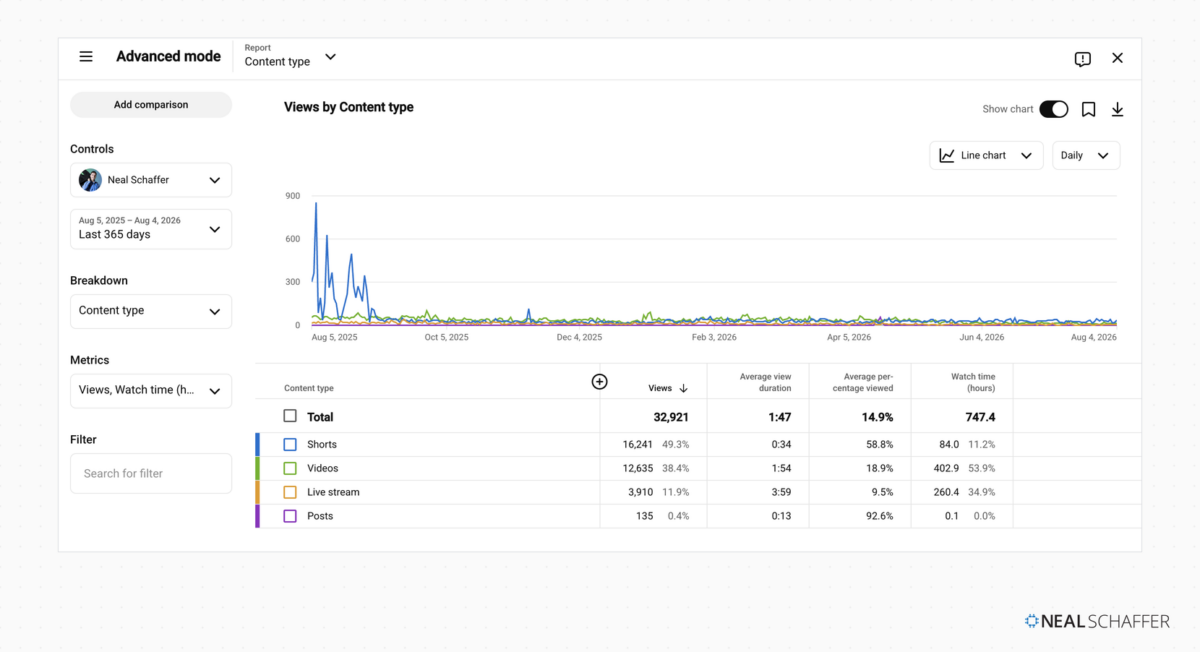
The content-type split reinforces it. Shorts pulled 16,241 views in total, 49.3% of everything, but delivered only 11.2% of my watch time. Live streams pulled 11.9% of views and 34.9% of watch time. Half my view count comes from the format that builds the least depth. That is a tradeoff worth going in with your eyes open if you are publishing YouTube Shorts to grow a channel.
I should flag something against my own argument here. In Digital Threads I cited the platform-wide figure that recommendations generate around 70 percent of YouTube’s views. My channel gets 6.3% that way. Both are true. The platform average is dominated by entertainment channels feeding a browse habit, and a marketing channel answering specific questions sits at the opposite end of that distribution. If you publish for a business audience, expect your numbers to look more like mine than like the platform average.
None of that traffic arrived because someone subscribed. It arrived because someone was looking for an answer and my video matched. Pew Research Center found that 84% of U.S. adults use YouTube, more than any other platform it surveys. Most of them are not browsing a subscription feed. They are searching.
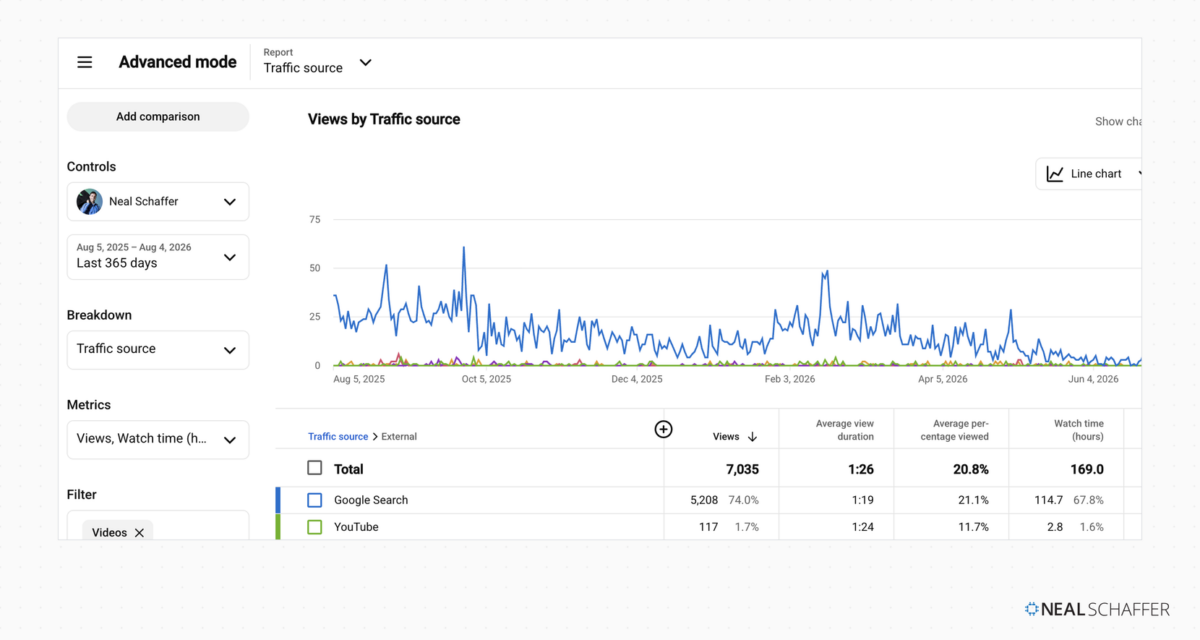
One number underlines it. Within my long-form videos specifically, Google Search sent 5,208 views against YouTube search’s 3,181. On that slice of my channel, Google out-referred YouTube itself.
If you take one operational lesson from my numbers, take this one: treat your channel as a search asset. That means the discipline of YouTube SEO matters more to your growth than any subscribe-button tactic. It is a large part of why my videos still surface for people who have never heard of me.
The Three Real Reasons I Have 7,453 Subscribers
None of the three is a tactic you can copy this week, which is exactly why I want to name them. Two are functions of time, and the third is something I paid for and would now tell you to skip. Being honest about all three is more useful to you than pretending a checklist got me here.
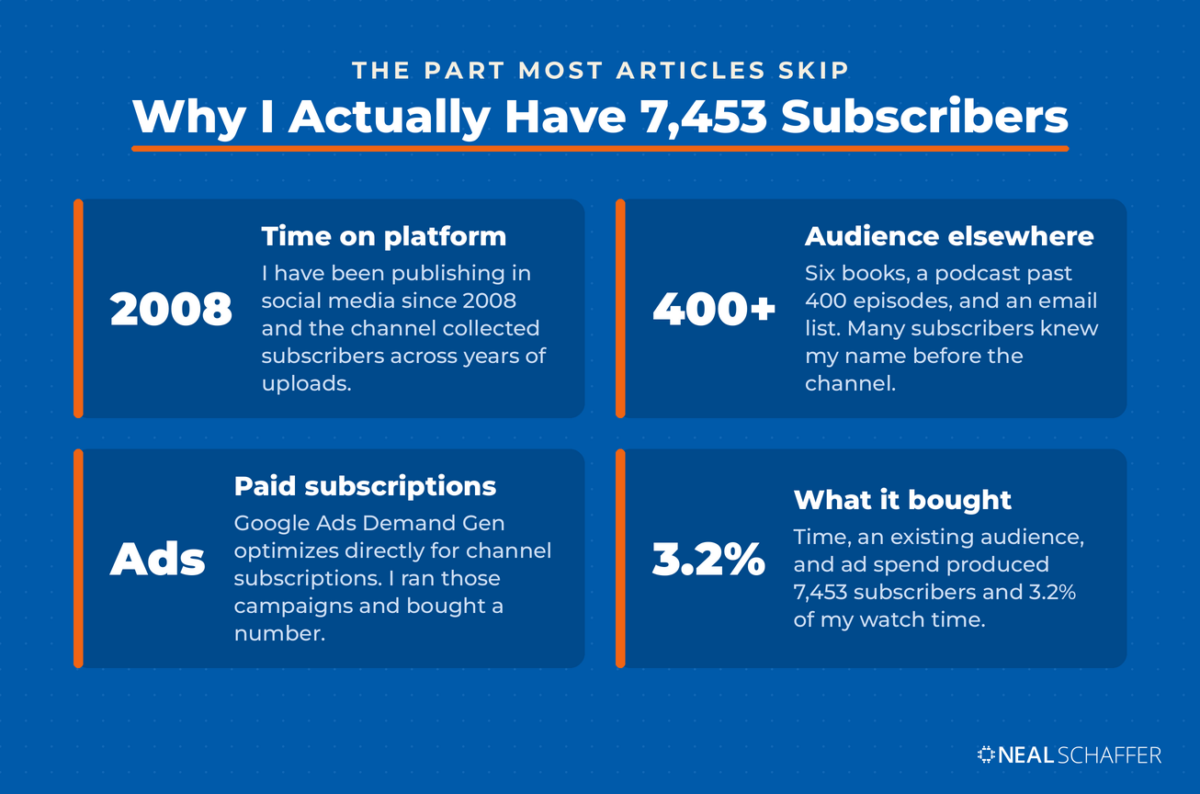
One: I have been doing this a long time. I have been publishing in social media since 2008, and the channel has accumulated subscribers across years of uploads. Longevity is not a strategy, but it is an explanation. Any article that shows you a subscriber count without saying how long it took is hiding the most important variable.
Two: I arrived with an audience. Six books, a podcast running past 400 episodes, keynotes in 14 countries, and an email list. A meaningful share of my subscribers found me somewhere other than YouTube and subscribed because they already knew my name. If you are building a personal brand on YouTube from zero, my raw count is not a fair comparison for you.
Three: I ran paid subscriber campaigns. This is the one nobody admits. Google Ads lets you optimize a Demand Gen campaign directly for YouTube channel subscriptions as a conversion action, serving ads to people the system predicts are likely to subscribe. Google even replaces the call-to-action button with a subscribe button. I experimented with it, the same way marketers once bought Facebook page likes.
And the same way we all stopped talking about Facebook like campaigns, I do not think we should be talking about YouTube subscriber campaigns. I bought a number. The number did not buy me an audience, and my 3.2% subscriber watch time is partly the bill for that.
What Actually Earns a Subscriber?
Craft. Specifically, three things: picking a narrow audience and consistently serving it, getting better at video creation and storytelling, and packaging each video so the right person clicks and the wrong person does not. Subscriptions accumulate as a byproduct when those three are working together.
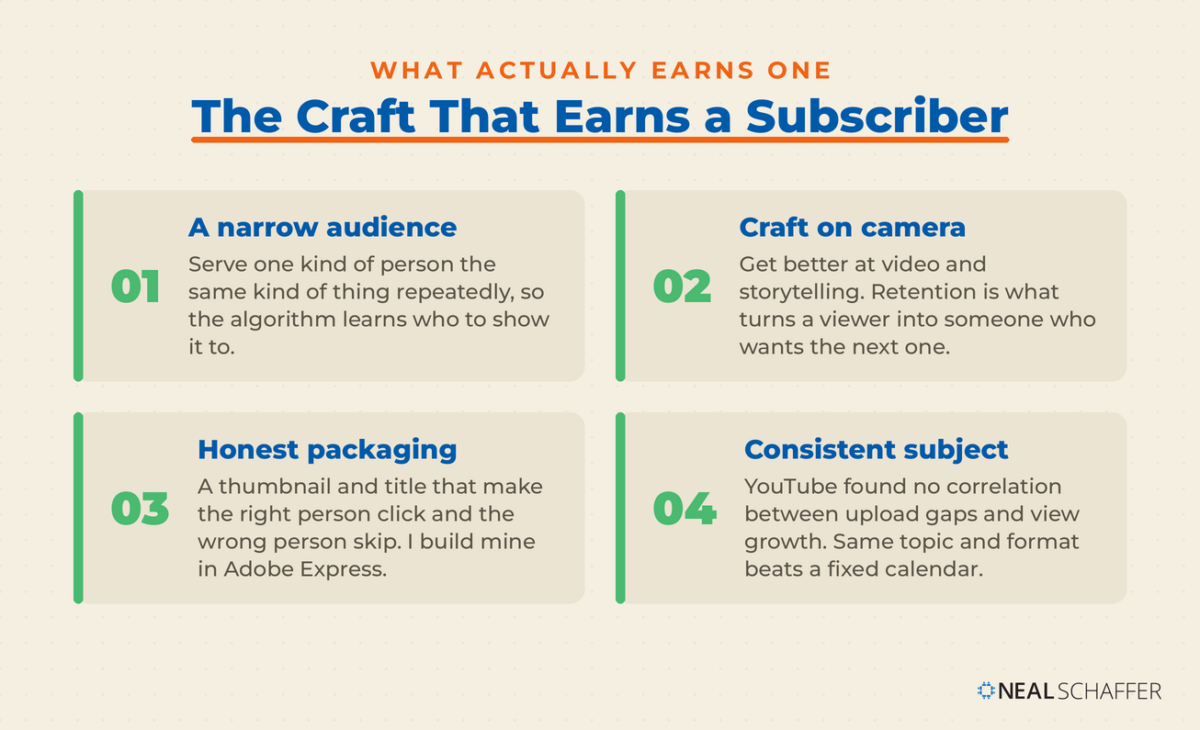
Start with the audience. The channels with large, engaged subscriber bases deliver a recognizable kind of content to a recognizable kind of person, over and over. The algorithm learns who to show them to. That is what consistency actually means, and it is worth being precise here because “be consistent” usually gets translated into “upload every Tuesday.”
YouTube’s own analysis contradicts the calendar reading. It says growth in views across uploads is not correlated with time between uploads. A study of thousands of channels that took a break found no correlation between break length and changes in views. The consistency that matters is consistency of subject and format, not frequency. As I framed it in Digital Threads, when you are consistent in the type of content you post, the algorithm knows where to put it.
Then the packaging. YouTube reports that 90% of its best-performing videos have custom thumbnails. Changing a title or thumbnail can re-rank a video, because viewers interact with it differently once it looks different. I build my thumbnails in Adobe Express, where I serve as an official Ambassador, and Canva remains a solid alternative if that is already your tool. If you want to compare options, I have looked at a range of YouTube thumbnail approaches in more depth.
The rest of the tactic list still has a place, as long as you treat it as maintenance rather than strategy:
- A channel trailer so a first-time channel visitor understands what they are committing to.
- Playlists organized by outcome rather than upload date, so one video leads into the next.
- YouTube cards and end screens that make subscribing a click instead of a scroll, and route viewers to a related video.
- Keyword research before you film, so the video targets something people actually search. Tools like TubeBuddy and vidIQ surface search demand inside YouTube itself, and I keep a working list of YouTube tools that handle this.
- Posts, the feature most creators still call the community tab, which no longer carries a subscriber threshold and reaches subscribers directly from your channel’s Posts tab.
- Collaborations with creators serving an adjacent audience, which is the fastest legitimate way to reach people who do not know you.
- Contests and giveaways that reward engagement rather than trading a prize for a subscription.
- Embedding your videos in blog posts, which is straightforward in WordPress and turns your existing readers into viewers.
- Cross-promotion to the audiences you already have. I have shared my own thumbnails as images on X with a link back to the video, hoping for a little extra visibility in that algorithm.
On the last point, one caution from my numbers: none of those channels showed up meaningfully in my traffic report. Cross-promotion is worth doing. It is not where growth comes from.
A YouTube consultant put the reframe better than I have. Dane Golden, founder of the agency VidAction, told me on my podcast that the subscriber question is the wrong one:
“I always say that’s the wrong question. It’s an interesting question, but it’s not the most important one. The most important one is how do you get the right people to watch longer?”
Worth noting that Dane is the same YouTube marketer whose research produced the 14% benchmark I cited earlier. The person who helped establish the ratio now says the ratio is not the point.
Should You Buy YouTube Subscribers?
No, and the reason is mechanical rather than moral. YouTube’s fake engagement policy prohibits anything that artificially increases views, likes, comments, or other metrics, whether through automated systems or by serving videos to unsuspecting viewers. Channels that violate it can be terminated and removed.
That policy also bans sub4sub arrangements, where you agree to subscribe to someone’s channel only if they subscribe to yours. Encouraging viewers to subscribe, like, share, or comment remains completely fine. Trading subscriptions is not.
Set the policy risk aside and the practical damage is worse. I told a story in Digital Threads about an early consulting client who ran an iPad giveaway on their Facebook page and gained a few thousand fans overnight. Those fans wanted the iPad, not the business. The algorithm used them as a test base, they did not engage, and the page effectively sank its own organic reach.
Subscribers you did not earn do the same thing on YouTube. They sit in your audience pool signaling disinterest every time you upload. If your Shorts or videos are underperforming, a padded subscriber base is one of the reasons worth checking, alongside the more common causes I have written about for YouTube Shorts not getting views.
Does Your Subscriber Count Ever Matter?
Yes, in exactly one place: monetization eligibility. The YouTube Partner Program uses subscriber count as a gate, and this is the single context where chasing the number is a rational business decision rather than vanity. Past those thresholds, the count stops doing useful work for you.
| YPP tier | Subscriber threshold | Plus |
|---|---|---|
| Fan funding and Shopping features | 500 | 3 public uploads in 90 days, and 3,000 watch hours in 12 months or 3 million Shorts views in 90 days |
| Ad revenue and Premium revenue share | 1,000 | 4,000 watch hours in 12 months or 10 million Shorts views in 90 days |
Both tiers are documented in YouTube’s Partner Program eligibility requirements and the expanded program terms. The 500-subscriber tier is limited to a published list of countries, which includes the United States. Notice what sits next to the subscriber number in both rows: watch hours and views. Even the one place the count matters, it never matters alone.
For a business, monetization is usually beside the point anyway. If you use video to generate leads and clients rather than ad revenue, the metrics that predict revenue are watch time, retention, and what happens after the video. Not the scoreboard at the top of your channel. That is a different way to think about the platform than most creator advice assumes, and it is the frame I use when I plan video marketing for clients.
Frequently Asked Questions
You need 500 subscribers for fan funding and Shopping features, and 1,000 subscribers for ad revenue sharing, in both cases alongside a watch-hours or Shorts-views threshold. Subscriber count alone never qualifies you.
Because subscribing does not deliver your next upload to anyone automatically. YouTube ranks what appears in a subscriber’s Home feed on performance, so a subscriber who does not watch and enjoy your videos will gradually stop being shown them.
They generate reach, and on my channel Shorts produced nearly half my views. But they delivered only 11.2% of my watch time at a 34-second average view duration, so they build volume faster than they build the depth that converts a viewer into a committed subscriber.
Yes, because plenty of people who enjoy a video simply forget. Ask once, briefly, at a point where you have already delivered value. Just do not expect asking to compensate for a video that has not earned the request.
You cannot remove subscribers yourself, and there is no need to try. Focus on publishing for a clearly defined audience so that new subscribers arrive with genuine interest, which is what shifts the ratio over time.
Stop Optimizing the Scoreboard
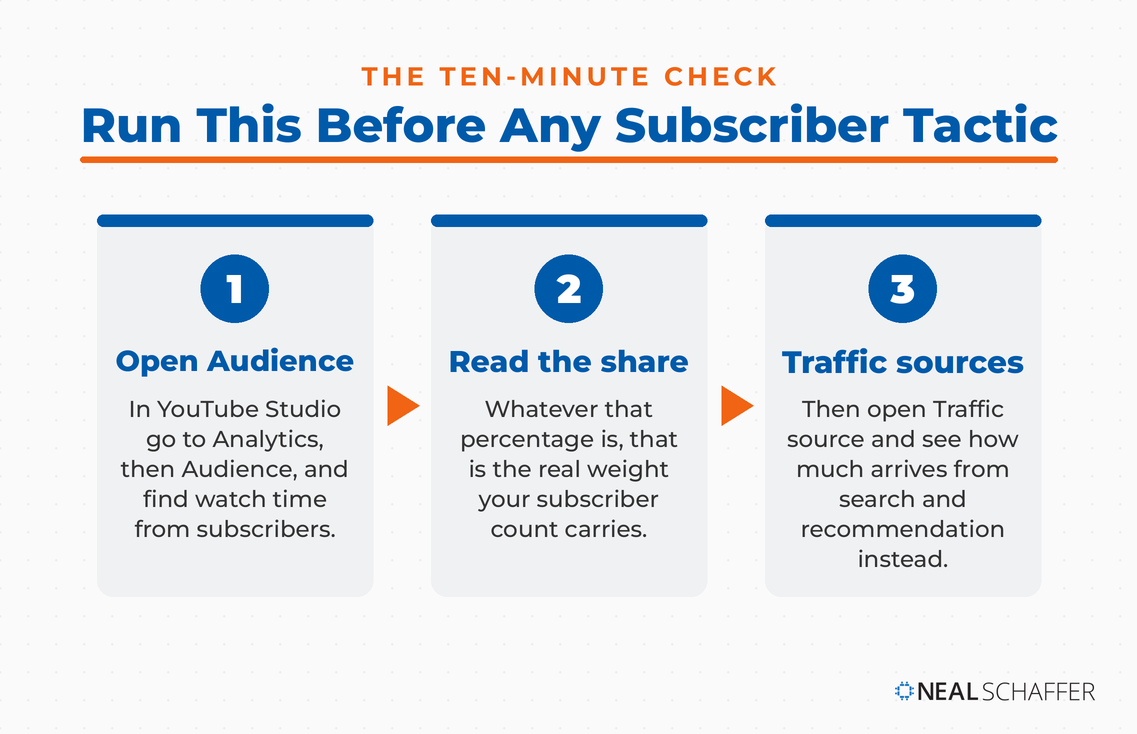
Open YouTube Studio, go to Audience, and find your watch time from subscribers. Whatever that percentage is, it is the real weight your subscriber count carries. Then look at your traffic sources and see how many views arrive from search and recommendation instead. That single exercise will do more for your strategy than any subscriber tactic on any list.
Then get to work on the part that compounds. Pick a narrow audience. Answer the questions they are genuinely searching for. Get better at packaging each video so the right person clicks. If you want the wider numbers behind that shift, the current YouTube statistics are worth bookmarking. For the decisions that come before any of this, start with becoming a YouTuber.
If you would like help building video into a coordinated strategy alongside your search and email channels, download a free preview of Digital Threads or get in touch about Fractional CMO services.
Actionable advice for your digital / content / influencer / social media marketing.
Join 13,000+ smart professionals who subscribe to my regular updates.
