

While most marketers spend their budgets chasing attention on mass-market social networks like Facebook, Instagram, and TikTok, sales professionals have always known something different: LinkedIn is where the action is. When I speak on social selling at conferences and corporate events, I am still genuinely surprised by how many sales pros have either never heard of the LinkedIn Social Selling Index, or heard about it years ago and never bothered to look at theirs.
That gap costs them.
I’ve been writing about LinkedIn since the early days of social media, authoring six books in total including three on this platform with my latest being Maximizing LinkedIn for Business Growth, and I’m an Executive Education Lecturer at Rutgers Business School teaching social media marketing and social selling. After 15+ years helping companies turn LinkedIn into a real revenue channel as a Fractional CMO, I’ve watched the SSI evolve from “the metric LinkedIn used to sell Sales Navigator subscriptions” into something genuinely useful: a free diagnostic tool that tells you exactly where your LinkedIn habits are working and where they’re falling apart.
That being said, here’s what makes 2026 different. LinkedIn itself has signaled, on its own Sales Navigator page about the SSI, that the score doesn’t reflect the modern sales environment the way it used to, and is steering sellers toward AI-powered tools inside Sales Navigator instead. The score isn’t dead, but how you should use it has changed. Let me walk you through the whole thing.
Key Takeaways
✅ The SSI is a 0-to-100 score across four pillars. Each pillar is worth up to 25 points: establish your professional brand, find the right people, engage with insights, and build relationships.
✅ Anyone can check their SSI for free. You don’t need Sales Navigator. Log into LinkedIn and go to the Social Selling Index page.
✅ A “good” SSI is around 65 or higher. The average score sits in the 40-to-50 range, and 75+ puts you in thought leader territory.
✅ LinkedIn is officially shifting away from SSI as a north-star metric. The platform is pushing AI-powered Sales Navigator features instead, but the score still works as an activity diagnostic.
✅ SSI measures behavior, not outcomes. A high score means you’re doing the right things on LinkedIn. It does not guarantee closed deals.
✅ Focus on your weakest pillar first. Most people score 15-20 on their strongest pillar and 5-10 on their weakest. That gap is where the fastest gains live.
What Is the LinkedIn Social Selling Index?
The LinkedIn Social Selling Index is a free score from 0 to 100 that measures how effectively a professional uses LinkedIn for social selling. The score is calculated across four pillars: establishing a professional brand, finding the right people, engaging with insights, and building relationships. Each pillar is worth up to 25 points, and the total updates daily. Take a glimpse of mine below:
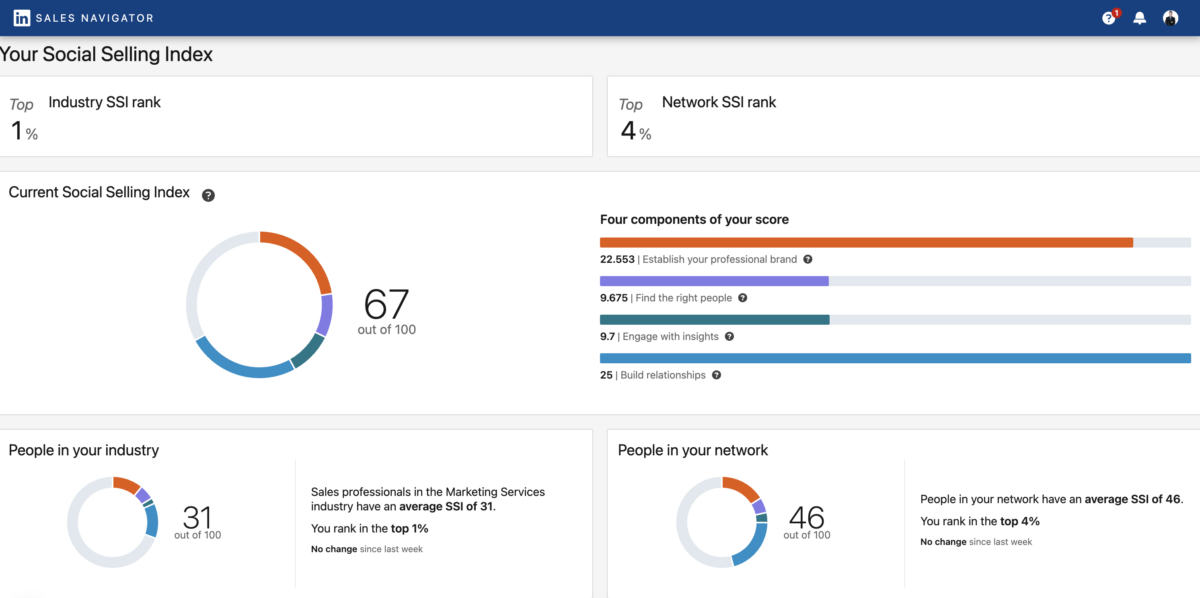
Even a Top 1% industry score has uneven pillars. Mine maxes out on Build Relationships at 25, but Find the Right People sits below 10, which tells me exactly where my next gains live, and demonstrates the diagnostic point this whole post is making. Don’t chase the total. Chase the laggard.
If you are logged into LinkedIn, you can find your own SSI score here:
LinkedIn launched the SSI back in 2014, originally as a Sales Navigator-only feature designed to gamify social selling and justify Sales Navigator subscriptions. Over the years it became free for everyone, and a generation of sales reps treated it as a leaderboard. The four pillars haven’t really changed, but the way LinkedIn frames the score has, which I’ll get to in a minute. As one analysis from Expandi notes, the industry average SSI sits around 35, which gives you a sense of how much of LinkedIn’s user base is barely engaging with the platform at all.
If you’ve never seen yours, it’s worth pulling it up right now. The screen LinkedIn shows you breaks your total score into the four pillar scores, and it also benchmarks you against your industry and your network. That benchmark is honestly more useful than the raw number, because LinkedIn grades you on a curve. A 60 in a hyperactive industry like SaaS sales doesn’t mean the same thing as a 60 in a niche manufacturing vertical.
What Does Social Selling Actually Mean?
Social selling is the practice of using social media as part of your sales process to find, research, and build trust with prospects before the formal sales conversation. In B2B contexts, this almost always means LinkedIn, because that’s where the decision-makers are. In an internal study, LinkedIn found that social selling leaders create 45% more opportunities than peers with lower SSI scores, are 51% more likely to reach quota, and 78% of social sellers outsell peers who don’t use social media at all.
I cover the broader strategy in detail in my book Maximizing LinkedIn for Business Growth, but the short version is this: in B2B sales, your prospect is researching you before they ever reply to your message. Social selling is the practice of making sure that what they find when they look you up actually moves them closer to a conversation.
It’s also why I tell every sales team I work with that LinkedIn is the one channel where the rep’s personal profile matters more than the company’s brand. People buy from people. Per US Chamber of Commerce coverage of social selling, the SSI is best understood as a proxy measurement showing how effective your sales tactics are inside LinkedIn specifically.
Why Is LinkedIn Moving Away From SSI in 2026?
LinkedIn has officially de-emphasized SSI as a primary metric, redirecting sellers toward AI-powered tools inside Sales Navigator. The Sales Navigator page on the SSI now states that the score “no longer accurately reflects the modern sales environment” and that high SSI scores don’t always correlate with measurable sales outcomes.
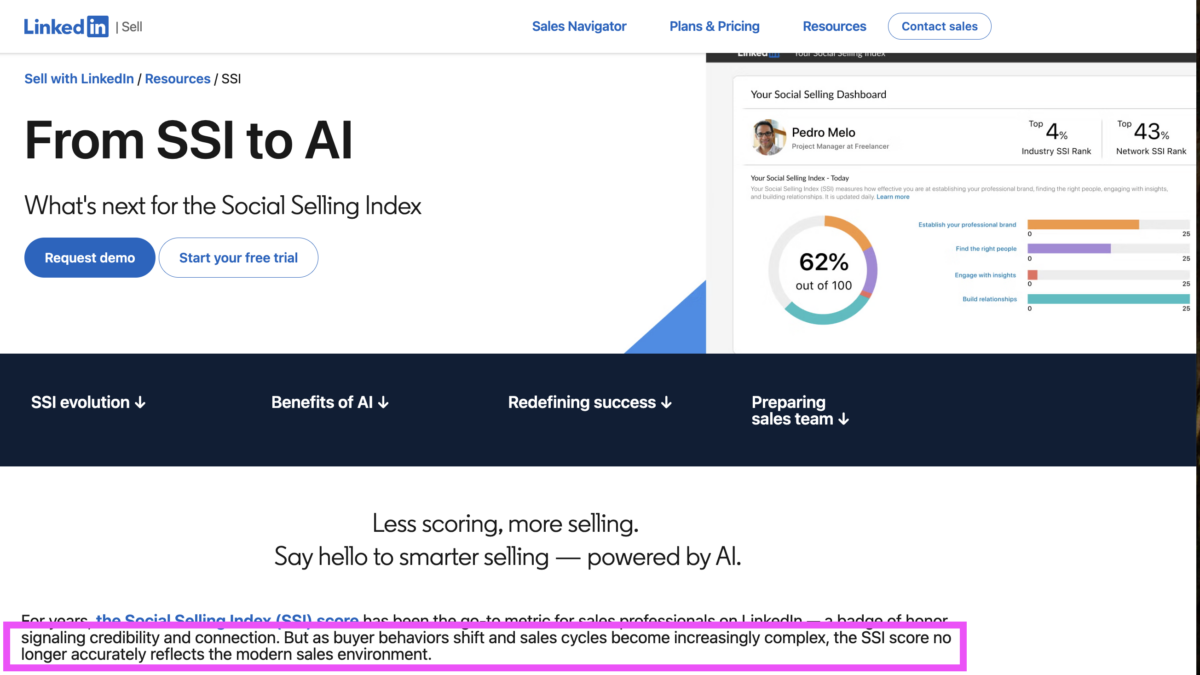
The score still exists, but its role has shifted. This is the part most articles about SSI either miss or skip past, and it matters. LinkedIn’s own argument is that the time and effort needed for high SSI scores can distract people from closing deals and building deep customer relationships. They’re not wrong. I’ve watched sales reps obsess over moving their score higher by a few points while neglecting the actual pipeline conversations that pay their commission checks.
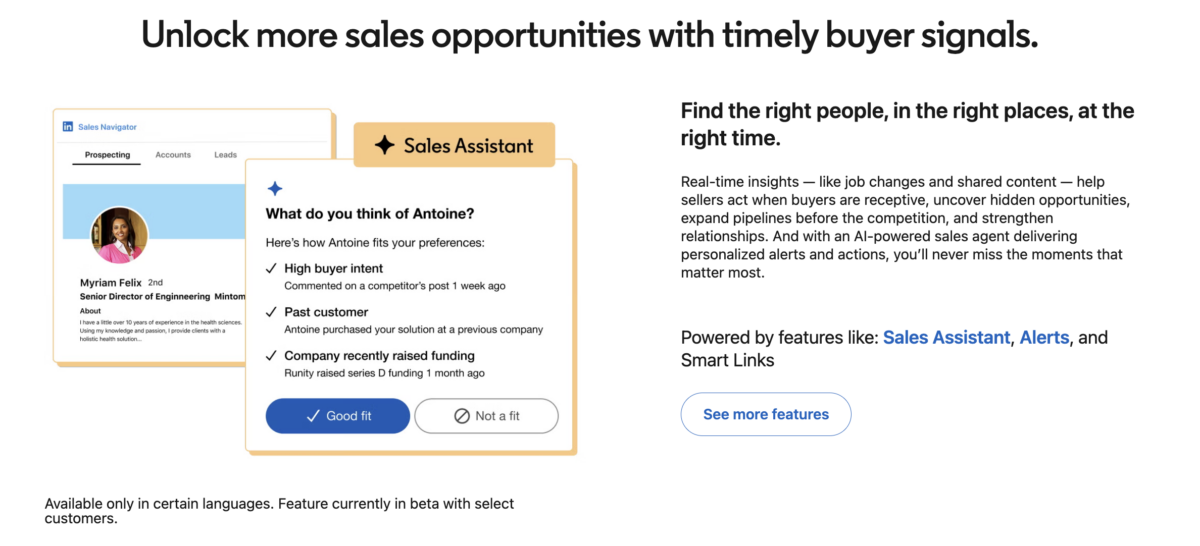
So what’s LinkedIn pushing instead? AI-powered features inside Sales Navigator: Account IQ for instant account research, Lead IQ for prospect intelligence, Sales Assistant for buyer intent alerts, and Message Assist for AI-personalized outreach. Per a Forrester study LinkedIn cites, Sales Navigator users save more than 300 hours per year from AI-driven insights, plus another 65 hours from CRM integration and reduced tool-switching alone.
Trying to Keep Up with Digital Marketing?
Just released: my new book to help small businesses, entrepreneurs, and marketers master digital marketing in today’s digital-first world.
Drawing on my Fractional CMO experience, Digital Threads simplifies complex strategies into clear, actionable steps for success.
Transform your business today—grab your copy! Click the cover or button below to buy on Amazon.

Here’s my take, having watched this kind of platform pivot before. The behaviors the SSI rewards are still the right behaviors. A complete profile, targeted prospecting, content engagement, and real relationship-building still drive results. What’s changed is that LinkedIn now sees more profit in selling AI tools than in promoting a free score. The SSI didn’t break. The business model around it just shifted.
For most sales pros, this means treating SSI as a weekly diagnostic instead of an obsession. Use it to find your weak pillar, fix it, and get back to actually selling.
What Are the Four Pillars of the LinkedIn SSI?
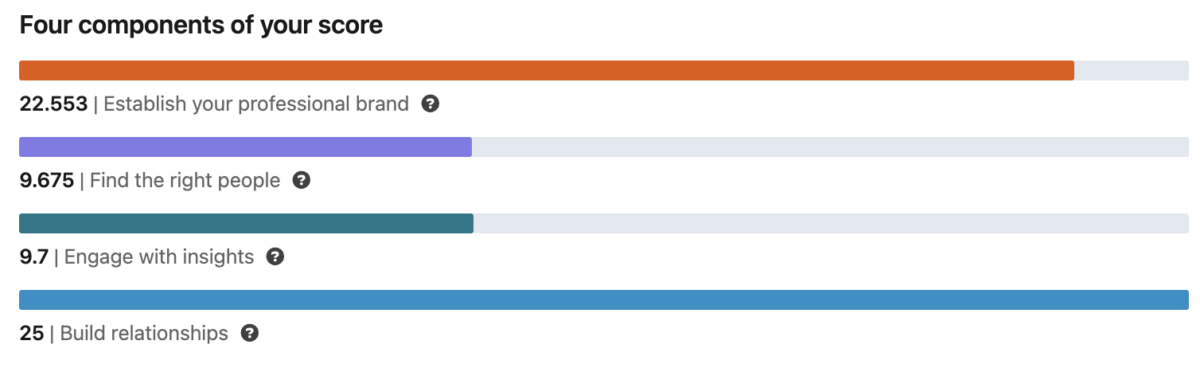
The LinkedIn SSI is calculated across four equally weighted pillars, each worth up to 25 points: establish your professional brand, find the right people, engage with insights, and build relationships. Together they total a maximum of 100 points. The fastest way to raise your score is to identify your weakest pillar and concentrate effort there first.
Let me break each one down with what actually moves the needle. First, a quick at-a-glance reference for the four pillars and what each one rewards:
| Pillar | What It Measures | Primary Levers | Hardest For |
|---|---|---|---|
| Establish Your Professional Brand | Profile completeness, headshot, headline strength, content publishing, recommendations | Custom banner, value-focused headline, posting 3-5 times per week | New users, infrequent posters |
| Find the Right People | Search activity, prospect targeting, profile views | Daily search, Boolean operators, advanced filters, saved searches | Non-sales roles |
| Engage With Insights | Content consumption, sharing, comment quality, post engagement received | Thoughtful comments, hashtag follows, original posts that earn engagement | Casual scrollers |
| Build Relationships | Connection quality, acceptance rate, message responsiveness, network seniority | Personalized requests, 24-hour response time, targeting senior contacts | High-volume connectors |
Pillar 1: Establish Your Professional Brand
This pillar measures how complete and credible your profile is, plus how consistently you publish content that builds authority in your space. Profile completeness alone won’t max it out. You also need to be creating content that earns engagement.
The profile side is the easier half. Make sure every section is filled out, your headshot is professional, your headline is customer-focused instead of job-title-focused, and your About section reads like a positioning statement rather than a resume. If you’re using something like “Sales Manager at Acme Corp,” you’re leaving points on the table. Try something closer to “Helping B2B SaaS teams cut churn 30% through retention-focused account management.” For more patterns that work, see my collection of LinkedIn headline examples.
Your photo and banner matter more than people realize. A weak headshot signals an inactive profile to LinkedIn’s algorithm, and a default banner is a wasted billboard. Pair your headline work with a fresh LinkedIn headshot and a custom LinkedIn background photo.
The content side of this pillar is where most people leak points. Posting 3-5 times per week, with a mix of long-form thought leadership and shorter conversation starters, is what tends to move the score. Recommendations matter too, both received and given, since they reinforce credibility. If you’ve never asked for one before, the etiquette of how to write a recommendation on LinkedIn cuts both ways.
Pillar 2: Find the Right People
This pillar measures how actively you use LinkedIn’s search and prospecting features to identify the right decision-makers. It’s the most points-dense pillar for sales pros and the hardest one to score well on if you’re not in sales.
What moves it: spending time daily in LinkedIn’s search interface, using advanced filters to narrow by job title, company size, geography, and industry, viewing the resulting profiles, and connecting with the people who fit your target. Random browsing won’t do it. The system rewards intentional, repeated prospecting behavior.
If you’re not already using Boolean operators in search, you’re working twice as hard for half the result. Master the operators on LinkedIn Boolean search and you’ll narrow results in useful ways instead of fishing through noise.
Sales Navigator helps with this pillar more than the others, since it adds 50+ advanced search filters, saved searches, and lead alerts. Whether you actually need it depends on your role. For most non-sales professionals, free LinkedIn is enough to get this pillar above 18. If you’re in a pure sales role and live in LinkedIn daily, the math on LinkedIn Premium starts to make more sense.
Pillar 3: Engage With Insights
This pillar measures whether you’re actively consuming and sharing relevant content, plus how much engagement your own posts generate. It’s the easiest pillar to improve in 30 days, and it’s also the one most professionals systematically underuse.
What works: commenting thoughtfully on 3-5 posts a day from people in your target market, sharing or reposting industry articles with your own commentary added, following relevant hashtags so content from outside your network shows up in your feed, and posting your own original content consistently. The system rewards both giving and receiving engagement.
Comments matter more than likes. A comment over 15 words on a prospect’s post gets you in their feed, in their notifications, and on their radar in a way that a thumbs-up never will. As one social selling guide from skrapp puts it, “comments over 15 words have double the impact” of shorter ones for engagement signals. For discovery beyond your existing network, LinkedIn hashtags work strategically. Long-form content also performs disproportionately well in this pillar, which is part of why publishing through a LinkedIn newsletter can move your score faster than scattered posts.
Pillar 4: Build Relationships
This pillar measures how you’re growing your network and the quality of those connections. Specifically, LinkedIn looks at your acceptance rate on connection requests, the seniority of the people connecting with you, and how actively you’re maintaining those relationships through messaging and engagement.
What works: personalizing every connection request with at least one sentence of context, targeting decision-makers and senior people in your industry, replying to messages within 24 hours, and sending periodic value-add messages to people in your network rather than only reaching out when you need something.
What kills this pillar: spraying generic connection requests to everyone with a pulse. Acceptance rate is one of the most overlooked SSI levers, and high-volume, low-quality requests will pull your score down faster than not connecting at all. Pair connection growth with thoughtful follow-up to keep the relationship pillar healthy.
How Do You Check Your LinkedIn SSI Score?
Anyone with a free LinkedIn account can check their Social Selling Index score for free. Log into LinkedIn, then navigate to the Social Selling Index page at . The dashboard shows your total score, your pillar-by-pillar breakdown, your industry rank, and your network rank. No Sales Navigator subscription is required.
Bookmark that page and check it weekly during the first few months of any deliberate improvement effort. Daily checking creates more anxiety than insight, since the score updates based on a rolling window of activity and individual day-to-day movements rarely tell you anything actionable. Weekly is the right rhythm.
When you look at your dashboard, focus on three things: which pillar is weakest, where you rank inside your industry, and where you rank inside your network. The industry rank is the most informative number on the page, because it tells you whether your behavior is keeping pace with the people you actually compete with for attention.
What Is a Good LinkedIn SSI Score?
A good LinkedIn SSI score in 2026 sits at 65 or above for active B2B sellers, well past the all-user average of 40 to 50, with scores of 75+ placing you in thought leader territory. The real benchmark, though, is your industry rank: aim for the top 10% of your industry. That framing aligns with what I see in my own client work, and with what other LinkedIn experts have observed.
As Brenda Meller, LinkedIn marketing strategist at Meller Marketing puts it:
“A higher SSI does not necessarily mean more sales.”
She points out that her own score dips when her client workload is high, which is exactly the kind of real-world reminder that makes SSI useful as a benchmark, not as a target.
Here’s how to read the ranges in practice:
| SSI Score | What It Means | Where Most People Land |
|---|---|---|
| 75-100 | Top performers, thought leader territory | Top 1-5% of industry |
| 65-74 | Strong B2B seller, consistent and targeted | Top 10-25% |
| 55-64 | Active but uneven, one weak pillar likely | Top 25-50% |
| 40-54 | Average user, room for big gains | Bulk of LinkedIn users |
| Under 40 | Inactive or incomplete profile | Casual LinkedIn presence |
A few practical notes on these ranges. First, the gains above 75 get harder fast. Going from 50 to 65 in three months is realistic with consistent daily effort. Going from 75 to 85 takes a year of sustained work, and the marginal pipeline benefit shrinks the higher you go.
Second, your score will fluctuate by a few points week to week even when you don’t change anything. Don’t read meaning into a 1-2 point drop. Look at month-over-month trends instead.
Third, your industry context matters more than the raw number. While the all-user average sits in the 40-to-50 range, nrev’s analysis points out that the average for active B2B sales professionals sits closer to 35, which tells you a score in the high 50s can put you well ahead of your direct competitors in some segments.
How Do You Improve Your LinkedIn SSI Score?
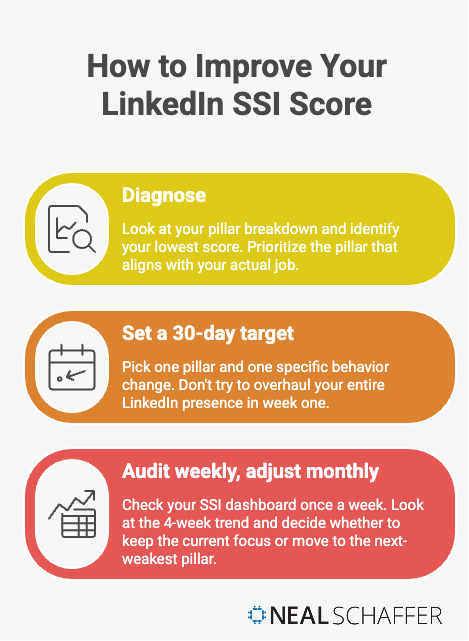
The fastest way to improve your LinkedIn SSI is to identify your weakest pillar and concentrate 70% of your effort there before optimizing the others. Most professionals score unevenly across the four pillars, which means there’s almost always one specific behavior that, if fixed, will move the total score faster than working on everything at once.
Here’s the prioritization framework I walk clients through:
Step 1: Diagnose. Look at your pillar breakdown and identify your lowest score. If it’s a tie, prioritize the pillar that aligns with your actual job. Sales pros should fix “Find the Right People” first. Marketers and consultants should fix “Engage with Insights” first.
Step 2: Set a 30-day target. Pick one pillar and one specific behavior change. Don’t try to overhaul your entire LinkedIn presence in week one. Examples: “Publish 2 long-form posts per week for 30 days” or “Send 5 personalized connection requests per day to VPs in my target market for 30 days.”
Step 3: Audit weekly, adjust monthly. Check your SSI dashboard once a week. Don’t change your strategy based on a single week of data. Look at the 4-week trend and decide whether to keep the current focus or move to the next-weakest pillar.
The behaviors below tend to produce the biggest score movements per hour invested:
| Behavior | Pillar Affected | Time Investment | Typical Score Impact |
|---|---|---|---|
| Complete every profile section, custom banner, value-focused headline | Establish Brand | 2-3 hours, one-time | +3-5 points in 7-14 days |
| Publish 1-2 long-form posts per week | Establish Brand + Engage | 2 hours per week | +3-7 points in 30 days |
| 10-15 minutes daily of targeted prospect search | Find the Right People | 75 minutes per week | +4-8 points in 30 days |
| Comment thoughtfully on 5 posts per day | Engage with Insights | 15-20 minutes per day | +5-10 points in 30 days |
| Personalize every connection request and respond to messages within 24 hours | Build Relationships | Ongoing | +2-4 points in 30 days |
A few honest caveats. These ranges come from my own experience and aren’t a guarantee. Some people see faster gains, some slower. The biggest variable is consistency. Daily 30-minute LinkedIn sessions outperform sporadic 4-hour binges, every single time.
If you’re starting from below 40, the fastest gains come from the brand and engagement pillars. Spend the first two weeks on a profile overhaul and content publishing, then add prospecting in week three.
If you’re above 65 already, the next 5 points usually live inside whichever pillar is dragging the average down. Get your pillar breakdown, find the laggard, and focus there. The same activities that move your SSI also drive LinkedIn marketing strategy outcomes more broadly, including LinkedIn lead generation results.
Should You Still Care About SSI in 2026?
Yes, but not as a target. The SSI is most useful in 2026 as a free, unbiased diagnostic of your LinkedIn behavior, not as a KPI to chase. The score reflects whether you’re doing the activities that correlate with social selling success, which means a low score is a signal that something specific in your habits needs attention.
A high score, on the other hand, doesn’t guarantee a single closed deal. As one 2026 LinkedIn statistics roundup from Martal frames it, social selling has moved from buzzword to baseline in modern B2B sales, and the SSI behaviors are still the right behaviors even if the score isn’t the headline metric anymore.
This is the mental shift that separates people who get value from SSI from people who get distracted by it. Treat the score the way you’d treat a fitness tracker: useful for spotting trends and weak spots, useless as the goal itself.
If you’re a B2B sales rep, your real KPIs are pipeline created, opportunities advanced, and revenue closed. SSI is a leading indicator that points at the LinkedIn behaviors driving those numbers, but it’s not the same thing as them. A rep with a 78 SSI who’s prospecting at random will lose to a rep with a 55 SSI who’s targeting accounts with active buying signals. Every time.
If you’re a founder, marketer, or consultant building a personal brand, the SSI is even more useful, because the four pillars map almost perfectly to what makes a personal brand work on LinkedIn. Your score becomes a rough read on whether your visibility strategy is actually working.
What I’d push back on, regardless of role, is treating SSI as a vanity metric or a leaderboard. You’re not competing with the rest of LinkedIn. You’re trying to turn the platform into a real source of revenue, opportunity, and credibility, and the SSI is one of several tools that can help you do that.
Frequently Asked Questions About the LinkedIn Social Selling Index
The LinkedIn Social Selling Index generates a lot of questions because it sits at the intersection of LinkedIn’s product strategy and individual sales performance. Below are the questions I get most often when speaking on social selling, with practical answers grounded in what’s actually happening on the platform in 2026 rather than outdated advice from when SSI was LinkedIn’s headline metric.
Yes. Anyone with a free LinkedIn account can view their full SSI dashboard at no cost. You don’t need LinkedIn Premium or Sales Navigator. The score updates daily based on your recent activity and includes both your industry and network benchmarks for context.
There’s no public confirmation that LinkedIn’s content algorithm uses the SSI score as a direct ranking input. What’s more likely is that the behaviors LinkedIn rewards in the SSI calculation, like consistent posting, meaningful engagement, and complete profiles, also happen to be the behaviors LinkedIn’s algorithm rewards with greater visibility. The correlation is real, even if the score itself isn’t a direct ranking factor.
Daily. LinkedIn refreshes your SSI score each day based on a rolling window of recent activity, often described as the last 90 days. That means a sustained behavior change shows up in your score within a week or two, but it also means a long break from LinkedIn will pull your score down. Consistency matters more than intensity.
Indirectly, yes. The activities that raise your SSI score, like maintaining a strong profile, prospecting consistently, sharing valuable content, and building relationships, are the same activities that drive social selling outcomes. But the SSI itself is a measure of activity, not results. Treat it as a leading indicator, not as a sales metric.
Start Using Your SSI as a Diagnostic Today
Your LinkedIn Social Selling Index isn’t a leaderboard. It’s a free read on whether your LinkedIn habits are pointed in the right direction, and the people who get the most out of it are the ones who use it as a weekly check-in, not a daily obsession. Pull up your dashboard, find your weakest pillar, pick one specific behavior to change for the next 30 days, and ignore the rest of the score until you see your weak pillar move.
If you want a complete framework for turning LinkedIn into a real revenue channel, my book Maximizing LinkedIn for Business Growth walks through the full playbook, from profile to pipeline. You can also grab the free preview ebook if you want to try the first chapters before committing. And if you’d rather have a strategic partner walking your team through this, my Fractional CMO services include LinkedIn social selling enablement as well as social selling-specific LinkedIn training as part of the broader engagement.
The SSI is a useful tool. Use it. Just don’t let it become the point.
Actionable advice for your digital / content / influencer / social media marketing.
Join 13,000+ smart professionals who subscribe to my regular updates.
