


“Is my Domain Rating good?” is one of the most common questions in SEO. The honest answer: it depends entirely on what you compare it to.
Domain Rating (DR) is Ahrefs’ measure of how strong a website’s backlink profile is, on a scale from 0 to 100. It’s relative by design: your score reflects how your backlink profile stacks up against every other website in our index.
That’s why “what’s a good DR?” has no single answer. A DR of 60 could be excellent in one industry and middling in another. It could be more than enough to rank for one keyword and nowhere near enough for another.
There’s one more thing worth knowing before you judge your own score. DR is logarithmic, so websites aren’t spread evenly across the 0–100 scale. The internet is mostly small, new, or abandoned sites, which means the overwhelming majority of domains sit right at the bottom — DR 0 to 10. Climbing from DR 20 to 30 takes a handful of links. Climbing from 70 to 80 can take thousands. So a “high” number is rarer than it looks.
Rather than chase a magic number, judge your DR the three ways that actually matter: against your competitors, against your industry, and against the specific keywords you want to rank for. Here’s how to do each, with real data.
The most practical benchmark isn’t the whole internet — it’s the specific companies you’re fighting for the same customers.
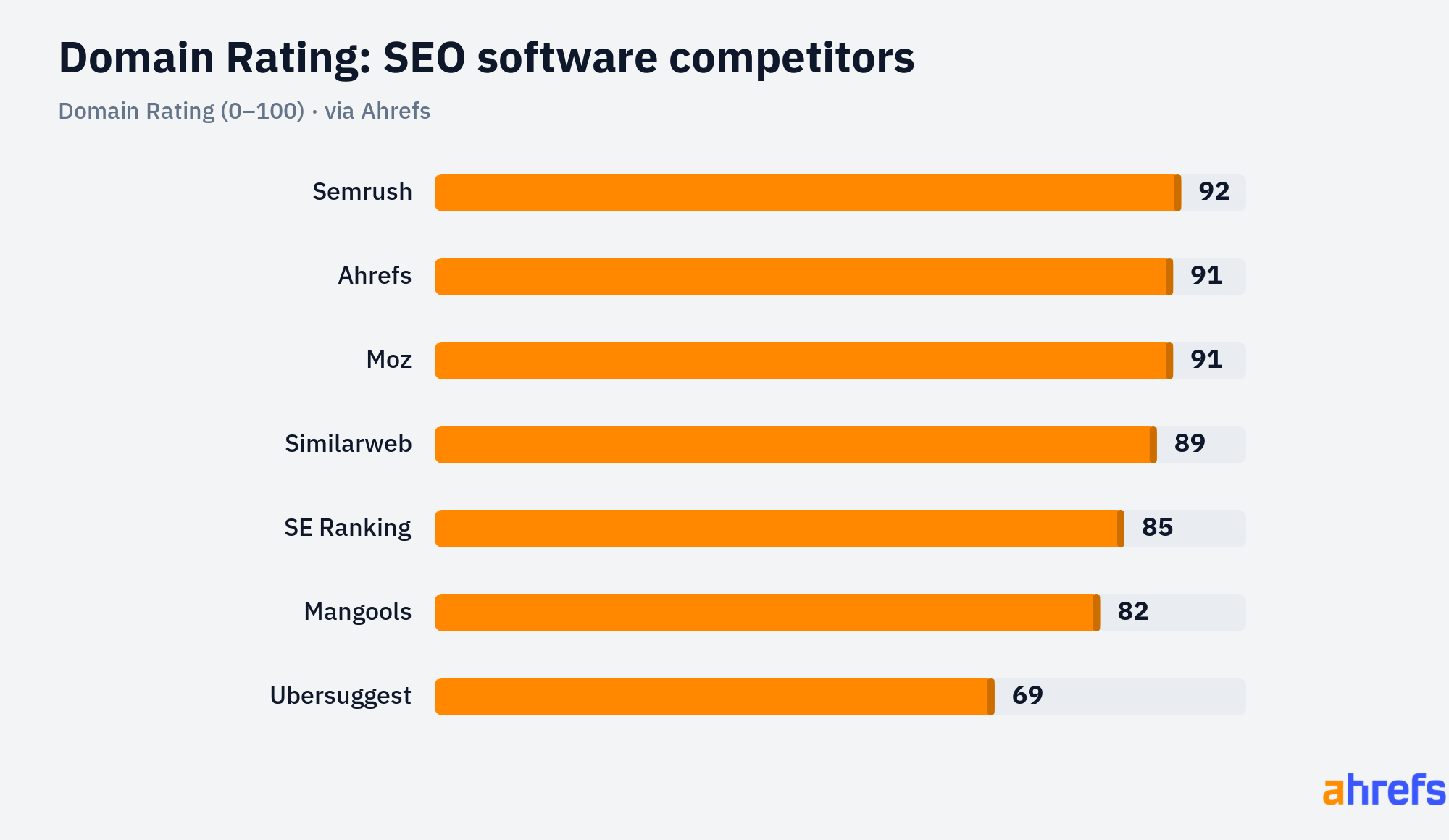
Take the SEO software space. Here’s how the major players compare:
| Website | Domain Rating | Referring domains |
|---|---|---|
| Semrush | 92 | 132,404 |
| Ahrefs | 91 | 100,201 |
| Moz | 91 | 106,417 |
| Similarweb | 89 | 49,594 |
| SE Ranking | 85 | 19,574 |
| Mangools | 82 | 15,770 |
| Ubersuggest | 69 | 1,522 |
In this market, a “good” DR is 80+ — that’s just the cost of entry. A DR of 69 (Ubersuggest) stands out as the outlier, and the referring domains column shows why: it has a fraction of the linking websites the rest of the pack has earned. That’s DR doing its job — it’s a summary of your backlink profile’s strength relative to the field.
Run the same comparison for your own niche. If your competitors cluster around DR 40, then a DR of 50 is genuinely good. If they’re all at 85, a DR of 70 means you have ground to make up. “Good” is whatever beats the people you’re actually competing with.
How to calculate this with Ahrefs
- Open Batch Analysis (Site Explorer → Batch Analysis).
- Paste in your domain plus your direct competitors — up to 200 at once.
- Set the mode to Domain and hit Analyze.
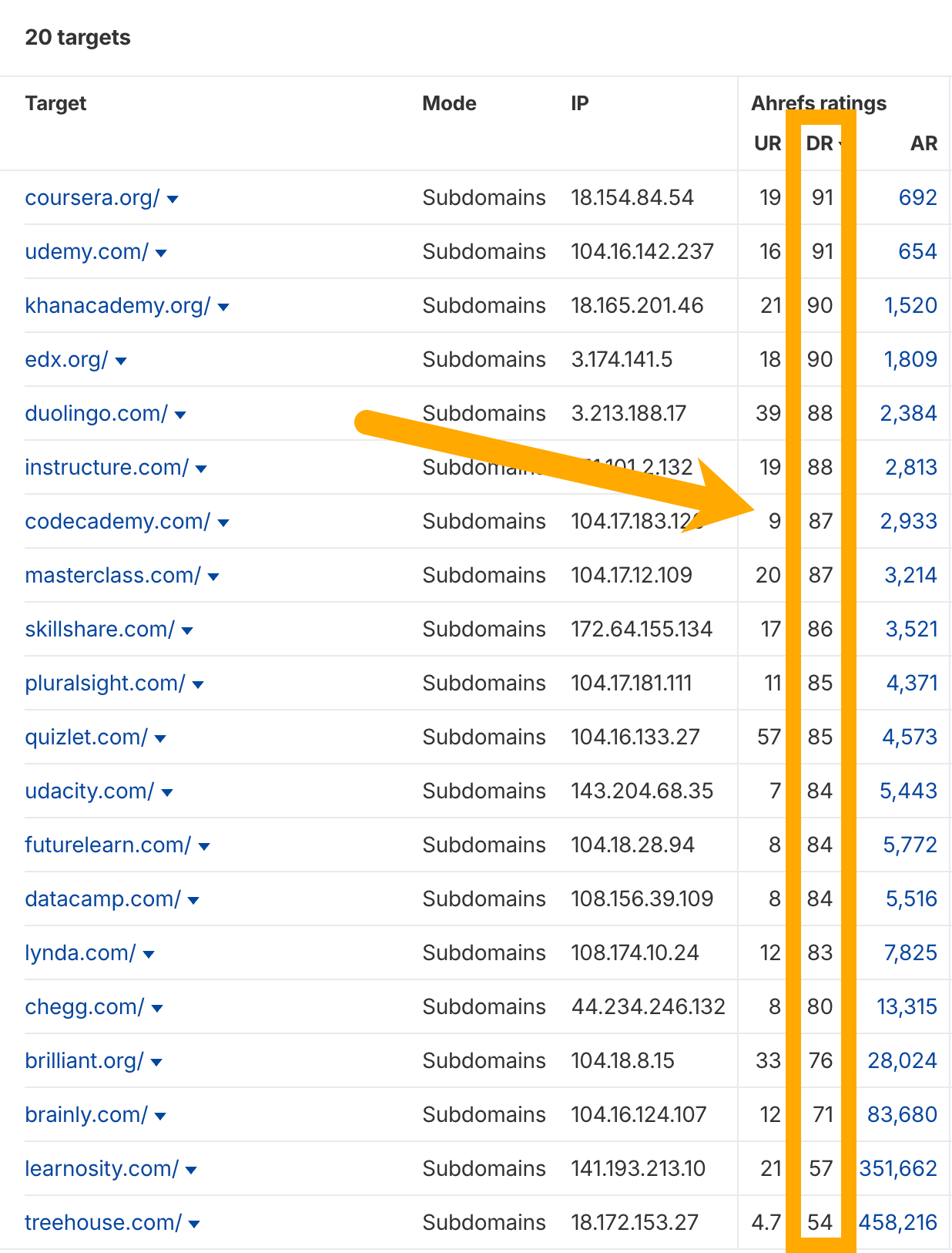
- Sort the results by the DR column.
You’ll see your whole competitive set ranked by Domain Rating in one view, exactly like the table above. That instantly tells you whether your DR is “good” for the company you keep.
Tip
No Ahrefs account? The free Website Authority Checker gives you the DR of any single domain — run it on yourself and a few rivals to get a quick read.
Zoom out from direct rivals to your whole sector, and the picture shifts again.
To give you a quick example, I used our SEO agent, Agent A, to pull the Domain Rating of 600 SaaS companies to see what “normal” looks like across an entire industry:
| Benchmark | Domain Rating |
|---|---|
| Bottom quartile | 38 |
| Median SaaS company | 62 |
| Top quartile | 77 |
| Top 10% | 86 |
So if you run a SaaS site, DR 62 is dead average, DR 77 puts you in the top quarter of your industry, and anything above 86 is elite company. That’s a far more useful yardstick than a generic “70 is good,” because it’s measured against businesses like yours.
The lesson isn’t the specific SaaS numbers, it’s the method. Build a list of 20–30 companies in your space, check their Domain Ratings, and you’ve got an industry benchmark tailored to you.
How to calculate this with Ahrefs
- Build a list of 20–50 companies in your industry (your own customer list, a “top X tools” roundup, or competitors’ competitors all work).
- Drop the domains into Batch Analysis and export the DR column.
- Sort low to high and read off the quartiles: the middle value is your industry median, the top 25% marks “strong,” the bottom 25% marks “lagging.”
That gives you a benchmark calibrated to your sector — far more meaningful than any universal number.
This is the comparison that actually predicts whether you can rank (and the one almost nobody runs).
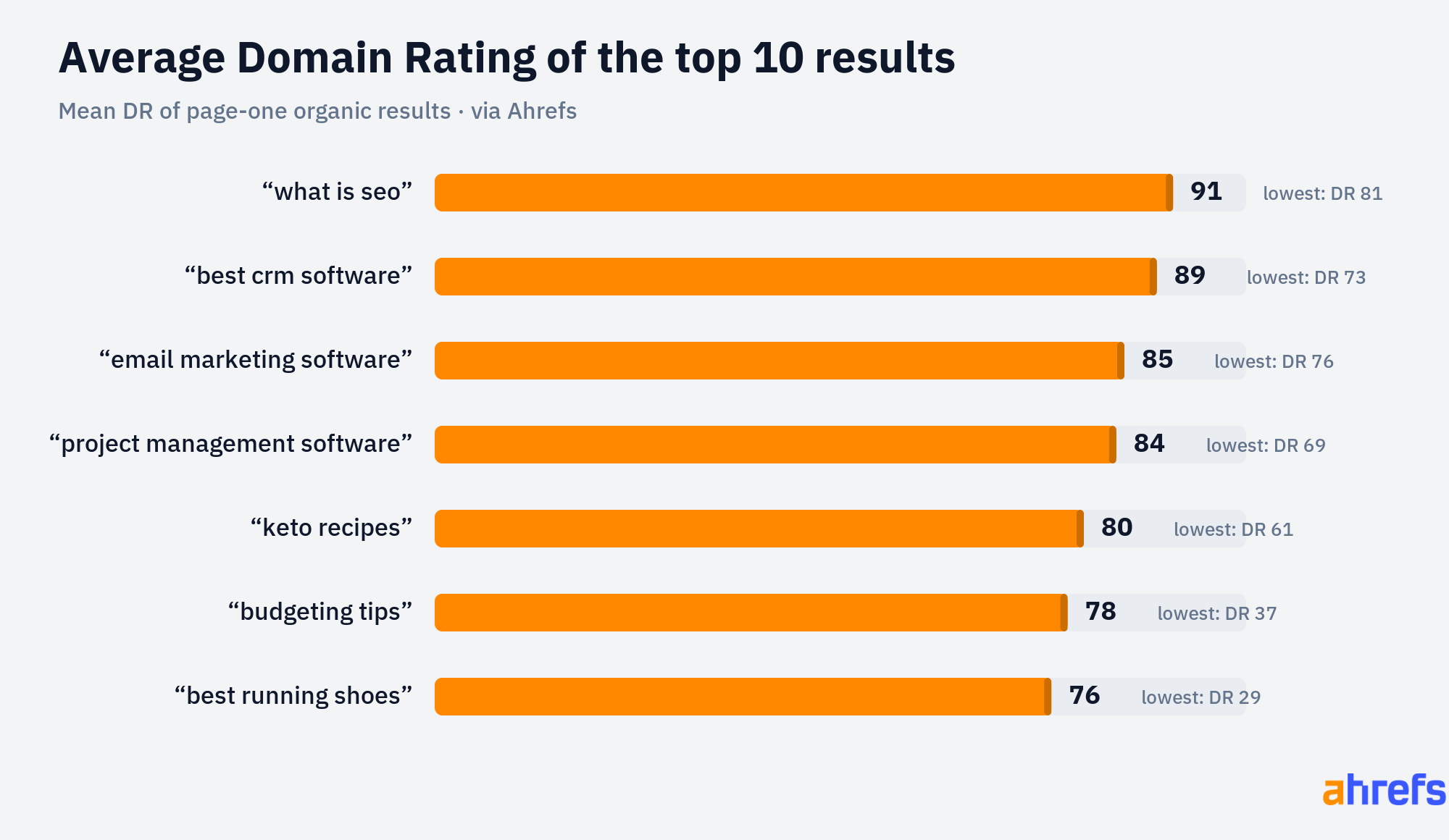
Instead of asking “is my DR good?”, ask “what DR do the sites already ranking for my target keyword have?” Here’s the average Domain Rating of the top 10 organic results for a range of keywords:
| Keyword | Avg DR of top 10 | Lowest DR ranking |
|---|---|---|
| what is seo | 91 | 81 |
| best crm software | 89 | 73 |
| email marketing software | 85 | 76 |
| project management software | 84 | 69 |
| keto recipes | 80 | 61 |
| budgeting tips | 78 | 37 |
| best running shoes | 76 | 29 |
Two lessons jump out.
First, competitive commercial keywords demand serious authority. To compete for “best CRM software,” you’re up against a SERP averaging DR 89. A new site at DR 20 isn’t getting onto that page anytime soon, no matter how good the content.
Second — look at that “lowest DR ranking” column. A DR 29 site ranks on page one for “best running shoes.” A DR 37 site ranks for “budgeting tips.” DR is not a ranking factor, and it’s not a gate. Lower-authority sites absolutely rank, especially for less competitive or more informational queries. DR tells you how steep the climb is, not whether it’s possible.
How to calculate this with Ahrefs
- Enter your target keywords in Keywords Explorer.
- Click Add filter and add your website’s DR to the Lowest DR filter.
- Review your list of keywords with similar DR websites already ranking in the top 5.
If your filtered list comes back nearly empty, the keywords in this space are locked up by high-DR sites — pick an easier topic first. But if you get a healthy list back, those are your openings: keywords where sites at your authority level are already ranking, so you can compete without needing to outgrow everyone first.
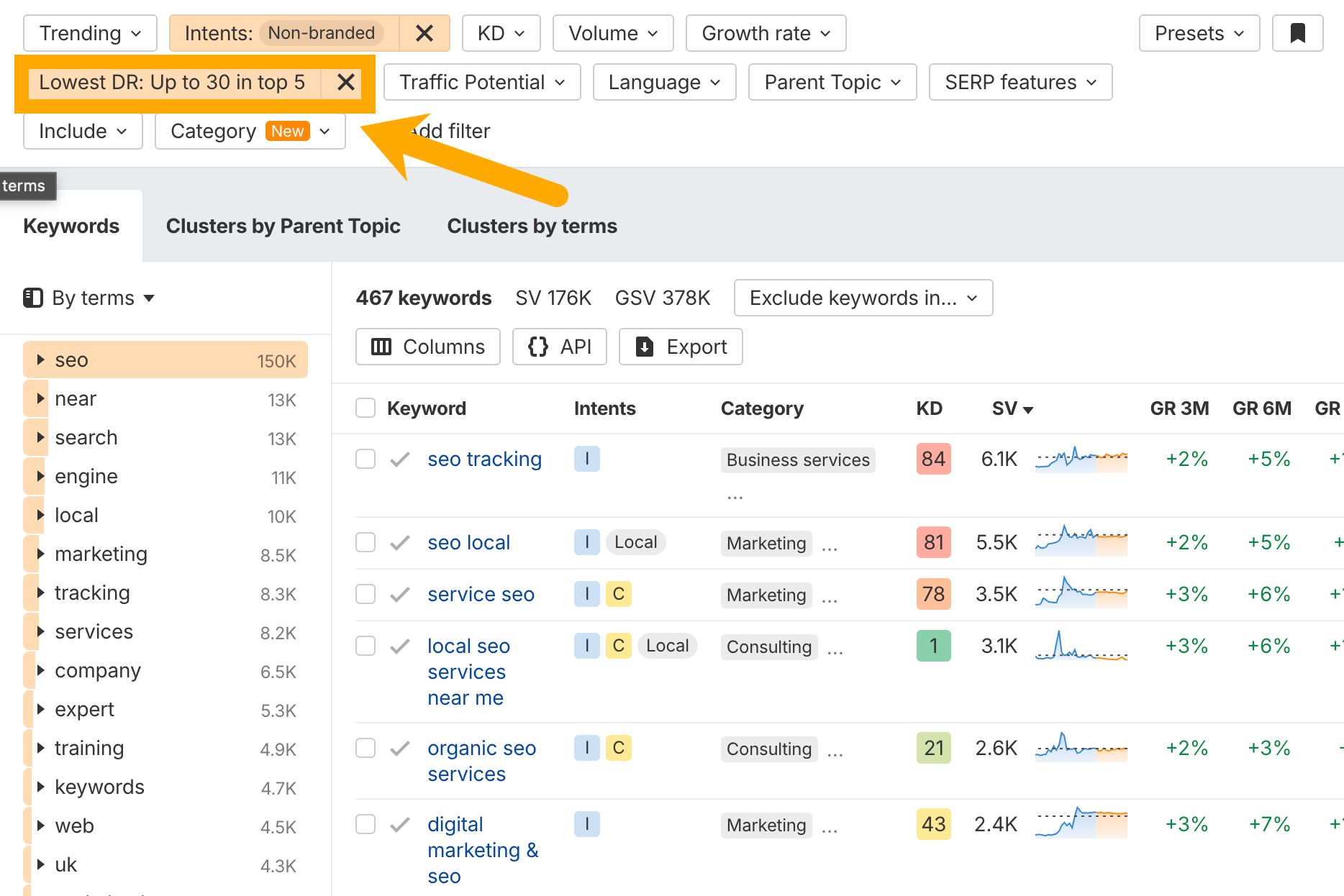
In the example above, filtering a list of SEO keywords to “Lowest DR: up to 30 in top 5” cuts thousands of terms down to 467 winnable opportunities — proof that a modest DR is no barrier if you pick the right battles.
It’s worth saying plainly, because it’s the most common misconception: DR is not a Google ranking factor. Google doesn’t use Ahrefs’ Domain Rating. It’s our metric, built from the size and quality of a site’s backlink profile.
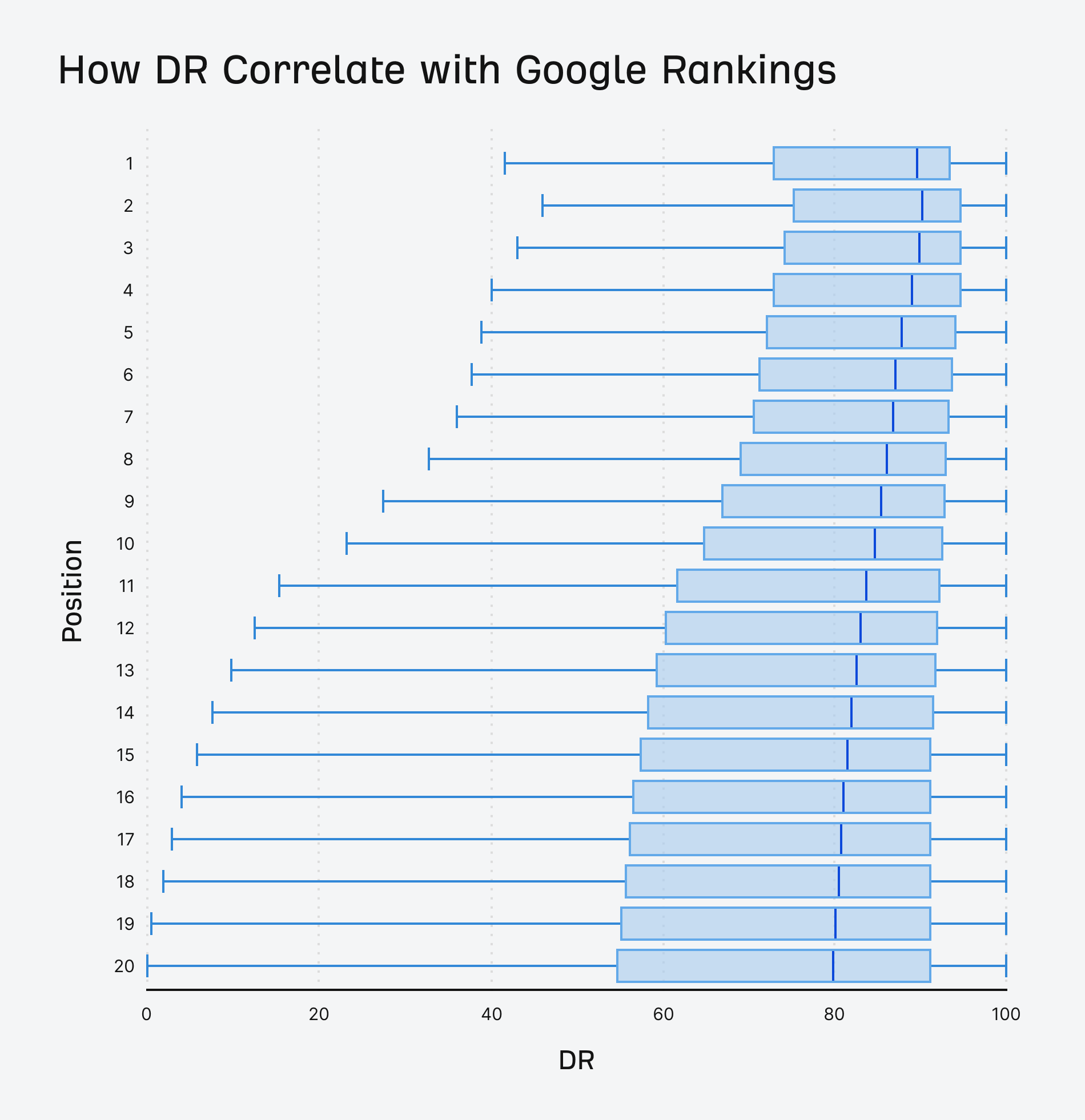
What DR correlates with is competitiveness. Strong backlink profiles tend to come with the things that do help you rank — authority, trust, and the resources to produce and promote good content. But the correlation is loose, which is why you see DR 29 pages on page one and DR 90 pages buried on page five for the wrong query.
When we studied this back in 2025, we found that DR has a 0.131 correlation with SERP rankings: a small positive correlation, and far from definitive.
Treat DR as a strategic gauge, not a scoreboard:
- Use it to size up how hard a keyword or niche will be.
- Use it to track your own backlink growth over time.
- Don’t obsess over moving it a few points. The points themselves don’t rank you — the links behind them do.
Since DR is built almost entirely on your backlink profile, improving it comes down to earning more high-quality referring domains:
- Earn links from more unique websites. DR rewards the number of distinct domains linking to you, not raw link count. Ten links from ten sites beat a hundred from one.
- Volume of unique domains is what actually builds DR. Counterintuitively, you can reach a high DR with links from low-DR sites alone — you just need a lot of them. A single link from a huge site like TechCrunch barely moves your DR, because its link equity is split across the 100,000+ sites it links out to. Chase more distinct referring domains, and don’t over-index on any one big link.
- Create genuinely linkable assets — original data, free tools, definitive guides — that other sites want to cite.
- Reclaim and fix — find unlinked brand mentions and broken links pointing to your old pages, and turn them into live links.
Improvement is gradual and logarithmic: the higher your DR, the more links each additional point requires. Focus on the links and the DR score follows.
There’s no universal “good” Domain Rating. There’s only good relative to something:
- Good vs. your competitors: beating the specific sites you compete with.
- Good vs. your industry: where you sit among your peers.
- Good vs. the SERP: enough authority to compete for the keywords you actually want.
Check yours, then check those three benchmarks. That’ll tell you far more than any one-size-fits-all number ever could.
