


Online shopping keeps growing. Your share of it probably is not. US retail ecommerce reached $340.2 billion in the second quarter of 2026, 17.1% of all retail sales and up 12.2% year over year against 6.7% growth for retail overall, according to the Census Bureau. The category is expanding at roughly twice the rate of the stores on the street.
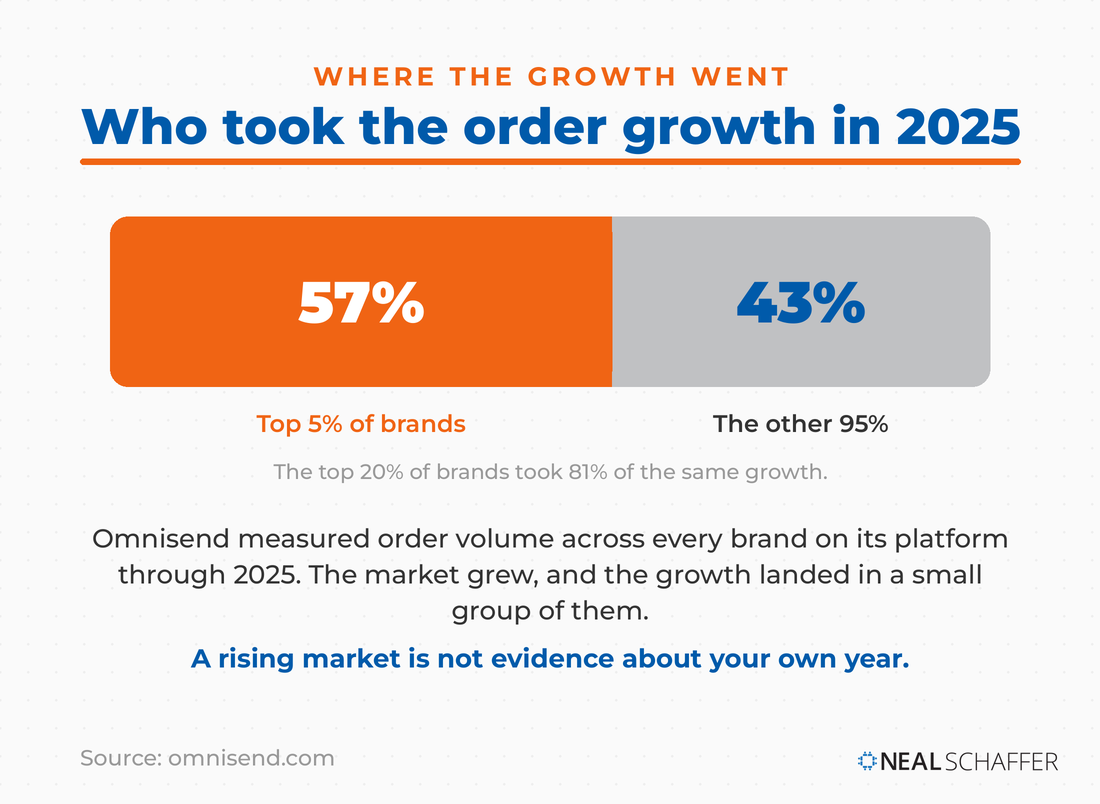
Now look at who got that growth. Omnisend measured order volume across the 150,000 brands on its own platform and found it up 98% year over year in 2025. But the top 5% of those brands captured 57% of the growth, with the top 20% absorbing 81% of it. From a distance the market looked healthy. Up close, most brands were competing for what was left.
So the market is not the problem. Something else separates the brands pulling away from the ones standing still, and in my experience it is rarely budget.
I am a Fractional CMO for B2B and ecommerce brands, and I have written six books on digital marketing, most recently Digital Threads. Every ecommerce client I have worked with in that role ran on Shopify, so the examples in my post on ecommerce marketing strategies come from that vantage point rather than from theory.
One thing worth saying before you read further, because it shapes everything below. I do not run a store. I have been building my first one, so I am closer to this than I used to be, but I am not an operator. I do not pick SKUs, manage inventory, or handle returns. I sit on the buyer’s side of the table. I am not selling you a platform or an agency retainer, so I have no reason to tell you that the channel I happen to sell is the one you need. If you want to know more about how I work with clients, that is the lens.
Key Takeaways
✅ Growth is concentrating. A rising market no longer lifts every store, so “ecommerce is booming” tells you nothing you can act on.
✅ Paid acquisition gets more expensive on its own terms every year. Owned channels, meaning search, email and your own product pages, are where a smaller brand can still compound.
✅ AI assistants have become a real source of buying traffic, and the shoppers arriving that way convert better than the ones arriving from ads. Most product pages are not written for the machines doing the recommending.
✅ Cart abandonment is largely a checkout problem. The reasons shoppers give for walking away are mostly decisions about your checkout flow and your shipping terms, not about your marketing.
✅ Shoppers validate everything now. Reviews, questions and customer photos are conversion infrastructure, not decoration.
✅ Measure key events, not traffic. A page that brings visitors and no purchases or signups is costing you money to maintain.
What Is Ecommerce Marketing?
Ecommerce marketing is the coordinated set of activities that gets an online store found, gets its products chosen, and gets its customers to come back. It spans search, content, email and SMS, paid media, social and creator partnerships, marketplaces, and the on-site work that turns a visit into an order.
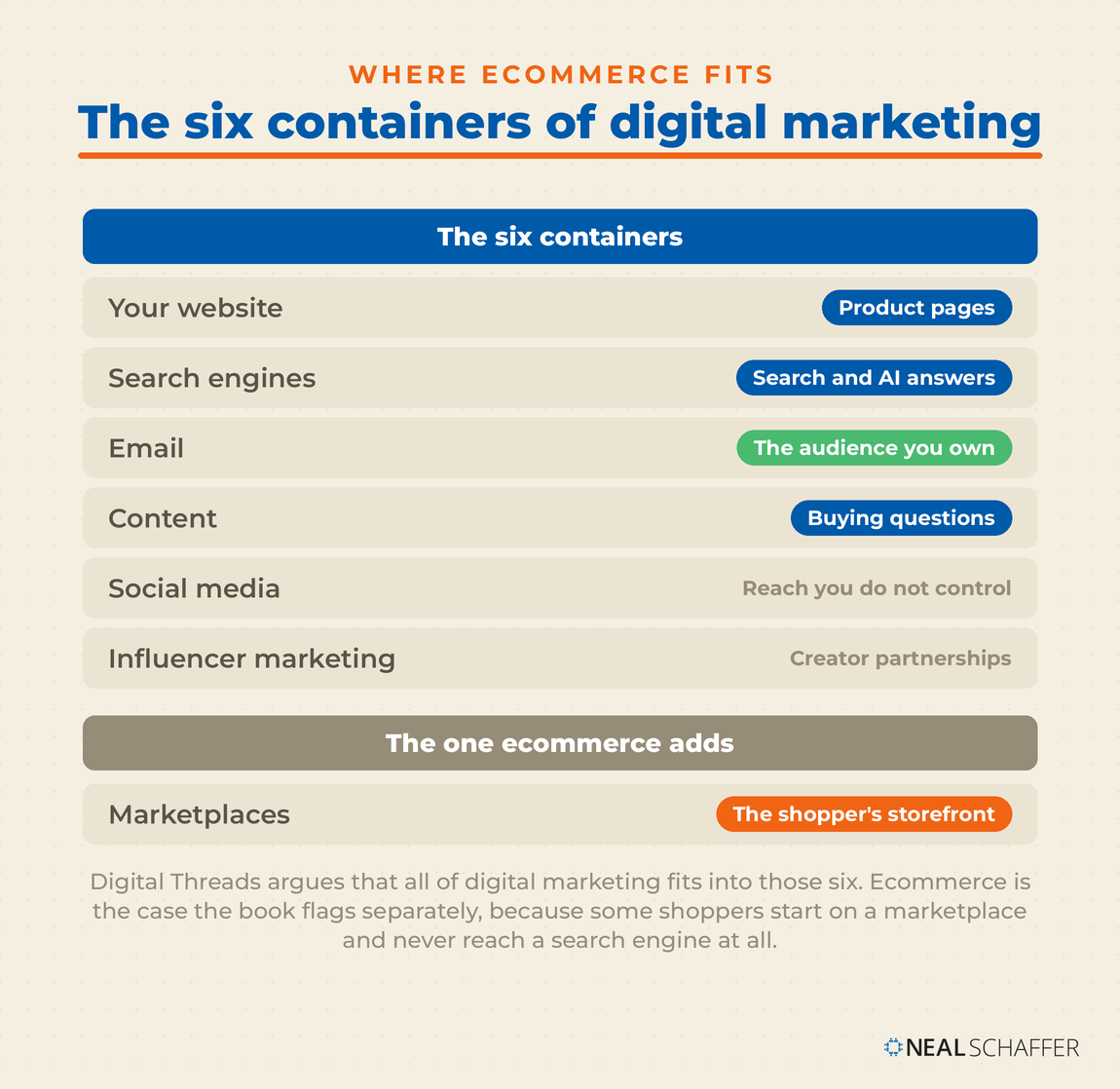
That definition sounds broad because the job is broad. In Digital Threads I argue that all of digital marketing fits into six containers: your website, search engines, email, content, social media, and influencer marketing. Ecommerce uses all six, plus one case the book flags separately. Some shoppers skip search engines and go straight to Amazon or another marketplace, which makes that marketplace their storefront rather than yours.
The other idea from the book that matters here is the relationship funnel. People move from the public, to knowing you, to trusting you, to buying, to advocating for you.
| Stage | What the shopper is doing | What you own here | What to watch |
|---|---|---|---|
| Public | Has never heard of you | Nothing yet | Reach, new visitors |
| Knows you | Has landed once and left | Your content and your product pages | Email capture rate |
| Trusts you | Comparing you against alternatives | Reviews, questions, policies | Add-to-cart rate |
| Buys | In the checkout | Your checkout flow | Conversion rate, cart abandonment |
| Advocates | Reviewing, referring, reordering | Post-purchase email, loyalty | Repeat purchase rate |
From what I have seen working with ecommerce clients, budgets cluster at the first two rows and the fourth, while trust and advocacy get almost nothing. That imbalance is the pattern I run into most.
Which raises the question of where the money should go instead, and that starts with why this got harder.
Why Did Ecommerce Marketing Get Harder in 2026?
Three things changed at once. Growth concentrated into a small group of brands. Paid acquisition kept getting more expensive on the platforms most stores depend on. And the discovery layer between shoppers and products began shifting from a list of blue links toward AI assistants that summarize, compare and recommend.
Take the paid pressure first, because it is the one you feel monthly. Meta reported that its average price per ad rose 12% year over year in the second quarter of 2026 while ad impressions delivered grew 14%. More inventory, and still a higher clearing price. That is an auction that rewards advertisers with scale and better data. It is a harder place to be the brand trying to break in.
Shopper behavior moved too. Bazaarvoice surveyed shoppers for the twentieth edition of its Shopper Experience Index. It found 97% now consult multiple sources before buying, with 60% needing two or three sources and 37% needing four or more. A single ad impression no longer closes anything. It opens a research project.
Put those together and the arithmetic changes. If most shoppers need two to four sources before they buy, and the cost of each paid touch rises every year, then the channels you own have to carry more of the load. Not because owned media is virtuous, but because it is the only part of the equation whose price you control.
That leaves the practical question of which channels earn their place, and the answer splits by job.
Which Channels Bring New Customers In?
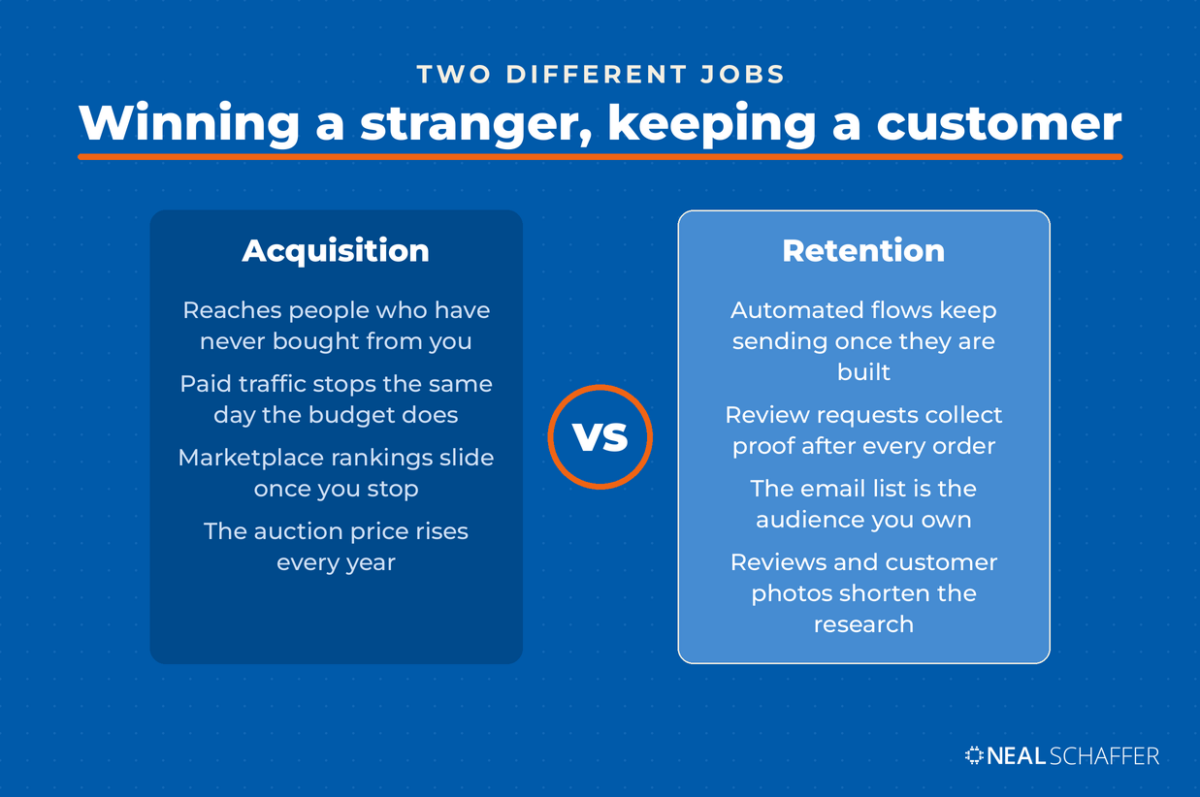
Acquisition channels do one job: put your product in front of someone who has never bought from you. The four that consistently earn their budget are organic search, content that answers buying questions, paid social and search, and marketplaces. The right mix depends on your margin and on how considered your product is.
| Channel | What it buys you | How fast it works | What happens when you stop |
|---|---|---|---|
| Organic search | Buyers already looking for your category | Two to three quarters | Rankings decay slowly |
| Content | Buyers not yet searching for you by name | Two to three quarters | Pages keep earning |
| Paid social and search | Volume and speed on demand | Days | Traffic stops the same day |
| Marketplaces | Access to shoppers who never visit your site | Weeks | Listings stay, ranking slides |
Search and content
Organic search compounds. Every product page and article you rank keeps working after the budget stops, which is the opposite of how paid behaves. For stores this splits into on-site work and off-site work, and both matter. The on-site side sits in ecommerce SEO best practices and the Shopify SEO checklist. Then content marketing for ecommerce takes on the articles that bring in people not yet searching for your product by name.
The mistake I run into most often is a blog treated as a traffic exercise disconnected from the store. A post that ranks and sends readers to a page with no product link, no email capture and no next step is an expense.
Paid social and paid search
Paid buys speed. I would argue it builds no asset, and the price rises every year, which is what Meta’s own reported figure above shows. Use it to test offers and creative quickly, to retarget people who already visited, and to defend branded terms. Treat it as rented attention with a rising rent, and cap the share of revenue you are willing to hand back to it.
One Strategy to Connect All Your Marketing
My latest book helps small businesses, entrepreneurs, and marketers bring search, email, and social together into one digital marketing strategy that actually compounds.
Drawing on my work as a Fractional CMO, Digital Threads turns complicated tactics into a clear, practical plan you can follow, whatever your budget or team size.
Grab your copy on Amazon and start weaving your own digital threads. Click the cover or the button below to get started.

Marketplaces
Amazon is a search engine before it is a store, and it deserves its own strategy rather than a copy of your website copy. The ranking side sits in Amazon SEO and the campaign side in Amazon marketing strategies. If you are still deciding where to sell at all, Amazon and Shopify walks the trade-off, and the usual answer is to run both and use your own store to build the list.
Acquisition is only half the machine, and it is the expensive half. From what I have seen, the cheaper half is the one stores underbuild.
Which Channels Turn Buyers Into Repeat Buyers?
Retention channels work on people who already know you, which makes them cheaper per order than anything in the acquisition column. Email and SMS are where the automation revenue concentrates. Reviews, questions and customer photos do the trust work that makes a second purchase feel obvious rather than risky.
Email and SMS automation
For most stores this is the highest-return work available, and it is chronically underbuilt. Across the same Omnisend merchant base, automated emails made up just 2% of sends but drove 30% of all email revenue, earning 16 times more per send than scheduled campaigns. Two flows did the heavy lifting: abandoned cart and welcome messages together drove 76% of all automation-generated orders.
That last number is the practical one. If you build nothing else this quarter, build those two, in that order. The full flow set is laid out in ecommerce email marketing, and there are abandoned cart email templates you can adapt rather than write from scratch.
There is a structural reason to prioritize email that has nothing to do with those numbers. As I put it in Digital Threads, your list is the only audience you actually own. You do not own the social platforms, and you do not control the algorithms that decide who sees you on them. When a channel changes its rules, the list is what survives.
Reviews, questions and customer photos
Given that 97% of shoppers consult multiple sources, the sources they find had better include yours. Reviews on the product page, customer photos, and a questions section that answers what your support inbox already fields all shorten the research project you are asking someone to complete.
Two things make this harder than it sounds. Reviews need volume and recency to persuade, which means the post-purchase request has to be automated rather than remembered. And your product photography has to be good enough that the customer photos do not look better than yours, which is why I wrote about ecommerce photography.
Both halves of the machine depend on being found in the first place, and I would argue that part of the job has changed more in the last eighteen months than in the eight years before it.
How Is AI Changing Ecommerce Discovery?
AI assistants are now a real acquisition channel for retail. Adobe Analytics draws on more than a trillion visits to US retail sites. It found AI-sourced traffic up 393% year over year in the first quarter of 2026, converting 42% better than non-AI traffic in March, reversed from 38% worse a year earlier.
That reversal is the number to sit with. In one year, the shopper arriving from an AI assistant went from your worst visitor to your best.
The catch is that a lot of stores are not readable by the systems doing the recommending. Adobe’s content visibility benchmark scored US retail homepages at an average of 75% and individual product pages at 66%. Roughly a third of the content on the page where the purchase decision happens cannot be read by a large language model.
What to fix on your product pages
Fixing that is mostly structured data and plain writing, and it is more concrete than the phrase “AI optimization” suggests.
- Add merchant listing markup to every product page. Google Search Central separates merchant listings from product snippets. Merchant listings are for pages where a customer can buy from you. They support properties product snippets do not, including apparel sizing, shipping details and return policy.
- Add return policy and loyalty program markup under your Organization schema, which is where Google’s documentation places business-level policies rather than repeating them on every product.
- Write the answer in the page text, not only in an image or a tab. If a specification lives inside a graphic or behind a JavaScript accordion, assume a model cannot see it.
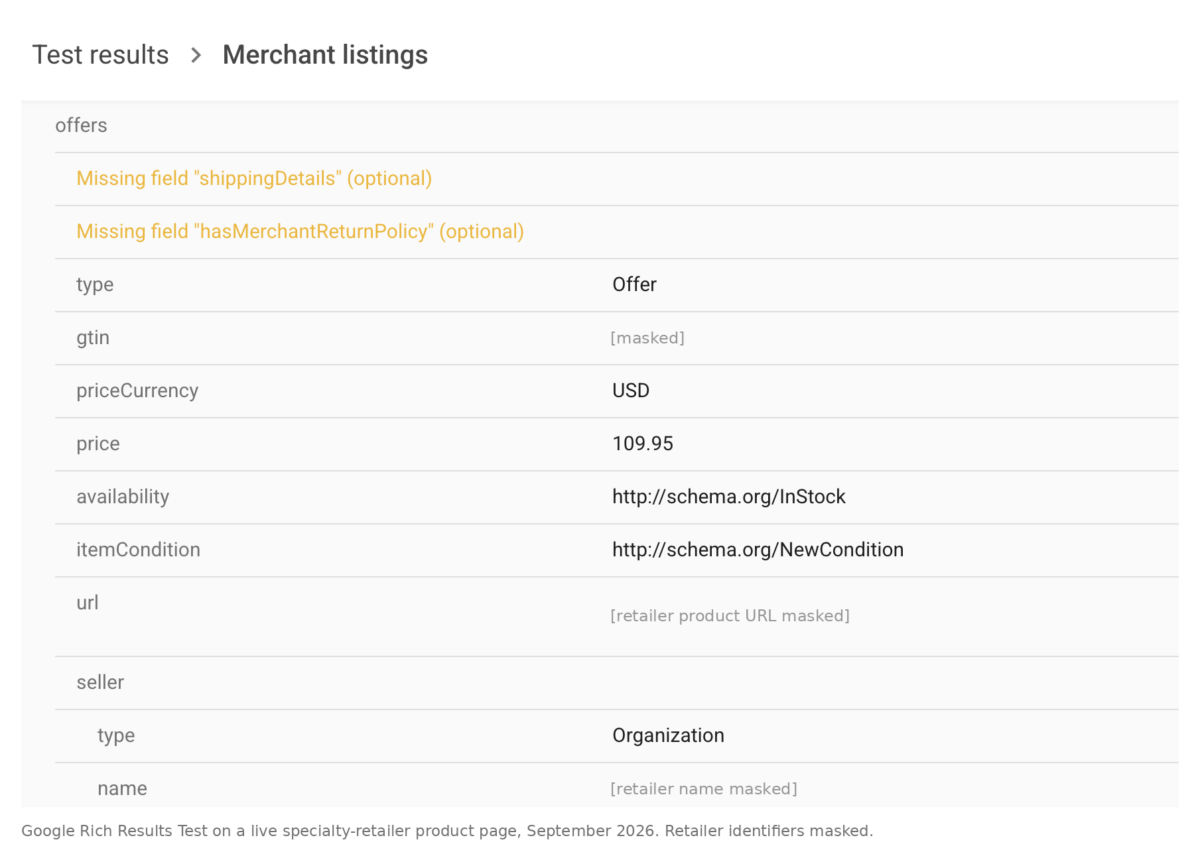
Run each change through Google’s Rich Results Test before you move on, because markup that fails validation earns you nothing and fails quietly. The test is also a fast way to see how far behind the field is. I ran it against a live product page at a well-known specialty retailer while writing this, and it returned a valid merchant listing carrying price, availability and condition, with both `shippingDetails` and `hasMerchantReturnPolicy` flagged as missing. Those two are the properties that separate a merchant listing from a plain product snippet, and they were the two nobody had filled in.
What this looks like on my own site
I have watched this shift rather than read about it. Across the twenty Ecommerce Marketing pages I actively maintain, Bing sent 15.0% of views over the past twelve months against Google’s 10.3%. Over the last 180 days that gap widened to 21.4% against 7.1%. AI assistants sent 1.8% of views to this category against 1.5% site-wide.
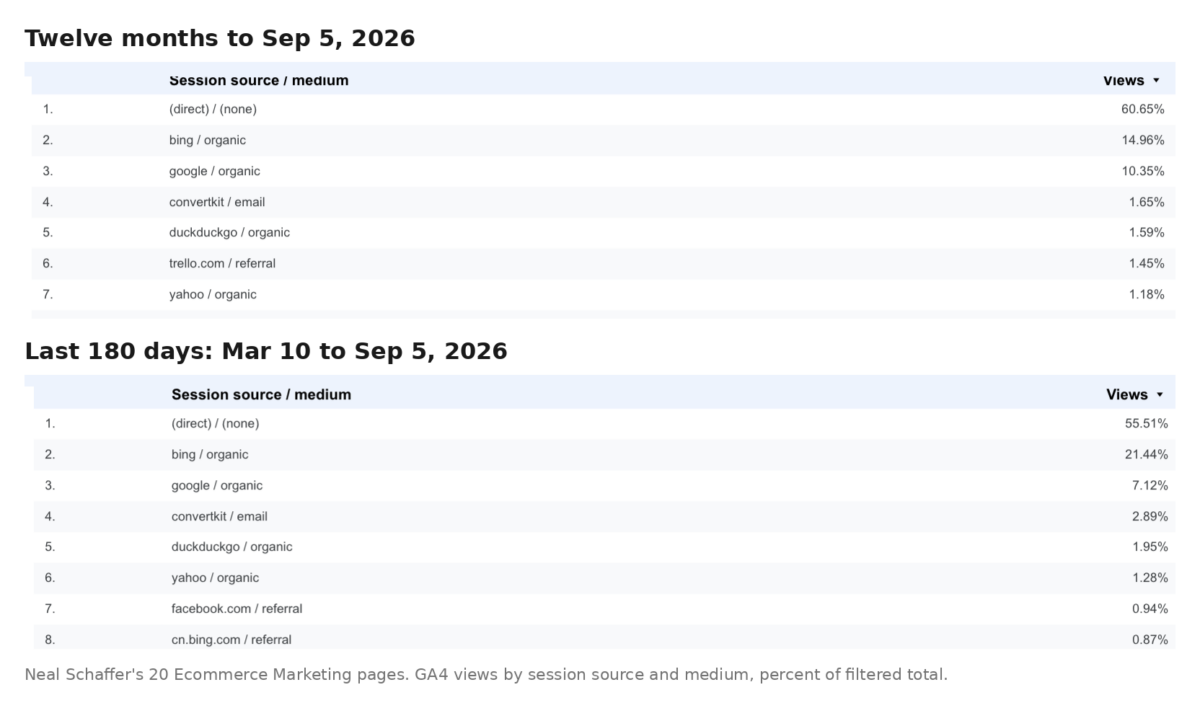
Two caveats on my own numbers, because they cut against the easy reading. Bing runs higher still across the rest of my site, so ecommerce is the category where Bing does least well for me rather than best. And I run an information site rather than a store, so treat all of this as directional rather than as your numbers. The direction is one I would take seriously, and I follow where it is heading in ecommerce trends and AI in ecommerce.
Getting found is one problem. Getting the found shopper to finish is a different one, and it is where the money actually leaks.
Why Most Ecommerce Marketing Problems Turn Out to Be Checkout Problems
Most advice about improving ecommerce results points at the top of the funnel. From what I have seen, the larger recoverable loss sits at the bottom. Baymard Institute’s meta-analysis of 50 studies puts the average documented cart abandonment rate at 70.22%, a figure that has barely moved across studies going back to 2006.
Before you panic at that number, understand what is inside it. Baymard found 42% of US online shoppers had abandoned a cart because they were browsing and not ready to buy, which no marketing fixes. The rest is where the work is.
| Reason for abandoning (excluding browsers) | Share of US online shoppers |
|---|---|
| Extra costs too high: shipping, tax, fees | 40% |
| Delivery was too slow | 20% |
| Did not trust the site with card details | 19% |
| Site required creating an account | 18% |
| Checkout too long or complicated | 17% |
Read that list again. Not one of those is a marketing problem. Every one is a decision someone made about your checkout or your shipping terms. Baymard’s research also comes with a countable benchmark: the average US checkout flow shows 23.48 form elements by default, against an ideal of 12 to 14.
Two changes I would put first, and the reasoning behind them probably matters more than the instruction itself. Show the full landed cost, including shipping and tax, before the final step, because extra costs are the largest fixable objection in that ranking. And offer guest checkout, because forcing account creation costs you the 18% who abandoned over exactly that.
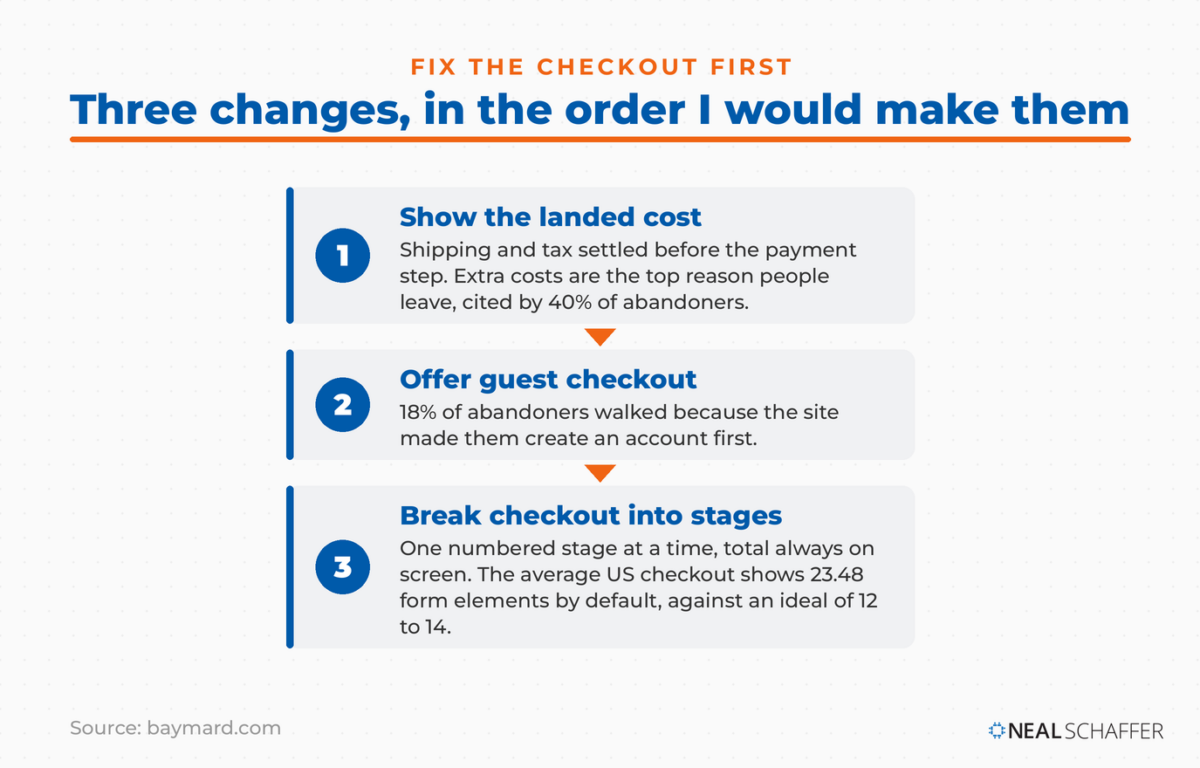
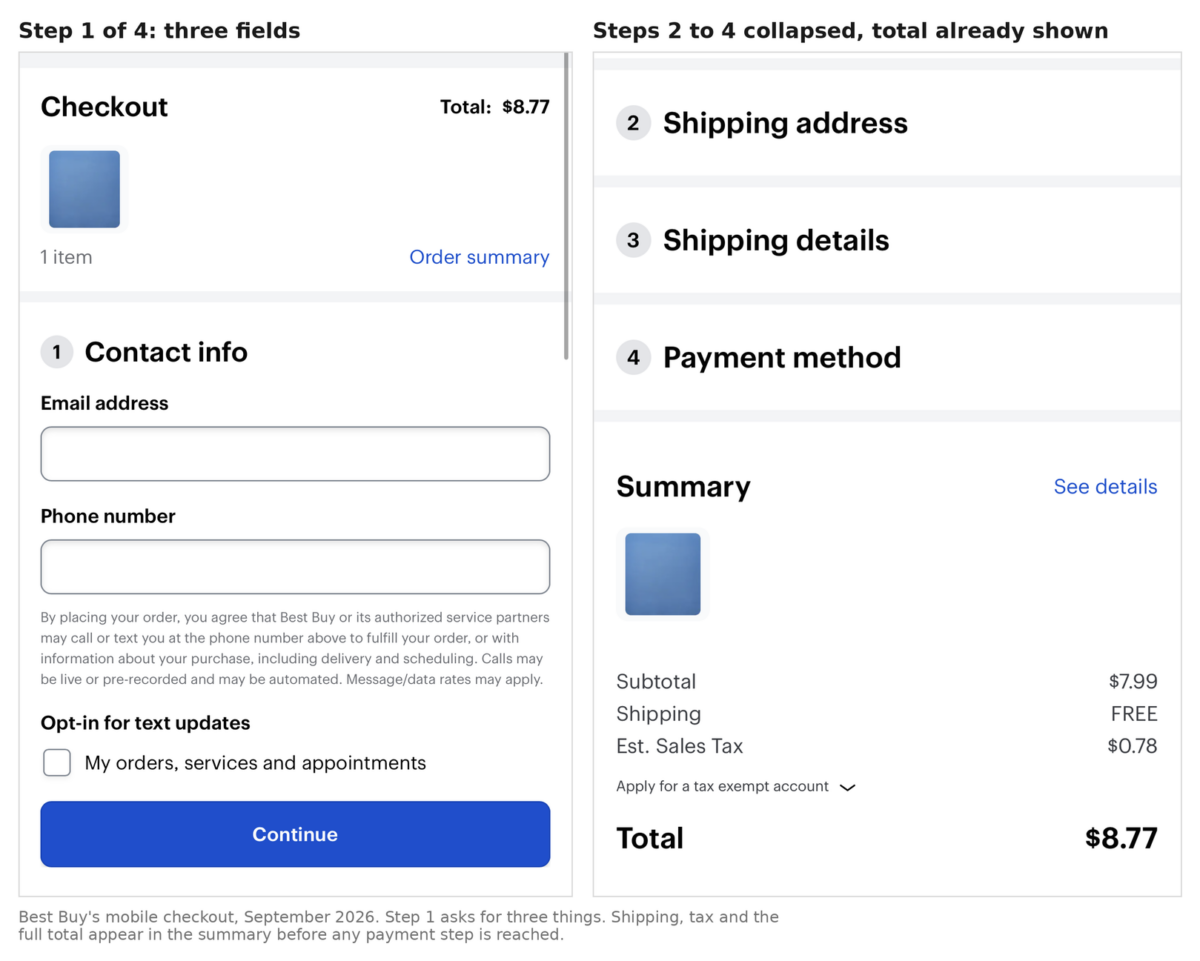
Both are cheaper than a single month of ad spend, and neither needs a new tool. A third worth copying: break the form into numbered steps and keep the running total visible throughout. I walked Best Buy’s mobile checkout while writing this, and step one asks for three things, with shipping, tax and the full total already showing in the summary before payment is reached. The fields still add up, but the shopper never faces all of them at once and never gets surprised at the end. For a benchmark to measure yourself against afterwards, the numbers sit in what counts as a good ecommerce conversion rate. The platform side shows up in is Shopify worth it, WordPress against Shopify and ecommerce hosting. Page speed is a checkout problem too.
Fixing the leak only pays off if you can see it, which brings up the least glamorous part of the job.
What Should You Actually Measure?
Measure money and the events that lead to money. That means orders, average order value, repeat purchase rate, contribution margin after acquisition cost, and email signups. Traffic, impressions, followers and rankings are inputs. They tell you whether the machine is running, not whether it is producing anything.
Andrew Maff, founder of the ecommerce agency BlueTuskr, put this bluntly when he told me on my podcast that “you can’t pay your bills with organic traffic. It’s a vanity metric.” His broader argument was that SEO and conversion optimization pull acquisition costs down over time, while paid ads are money in and money out with nothing left behind.
The practical version is to pick five to seven numbers and ignore the rest. The case for which ones sits in the ecommerce KPIs that predict growth, and the short answer is that a dashboard with forty metrics on it is a dashboard nobody reads.
One measurement habit worth stealing regardless of your stack: attribute conversions by landing page rather than by the page where the conversion fired. Otherwise every signup gets credited to your thank-you page and you learn nothing about which content did the work.
Knowing what to measure is the straightforward part. Deciding what to do about it, quarter after quarter, is what most growing brands find hard to staff.
What Does a Fractional CMO Do for an Ecommerce Brand?
A Fractional CMO provides senior marketing leadership on a part-time basis: setting strategy, choosing which channels get funded, and holding agencies and freelancers to a plan. For ecommerce brands the role tends to show up when the founder is still making every marketing decision and the spend has outgrown that arrangement.
The gap it fills is specific. An agency executes a channel well and has a commercial interest in that channel growing. A junior in-house marketer executes but has no standing to tell the founder the paid budget should be cut. The Fractional CMO role exists to make the allocation call, which is the one nobody else in the arrangement is positioned to make.
In my own ecommerce client work the recurring diagnosis has been the one I described earlier. The store is well built and the ads are running, while the blog and the email flows sit neglected because nobody owns them. That is a strategy problem wearing an execution costume.
If you are weighing an outside team instead, ecommerce marketing agencies goes into what separates a genuine specialist from a generalist with an ecommerce page. I also maintain a directory of growth-focused ecommerce agencies with Clutch. If you would rather have the allocation call made alongside you, that is what my Fractional CMO work is for.
Whichever route you take, the sequencing is the same, and it is shorter than most plans you will be sold.
Your First 90 Days
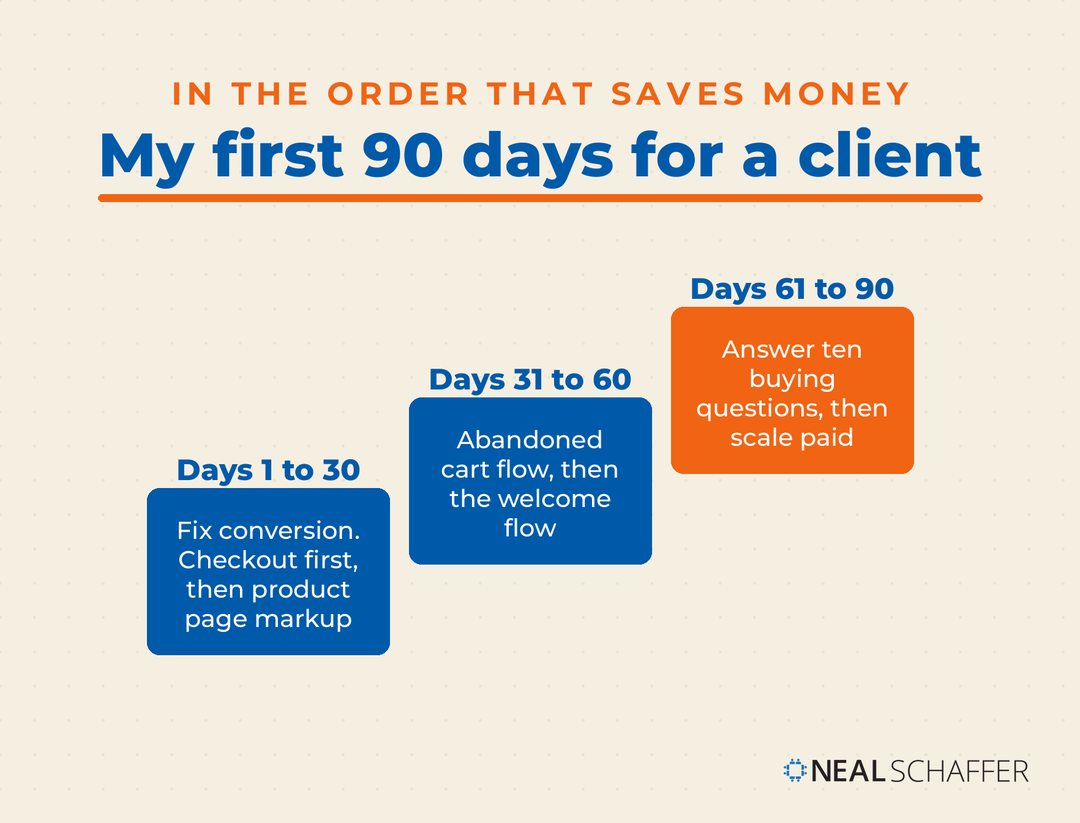
Work in this order, because each step makes the next one cheaper. Fixing conversion first means every visitor you buy afterwards is worth more. Building owned channels second means you stop renting all of your traffic. Scaling paid last means you are scaling something that already works.
Days 1 to 30: fix the leak. Open your own checkout on a phone. Count the form fields and cut everything you cannot justify. Turn on guest checkout. Show shipping and tax before the final step. Then check your product pages for merchant listing markup in Google’s Rich Results Test and fix whatever is missing.
Days 31 to 60: build the two flows. Set up an abandoned cart sequence and a welcome sequence, in that order. Those two carried 76% of automation-generated orders in the data above. Add an email capture offering something more specific than a newsletter. Set up a post-purchase review request so social proof piles up without anyone remembering to ask.
Days 61 to 90: build the compounding asset. Pick the ten buying questions your support inbox answers most often and publish a real answer to each, on your own site, linked to the products they concern. Add reviews and a questions section to your top ten product pages. Only now increase paid spend, and only against the pages you just improved.
Nothing on that list needs a new platform, and almost none of it needs new spend. It needs someone to own it.
Frequently Asked Questions About Ecommerce Marketing
There is no universal percentage that survives contact with a real product margin. The more useful constraint is contribution margin after acquisition cost: if a channel cannot deliver a customer for less than the profit that customer generates, the answer is not more budget. Start small on paid, measure cost per acquisition against average order value, and scale only what stays profitable.
Yes, and arguably more than before, because the same structural work now serves two audiences. Clear headings, plain-text answers and product structured data help you rank on Google and help AI assistants read and recommend your products. Adobe found roughly a third of the content on the average retail product page cannot be read by a model. The ceiling here is higher than the effort suggests.
Reduce checkout friction. It is faster than any acquisition project because the people involved have already chosen to buy. Removing surprise costs addresses the largest fixable objection in Baymard’s ranking. Offering guest checkout addresses the 18% who abandoned over forced account creation. Neither change requires new traffic.
It depends on whether your customers search for products the way they search for information. Many shoppers skip search engines entirely and start on a marketplace, which means an absence there is an absence from the search. The counterweight is that a marketplace owns the customer relationship, so the common answer is to run both and use your own store to build the list.
Conversion fixes show up within weeks, because the traffic already exists. Email automation shows up within a month or two of building the flows. Organic search and content usually take two to three quarters to move, which is precisely why they get abandoned and precisely why they still work.
Where to Take Your Ecommerce Marketing Next
Pick one thing from the 90-day plan and do it this week. If you only have an hour, spend it counting the form fields in your own checkout on your own phone, then cutting the ones you cannot defend. That single exercise costs nothing and needs no approval from anybody.
If you want the tactical layer underneath all of this, 20 ecommerce marketing strategies breaks the channels above into specific plays, and must-have ecommerce tools is the stack that supports them without the bloat.
If you are earlier than that and still deciding what to sell, start with how to make money with ecommerce and how to make money on Shopify. For B2B sellers, B2B ecommerce examples shows what this looks like outside consumer retail. Video sits alongside all of it, and promoting a Shopify store on YouTube is where I would start there.
And if you want the whole system rather than the channel list, grab a free preview of Digital Threads, which lays out the framework the sections above are built on. If you want it applied to your business specifically, that is what my Fractional CMO services and my Digital First Mastermind are for.
