

I have a Facebook Group with 1,700 members. It is set to private and visible, and it has three thoughtful questions waiting at the door for anyone who wants in.
It is also quiet. A dozen posts sit unread in the pending queue, and most days nobody adds a new one.
Here is what makes that worth writing about: in the entire life of that group, I never once asked a member for their email address. Not at the door, not in the cover image, not in the description. I built an audience of 1,700 people on land I do not own, and I never built a bridge off it.
I have spent fifteen years advising businesses on digital marketing. I teach social media to executives at Rutgers Business School, and I work as a Fractional CMO connecting channels for a living. I still made the most basic mistake available in this one. So this post is not a list of community-building tips you can find anywhere. It is the playbook I would follow if I started over tomorrow.
Key Takeaways
✅ Facebook group marketing means using a group you own as a marketing channel, which is a different job from joining other people’s groups to promote yourself.
✅ Almost 1.8 billion people use Facebook Groups every month, across 25 million monthly active public groups, according to Meta.
✅ A group without a business objective becomes a maintenance task. Mine reached 1,700 members before I gave it one, and by then I could only use it once.
✅ Membership questions are, I would argue, the most underused lead capture point on Facebook, and Facebook lets you ask up to three of them.
✅ Since November 2025, private groups can be converted to public, which removed the one-way door that used to make the privacy decision permanent.
✅ The group and the list do different jobs. The list gives you a line nobody can throttle. The community gives you the repeat contact that makes that line convert.
What Is Facebook Group Marketing?
Facebook group marketing is the practice of using a Facebook Group you own and moderate as a channel to reach, engage, and convert an audience. It differs from posting in other people’s groups, which is outreach. Here you control the membership, the rules, the content, and the terms of entry.
That distinction matters more than it sounds, because the two need completely different skills. Joining groups is a prospecting activity. Running one is a publishing and moderation commitment that never ends.
Most people searching this topic want the second one. They have a business, they have watched their Facebook Page reach collapse, and they have heard that groups still get distribution. That instinct is correct. What follows is the part nobody tells you.
Why Use a Facebook Group Instead of a Facebook Page?
A Facebook Group beats a Facebook Page on distribution because group content reaches people through membership rather than through follower ranking. Members get notifications, posts appear in their feed with less algorithmic filtering, and the conversation runs peer to peer instead of brand to audience. The tradeoff is that a group demands ongoing moderation.
The reach gap is not subtle. Socialinsider’s Q2 2026 Facebook benchmarks put Reels at 0.13% engagement, albums at 0.11%, image posts at 0.10%, and status posts at 0.08%. Reels was the best-performing format on a Page that quarter, and it is still a rounding error.
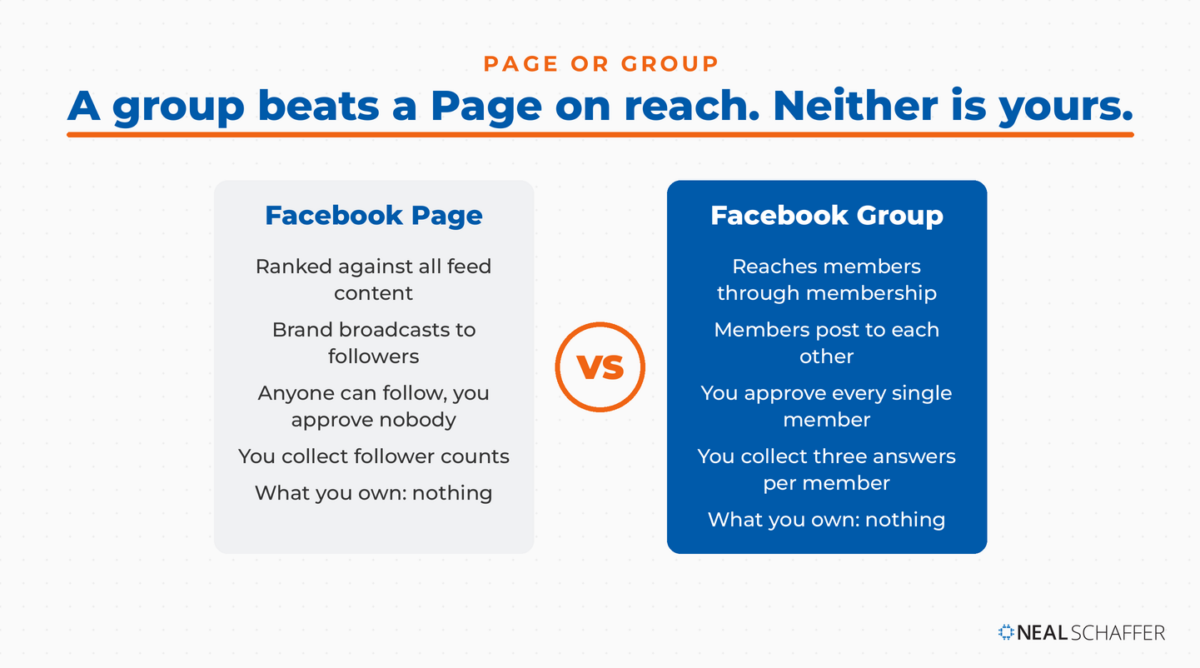
| Facebook Page | Facebook Group | |
|---|---|---|
| Distribution | Ranked against all feed content | Membership-based, with notification options |
| Conversation direction | Brand broadcasts to followers | Members post to each other |
| Entry control | Anyone can follow | You approve every member |
| Data you can collect | Follower counts and post metrics | Answers to three membership questions |
| Ongoing cost | Content production | Content production plus moderation |
| What you own | Nothing | Nothing |
Look at that last row. It is the same answer for both, and it is the thing this entire post turns on.
Nearly every guide stops at the reach comparison and tells you to go start a group. That advice is exactly what I followed, and it is incomplete in a way that took me years to notice.
What Most Facebook Group Advice Gets Wrong
Most Facebook group advice optimizes for member count, the one metric that feels like progress and produces nothing on its own. Engagement is different, and it is genuinely valuable. But neither pays until the group has a job: somewhere for a member to go next, and a way to reach them when Facebook does not.
The two years with no objective
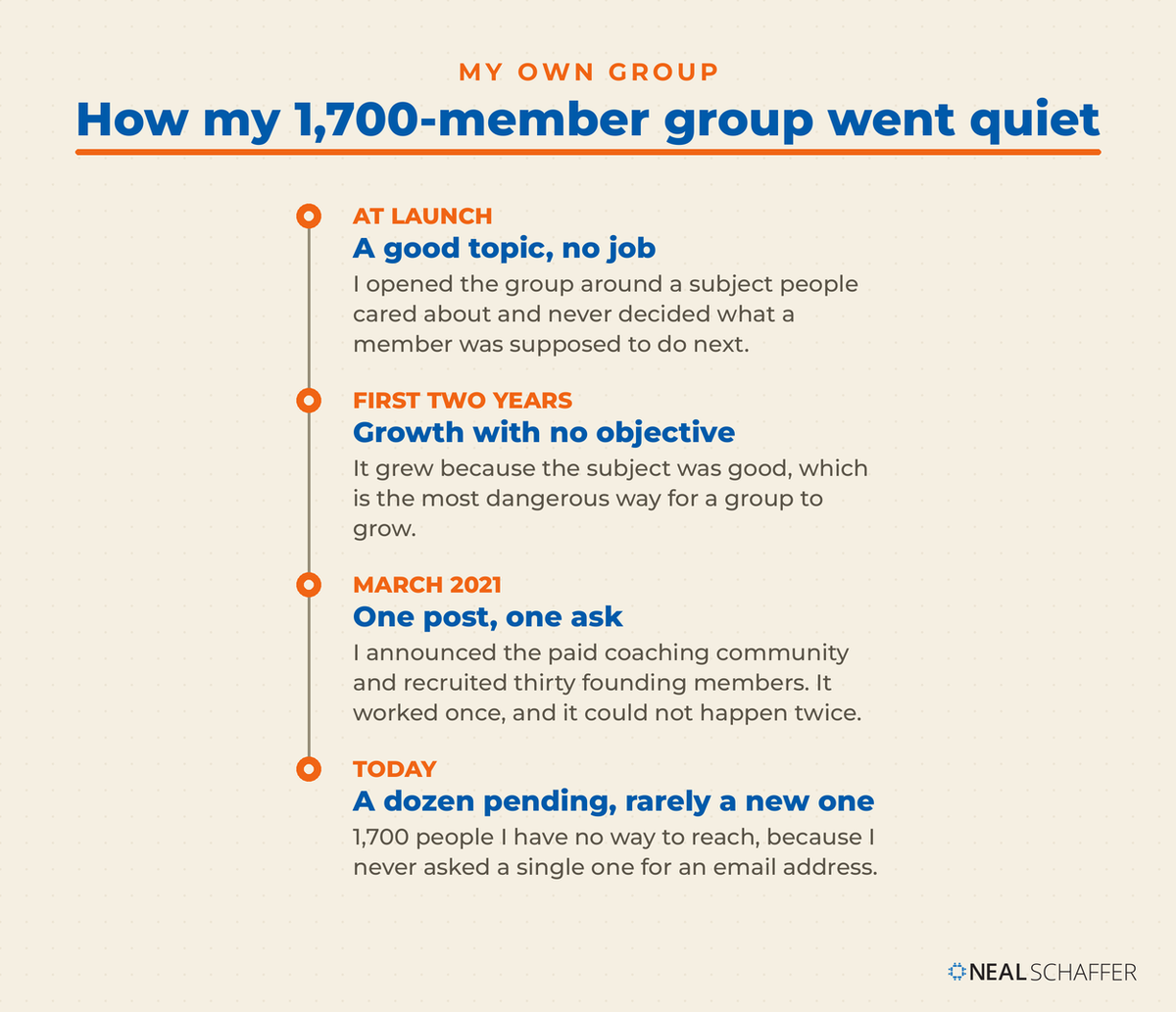
For about two years there was no business objective attached to it. No stated purpose beyond the topic, no defined outcome, no plan for what a member was supposed to do next. It grew organically because the subject was good, which is the most dangerous way for a group to grow.
Then in March 2021 I gave it a job, in a single post. I told the group that running it for free had not let me help as many people and businesses as I wanted. I was launching a paid group coaching community and recruiting my first thirty founding members. I left the link and kept the free group open for general questions.
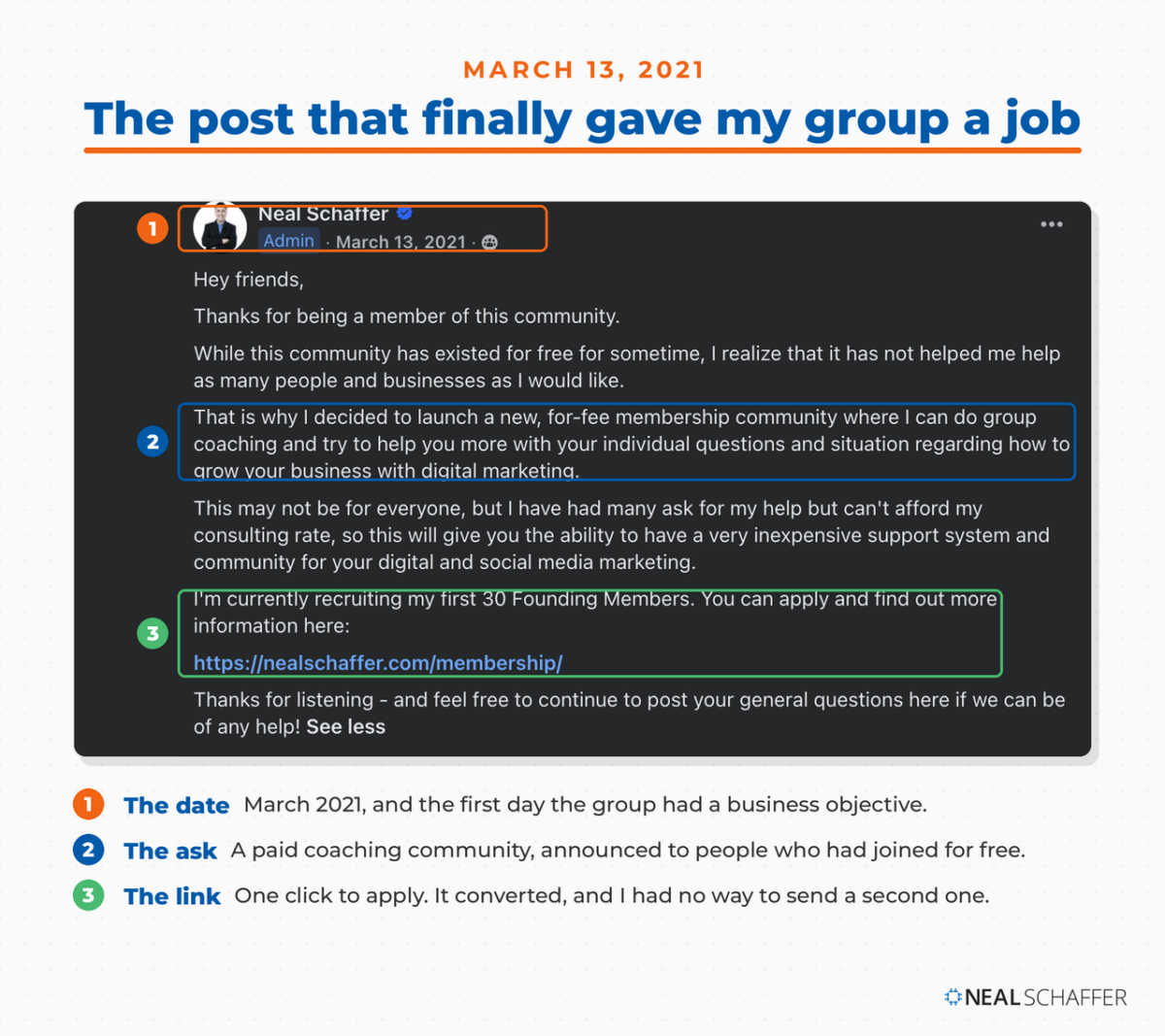
That post did what it was meant to do. What it could not do was happen twice. I reached 1,700 people once, on a day Facebook chose to show them an announcement, and after that I had no way to reach any of them again. That is the part I would undo.
Three good questions and one wasted slot
The three questions I ask at the door are genuinely good questions. How did you find out about this group? What are you trying to learn from this group? What can you contribute to this group? Those tell me about my marketing channels, my audience’s problems, and their willingness to participate.
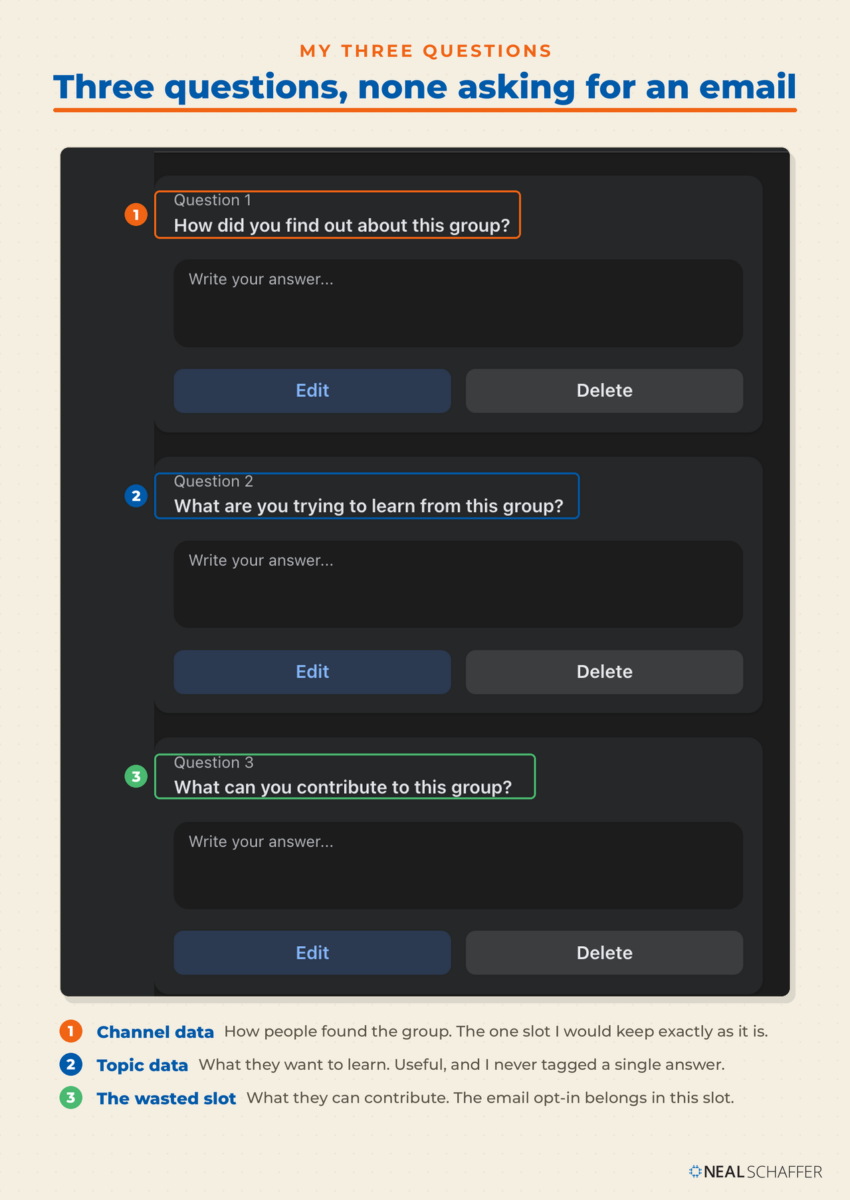
And I did nothing with any of it. The answers sit in Facebook, visible only to admins and moderators, as they have since the feature rolled out. They never reached my CRM. They never triggered a follow-up. They were research I collected and then filed in someone else’s filing cabinet.
Here is the fix I would apply if I rebuilt those three questions today:
| Question slot | What I ask now | What I would ask instead |
|---|---|---|
| 1 | How did you find out about this group? | Keep it. Channel attribution is genuinely useful. |
| 2 | What are you trying to learn from this group? | Keep it, but tag the answers so content can be built against the pattern. |
| 3 | What can you contribute to this group? | Replace with an opt-in: would you like my weekly newsletter? If yes, share your best email. |
That opt-in converts a vanity metric into an asset, one member at a time. The same slot that has been giving me answers I never used would be giving me a subscriber at the door.
Is Your Digital Marketing All Over the Place?
My latest book helps small businesses, entrepreneurs, and marketers bring search, email, and social together into one digital marketing strategy that actually compounds.
Drawing on my work as a Fractional CMO, Digital Threads turns complicated tactics into a clear, practical plan you can follow, whatever your budget or team size.
Grab your copy on Amazon and start weaving your own digital threads. Click the cover or the button below to get started.

In fairness to my past self, some of this got easier after I stopped. Meta did not ship automatic approval or decline of member requests based on whether someone completed the membership questions until March 2022. Email invites and QR codes for growing a group arrived in the same release. Running that workflow in 2019 meant reading every answer by hand.
How Should You Set Up a Facebook Group in 2026?
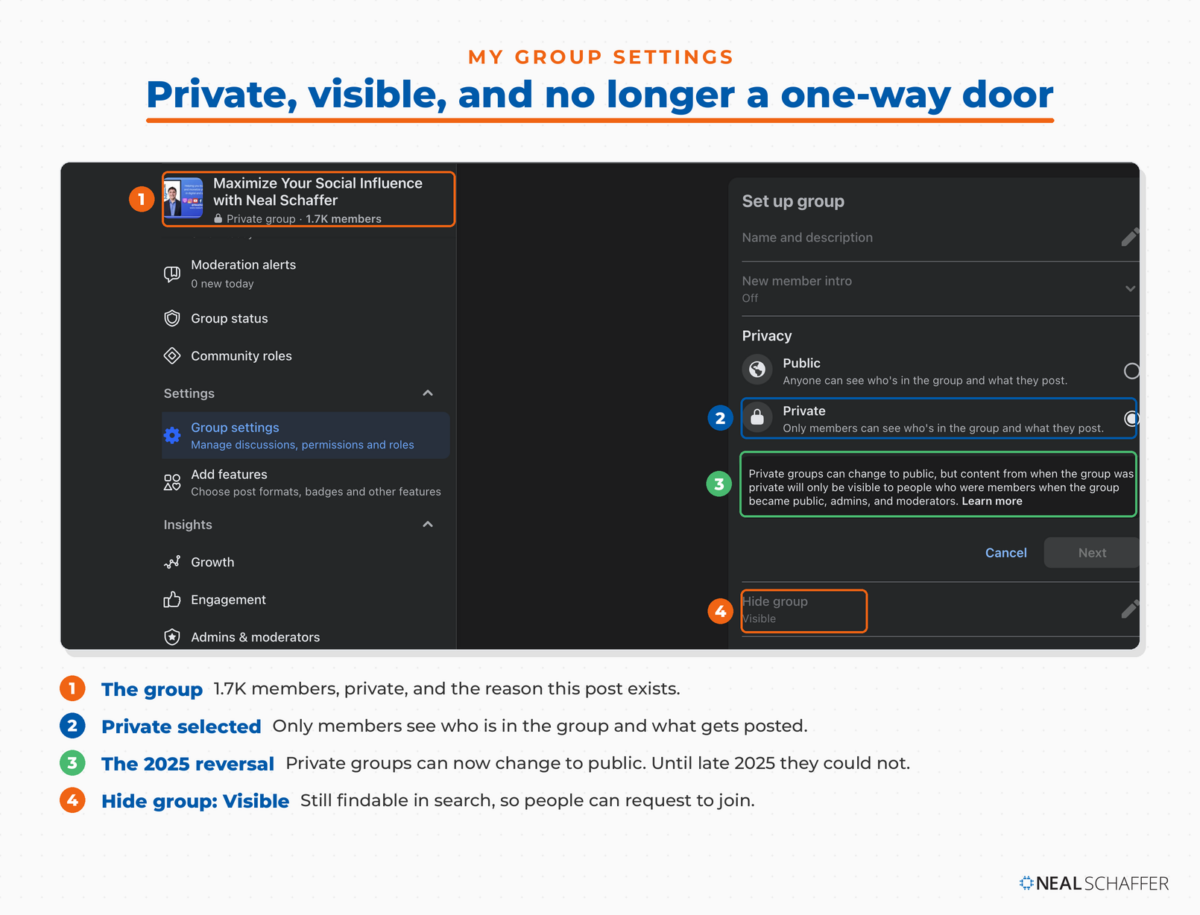
Set your group to private and visible, and leave limited membership off. Private means only members see who is in the group and what gets posted. Visible means people can still find it in search and request to join. That combination gives you the exclusivity that drives participation without hiding the group from the people you want in it.
Limited membership lets people join a private group without your approval, which converts your membership questions into participation questions and moves the whole screening step to after they are already inside. If the door is where you plan to capture email addresses, that setting takes the door away.
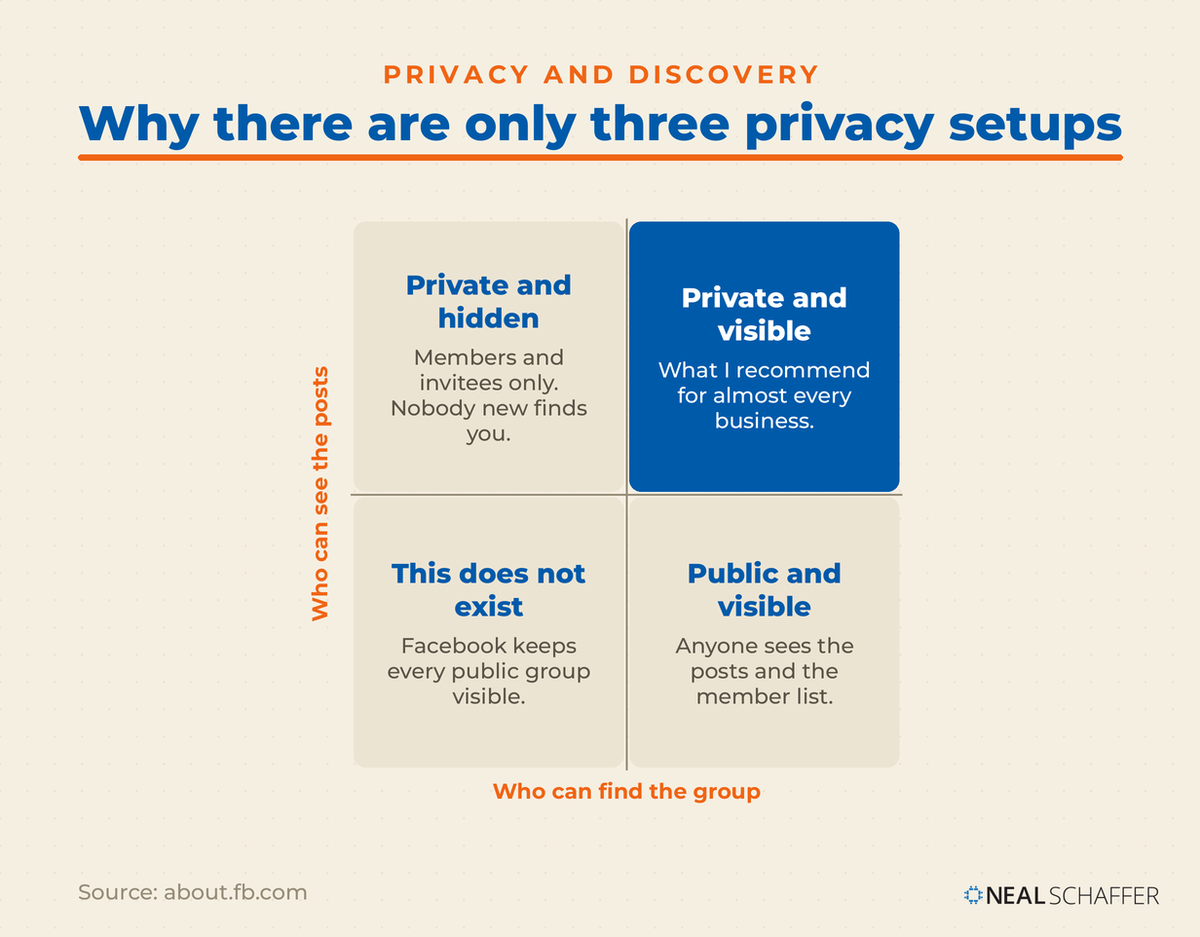
The old vocabulary is gone. Anyone telling you to set your group to “Closed” is working from pre-2019 instructions. Meta retired the public, closed, and secret model in August 2019. It became public or private, with discoverability split out as its own toggle, and every former closed group was converted to private and visible. Hidden means only current, invited, and former members can find it, and public groups stay public and visible.
One thing changed recently that matters for this decision. In November 2025, Meta began rolling out the option for private group admins to convert a group to public. Content shared while the group was private stays visible only to people who were members before the change. After conversion, only admins and moderators can see the member list. There is a three-day window in which any admin can cancel.
I confirmed this is live in my own account settings before writing this. It is a real reversal of what used to be a permanent decision, and it lowers the stakes on the privacy choice considerably.
| Setting | Who sees posts and members | Findable in search | Membership questions available |
|---|---|---|---|
| Public, visible | Anyone | Yes | Participation questions |
| Private, visible | Members only | Yes | Yes |
| Private, hidden | Members only | Members and invitees only | Yes |
That much I got right. What comes next is the part I skipped.
How Do You Turn Group Members Into Email Subscribers?
Move members onto your email list through four capture points. Ask for the address in a membership question. Promote a lead magnet in your cover image. Put a call to action in the group description. Pin a welcome post. Each catches a different person at a different moment, and together they turn a group into a list-building engine.
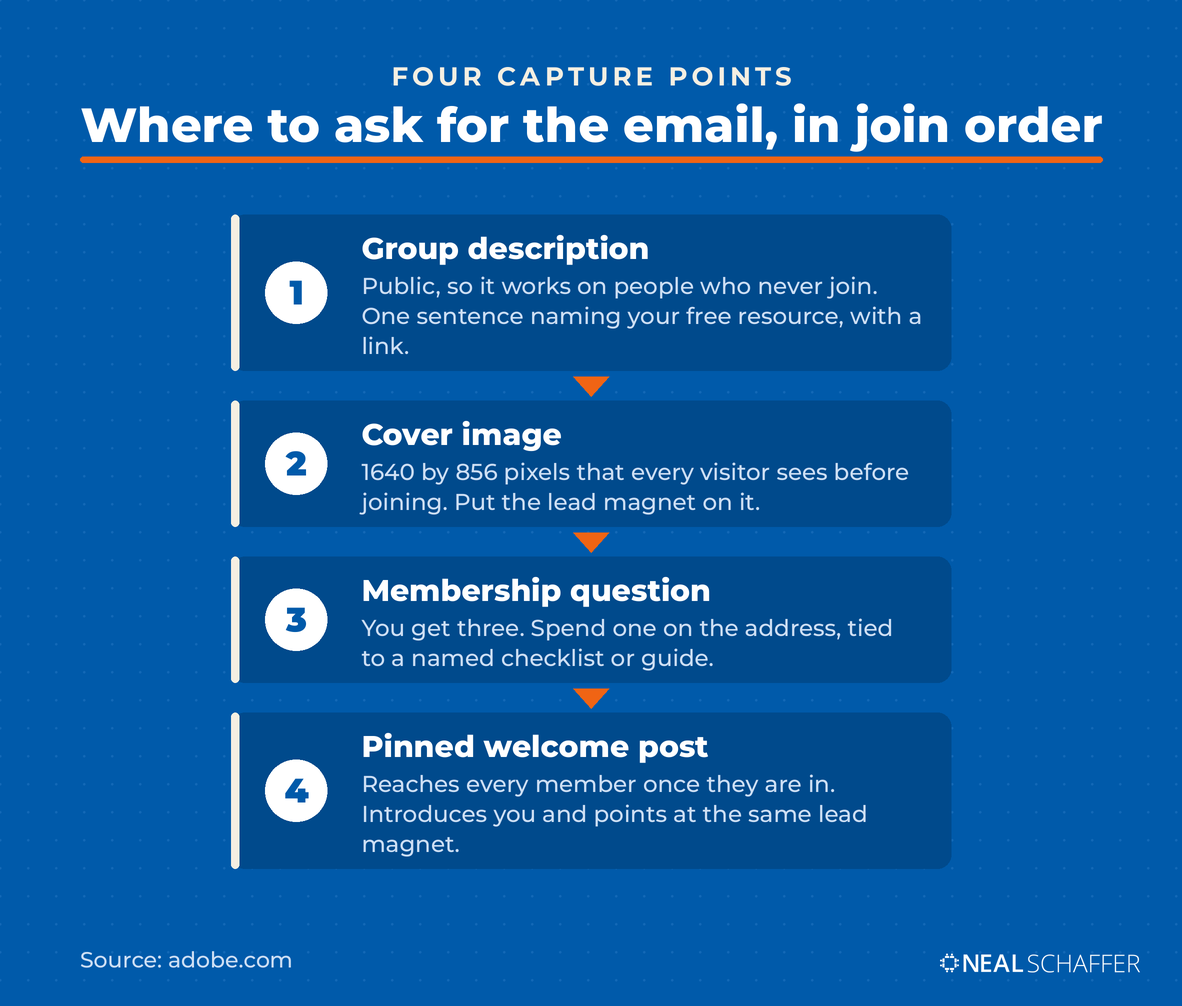
Take them in order.
The membership question
You get three, each seen only by you and your moderators, and each capped at 200 characters. Spending one on an email opt-in costs you a research question. It buys you a subscriber at the exact moment someone has decided they want what you offer. Make the ask explicit and tie it to something specific, like a checklist or a guide, so the exchange is obvious, and write it out before you paste it, because 200 characters goes fast when you are naming a lead magnet and asking for an address in the same breath.
One thing no guide mentions: answering is not mandatory. Meta says so plainly, which means a member can skip your email question and still be approved. Admin Assist can automatically decline anyone who leaves the questions blank, so that setting is what puts teeth in the ask, at the cost of turning away people who would have joined. I would rather have the member and lose the address, but the lever is there if you disagree.
Expect to do this by hand. Meta deprecated the Facebook Groups API permissions in Graph API v19.0 on January 23 2024 and set their removal for April 22 2024. No third-party tool can pipe those answers into your email platform for you. One well-aimed question beats three vague ones, because you will be transcribing the answers yourself.
The cover image
Facebook group cover photos display at 1640px by 856px, which is a wide banner that every visitor sees before they join. Adobe notes that cropping happens on upload and that how much stays visible depends on the device, so keep the offer well inside the middle of the frame or you will lose it on mobile. Mine currently promotes nothing. It should carry the lead magnet and the offer. I build my graphics in Adobe Express, which ships hundreds of templates already sized for a group cover. There is no design excuse for leaving this space empty.
The group description
This is public, which makes it the only capture point that works on people who have not joined yet. A single sentence naming your free resource, with a link, collects addresses from browsers who never convert into members.
The pinned post
Announcements reach every member. A pinned welcome post that introduces you, states the group’s purpose, and points to your lead magnet does the onboarding job that Facebook does not do for you. If you want to accelerate any of this, Facebook ads targeting group signups can feed the top of it, though I would get the organic mechanics working first.
Why the list is worth the trouble
None of this works if you have nothing worth trading for an address. Building the lead magnet comes before building the capture points. If you are starting from zero, building an email list is the prerequisite project.
Why bother, when the group is right there and already has your people in it? I put it this way on an episode of my podcast Your Digital Marketing Coach: “No social media or search engine algorithms stand in our way, and our list is truly a brand asset that we own and have control over.”
An address on its own is still a thin relationship. In Digital Threads I cite Google’s Zero Moment of Truth research, which found that the average number of information sources a shopper used before buying doubled between 2010 and 2011. Those sources are best understood as different marketing channels.
Read that alongside the group and the point stops being either-or. An email address is one of those sources. A community where somebody shows up each week, asks a question, and answers someone else’s is another, and it keeps working long after a single newsletter has been opened and forgotten.
So the goal is not to harvest addresses and walk away. A subscriber who also participates in your community is several touch points ahead of a subscriber who only ever opens a newsletter. Mine had neither, which is the actual failure. Not that I skipped the capture points, but that I skipped them and let the room go quiet.
Capture points only pay off if people keep showing up, which brings us to the part that killed my group.
What Should You Post to Keep a Facebook Group Alive?
Post consistently on a small number of recurring formats rather than sporadically on many. Groups die from irregularity, not from bad content. A weekly discussion prompt, a monthly member spotlight, and an occasional live session will outperform a burst of creative posting followed by three weeks of silence.
Discussion prompts do the heaviest lifting because they generate member posts rather than your posts. Ask about the problem your audience actually has. Ask what they are stuck on this week. The engagement-driving post formats that work on a Page work harder inside a group, because members are self-selected and already interested.
Visual content earns disproportionate attention in a group feed, and using visual content in your marketing is the cheapest way to break up a wall of text posts. Member-created content is better still. Asking permission to reshare what your members already post gives you user-generated content and rewards the person who made it.
The operational fix is boring and it is the whole game. Put group posts on the same content calendar as everything else you publish. My group went quiet because it lived outside my publishing system, which meant it only got attention when I remembered it. If you need format ideas to fill that calendar, the same thinking behind Facebook post ideas applies inside a group.
Consistency assumes the group is worth being consistent about, and that depends on a question most people never ask.
Should Your Facebook Group Be Free or Paid?
A free group works when it feeds something you sell. A paid group works when membership itself is the product. The failure mode is a free group with no downstream offer, because it costs real moderation time and returns attention you cannot convert or measure.
I run both, which is how I know the difference is not theoretical.
The free one is the 1,700-member group. Open topic, no gate beyond the questions, no product behind it. The paid one is the private group inside my Digital First Mastermind, where membership is the paid relationship and the group is a benefit within it. That group has a job. It gives someone a reason to show up, and it gives me one too.
That March 2021 announcement was the moment I chose between them, and I would make the same call again. What I got wrong was assuming the free group could stay useful without a job of its own once the paid one existed.
What separates them is where the group sits in the business, not how big it is. The channel-ordering argument in Digital Threads applies here: each channel prepares the ground for the next. A community sits near the end of that order. It amplifies an offer that already exists. It does not substitute for one.
So the question to settle before you start a group is not whether you can grow it. It is what you are going to sell to the people inside it, and what happens to them if Facebook changes the rules. Answer both and the group becomes an asset. Skip them and you get what I got.
That also means a group is the wrong move for a lot of businesses.
Who Should Not Start a Facebook Group?
Skip the group if you cannot moderate it weekly for at least a year. Skip it if your audience is not already active on Facebook, or if you have no offer for members to move toward. A dormant group is worse than no group, because it advertises neglect to everyone who finds it.
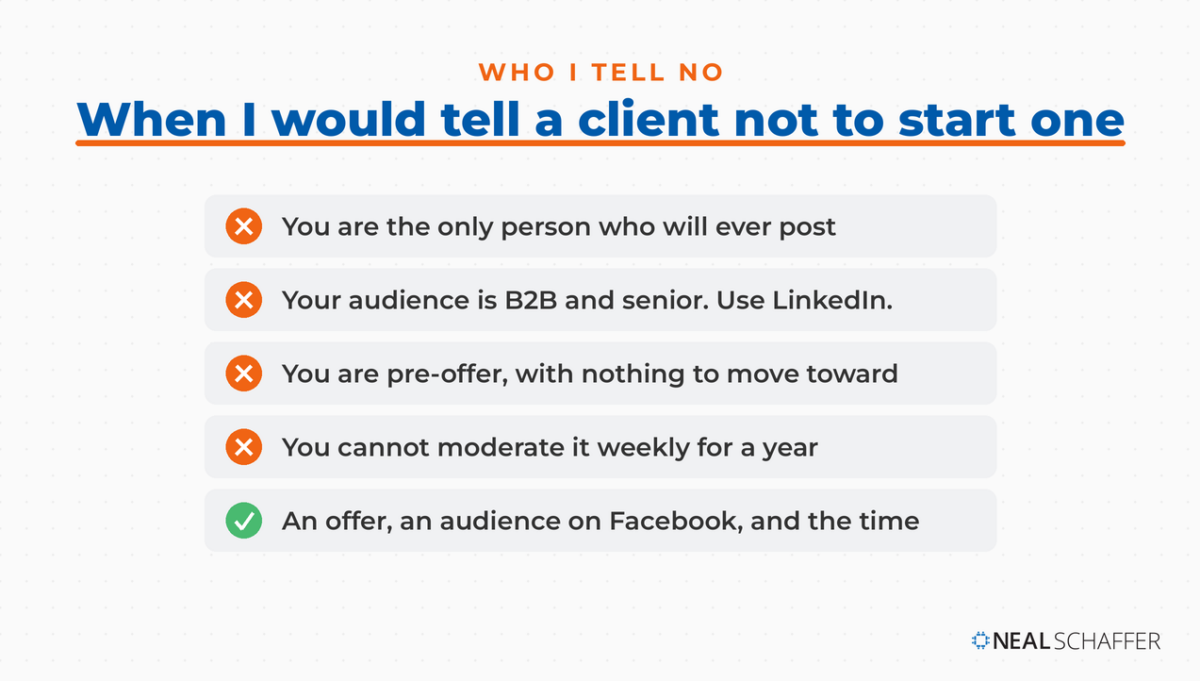
Three situations where I would tell a client no:
- You are the only person who will ever post. A group with no peer conversation is a Page with extra steps and more work. Run a Facebook Page properly instead.
- Your audience is B2B and senior. Executives are not spending discretionary time in Facebook Groups. That effort belongs on LinkedIn.
- You are pre-offer. If there is nothing to buy and no list to join, a group collects attention you have no way to use.
There is also a platform question worth sitting with. Facebook is not the only place to build a community space. Creating a subreddit for your business gives you comparable ground with different mechanics and a different audience. Pick the one where your people already are, not the one you already understand.
If none of those disqualifiers apply to you, the questions below are the ones I get asked next.
Frequently Asked Questions
Yes, if the group feeds an offer. Group posts reach members through membership and notifications rather than through follower ranking, which is why distribution holds up better than on a Page. That access is worth real money as repeat contact, provided members have somewhere to go next.
Fewer than you think. A group of 200 engaged members who buy is worth more than 1,700 quiet ones, which I can say with some authority. Judge the group on conversations started and subscribers captured, not on the member counter.
Yes, through membership questions, your cover image, your group description, and pinned posts. Facebook does not export member emails for you, so every address has to be volunteered by the member and moved to your email platform deliberately.
Private and visible for most businesses. Private drives participation because members know the conversation stays inside, and visible keeps the group findable. Since late 2025 you can convert a private group to public later, so the decision is no longer permanent.
A Page is a brand profile that broadcasts to followers. A Group is a membership space where people post to each other. Most businesses need the Page for credibility and discovery, and add a Group only when they have a community worth moderating.
Start With the Exit, Not the Entrance
Before you create a Facebook Group, decide what a member is supposed to do next, and write it down. That single decision determines whether the group becomes a business asset or a maintenance task. Everything after it is execution: the privacy settings, the capture points, the posting rhythm, and the offer waiting at the end.
Then build the capture points before you build the audience. Set the group to private and visible. Put your lead magnet in the cover image and the description. Spend one of your three membership questions on an email opt-in. Doing this on day one costs nothing. Retrofitting it onto 1,700 people, as I am about to find out, is considerably harder.
And keep the room worth returning to. The address is what lets you reach someone; the community is what makes them want to hear from you. A group that captures emails and then goes silent has solved half the problem, which is the half I solved.
Put the group on your content calendar the same week you launch it. A group that only gets attention when you remember it will go quiet, and quiet groups do not come back easily.
For the wider context on where a community fits among your other channels, the current Facebook statistics are worth bookmarking. The Page and ad side that a group sits alongside is covered in my Facebook marketing hub.
And if you would rather not learn this the way I did, there are faster routes. Download a free preview of Digital Threads for the channel-ordering framework behind all of it. Join my Digital First Mastermind, where I answer questions like this weekly. Or get in touch about Fractional CMO services if you want someone to build the system with you.
Actionable advice for your digital / content / influencer / social media marketing.
Join 13,000+ smart professionals who subscribe to my regular updates.
