


You are deciding whether to keep paying for a blog, or whether to start one at all. Fair question to ask right now. From what I have seen across my own site and my clients’ sites, Google traffic is down almost everywhere. AI answers now sit above the results. And half your feed says blogging died somewhere around 2023.
The short answer is yes, blogging still works. The longer answer, from eighteen years of running one, is that the version of blogging that worked in 2015 stopped working. Most people are also judging it on the wrong scoreboard.
I have been publishing on this blog since 2008. Roughly 700 posts, across fifteen categories, written by me. I work as a Fractional CMO, and I wrote Digital Threads about pulling search, email and social into one strategy that a small business can actually run. My blog got hit hard by Google. It is also still the front door to everything I sell, and the reason people end up on my newsletter where I can talk to them directly.
My traffic went up this year. My email signups did not. That number is in here too.
Key Takeaways
✅ Blogging still delivers for most people who do it: in Orbit Media’s survey of 808 content marketers, four in five report results from their blog
✅ What died is commodity blogging, and Google says so in its own words, drawing a line between content that restates common knowledge and content that could only come from you
✅ Judging your blog by Google alone will mislead you, and judging it by sessions will mislead you too: my traffic grew this year while my email signups did not
✅ Visitors arriving from AI assistants convert about three times better than other organic traffic, and are twice as likely to subscribe to a newsletter
✅ Publishing without a plan is where blogs die, since 96.55% of pages earn nothing from Google
Is Blogging Still Relevant in 2026?
Yes, blogging is still relevant in 2026, but only as a way to publish something nobody else can. Blogs that restate common knowledge have stopped earning traffic. Blogs that carry firsthand experience, original data, and a point of view still rank, still get cited by AI assistants, and still generate leads.
The survey behind that takeaway is worth unpacking. Orbit Media has run it annually for twelve years, and in the most recent one, 21% of respondents reported strong results from their blog while another 60% reported some results.
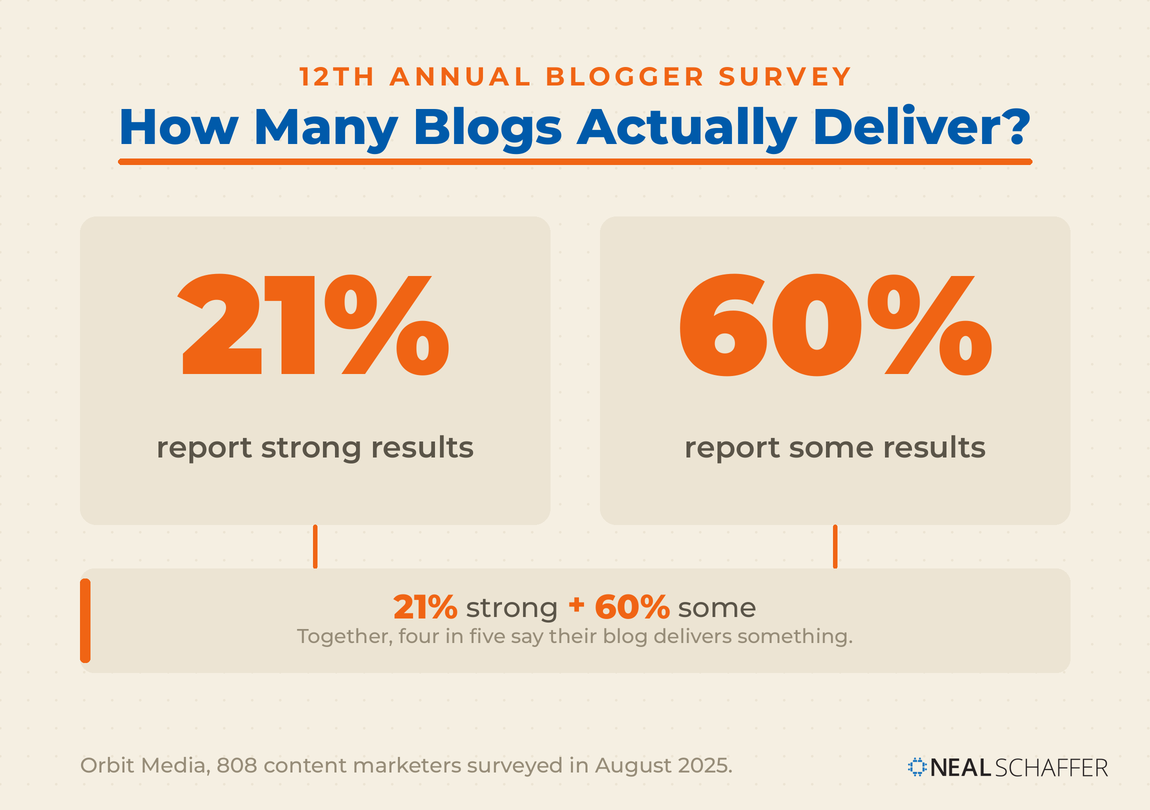
Notice what those numbers also say. Only one in five is doing well. Blogging is not a coin flip you win by showing up.
And the difficulty is rising in a specific direction. In the same survey, 63% named attracting visitors from search as their top challenge, the highest that figure has ever been.
Which raises the question I get asked immediately afterward: if blogging still works, why does it feel so much harder than it did?
What Actually Changed About Blogging, and What Did Not
What changed is the value of ordinary information. Google’s generative AI search guidance now separates commodity content, which restates common knowledge, from content only its author could have produced. Answering a common question competently used to earn traffic. What did not change is the value of something only you know.
The example Google picks to illustrate that line is worth sitting with. “7 Tips for First-Time Homebuyers” is commodity content. “Why We Waived the Inspection & Saved Money: A Look Inside the Sewer Line” is not.
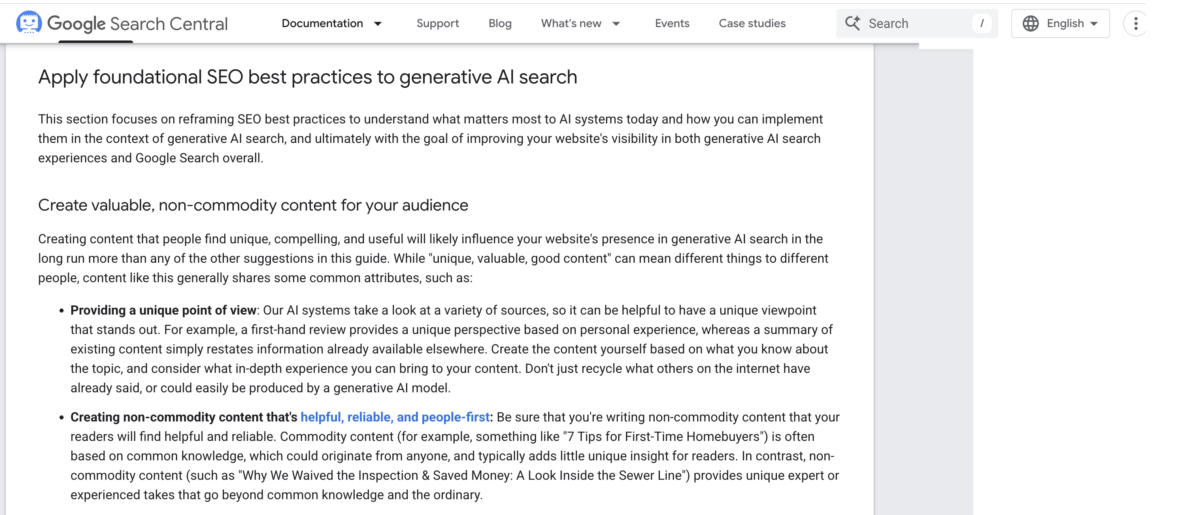
Read those two titles again and count how many posts on your blog look like the first one. That was the entire business model of corporate blogging for about a decade.
Google says the same thing a second way in its helpful content self-assessment. One of its questions asks whether your content shows first-hand expertise, the kind that comes from actually using a product or visiting a place. I quoted that exact line in Digital Threads, before AI Overviews existed. It has only become more load-bearing since.
The part nobody tells you is that this is good news if you run a small business. You have used the products. You have made the mistakes. A content team of thirty writers covering forty industries has not.
That is the theory, and I would have written it two years ago too. Then I went and looked at where my traffic actually comes from.
Where Does Blog Traffic Actually Come From Now?
Not from where you think. Most people judge their blog by Google alone, because Google is 91% of the search market and Search Console is free. On my site this year, that habit would have produced completely the wrong conclusion, because the traffic did not disappear. It moved to a different search engine.
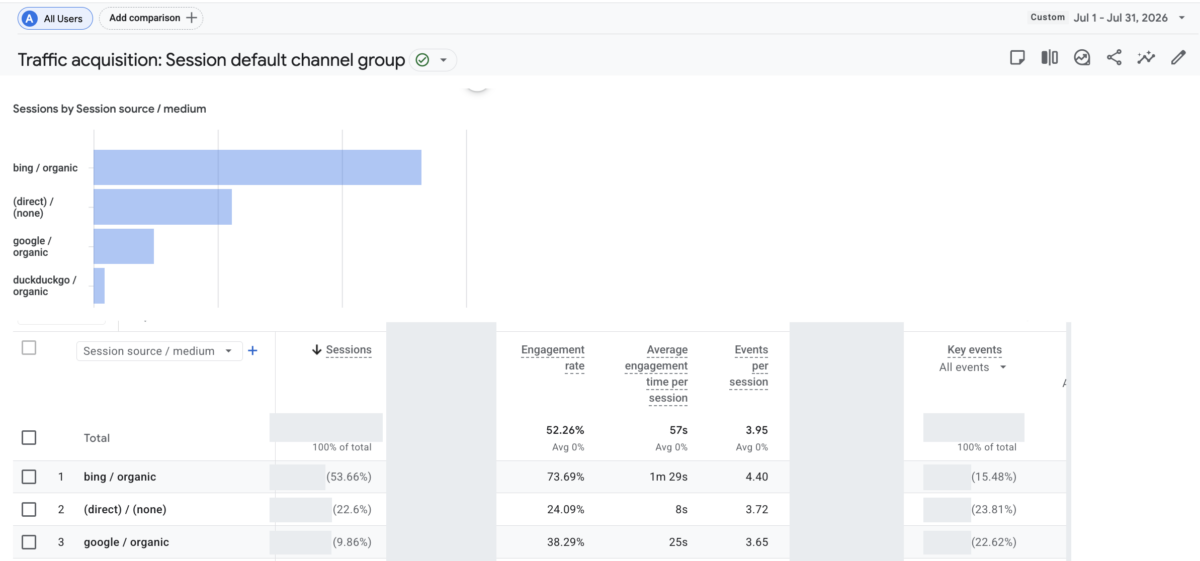
Here is the shape of it. Against January, my Google organic sessions in July were down 45.66%, while Bing organic was up 69.44%. Total sessions across the whole site rose 13.59% over the same stretch. The traffic did not leave. It changed doors.
| Search engine | Share of the worldwide market, July 2026 | Sessions on my site in July, indexed to Google |
|---|---|---|
| 91.31% | 1 | |
| Bing | 4.47% | 5.4 |
Market share figures come from StatCounter’s July 2026 worldwide data. The right-hand column is my own analytics, with Google set to 1 so the two columns can be read against each other.
And it is not a one-month blip. I checked again this week, and the gap has held at roughly five to one across the trailing twenty-eight days.
The mechanism is not mysterious. Google’s helpful content system suppressed my site and I am still working through it. Bing never suppressed me at all. So one channel halved while the other kept growing, and the gap between them is mostly Google’s doing rather than anything clever I did on Bing.
Turn LinkedIn Into a Real Growth Channel
My latest book helps professionals, entrepreneurs, and business owners turn LinkedIn from a static profile into a real source of clients and growth.
Maximizing LinkedIn for Business Growth gives you clear, practical steps to build a profile that gets noticed and a network that actually sends business your way.
Grab your copy on Amazon and put it to work this week. Click the cover or the button below to get started.

Which also makes my split an outlier rather than a benchmark. It is one site, in one niche, with a Google problem most sites do not have. Do not expect five to one on yours.
But the operational point holds regardless of the size of the gap. Had I judged my own blog by Search Console alone in July, I would have concluded it was dying. I would have been reading one sixth of the picture. Open your analytics and break your organic traffic out by search engine before you decide anything.
Volume is only half the question, though, and it is the half that flatters me. The half that pays is which of those sessions turned into something.
Which Search Traffic Actually Turns Into Business?
Not the source sending the volume, and in my case not any of them. My July sessions ran 13.59% above January. My email signups over the same period came in flat. Half a year of traffic growth bought nothing I can bank, and signups are the number I judge this blog on.
That is the finding I trust most here, because it rests on the biggest numbers in the report. Everything below it is thinner, and I would rather mark that than let it pass.
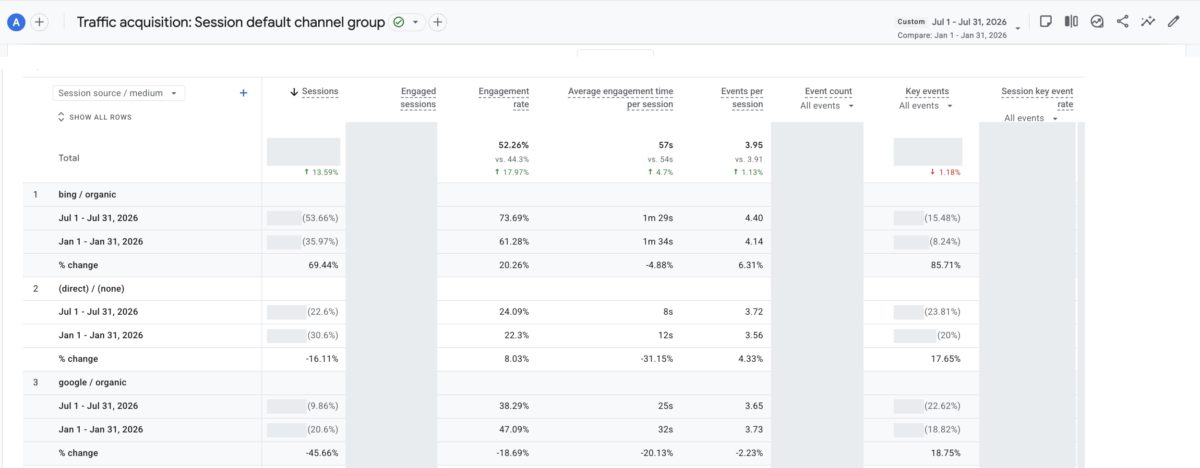
| Source | Sessions, January to July | Share of July sessions | Share of July email signups |
|---|---|---|---|
| Bing organic | +69.44% | 53.66% | 15.48% |
| Direct | -16.11% | 22.60% | 23.81% |
| Google organic | -45.66% | 9.86% | 22.62% |
Read the last two columns against each other rather than down. Google produced more signups than Bing did in July, on roughly a fifth of the sessions. Direct traffic, which most people ignore entirely, out-earned both.
Now the caveat, and it is a big one. That last column is built on a far smaller pool of events than the session figures sitting beside it, so read it as a direction and not a measurement. Anyone quoting a precise conversion multiple off one site’s monthly signups is quoting a coincidence, and that includes me.
One detail inside that I still cannot account for. Bing’s sessions looked more engaged than Google’s, not less, at a 73.69% engagement rate and 1m 29s average engagement time against Google’s 38.29% and 25s. I know why Bing sends more traffic. I do not know why the traffic it sends reads as more engaged and signs up less, and I would rather say so than invent a reason.
What I take from all of it is narrow and practical. Pick the outcome you actually want, then find out which source delivers it. On my site the traffic chart and the outcome chart disagree, and only one of them pays.
Neither engine is the whole story, though. Some of the traffic worth having now arrives from the AI tools everybody assumes are the problem.
Is Blogging Dead Because of AI?
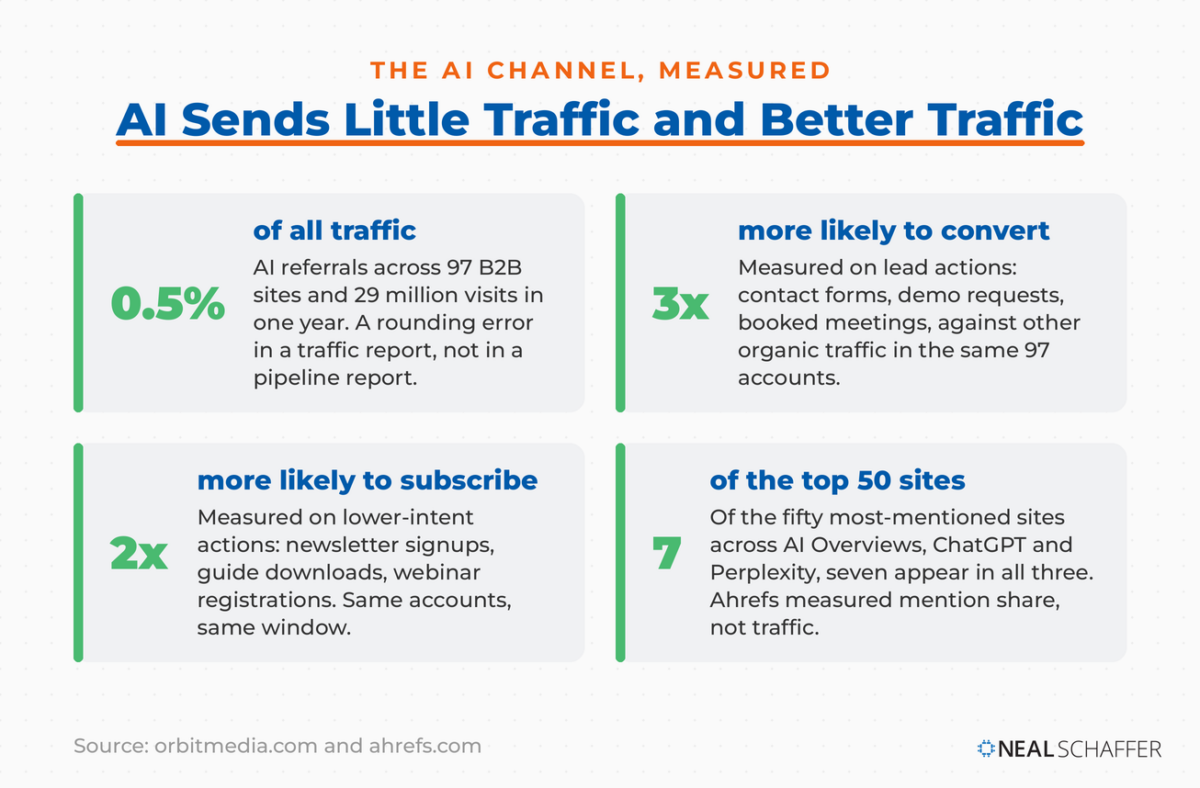
No, and the data cuts the other way. Visitors arriving from AI convert about three times better than other organic traffic, and they are twice as likely to subscribe to a newsletter. AI has not removed the reason to publish. It has changed what a blog post has to contain to be worth publishing.
The Orbit Media research I linked in the takeaways above covered 97 B2B websites and 29 million visits over a year. Visitors arriving from AI sources were about three times more likely to become a lead than other organic traffic. They were also twice as likely to subscribe to a newsletter, download a guide, or register for a webinar.
Two caveats travel with that number. AI referrals were only half a percent of total traffic in the same study, so this is a small, high-quality channel rather than a replacement for search. And the conversion gap probably says as much about who bothers to click out of a chatbot as it does about your page.
There is a breadth problem underneath this too. Ahrefs looked at the fifty most-mentioned websites across AI Overviews, ChatGPT and Perplexity, and found only seven appeared in all three. Being cited by one assistant tells you very little about the others.
On a recent episode of my podcast Your Digital Marketing Coach I put the underlying problem plainly:
“Without content, you are invisible. You are a ghost to Google and you’re a ghost to LLMs.”
That is the case for blogging in 2026 in one line. An assistant cannot recommend a business it has never read anything about. If you want the mechanics of how AI systems pick what to lift and what to cite, I worked through my own numbers on AEO versus GEO.
So the question stops being whether to blog at all. It becomes what to put in the posts.
What Kind of Blog Post Still Works in 2026?
The kind you could not have written without doing something first. Original data, tested results, named tools you actually pay for, and a clear position. Orbit Media’s survey found that the least common blogging practices correlate most strongly with results, which is the whole opportunity in a sentence.
Their data is consistent enough to plan around. Below are the practices that separated the marketers reporting strong results from the 21% benchmark across all respondents.
| Practice | Share reporting strong results |
|---|---|
| Publishing posts over 2,000 words | 39% |
| Collaborating with influencers on content | 37% |
| Publishing multiple times per week | 37% |
| Adding seven or more visuals per post | 50% |
| Writing guest posts for other sites | 30% |
| Always checking analytics after publishing | 32% |
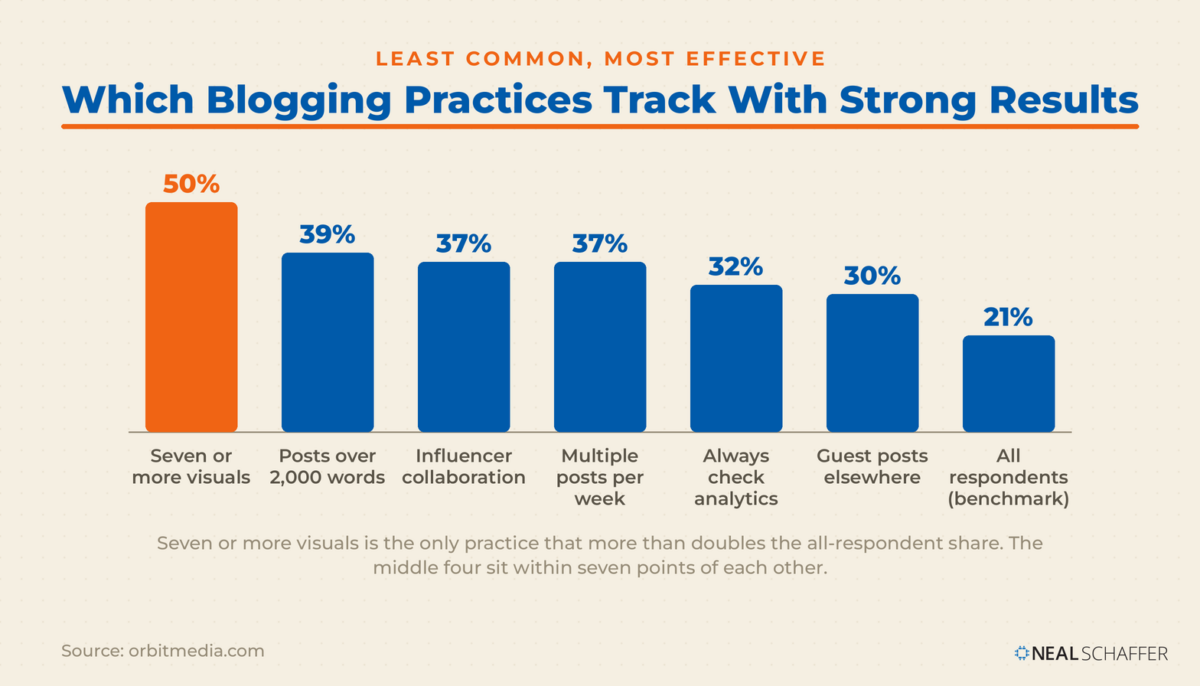
None of those is a hack. Every one of them is more work than what most people are doing, which is exactly why they still pay.
One correction on length, though, because that first row gets misread constantly. The Google guidance I cited earlier says plainly that there is no ideal page length and no preferred word count. Long posts correlate with results because thorough treatment tends to run long, not because word count is a lever you pull. Writing 2,400 words of padding will do nothing for you.
The two practices I would start with are original data and visuals, because they are the two an AI-drafted competitor cannot copy from you. Pull a number out of your own analytics, your own sales records, or your own inbox, and build a post around it. If you need help finding angles, my running list of blog post ideas is organized around exactly this.
Knowing what to write is half of it. Building the page so a reader and a machine can both use it is the other half.
How Should You Format a Blog Post So People Read It?
Put the answer first and break the page into pieces that stand alone. A reader scanning on a phone and a machine lifting a passage want the same thing. A question-shaped heading, a short self-contained answer under it, then the evidence. Bury the answer and both leave.
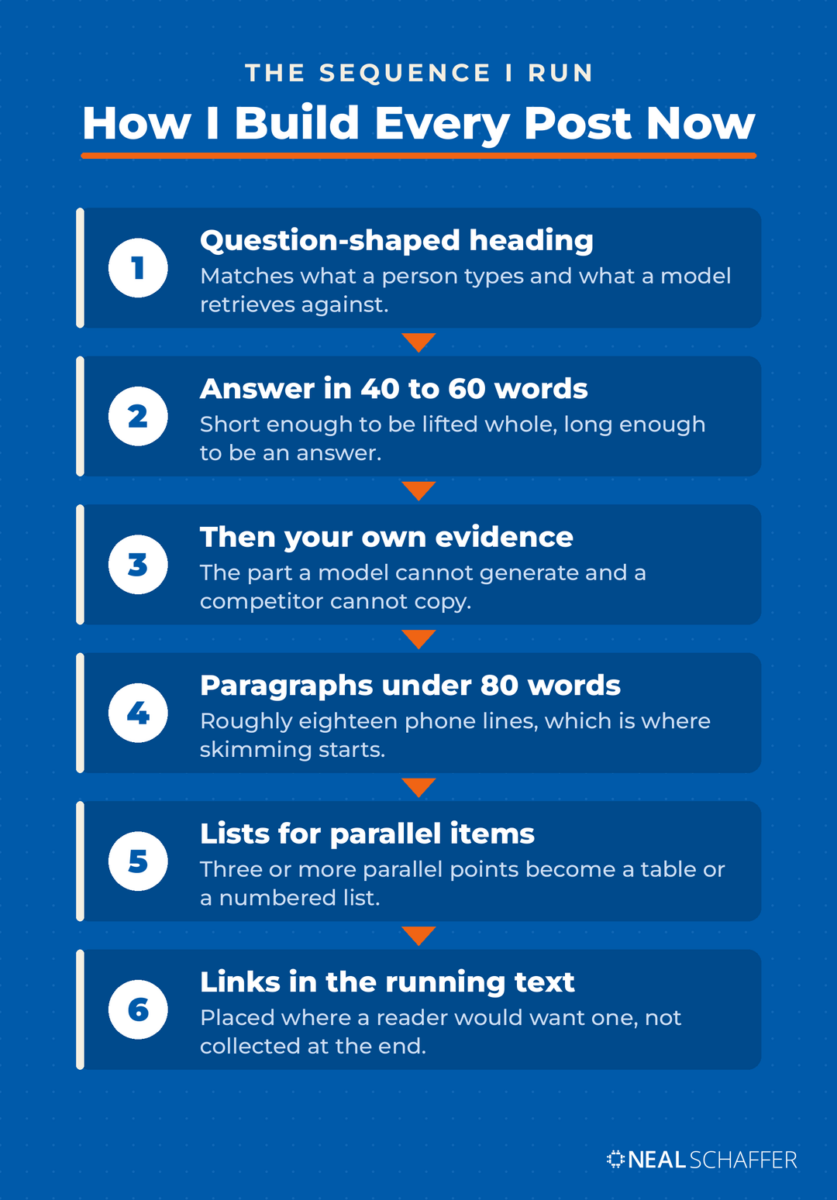
Here is the sequence I run on every post now.
- Write the heading as a question somebody would actually type. Not “Content Length Considerations” but “How long should a blog post be?”
- Answer it in the first 40 to 60 words underneath. No setup, no throat-clearing, no history of the topic.
- Follow the answer with something only you have. A number, a screenshot, a result.
- Keep paragraphs under about 80 words. On a phone, 100 words is roughly eighteen lines, and readers stop reading and start skimming.
- Use tables and lists for anything with more than two parallel items, because each one travels on its own when a machine pulls it.
- Put your internal links inside the sentences where the topic comes up, not in a link box at the bottom that no lifted passage will ever carry with it.
That last placement, links inside sentences rather than in a box, I would argue matters more than it used to, and almost nobody does it. I go deeper into the mechanics in my post on blog post format.
Uniqueness has a formatting dimension too. If your post reads like every other post on the topic because it is structured like every other post on the topic, the structure is doing half the damage. Reorganize around the question you are best placed to answer rather than around the outline the top-ranking page used.
Formatting gets the page read. What you do with the reader afterward decides whether the blog earns anything.
Should You Still Link Out and Collect Reader Questions?
Yes to both, though the second one no longer has to mean comments. Linking out and collecting reader questions used to be about goodwill and relationships. They still are. But they now also feed the two things that survived the drop in search clicks. Being mentioned by other people, and holding something a generated summary cannot reproduce.
Plenty of business owners still flinch at linking to another site. The worry is that you are handing away a reader. In practice you are showing the reader you did the work, and you are giving the other site a reason to notice you exist. Relationships in your industry get built this way far more often than through outreach emails.
Reader questions are the same trade in a different form. They arrive as specific problems, from actual customers, in their own words, and no model generated them. They are also the best keyword research you will ever get for free.
For most of this blog’s life those questions came through the comment box. In 2021 a reader named Geraldine told me a link embedded in one of my blogging posts pointed at a page I had retired years earlier. She was right, and I would not have found it on my own.
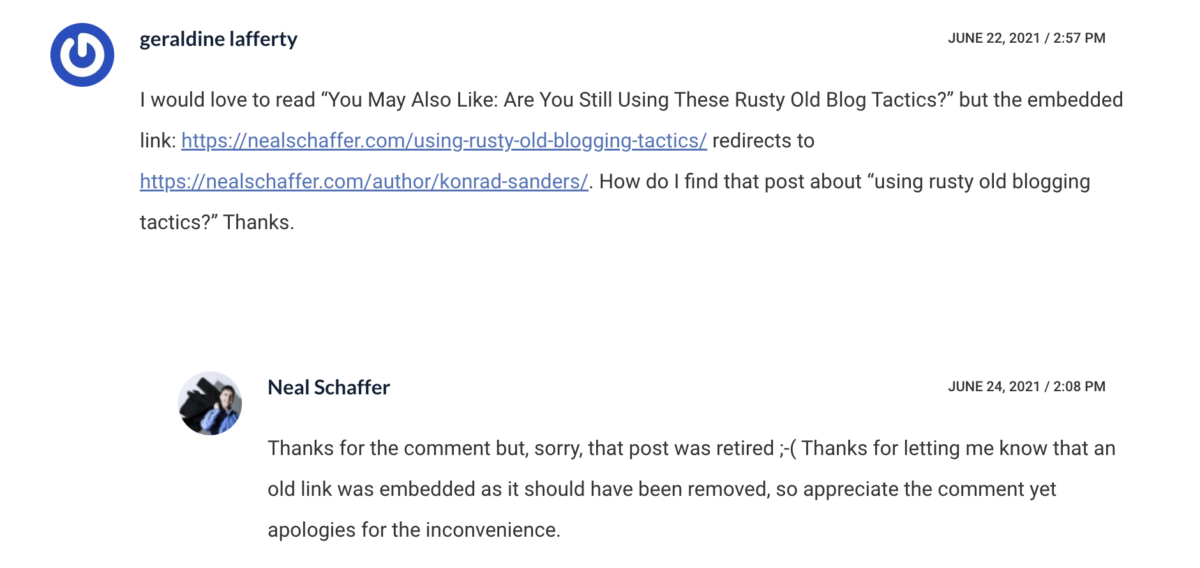
I closed comments anyway. Over time the spam ran far ahead of the real comments, and moderating that across hundreds of posts was eating hours I would rather spend writing. Whether to keep comments open is still an argument in the blogging community, and I would not claim there is one right answer. That was mine.
What changed was the collection point, not the value. The questions still reach me, through newsletter replies, through email, through social. Keep a running file of them wherever yours land.
Then go and write the post that answers the one that came up three times.
Links and reader questions build standing over years. Neither of them belongs to you, though, which is the gap the next section fills.
How Do You Turn Blog Readers Into an Audience You Own?
Get them onto an email list, and ask at the moment they are most engaged rather than the moment they arrive. Search visibility is rented from companies that keep changing the terms on you. An email list is the only part of this you own outright, and every blog post is a chance to convert a stranger into a subscriber.
The mechanics matter more than most people think. An opt-in that fires two seconds after someone lands interrupts a person who has not decided they like you yet. Wait until they have read something, then ask.
On my own site I ask on the way out. I build my popups in Elementor, so the path is Templates, then Popups, then edit the one you want. Click the arrow beside the Publish or Update button to open Publish Settings. Open the Triggers tab and switch On Page Exit Intent to Yes.
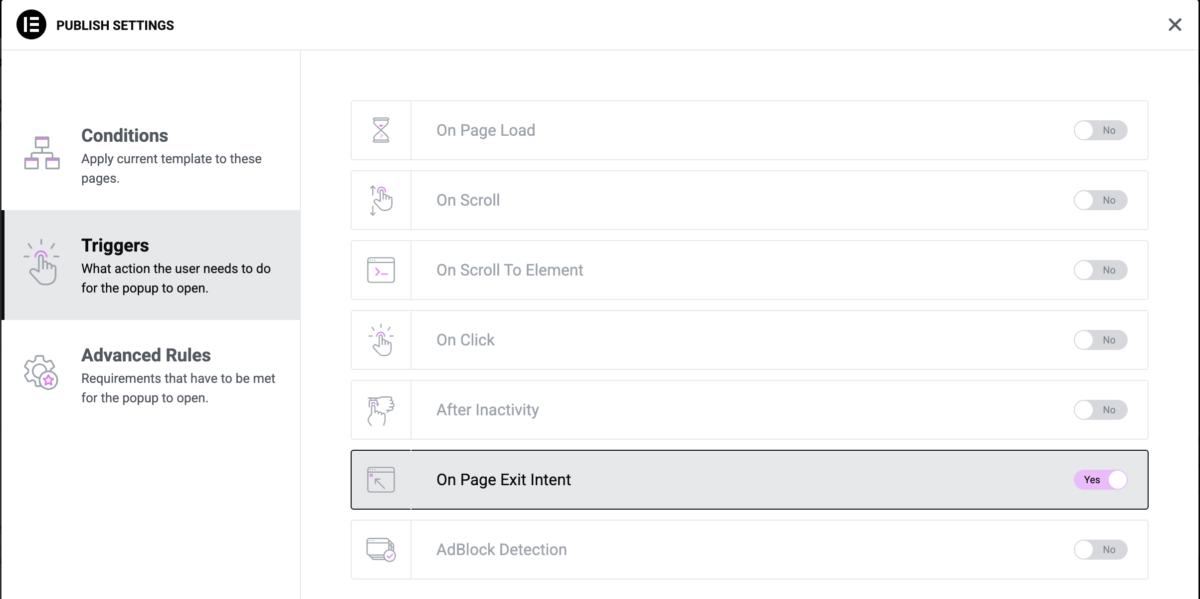
Every other trigger on mine is set to No, and that is deliberate rather than lazy. If you would rather catch people mid-read than on the way out, turn on On Scroll instead and set the percentage of the page they have to cover first. Running both at once is how you end up annoying the same reader twice.
Give the subscription a reason to exist beyond “get my updates.” A checklist, a template, a chapter, a spreadsheet you already built for a client. Something the person reading that specific post would want the moment they finish it.
This is also the measurement fix for the session-versus-signup gap I showed earlier. Rankings and impressions move for reasons you cannot control. Email signups per month is a number you can actually read, and it is what I judge my own blog on. It is also the list that almost every route to monetizing a blog runs through.
All of which assumes a blog is the right investment for you. For some businesses it is not, and I would rather say so.
Who Should Not Start a Blog in 2026?
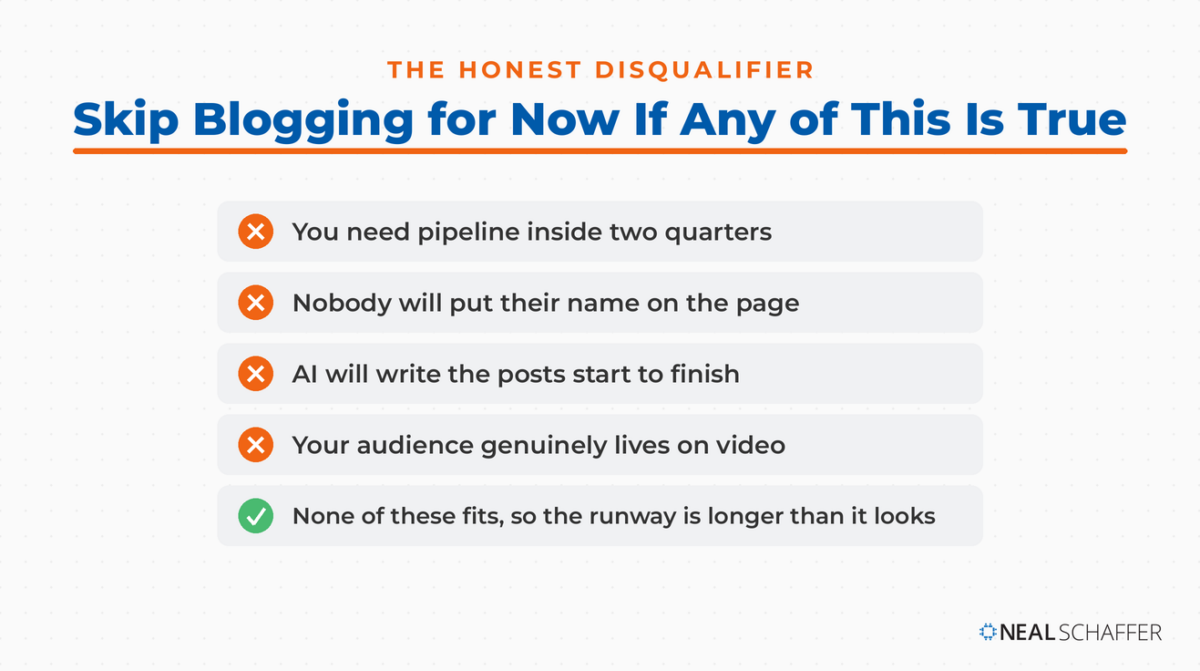
Anyone who needs results in under six months, and anyone who is not willing to publish something firsthand. Blogging is a slow, compounding channel that rewards accumulated depth. If your business needs leads this quarter, spend the money on ads and come back to this when you have runway.
The numbers here are unforgiving. The Ahrefs research behind that 96.55% figure in my takeaways above looked at around 14 billion pages, and it ran in December 2023, before AI Overviews were widespread. Treat it as a floor rather than a current reading.
Almost all of those pages were published by someone who believed publishing was the strategy. It is not. Choosing what to publish is the strategy.
Skip blogging, at least for now, if any of these describe you:
- You need measurable pipeline inside two quarters
- Nobody at the company will put their name and their actual opinions on the page
- You are planning to have AI write the posts start to finish, which Orbit Media found among the least likely approaches to produce strong results
- Your audience genuinely lives on video, in which case start by weighing blogging versus vlogging before committing
If none of those apply, the runway is longer than the discourse suggests, and my collection of business blogging statistics is where I keep the numbers updated.
Frequently Asked Questions About Whether Blogging Is Still Relevant
Blogs are still relevant, and they do a job social media cannot. A blog post is an asset you own that stays findable for years. A social post is rented reach that dies in about 48 hours. The two work best together, which is why I treat blogging and social media as one system rather than a choice.
No. AI has killed the value of generic blog content and raised the value of firsthand content. Assistants need source material, and they cannot generate genuine experience. In Orbit Media’s study of 97 sites, visitors arriving from AI converted about three times better than other organic traffic, and were twice as likely to subscribe to a newsletter.
Yes, and small businesses have an advantage they rarely use. You have firsthand experience with your own products and customers, which is exactly what the Google guidance cited above rewards and what a large content team cannot fake. The constraint is capacity, not opportunity, so publish less often and make each post carry something only you have.
Consistency just might matter more than volume, and quality more than both. Orbit Media found that marketers publishing multiple times a week were most likely to report strong results. Longer, more researched posts correlated just as strongly. One genuinely firsthand post a month beats four thin ones.
It is not too late, but the entry strategy has changed. Starting a broad blog to chase search volume is finished. Starting a narrow blog about work you actually do still works. That is the content nobody can produce at scale. My post on how to start a blog picks up from there.
Start With the One Post Only You Could Write
Do not rebuild your whole blog this month. Open your analytics, break organic traffic out by search engine, and write down what you find. That split tells you whether your blog has a demand problem or a measurement problem. Most people have never looked.
Then pick one post. Not a topic from a keyword tool, but a question a customer asked you this month that you answered well in an email. Write that one, with your own numbers and your own screenshots in it.
After it publishes, add an opt-in and start counting email signups instead of rankings. Give it ninety days before you judge anything.
For the mechanics of getting those posts found, read my post on blog SEO next. My blogging tips get into the habits that keep it sustainable. If you would rather have someone build this into a plan across search, email and social at once, that is the work I do as a Fractional CMO. You can also grab a free preview of Digital Threads and start there.
DIY your digital marketing with AI.
Practical advice on social, content, influencer, and search marketing, plus the AI tools that make each one easier. Join thousands of founders and business owners who read it.
