

Influencer marketing is entering a new phase. For years, brands relied on platforms that helped them search for creators, send outreach emails, and track performance. That model still dominates, but it no longer scales efficiently.
As campaign volume increases and timelines shrink, manual workflows are becoming the biggest constraint, not budget or creativity.
According to our 2026 Influencer Marketing Benchmark Report, 87.49% of marketers plan to increase their influencer marketing budgets, with 72.22% expecting increases of more than 50%. At the same time, 65.9% of campaigns are expected to deliver payback within 1 month, with nearly half achieving returns in under 2 weeks.
Growth is no longer the challenge. but rather execution at scale.
Agentic AI is emerging as the solution. Instead of simply assisting marketers, a new generation of platforms can execute key parts of influencer campaigns autonomously. From identifying brand-fit creators to generating outreach and optimizing performance, these systems move beyond tools and start functioning as decision-making layers within the campaign itself.
The shift is already visible across the market. Influencer marketing platforms are introducing embedded AI agents, while specialized tools are expanding their automation capabilities.
At the same time, newer entrants are building around AI-first workflows from the ground up. Together, these platforms are shaping what can now be defined as agentic influencer marketing infrastructure.
This guide breaks down the best agentic influencer platforms available today, how they work, and how brands and agencies can use them to scale creator campaigns more efficiently.
What Are Agentic Influencer Platforms?
Agentic influencer platforms are systems that use AI to execute and optimize influencer marketing workflows with minimal human input. Instead of relying on marketers to manually search, evaluate, and manage creators, these platforms can make decisions, take actions, and continuously improve outcomes based on data.
The distinction becomes clearer when compared to earlier generations of tools.
Traditional influencer marketing platforms function as databases and workflow managers. They help brands find creators, organize campaigns, and track results, but every step still depends on human direction.
Even AI-assisted tools, while more advanced, typically focus on isolated tasks such as recommending creators or generating email templates.
Agentic platforms go further by connecting these capabilities into a continuous system. A single workflow can start with campaign inputs, move into AI-driven creator discovery, generate personalized outreach, and adapt based on performance signals.
In short, the system actively participates in executing influencer marketing programs.
How Agentic Platforms Differ From Traditional Influencer Platforms
The most important difference lies in how decisions are made. Traditional platforms require marketers to define each step, from selecting creators to adjusting campaign strategy. Agentic systems can evaluate multiple variables at once, including content style, audience fit, and past performance, and then act on those insights automatically.
Another key distinction is the presence of feedback loops. In a traditional setup, optimization happens after a campaign ends, based on reports and analysis. Agentic platforms operate in real time, continuously refining creator selection, messaging, and distribution strategies as new data becomes available.
To make the distinction clearer, the table below compares agentic platforms with AI-assisted tools and traditional influencer marketing platforms:
|
Capability |
Agentic Influencer Platforms | AI-Assisted Influencer Tools |
Traditional Influencer Platforms |
| Core Function | Autonomous campaign execution | Task-level automation | Workflow management |
| Creator Discovery | AI-driven, context-aware matching | AI recommendations | Manual search and filtering |
| Outreach | Automatically generated and personalized at scale | Template-based assistance | Fully manual |
| Decision-Making | AI-driven, multi-variable evaluation | Human-led with AI input | Fully human-driven |
| Optimization | Real-time, continuous feedback loops | Partial optimization | Post-campaign analysis |
| Campaign Management | Adaptive and self-improving | Semi-automated workflows | Static workflows |
| Scalability | Designed for high-volume campaigns | Limited by human oversight | Limited by manual effort |
Finally, agentic platforms are designed for scale.
Managing dozens or hundreds of creators manually introduces delays and inconsistencies. By automating repetitive decisions and standardizing workflows, these systems allow brands and agencies to run high-volume influencer programs without sacrificing precision or control.
Together, these differences mark a transition from influencer marketing tools to influencer marketing systems. The platforms covered in this guide represent different stages of that evolution, with some offering fully agentic capabilities and others moving in that direction through layered AI functionality.
Best Agentic Influencer Platforms
The platforms below represent the early stage of agentic influencer marketing. Some are fully agentic by design, while others are evolving toward autonomous execution through layered AI capabilities. Let’s see what the best have to offer.
Top
best agentic influencer platforms
2026
Best For: Mid-market to Enterprise Consumer brands
Pricing: Available on request, with free discovery access for testing
Agentic Maturity Level: Fully agentic, AI-first system
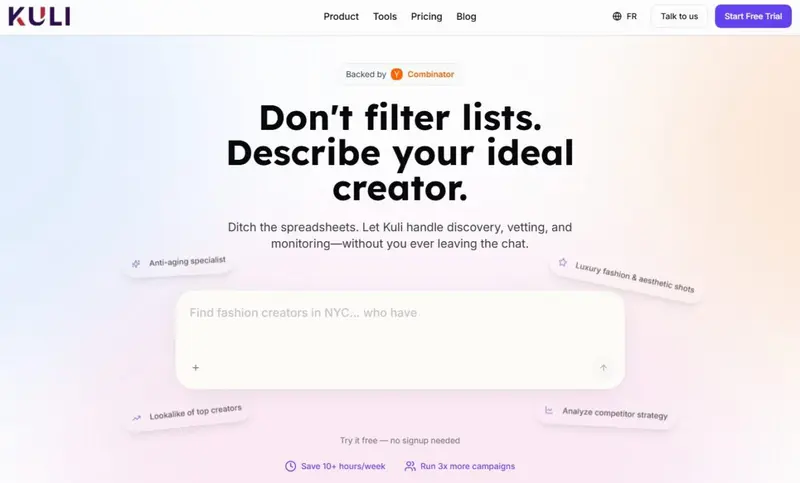
Kuli is built as an AI-first system that analyzes creator content directly, rather than relying on filters, tags, or self-reported data. Instead of searching through an influencer database, teams input brand context and campaign goals, and the platform generates creator recommendations based on how content is actually produced and communicated.
The key shift is that Kuli compresses multiple steps into one. Discovery, validation, and competitive research happen simultaneously, with outputs that explain why a creator fits a campaign. This reduces the need for manual shortlisting and speeds up early-stage campaign execution.
How Kuli Makes Decisions
Kuli evaluates creators based on content patterns. It looks at tone, format, and messaging across videos to determine alignment with a brand. That allows the system to recommend creators who match creative direction, not just audience demographics.
The platform also tracks competitor activity and content trends, surfacing insights without requiring manual research. Instead of building lists from scratch, teams start with high-confidence recommendations generated by the system.
Where Kuli Delivers Value
The strongest advantage is in content-level understanding. Kuli can distinguish between creators who look similar on paper but produce very different types of content. This improves creator-brand fit, especially for campaigns where creative execution matters as much as reach.
It also reduces repetitive work. Tasks like filtering, reviewing profiles, and comparing creators are handled by the system, allowing teams to focus on approvals and strategy instead of discovery.
Strengths
- Content-driven matching improves creator selection accuracy
- Agentic workflow reduces manual discovery and research
- Built-in competitive insights support faster decision-making
Limitations
- Less transparent than traditional filter-based platforms
- Still requires human input for strategy and final approvals
When to Use Kuli
Kuli fits brands and agencies running content-heavy campaigns or managing high volumes of creators. It is most effective when teams want to replace manual discovery with a system that can interpret content and generate actionable recommendations at scale.

Key Features: Influencer Search & Discovery, Influencer Discovery, Campaign Reporting, Influencer Analysis, Competitor Research, Influencer Campaign Monitoring, Brand Safety, AI Agent, Creator Intelligence, Creator Outreach, Creator Tracking, Comment Analysis, Video Intelligence, Format Analysis, Brief Preparation, Ecommerce Integration, Trend Analysis,
Channels: Instagram, TikTok, YouTube
Best For: Brands and Agencies of all sizes
Pricing: From $460 per month
Agentic Maturity Level: Semi to fully agentic with embedded AI agent capabilities
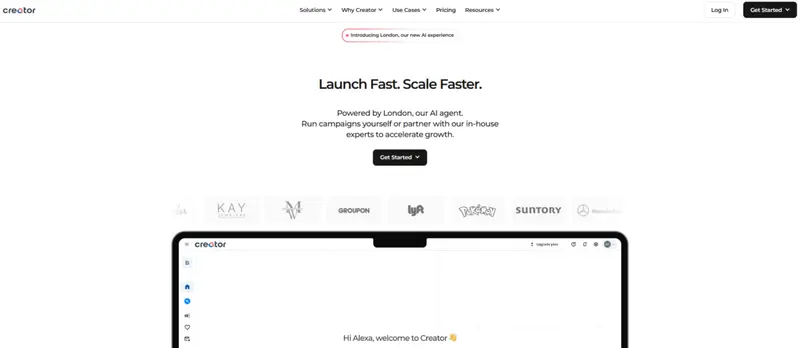
Creator.co is evolving from a traditional influencer marketing platform into a more agentic system through the introduction of its AI agent, London.
Instead of relying entirely on manual workflows, the platform now enables brands to automate key stages of campaign execution.
The platform still retains elements of a traditional system, such as campaign dashboards and managed services, but the addition of AI shifts how campaigns are initiated and scaled. Rather than building everything from scratch, teams can rely on the AI layer to generate structured outputs based on campaign inputs.
How Creator.co Makes Decisions
Creator.co’s London AI agent operates by translating campaign inputs into actionable steps. It can generate campaign briefs, identify relevant creators, and assist with outreach based on predefined objectives. This reduces the need for manual setup and speeds up early-stage campaign development.
Creator matching is supported by platform data and AI-driven recommendations, though it still leans on structured inputs rather than deep content-level analysis. The system improves efficiency by narrowing down options and assisting with execution, but human validation remains part of the process.
Where Creator.co Delivers Value
The main advantage lies in workflow automation. Creator.co reduces the time required to launch campaigns by handling repetitive setup tasks such as briefing and initial outreach. This makes it easier for teams to move from planning to execution without getting stuck in manual processes.
It also provides flexibility. Brands can choose between self-serve workflows or managed services, depending on how much control they want to retain.
The hybrid approach makes the platform accessible to teams that are not ready to fully rely on autonomous systems but still want to benefit from AI-driven efficiency.
Strengths
- AI agent assists with campaign setup, reducing manual effort
- Combines automation with managed services for flexibility
- Strong end-to-end workflow support from discovery to reporting
Limitations
- Less advanced content-level analysis compared to AI-first platforms
- Still relies on human input for validation and optimization
When to Use Creator.co
Creator.co is a strong fit for brands and agencies looking to introduce AI into their influencer workflows without fully replacing human oversight. It works best for teams that want to speed up campaign execution, reduce manual setup, and gradually transition toward more automated, agentic systems.
Read also:
Read also:
Check out the Introducing London: The AI Agent Rebuilding Influencer Marketing
Check it out
jQuery(‘#etpp_text a’).click(function() {
if (typeof gtag === ‘function’) {
gtag(‘event’, ‘click’, {‘event_category’: ‘Read also widget’});
}
// ga(‘send’, ‘event’, ‘Click’, ‘Read also widget’)
});
Key Features: Search/Discovery, Automated Recruiting, Influencer Relationship Management, Influencer Marketplace, Content Review, Content Library, Campaign Management, Campaign Reporting, Influencer Analysis, Audience Analysis, E-commerce Tools, Product/Gifting Tools, Fake Follower/Fraud Detection, Payment Processing, Social Listening, Competitor Research, Creator Marketplace,
Channels: Instagram, YouTube, TikTok
Best For: E-commerce businesses of all sizes
Pricing: From $478 per month
Agentic Maturity Level: Semi-agentic with embedded AI campaign assistant
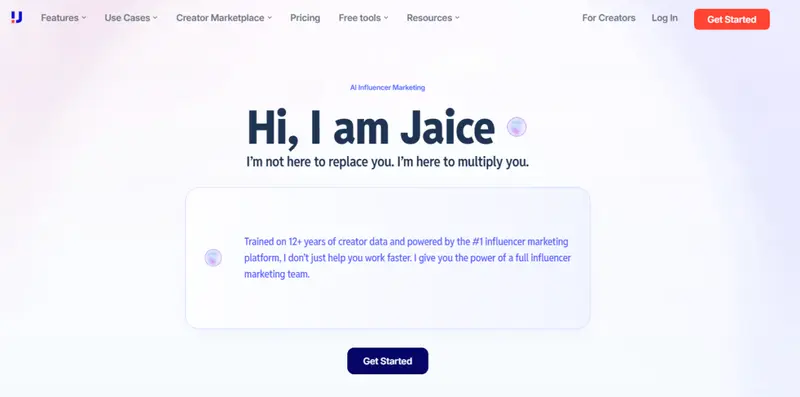
Upfluence is evolving into an agentic system through its AI assistant, Jaice, which sits directly inside the platform and connects discovery, campaign setup, and outreach into a single workflow.
Rather than operating as a separate tool, the AI layer is integrated into the core product, allowing teams to move from idea to live campaign without switching between systems.
The platform still builds on its traditional strengths, including a large creator database and ecommerce integrations, but Jaice changes how campaigns are initiated. Instead of manually searching and structuring programs, users can input goals and let the system generate creator lists, briefs, and outreach sequences in one flow.
How Upfluence Makes Decisions
Jaice operates by combining structured platform data with AI interpretation of campaign inputs. It evaluates creator fit based on audience alignment, engagement patterns, and historical performance signals, then generates curated creator lists without requiring manual filtering.
The system also supports lookalike discovery, allowing teams to start from a single creator and expand into similar profiles automatically. Outreach and campaign structure are generated within the same flow, meaning decisions around targeting and messaging are connected rather than handled separately.
While the system accelerates decision-making, it still relies on platform data and predefined signals rather than deep content-level analysis. Human validation remains part of the process, especially for final creator selection and campaign adjustments.
Where Upfluence Delivers Value
Upfluence’s strongest advantage is speed and execution. Campaigns that previously required multiple steps, such as defining briefs, building creator lists, and drafting outreach, can now be generated in minutes. This is particularly valuable for teams running frequent campaigns or managing affiliate-driven programs.
The platform also stands out in ecommerce integration. By connecting influencer campaigns directly to sales data, Upfluence allows teams to identify creators who are not just relevant, but capable of driving conversions. This adds a performance layer that complements its agentic capabilities.
Strengths
- AI assistant reduces campaign setup time and manual effort
- Strong ecommerce integrations connect creators to revenue outcomes
- Lookalike discovery and automated outreach improve scalability
Limitations
- Relies more on structured data than deep content analysis
- Still requires human input for validation and optimization
When to Use Upfluence
Upfluence is a strong fit for brands that prioritize speed, scale, and measurable performance. It works best for ecommerce teams and agencies running ongoing campaigns, where reducing setup time and connecting influencer activity to revenue are key priorities.
Key Features: Influencer Search & Discovery, Relationship Management, Campaign Management, Third Party Analytics, Automated Recruiting, Influencer Lifecycle Management, Team Collaboration Tools, Content Review, Campaign Reporting, Audience Analysis, E-commerce Tools, Product/Gifting Tools, Payment Processing, Social Listening, Affiliate Management, Affiliate Campaigns,
Channels: Instagram, Youtube, Facebook, Twitch, Tiktok, Twitter, Pinterest, Blogs
Best For: Brands and agencies scaling high-volume creator programs with lean teams
Pricing: Free plan available, paid plans start at $299 per month with AI recruitment features
Agentic Maturity Level: Fully agentic with multi-agent workflow system
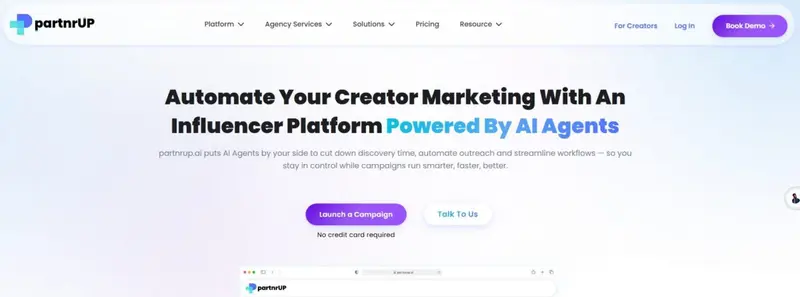
partnrUP is built around a multi-agent system where each stage of the influencer workflow is handled by a dedicated AI agent.
Instead of a single assistant layer, the platform assigns specific roles such as discovery, recruitment, and campaign management to different agents that work together across the campaign lifecycle.
The platform connects sourcing, outreach, campaign execution, and performance tracking into one continuous system. Rather than switching between tools or manually coordinating steps, campaigns move forward through automated workflows where creators are discovered, contacted, and managed with minimal manual input.
How partnrUP Makes Decisions
partnrUP distributes decision-making across its AI agents. Discovery agents identify creators based on campaign parameters, recruitment agents evaluate fit and handle outreach, and management agents track progress and ensure execution stays on schedule.
The system adapts based on user input and campaign outcomes. As teams approve or reject creators, the platform refines its recommendations and improves future recruitment cycles. Outreach is automated and personalized, helping increase response rates without requiring manual communication at scale.
Where partnrUP Delivers Value
The main advantage lies in workflow automation across the entire campaign lifecycle. Instead of optimizing individual steps, partnrUP removes friction between them.
Discovery, outreach, approvals, and payments are handled within one system, reducing the need for coordination across multiple tools or spreadsheets.
The platform is particularly effective for scaling. It enables teams to manage large volumes of creators without increasing operational overhead. Reported improvements include higher response rates and significantly reduced time spent on coordination and administrative tasks, making it easier to run consistent campaigns at scale.
Strengths
- Multi-agent system automates the full influencer workflow
- Strong automation in outreach, recruitment, and campaign management
- Built for scaling creator programs without increasing headcount
Limitations
- Relies on structured inputs rather than deep content-level analysis
- Requires oversight to ensure brand alignment and quality control
When to Use partnrUP
partnrUP is best suited for brands and agencies running ongoing or high-volume influencer campaigns. It works particularly well for teams looking to replace manual coordination with a system that can manage sourcing, outreach, and execution in a unified, automated workflow.
Why Agentic AI Is Reshaping Influencer Marketing
Influencer marketing has reached a point where execution, not strategy, is the primary constraint. Most brands already understand how to run campaigns and where to invest. The challenge now is managing the growing complexity of creator programs without slowing down performance.
One signal stands out. According to our 2026 Benchmark Report, 66.3% of brands now run influencer programs entirely in-house. The shift places operational pressure on internal teams that are often not built to manage large-scale creator ecosystems.
At the same time, brand awareness remains the most selected campaign goal, meaning teams are expected to deliver consistent, high-volume content output, not just one-off campaigns.
The scale problem is further amplified by platform dynamics. TikTok alone has more than 1.58 billion monthly active users, and users spend close to an hour per day on the platform. That level of consumption demands a continuous stream of creator content, not occasional activations. Managing that volume through manual workflows quickly becomes unsustainable.
Where Traditional Influencer Workflows Break Down
The traditional influencer marketing stack was built around control and visibility, not speed or adaptability.
- Discovery relies on static filters, which struggle to capture how creators actually produce content
- Outreach depends on manual sequencing, making personalization difficult at scale
- Campaign management requires constant coordination across creators, assets, and timelines
- Optimization happens after campaigns end, limiting the ability to improve results in real time
As campaign volume increases, these inefficiencies compound. Teams spend more time managing workflows than improving performance.
How Agentic Platforms Change the Model
Agentic platforms restructure influencer marketing by connecting decisions across the entire campaign lifecycle.
Instead of treating discovery, outreach, and optimization as separate tasks, these systems operate as continuous workflows. Creator selection is informed by real-time data, outreach adapts based on responses, and campaign performance feeds directly back into future decisions.
The key difference is coordination. Agentic systems ensure that each step builds on the previous one without requiring manual intervention. This allows campaigns to move faster while maintaining consistency in targeting, messaging, and execution.
Read also:
Read also:
Check out the Perplexity Bets on AI Agents With New Email Assistant
Check it out
Agentic Influencer Platforms Are Redefining Creator Marketing
Agentic systems are not just another layer of automation. They represent a shift in how influencer marketing is executed, moving from manual workflows to connected systems that continuously analyze, decide, and improve outcomes.
As campaigns grow in complexity and volume, relying on fragmented tools is becoming a limiting factor rather than a competitive advantage.
The platforms covered in this guide show that this transition is already underway. Some are built around fully agentic models, while others are integrating AI agents into existing workflows.
Together, they illustrate how the category is evolving and where it is heading next.
Choosing the best agentic influencer platforms is not about replacing teams. It is about enabling them to operate at a level of speed, scale, and precision that manual processes cannot match.
Brands and agencies that adopt these systems early will be better positioned to test faster, execute consistently, and turn influencer marketing into a repeatable growth engine.
About the Author

Writer
Nadica Naceva writes, edits, and wrangles content at Influencer Marketing Hub, where she keeps the wheels turning behind the scenes. She’s reviewed more articles than she can count, making sure they don’t go out sounding like AI wrote them in a hurry. When she’s not knee-deep in drafts, she’s training others to spot fluff from miles away (so she doesn’t have to).
